


Career Articles
How I Switched from Web Developer to ML Engineer (A Web Developer's Real Story)
PHP Developer Resume: Writing Guide & Key to Landing Your Dream Job
My Frontend Developer Interview at Google: What Really Happens Behind Closed Doors
Future of Electric Vehicle Course: Fast-Track Your EV Career


Get In Touch For Details! Request More Information
How to Address a Career Gap Professionally: Practical Guide for Job Seekers
Feb 25, 2026 7 Min Read 1092 Views
(Last Updated)
A career gap is any time you’re not working that lasts several months or more. It could be three months or three years. These breaks between jobs have become more common and more accepted today.
Things have changed a lot. The pandemic, economic problems, and new ideas about work-life balance have made career gaps normal.
In 2025, employers know that good workers sometimes step away from their jobs. People take breaks for health reasons, family care, personal growth, or things they can’t control like layoffs.
LinkedIn hiring insights and SHRM research show that recruiters now focus less on uninterrupted timelines and more on skills, recent experience, and job readiness. Instead, they want to know what you did during that time, how you explain it, and if you’re ready to work now.
The key is not having a perfect work history. It’s showing that you’ve grown, you’re ready, and you can talk about your career gap in a professional way.
Quick Answer:
You can address a career gap professionally by explaining it briefly, honestly, and confidently, focusing on what you learned or accomplished during that time and why you are ready to work now.
Recruiters value clarity, skills, and relevance more than a continuous timeline.
Table of contents
- How to Explain Career Gaps Clearly and Professionally
- Reasons for Employment Gaps Employers Understand
- Career Break Justification That Adds Value to Your Profile
- Resume Gap Tips to Minimize Employment Gaps
- Interview Questions About Career Gaps You Should Prepare For
- How to Explain a Career Gap in an Interview (With Sample Answers)
- Career Break Confidence: How to Speak Without Apology
- Employment Gap Strategies to Stay Job-Ready
- Addressing Job Gaps Smartly Across Resume and Interviews
- Common Mistakes to Avoid While Explaining Career Gaps
- Career Gap Communication: Resume, LinkedIn, and Interviews
- Conclusion
- Frequently Asked Questions
- How do I explain an employment gap?
- How much gap in a CV is acceptable?
- What is the best answer for a career gap?
- How to professionally explain a gap in employment?
How to Explain Career Gaps Clearly and Professionally
Before you start preparing, let go of the thought that your career gap will be an issue. According to LinkedIn research, 62% of workers report having a gap in their employment.
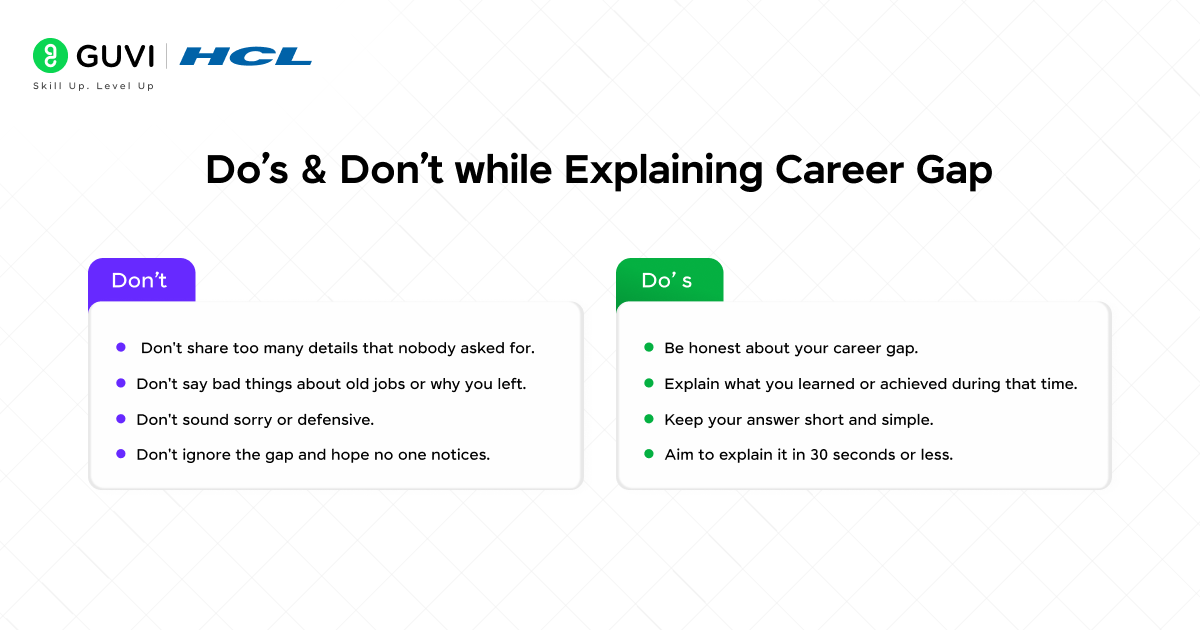
Start by preparing what you’ll say, and say it with confidence. When you talk about your employment gap, treat it like a simple fact. Don’t act like you need to apologize or explain too much. Keep your answer honest and short. It should take about 30 seconds or less.
Make your explanation about right now. Talk about why you took the break, what you learned or did during that time, and why you’re ready to come back. Employers care more about what you can do now than about the gap itself.
Don’t make these mistakes: Don’t share too many details that nobody asked for. Don’t say bad things about old jobs or why you left. Don’t sound sorry or defensive. And don’t ignore the gap and hope no one notices. Being quiet or unclear makes people worry more than a clear, honest answer.
If you’re not sure how to rebuild confidence, refresh your skills. HCL GUVI’s Zen Course supports job seekers who are returning to work after a break.
Reasons for Employment Gaps Employers Understand
Employers understand many reasons for career gaps. Health reasons like recovering from illness, surgery, or mental health care are completely okay.
Personal reasons like moving to a new city, taking care of aging parents, or following your partner’s job are understood. Family gaps for childcare or being a parent are normal for everyone now.
Layoffs, company closings, and hard economic times are not your fault. You don’t need to apologize for these. Going back to school, getting certificates, or training for a new career shows you’re investing in yourself.
Even taking time off to travel, volunteer, or recharge is fine when you explain it the right way.
Keep your explanation simple, and look forward to it.
For health gaps: “I took time off for a health issue, which is now fixed. I’m ready and excited to work.”
For family care: “I stepped away to care for a family member when they needed me. That’s done now, and I’m focused on my career again.”
For layoffs: “My job was cut when the company reorganized. I used that time to learn new skills in [area] and I’m excited about new opportunities.”

Career Break Justification That Adds Value to Your Profile
Turn your career break into something positive. Show what you did and how you grew during that time. Even if you didn’t plan your gap as a learning time, think about the skills you kept or learned.
This could be through volunteering, freelance work, online classes, personal projects, or even handling family situations that needed problem-solving.
Connect your break to real results when you can. Did you finish any certificates? Build a website? Run a community project? Learn new software? Even reading about your industry or keeping in touch with work friends shows you stayed connected to your field.
Show that your break had a purpose. Don’t sound defensive. Instead of saying “I had to take time off for family,” try “I took a planned break to handle family needs while taking online courses in digital marketing.” This changes how it sounds without lying about what happened.
Meet Edward, who turned a one-year career gap into a fresh start. He is a computer science student with a strong interest in data science.
Instead of worrying about the gap, Edward decided to improve his skills.
With the support of HCL GUVI’s Zen Class, he worked on building practical and job-ready skills. During this time, he completed the Master Data Science program at HCL GUVI.
Edward did not let his career gap hold him back. He used this time to learn modern tools, work on hands-on mini projects, and improve his problem-solving skills. These projects gave him confidence and real-world experience.
Today, Edward is a successful software engineer. He has strong technical skills, project experience, and the confidence to grow in a competitive tech career.
His story shows that with the right guidance, structured learning, and steady effort, a career gap can become a step toward success.
Explore many more success stories
Resume Gap Tips to Minimize Employment Gaps
Research shows recruiters spend about 6–8 seconds on an initial resume scan. A functional or combination resume works well if you have career gaps. This type puts your skills and achievements before your job timeline. But don’t completely hide your work dates. That looks like you’re trying to trick people and raises more questions.
Where you mention your career gap depends on how long it was. For gaps under six months, you might not need to mention them at all. For longer gaps, add a short line in your work history like “Career Break (2022-2023): Took care of family while getting Google Analytics certificate” or “Professional Development (2023): Full-time school to learn UX design.”
Use your skills section to show what you can do. Start with a strong summary of your best skills. Include a good skills section with tools and abilities that employers want. Show your accomplishments and results, not just what your job duties were. If you did freelance work, volunteered, or worked on projects during your gap, list them to show you stayed active.
Also Read: How to Restart Your Professional Journey After a Career Gap in 2026
Interview Questions About Career Gaps You Should Prepare For
Get ready for these common questions: “I see a gap in your resume between [dates]. Can you tell me about that?” or “What did you do during your time away from work?” or “Why do you want to come back to work now?” and “How did you stay current in your field during your break?”
Recruiters ask these questions to understand if you’re reliable, if you’ll stay if they hire you, if your skills are up to date, and if you’re honest. These questions aren’t meant to reject you. They just want to understand your story and see if you’re a good fit.
Use this three-part plan for your answers: First, briefly explain why you had a gap without sharing too much. Second, talk about what you did that kept you learning or growing. Third, show excitement about coming back to work and helping their company. Keep your answer under one minute unless they ask more questions.
How to Explain a Career Gap in an Interview (With Sample Answers)
Use the STAR method to structure your answer: Situation, Task, Action, Result.
| Reason | Sample Answer |
| Upskilling | “I took six months off to complete a data analytics certification. During that time, I built a portfolio project analyzing customer churn for an e-commerce dataset. That project taught me SQL, Python, and Tableau, which I’ll use in this role to support data-driven decisions. |
| Family Responsibilities | “I took a year off to care for a family member during a health crisis. That time taught me project management, prioritization, and resilience. I’m back now with full availability and excited to contribute to your team.” |
| Career Transition | “I spent eight months exploring different roles through freelance work and networking. That process confirmed my interest in UX design, which is why I’m here today. I also completed two certification courses and redesigned a nonprofit’s website during that period.” |
| Parental leave | “I took two years off when my child was born to focus on my family. During that time, I took online project management courses and stayed in touch with my work network. I’m excited to bring my new perspective and updated skills to a full-time job.” |
| Medical reasons | “I had to step away for health reasons, which are completely fixed now. I used that time well by getting certified in data analytics. I’m ready to commit to this role and excited about it.” |
| Layoffs | “My job was cut when the company changed its operation team. Instead of taking the first job I could find, I took time to pick the right next step and learn skills (add relevant skills). Now I’m looking for a company where I can stay long-term.” |
You can use the STAR method (Situation, Task, Action, Result) if you need to explain more.
But most career gap answers should be shorter and simpler. Your explanation should be two to four sentences and take 20 to 40 seconds. Only say more if they ask follow-up questions.
Career Break Confidence: How to Speak Without Apology
Build confidence by changing how you think about your career break. Your gap is one part of your work story, not something wrong with you. Practice your explanation until it feels natural, like talking about any other job change.
Your body language and how you speak matter a lot in interviews. Look the interviewer in the eye when you talk about your gap. Keep your shoulders back and sit up straight. Speak in a calm, steady voice. Don’t use apologetic words like “unfortunately” or “I’m sorry, but.” Then move smoothly to talking about your skills and why you want the job.
Practice with friends, mentors, or career coaches. Record yourself and listen for places where you sound sorry or defensive. Practice until explaining your gap feels like stating a simple fact about your work timeline, not confessing something bad. The more comfortable you get with your story, the more confident you’ll seem to interviewers.
Also Read: Career Change at 25: A Comprehensive Guide to Starting Fresh
Employment Gap Strategies to Stay Job-Ready
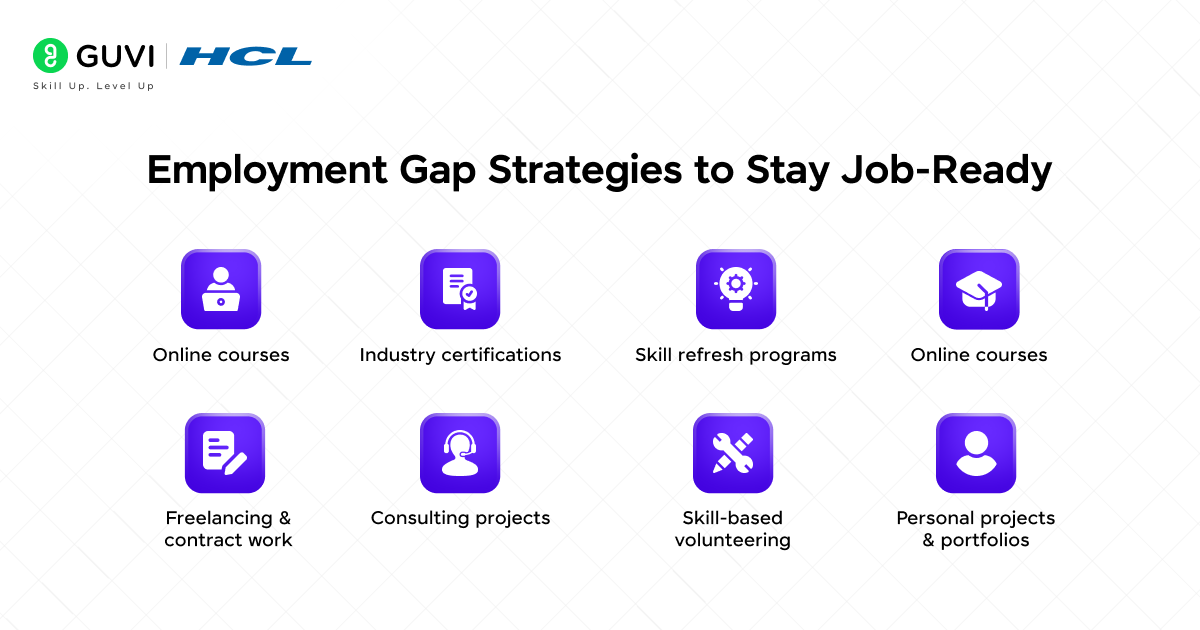
Staying ready for work during your gap makes you much stronger when you return. Take online courses and get certificates in your field through sites like Coursera, LinkedIn Learning, or programs for your industry. These show you take initiative and keep your skills fresh.
Freelancing, consulting, or contract work during your gap gives you recent experience and flexible hours. Volunteering, especially using your professional skills, fills your resume and helps you meet new people.
Doing free work for nonprofits that need marketing, money management, or other professional help counts as real experience.
Show that you keep learning by reading about trends in your industry through articles, podcasts, and webinars, going to online or in-person conferences and networking events, joining online groups in your field, and working on personal projects that show your skills, like building a portfolio, writing articles, or making case studies.
Use LinkedIn during your gap by keeping your profile current and active, sharing industry news and ideas, commenting thoughtfully on posts from your network, and joining LinkedIn groups for your profession. Try a headline like “Marketing Professional | Learning Digital Strategy | Open to Work” to be clear about where you are.
Addressing Job Gaps Smartly Across Resume and Interviews
Be upfront instead of defensive about your career gap. Mention it briefly in your cover letter if it makes sense, or include it naturally on your resume if you did useful things. Don’t wait for the interviewer to find it and ask about it, but don’t start with it either. Treat it as one fact among many about your professional life.
Adjust your career gap story for each job. Focus on parts of your break that match what the job needs. If you’re applying for a remote job, talk about how you managed projects on your own during your gap. If the job needs someone who learns fast, talk about the new skills you have. If the company cares about work-life balance, your career break shows that you make smart choices about your career.
Match your explanation to what the job requires. Research what matters to the employer and connect your gap to those things. If they need someone who can start fast, talk about how you stayed current. If they care about teamwork, mention networking or volunteer team projects during your break.
Common Mistakes to Avoid While Explaining Career Gaps
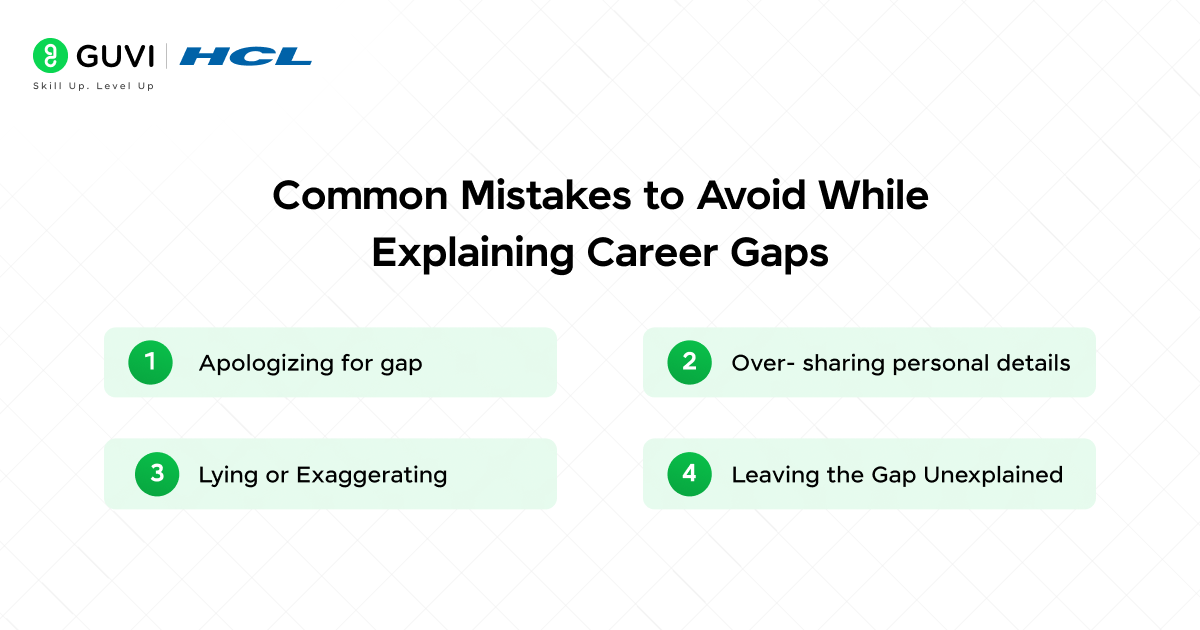
Apologizing for the Gap: Your gap isn’t a failure. Don’t treat it like one.
Over-Sharing Personal Details: You don’t need to explain medical diagnoses or family conflicts. Keep it professional and brief.
Lying or Exaggerating: Employment verification will catch fabricated roles or inflated timelines.
Leaving the Gap Unexplained: An unexplained gap raises more red flags than a brief, honest explanation.
Career Gap Communication: Resume, LinkedIn, and Interviews
Keep your story the same on all platforms. If your resume says “Career Development (2023-2024),” your LinkedIn should show the same dates and description.
If you mention taking courses in an interview, those courses should be on your LinkedIn certifications.
What to say: Keep explanations short and factual. Talk about useful things you did during your gap. Show excitement about going back to work. Focus on being ready and able to work now.
What not to say: Don’t share too many personal details that don’t relate to work. Don’t say bad things about old jobs or what happened.
Don’t give long, defensive explanations. Don’t lie or make up things about what you did. Don’t suggest you might need another break soon or that you’re not sure about staying.
Build a strong career story by seeing your whole career as a story where the gap is one chapter that helped you grow.
Make your journey sound purposeful, even if things didn’t go as planned at first. Your story should show you’re a complete professional whose value goes beyond any gap in your timeline.
Conclusion
Having a career gap doesn’t make you less valuable as a worker. What matters most to employers is your skills now, your readiness to help, and your ability to explain your story with confidence.
Show your skills through new certificates, recent projects, or volunteer work. Show you’re ready by learning about the company, making your resume fit the job, and being genuinely excited about the role. Show your growth by explaining what you learned while you were away and how it made you better.
Go into your job search with confidence. Thousands of people return to work after career gaps every day. Your break doesn’t make you less qualified. It makes you human. Employers want capable, committed workers who can do the job well. A well-explained career gap won’t stop you from getting the right job.
Prepare your story, own your path, and focus on what you offer. Your next career step is waiting for you.
Frequently Asked Questions
How do I explain an employment gap?
Be honest, brief, and focus on what you learned or did during the gap. Connect it back to the role you’re applying for.
How much gap in a CV is acceptable?
There’s no hard rule. Gaps under 6 months rarely need explanation. Longer gaps are acceptable when you show productivity and skill development.
What is the best answer for a career gap?
The best answer is truthful, growth-focused, and relevant to the job. Example: “I took time off to complete a certification and work on freelance projects that built my skills in this area.”
How to professionally explain a gap in employment?
Use your resume summary or a brief line in your work history. In interviews, use the STAR method to explain the situation, what you did, and what you learned.
Success Stories

About the Author
Salini Balasubramaniam
A curious, information-savvy writer loves to turn deep insights into authentic and engaging content that connects. With experience in writing for brands and driving audience engagement, I believe that words can make a powerful difference.
View all posts by Salini Balasubramaniam
Connect with me @














Did you enjoy this article?