


Career Articles
How Do You Choose the Right Electric Vehicle Course & Certification in 2026? The Only Guide You Need
Android Development Roadmap :10-Step Guide to Become an Android Developer


Get In Touch For Details! Request More Information

How Can Strategic Career Planning Boost Your Career?
Feb 13, 2026 5 Min Read 485 Views
(Last Updated)
Why do some professionals grow with intent while others just figure it out later? The difference is in whether you’re reacting to your career or actively shaping it. Strategic career planning gives you the tools to steer rather than drift. It connects your daily actions with long-term clarity and helps you prioritize skills. It assesses your career trajectory and connects each step with purpose.
Explore this guide to learn how structured planning shapes smarter choices and smart career growth.
- Over 11.6 million developers worldwide use C/C++, highlighting its strong presence in performance-critical and system-level domains.
- Around 72% of working developers use Python professionally, proving its role as a core language for data structure and algorithm design.
- Nearly 42% of recruiters in 2025 prefer candidates with Python expertise. It highlights how strongly it dominates the programming landscape.
Quick Answer: Strategic career planning aligns your actions with long-term goals, improves clarity, boosts skill development efficiency, sharpens self-awareness, enables data-driven decisions, and positions you for meaningful growth through SMART goals and consistent career self-assessment.
Table of contents
- What Is Strategic Career Planning?
- Conducting a Career Self-Assessment for Smarter Decision-Making
- How to Conduct a Career Self-Assessment
- Setting SMART Goals for Maximum Career Growth
- How to Use SMART Goals in Career Planning?
- Career Vision Versus Career Goals
- Top 5 Benefits of Strategic Career Planning
- Clear Professional Direction
- Stronger Control Over Career Outcomes
- Greater Efficiency in Skill Development
- Higher Adaptability in a Changing Market
- Improved Positioning for High-Quality Opportunities
- Key Steps in Creating a Strategic Career Plan
- Step 1: Build an Accurate Understanding of Yourself
- Step 2: Define a Career Direction Anchored in Evidence
- Step 3: Map Potential Pathways and Transitions
- Step 5: Establish a Review Rhythm That Encourages Adaptation
- Tools and Resources for Effective Career Planning
- Self-Assessment Tools
- Career Exploration Platforms
- Goal Setting and Planning Tools
- Skill-Building Platforms
- Professional Networking Resources
- Job Search Platforms
- Risk Management in Career Planning
- Common Mistakes to Avoid in Career Planning
- Final Words
- FAQs
- How often should I update my career plan?
- What tools can help me stay consistent with my career plan?
- How do I know if my career plan is realistic?
What Is Strategic Career Planning?
Strategic career planning involves structured decision-making that aligns your professional actions with long-term objectives. Rather than reacting to opportunities as they arise, you set direction based on clarity of purpose and the evolving demands of your field. This approach reduces misalignment between skills. and aspirations by anchoring decisions in intentional analysis. It also helps prioritize what to learn, where to focus effort, and how to allocate time.
Conducting a Career Self-Assessment for Smarter Decision-Making
A career self-assessment is all about identifying your preferences and understanding how they interact with your environment and the opportunities available to you. This process goes beyond surface-level reflection. It involves structured tools and questions that map how your interests, skills, values, and temperament fit into specific industries or problem spaces.
How to Conduct a Career Self-Assessment
- Clarify Strengths and Weaknesses: Reflect on tasks where you consistently perform well and areas where you need support. Focus on patterns, not isolated wins or failures.
- Understand Your Interests: List subjects, problems, or industries you return to repeatedly. These give clues to where intrinsic motivation is likely to sustain effort.
- Analyze Personality Fit: Consider how your temperament aligns with work environments. This helps filter roles that match your approach to processing, collaborating, and leading.
Setting SMART Goals for Maximum Career Growth
Setting career goals using the SMART framework shifts intention into action. Goals that are Specific, Measurable, Achievable, Relevant, and Time-bound leave less room for ambiguity and more room for structured progress. They act as checkpoints that reduce drift and clarify what to pursue in the short and medium term.
How to Use SMART Goals in Career Planning?
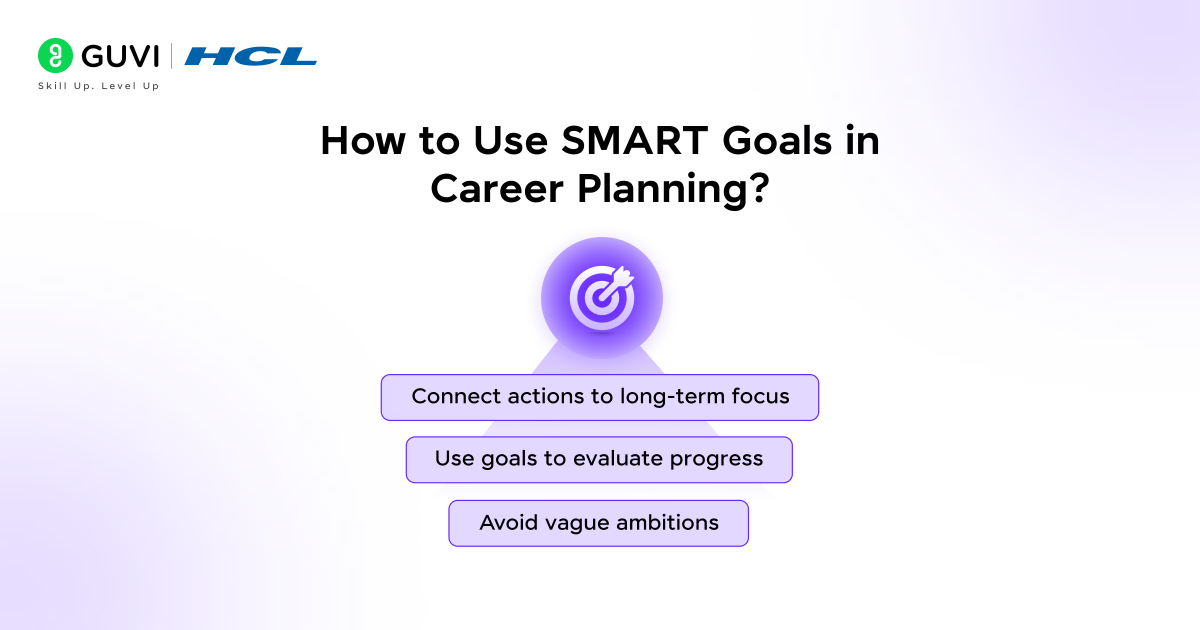
- Connect Actions to Long-Term Focus: SMART goals provide short-term clarity while reinforcing broader objectives. They keep tactical work aligned with your future direction.
- Use Goals to Evaluate Progress: Clear milestones help track what’s working. This reduces wasted time and allows for course correction with evidence.
- Avoid Vague Ambitions: Replace goals like “grow in my field” with “complete a cloud certification by June to qualify for senior engineering roles.”
- Examples of SMART Career Goals:
- Complete a professional certification in cloud security within the next four months
- Apply to five data science roles aligned with NLP in Artificial Intelligence experience by the end of this quarter
- Present at one industry conference this year on a project you’ve led
- Build a portfolio of three UX case studies tailored for B2B platforms by May

Career Vision Versus Career Goals
| Dimension | Career Vision | Career Goals |
| Purpose | Provides long-term direction and intent | Defines short- or medium-term steps toward that direction |
| Time Horizon | Often spans 5–15 years or an entire career arc | Typically spans weeks to 2 years |
| Scope | Broad and aspirational | Specific and actionable |
| Focus | Who you want to become | What you want to accomplish |
| Example | What do you want to accomplish | Launch one edtech feature within 6 months |
| Function | Anchors strategic choices | Structures progress and tracks outcomes |
| Revision Cycle | Reviewed occasionally as identity and values evolve | Reviewed regularly to align with changing conditions |
Top 5 Benefits of Strategic Career Planning
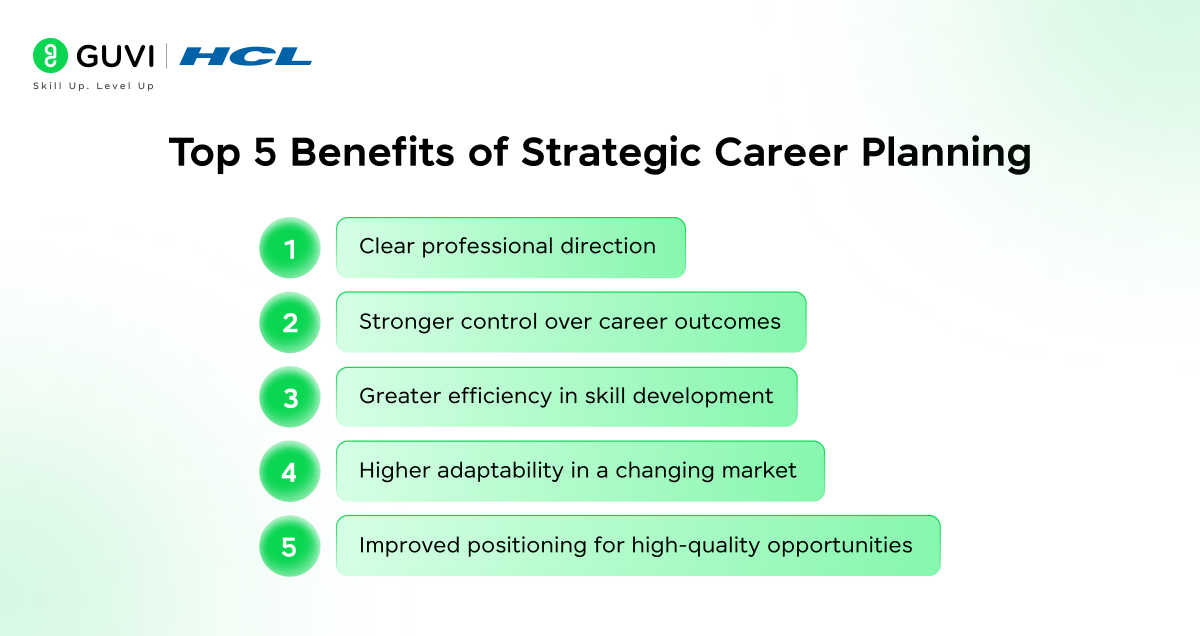
1. Clear Professional Direction
Strategic career planning creates a coherent pathway that links your abilities and market realities. This clarity prevents fragmented growth and replaces scattered efforts with direction that evolves as you gain insight and experience. The more deliberate the direction, the easier it becomes to recognize which opportunities genuinely advance your long-term goals.
2. Stronger Control Over Career Outcomes
A structured plan supports you to influence outcomes instead of waiting for external factors to shape your trajectory. You can make choices rooted in foresight by comprehending industry requirements and anticipating shifts. This sense of control bolsters confidence because decisions are grounded in deliberate reasoning rather than circumstance.
3. Greater Efficiency in Skill Development
A strategic approach highlights which competencies create the highest leverage for your path. As a result, learning becomes purposeful rather than reactive. You avoid investing time in scattered skills and focus on capabilities that build momentum across multiple stages of your career.
4. Higher Adaptability in a Changing Market
With a clear framework, change becomes easier to interpret and respond to. Market shifts, new technologies, or organizational restructuring are approached through analysis rather than uncertainty. Adaptability grows when you understand how each change affects your direction and which adjustments keep you anchored to your long-term intent.
5. Improved Positioning for High-Quality Opportunities
Professionals who plan strategically accumulate experiences and competencies in ways that create strong narrative coherence. Their profiles reflect sustained intention, making them attractive to employers who value consistency and the proficiency to grow within complex environments.
Key Steps in Creating a Strategic Career Plan
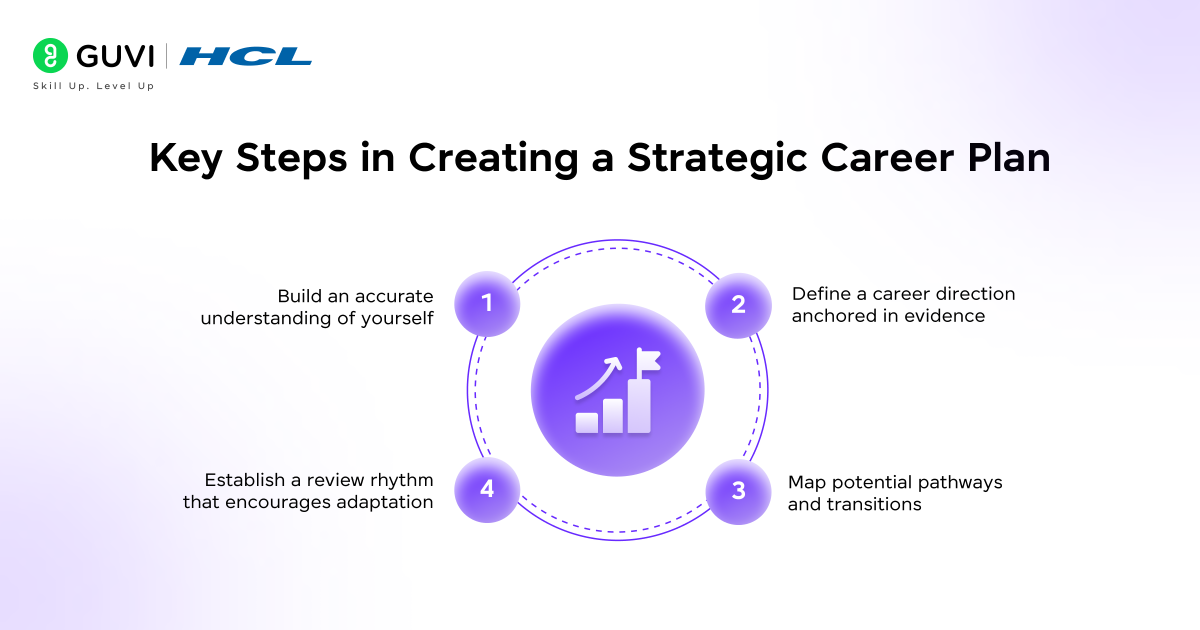
Step 1: Build an Accurate Understanding of Yourself
A strategic plan begins with insight into who you are as a professional. This involves examining patterns in your performance and preferred environments. When you understand how your strengths and temperament interact with different kinds of work, the foundation for meaningful direction emerges.
Step 2: Define a Career Direction Anchored in Evidence
Once the self-assessment provides clarity, translate those insights into a direction grounded in real possibilities. Study industries and the nature of work within roles you are considering. A direction supported by evidence allows you to choose goals that are both ambitious and realistic.
Step 3: Map Potential Pathways and Transitions
Career progression becomes more manageable when you understand how people advance within your target field. Identify skill gaps, transitional roles, and typical learning curves. This knowledge transforms career growth from a vague expectation into a sequence of informed decisions.
Step 5: Establish a Review Rhythm That Encourages Adaptation
A career plan gains value when it accommodates learning. Work on upskilling, schedule periodic reviews that examine progress, and shift professional interests. Adaptation within a consistent framework keeps your plan relevant and ensures that growth continues to reflect both your evolution and the demands of your field.
Tools and Resources for Effective Career Planning
Self-Assessment Tools
- SWOT Analysis: Helps identify your strengths, weaknesses, opportunities, and threats within a career context. Useful for mapping internal capabilities to external possibilities.
- DISC Assessment: Offers insights into behavioral styles. Helps evaluate how you communicate, collaborate, and respond to workplace challenges.
- Myers-Briggs (MBTI): Focuses on personality preferences and how they influence decision-making, learning, and interpersonal relationships.
- Skills Matrix: A Visual framework to assess current skill levels against role requirements. Ideal for prioritizing development efforts.
Career Exploration Platforms
- O*NET Online: Comprehensive database of job roles, required skills, and employment trends. Useful for researching industry expectations and emerging roles.
- LinkedIn Career Explorer: An Interactive tool that shows potential job transitions based on your profile. Helps identify adjacent career paths with transferable skills.
- Glassdoor & Levels.fyi: Enable benchmarking across salaries, benefits, and role expectations at top companies. Supports realistic decision-making based on transparency.
Goal Setting and Planning Tools
- Notion / Trello: Flexible digital workspaces for structuring SMART goals, tracking habits, and managing projects over time.
- Google Sheets Career Tracker: Custom templates to monitor job applications, learning sprints, skill goals, and feedback loops. Encourages data-driven planning.
Skill-Building Platforms
- HCL GUVI: Offers native‑language training, project portfolios, and certification programs tailored for the Indian market, enabling learners to up‑skill in the local context
- Coursera / edX / Udemy: Offer self-paced and instructor-led courses from global universities and institutions. Ideal for deepening technical or business capabilities.
- HackerRank / LeetCode / Codekata Codeforces: Designed for coding practice and competitive programming. Crucial for preparing for technical interviews at top firms.
Professional Networking Resources
- LinkedIn: Core platform for relationship-building, thought leadership, and visibility. Also, a channel for inbound recruiter interest.
- Lunchclub / Shapr: AI-powered networking apps that connect professionals for one-on-one career discussions or mentorship discovery.
- Meetup / Eventbrite: Help you identify relevant industry events, webinars, or cohort-based community groups for peer learning and hiring signals.
Job Search Platforms
- Wellfound (AngelList Talent): Focused on startup ecosystems and high-growth companies. Ideal for candidates looking for early-stage product roles.
- Himalayas / Hired: Curated platforms for remote-first roles across engineering, product, and marketing. Built-in filters align with lifestyle and location needs.
Risk Management in Career Planning
Even well-structured career plans face uncertainties. Strategic risk management ensures your plan remains adaptable and resilient in the face of change. Consider the following dimensions:
- Identify Potential Disruptions: Map external risks such as industry shifts, automation, or economic downturns alongside internal risks like burnout or skill gaps.
- Diversify Skills and Roles: Build cross-functional capabilities to avoid over-reliance on narrow expertise. This increases mobility across teams, roles, or sectors.
- Maintain Optionality: Keep alternative pathways open. Pursue certifications, side projects, or emerging tools that create career leverage in uncertain scenarios.
- Build a Financial Safety Net: Manage savings and emergency funds to absorb career shocks like layoffs or relocation.
- Review and Recalibrate Regularly: Schedule quarterly or biannual check-ins to assess changing risks and re-align decisions based on updated realities.
Common Mistakes to Avoid in Career Planning
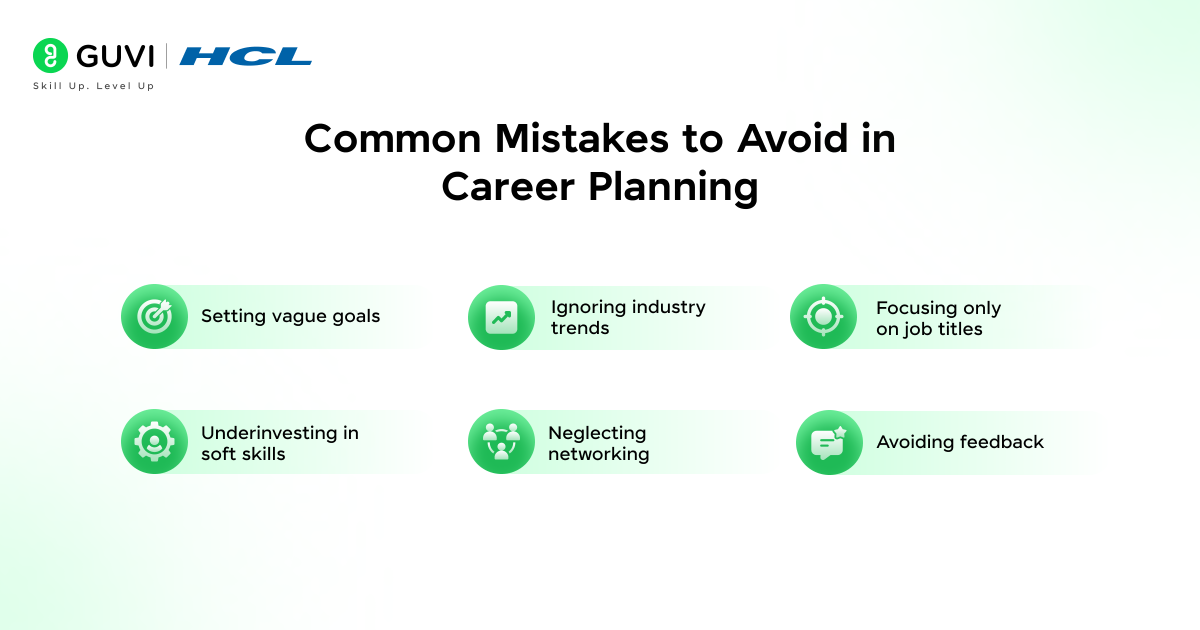
- Setting vague goals: Goals like “grow in my field” lack direction and are hard to measure or act on.
- Ignoring industry trends: Failing to adapt to changes in technology, roles, or demand can leave your skills outdated.
- Focusing only on job titles: Prioritizing roles based on status rather than alignment with your skills and growth potential can limit long-term success.
- Underinvesting in soft skills: Technical skills matter, but ignoring communication, leadership, and adaptability can stall advancement.
- Neglecting networking: Relying solely on online applications and ignoring relationship-building misses valuable opportunities.
- Avoiding feedback: Not seeking or acting on feedback from interviews, mentors, or managers slows improvement.
Boost your career with strong fundamentals! Enroll in our Networking Essentials for Beginners Course and build the technical foundation that powers smart career growth.
Final Words
Strategic career planning transforms reactive decisions into intentional momentum. It links self-awareness, market relevance, and future readiness into a structured path. Instead of chasing roles, you cultivate direction. It brings coherence between who you are, what the market needs, and where you want to grow. With evolving self-insight and adaptive choices, you stop drifting and start designing. Over time, this discipline compounds into career leverage and deeply earned progress.
FAQs
1. How often should I update my career plan?
A career plan benefits from regular updates every few months. These reviews help you evaluate progress, adjust goals, and respond to new opportunities or changes in your field without losing long-term direction.
2. What tools can help me stay consistent with my career plan?
Digital planners.and skills‑tracking sheets help maintain consistency. Many professionals use structured dashboards to monitor learning goals and new opportunities that align with their long-term path.
3. How do I know if my career plan is realistic?
A plan becomes realistic when it reflects your current skills, market demand, and achievable timelines. Comparing your goals with industry benchmarks, role expectations, and guidance from mentors helps validate whether your direction is grounded.
Success Stories

About the Author
Vaishali
I'm a seasoned writer with four years of experience across technical, non-technical, and just about every genre or niche you can imagine. Adaptable and curious, I enjoy exploring new topics and making information engaging and easy to understand. Fueled by a steady stream of tea, I approach each project with creativity, reliability, and genuine enthusiasm for storytelling.
View all posts by Vaishali
Connect with me @













Did you enjoy this article?