


Software Development Articles
Decoding Differences between Network OS and Distributed OS
Operating System Examples: Top OS Types, Features, and Uses Explained


Get In Touch For Details! Request More Information
Best DBMS Projects to Showcase in Your Professional Portfolio
Oct 10, 2025 9 Min Read 4889 Views
(Last Updated)
One can’t deny the fact that “Data is the new oil.” And the simple reason behind this is the frequency at which organizations utilize it to execute business operations and strategies, and how end users rely on it to make difficult decisions.
But having only access to large datasets is not enough. Data can be beneficial only when they are well organized, structured, and effectively managed over time without any technical hindrances. To serve this purpose, Database Management Systems (DBMS) were created to handle data operations in a much easier, secure, and organized manner.
With a real-world perspective, the significance of DBMS is very high; big tech giants and corporations rely heavily on DBMS when dealing with complex customer and workflow information, such as purchase history, customer IDs, sales and inventory records, employee details, etc.
So, based on the criticality of DBMS, it becomes extremely necessary for candidates who are aspiring to or who are already involved in building DBMS projects. That’s why in this particular blog, we will be discussing the most effective DBMS projects that uplift your profile as a software engineer.
Table of contents
- What is DBMS, Its Types, and Features?
- List of The Most Important DBMS Projects
- Student Records Database
- Hostel Room Allocation System
- Employee Attendance and Payroll System
- Digital Library Catalog
- Stock & Inventory Tracker
- Online Food Ordering Database
- Event Management Database
- Healthcare Patient Records System
- Secure Banking Transaction Database
- Smart City Traffic Management Database
- Conclusion
- FAQs
- What are some beginner-friendly DBMS projects?
- What is the importance of building DBMS projects?
- What are the most commonly used tools in DBMS projects?
What is DBMS, Its Types, and Features?
Definition:
A Database Management System (DBMS) that allows users and admins to create, store, manage, retrieve, and manipulate databases. It is a system that also enables backup and recovery of the databases in case of any technical corruption or outage. These advanced systems are developed to ensure scalability to support a large number of datasets, which is directly proportional to the growing number of users.
Types of DBMS
- Hierarchical DBMS: This system organizes data in a tree-like structure using parent-child relationships.
- Network DBMS: Network DBMS represents the data as a graph for enabling the many-to-many (multi-mapping) relationships.
- Relational DBMS (RDBMS): This DBMS system performs data storage in a tabular manner with rows and columns involved in it, using SQL for querying.
- Object-oriented DBMS (OODBMS): This stores the data as objects and blends the database and programming features.
- NoSQL DBMS: This system was introduced for designing and developing scalable and flexible databases, along with handling unstructured or semi-structured records.
Features of DBMS
- Efficient Data Access – Uses indexing and query optimization for fast retrieval.
- Data Integrity – Ensures accuracy and consistency of data.
- Data Security – Controls access to data using authentication and permissions.
- Backup and Recovery – Automatically handles data backup and restores after failures.
- Concurrent Access – Multiple users can access data at the same time without conflicts.
- Reduced Data Redundancy – Stores data centrally to avoid duplication.
List of The Most Important DBMS Projects
These are the following DBMS projects that reflect hands-on experience in managing and organizing real-world data. So, without any further ado, let’s get started.
1. Student Records Database
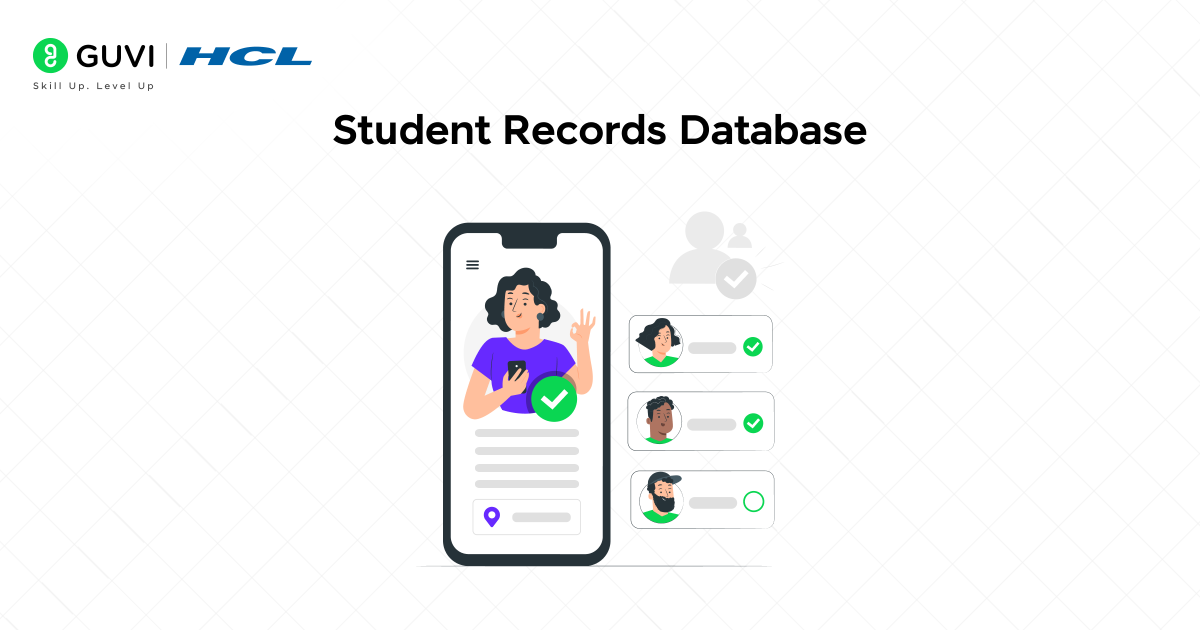
This is a DBMS project that mainly lays emphasis on storing, managing, and retrieving the student details such as names, contact information, courses in which they are enrolled, house team, attendance percentage, and other academic progress. The sole purpose behind developing this system is to replace the traditional methodology of manual record-keeping. This structured database system ensures high precision and better data monitoring for educational entities (schools, coaching institutes, colleges, etc).
Project Specifications:
Project Time Duration: 1 to 2 weeks
Complexity Level: Beginner
Tech Stack Implemented:
- Database: MySQL / PostgreSQL
- Tools: MySQL Workbench, pgAdmin
Core Competencies Developed:
- Learn how to exercise CRUD (create, read, update, and delete) operations with SQL queries.
- Maintain the data integrity through applying constraints. With the help of primary and foreign keys, establish entity relationships (ER).
- Practically design the relational database schemas.
Implementation Approach
- Begin the project execution phase by meticulously designing the database schema with multiple base entities such as Students, Class ID, Courses, Marks, and Attendance Percentage.
- Once the schemas are defined, map them with their respective sub-properties using foreign keys. Inject the tables with sample data and use SQL queries to fetch the student information and perform manipulation activities such as grade upgradation, progress reports, etc.
- For optimizing this particular project, indexing can be integrated into it for faster query execution, especially in the case of handling large datasets.

2. Hostel Room Allocation System
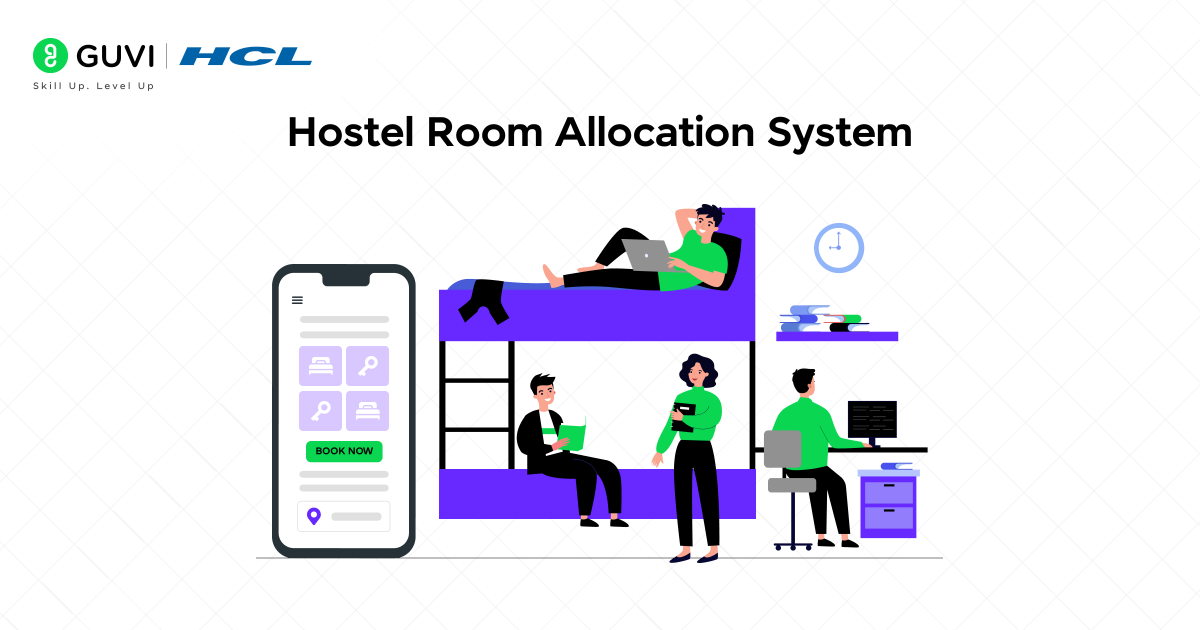
This is a DBMS project that mainly focuses on managing hostel accommodations by storing, monitoring, and retrieving student or occupant details such as room numbers, hostel blocks, occupancy status, and other related information. The main purpose of developing this system is to replace the traditional manual method of keeping hostel records. This structured database system ensures better accuracy, faster room allocation, and improved management of hostel facilities for educational institutions.
Project Specifications:
Project Time Duration: 1 to 2 weeks
Complexity Level: Beginner
Tech Stack Implemented:
- Database: MySQL / PostgreSQL
- Tools: MySQL Workbench, pgAdmin
- Languages: SQL, Python (for queries/automation)
- Frameworks/Libraries (optional extension): Flask / Django ORM, Pandas (for reporting)
Core Competencies Developed:
- Learn how to perform CRUD (create, read, update, and delete) operations with SQL queries.
- Maintain data integrity by applying constraints and using primary and foreign keys to establish entity relationships.
- Practically design relational database schemas for entities like Rooms, Students, Hostel Blocks, and Room Allocations.
Implementation Approach:
- Begin the project execution by designing the database schema with multiple base entities such as Students, Rooms, Hostel Blocks, and Room Allocations.
- Once the schemas are defined, map them with their respective sub-properties using foreign keys. Populate the tables with sample data and use SQL queries to fetch room allocation information, check room availability, assign rooms, and generate occupancy reports.
- For optimization, indexing can be integrated to allow faster query execution, especially when handling large datasets of students and rooms.
3. Employee Attendance and Payroll System
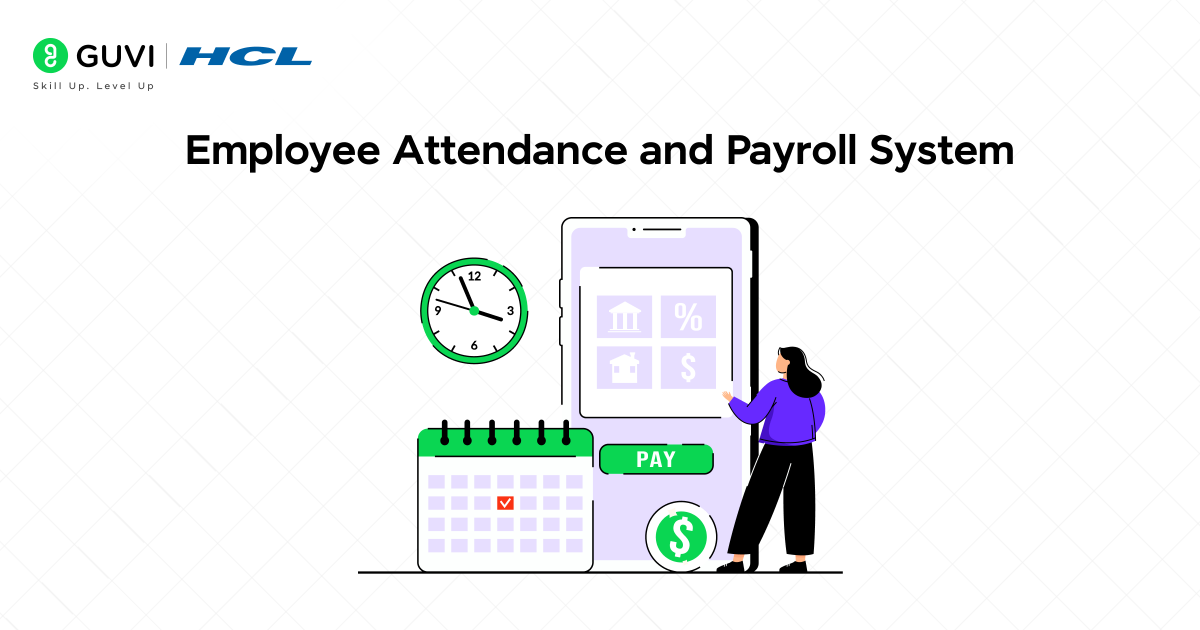
This is a DBMS project that primarily gets involved in managing employee attendance and payroll by storing, monitoring, and retrieving details such as employee information, attendance records, working hours, salary, and deductions. The main purpose of developing this system is to replace traditional manual logs and spreadsheets. This structured database system ensures better accuracy, faster payroll calculation, and improved monitoring of employee attendance for organizations or companies.
Project Specifications:
Project Time Duration: 1 to 2 weeks
Complexity Level: Beginner
Tech Stack Implemented:
- Database: MySQL or PostgreSQL
- Tools: MySQL Workbench, pgAdmin
- Languages: SQL (queries), optional Python for automation
- Frameworks/Libraries (optional extension): Flask/Django ORM (if web interface needed)
Core Competencies Developed:
- Learn how to perform CRUD (create, read, update, and delete) operations with SQL queries.
- Maintain data integrity by applying constraints and using primary and foreign keys to establish entity relationships.
- Practically design relational database schemas for entities like Employees, Departments, Attendance Records, and Payroll.
Implementation Approach
- Begin the project by defining the main operations, such as tracking daily attendance, updating employee records, and calculating payroll. Design relational tables for Employees, Departments, Attendance, and Payroll, linking them appropriately with primary and foreign keys.
- Populate the tables with sample data and simulate real-world scenarios, including clock-ins, leaves, and overtime hours.
- Use SQL queries to fetch attendance, compute salaries with deductions, and generate monthly payroll reports automatically.
- For optimization, indexing can be integrated to allow faster query execution, especially when handling large datasets of employee records.
4. Digital Library Catalog
A Digital Library Catalog is designed and developed for storing and managing the data of book names, authors, genres, publishers, borrowed time, etc. It is a smart and effective digital solution that helps in tracking the book availability status, pending amount in case of extended period, due dates, and borrower credentials. It is the best replacement for manual registers, which simplify the searching, issuing, and returning process. Local public libraries, schools, and colleges can adopt this DBMS system to maintain their collections without any physical interruptions.
Project Specifications:
Project Time Duration: 2 to 3 weeks
Complexity Level: Beginner–Intermediate
Tech Stack Implemented:
- Database: MySQL or PostgreSQL
- Tools: MySQL Workbench, pgAdmin
- Languages: SQL (queries), optional Python for automation
- Frameworks/Libraries (optional extension): Flask/Django ORM (if web interface needed)
Core Competencies Developed:
- Get a clear understanding of developing relational schema with multiple entities such as Books, Genre, Authors, Borrower Details, and Transactional Amount.
- Define relational mapping, such as One-to-Many and Many-to-Many. Hands-on experience in writing SQL queries for availability status, book issue/return dates, and borrower past activities (if applicable).
- Apply the essential constraints to maintain data integrity and accuracy to prevent duplication in the system records.
Implementation Approach
- Create all the base entities like Books, Genres, Authors, and Borrowers.
- After creating these entities, establish the relationships that a particular book or borrower can have ( for example, multiple borrowers can request a particular author or a book, or how many books the borrower has borrowed).
- Populate all these sample data in a table to simulate a physical library collection.
- Execute SQL queries to fetch the available books, latest books, and authors added, or popular choices.
- System enhancement for this project can be done by implementing trigger points for auto-updating book status when borrowed or returned.
5. Stock & Inventory Tracker
A Stock & Inventory Tracker streamlines the internal business workflow by providing real-time monitoring for products, stock levels, and supplier management, as well as maintaining the record data of sales and purchases. These parameters can all be integrated within the projects by beginners by using dummy API (application programming interface) data. Based on these data, administrators can easily ensure the current inventory level and mitigate the potential risks involved in overstocking or stockouts. This smart tracking DBMS system can be an ideal choice for small business owners, medium enterprises, and initial-stage startups who want to generate accurate reports on product movement and warehouse activities.
Project Specifications:
Project Time Duration: 2.5 to 3 weeks
Complexity Level: Beginner–Intermediate
Tech Stack Implemented:
- Database: MySQL or PostgreSQL
- Tools: MySQL Workbench, pgAdmin
- Languages: SQL (queries), optional Python for automation
- Frameworks/Libraries (optional extension): Flask/Django ORM (if web interface needed)
Core Competencies Developed:
- Draw relational structured tables for essential stock components such as Products, Orders, Stock Level, and Transactions. To ensure accurate and precise data mapping, define primary and foreign key constraints.
- Write effective SQL queries for adding new stock, updating inventory conditions, and generating descriptive stock documents. Also, you will take your first step in understanding how data integrity and stock modification triggers are maintained.
Implementation Approach
- Build systematic tables that will contain the data linked with the main entities (Products, Orders, Stock Transactions, etc.).
- Implement foreign keys to connect the products available to buyers and track the sales and purchasing activities or history.
- The sample data injected into the table will then be used to replicate the inventory motion.
- SQL querying will be carried out to check and update the stock quantities after sales and purchases. Based on these search results, comprehensive reports can be generated.
6. Online Food Ordering Database
An Online Food Ordering Database system manages the entire information related to restaurants, cloud kitchens, food items, customer feedback & details, and orders. By building it, you enable end users to browse menus, place orders, monitor the delivery status in real-time, and maintain the transaction records. This is a real-world software platform where food vendors, delivery partners, and customers are closely linked with each other through seamless data flow. This project includes multi-entity relationships, transactional tasks, and tracking orders in a rich database environment.
Project Specifications:
Project Time Duration: 5 to 6 weeks
Complexity Level: Intermediate
Tech Stack Implemented:
- Database: MySQL or PostgreSQL
- Tools: MySQL Workbench, pgAdmin,
- Languages: SQL, Python (for backend automation)
- Frameworks/Libraries: Flask or Django ORM, Pandas (for reporting), Jinja2 (for web templates)
Core Competencies Developed:
- Complete comprehension of relational schemas for Customers, Restaurants, Menu Items, Orders, and Payments.
- Establishing one-to-many and many-to-many relationships.
- Ability to run SQL queries for order management, tracking transactional volumes, and calculating sum totals.
Implementation Approach
- The development process starts with designing a relational system with closely connected tables for customers, restaurants, menu items, orders, and payments.
- This system is then responsible for handling the one-to-many relationships between restaurants and menu items, and many-to-many relationships between customers and orders through a transactions table.
- During this processing stage, SQL queries, predefined programming functionalities, and conditional constraints ensure the consistency in the data flow. Apart from this, the reports for order history, sales, and highly recommended food dishes are generated directly from the database.
- For the backend part, Python, accompanied by Flask or Django ORM, is used for enabling web-based interactions and real-time monitoring activities.
7. Event Management Database
An Event Management Database system manages all the information related to events, organizers, attendees, tickets, and payments. By building it, you enable users to browse upcoming events, register for them, manage ticketing, and maintain transaction records. This real-world software platform connects organizers, attendees, and payment systems seamlessly through structured data flow. This project includes multi-entity relationships, event scheduling, and ticket tracking in a comprehensive database environment.
Project Specifications:
Project Time Duration: 5 to 6 weeks
Complexity Level: Intermediate
Tech Stack Implemented:
- Database: MySQL or PostgreSQL
- Tools: MySQL Workbench, pgAdmin
- Languages: SQL, Python (for backend automation)
- Frameworks/Libraries: Flask or Django ORM, Pandas (for reporting), Jinja2 (for web templates)
Core Competencies Developed:
- Complete understanding of relational schemas for Events, Organizers, Attendees, Tickets, and Payments.
- Establishing one-to-many relationships between organizers and events, and many-to-many relationships between attendees and events.
- Ability to run SQL queries for ticket management, event registration, and revenue calculation.
Implementation Approach:
- The development process starts with designing a relational system with connected tables for Events, Organizers, Attendees, Tickets, and Payments.
- The system handles one-to-many relationships between organizers and their events, and many-to-many relationships between attendees and events through a registration table.
- During this stage, SQL queries, conditional constraints, and automated Python scripts ensure accurate ticketing, prevent double bookings, and maintain consistent transaction records. Reports for event attendance, revenue, and popular events are generated directly from the database.
8. Healthcare Patient Records System
A Healthcare Patient Records System is developed to maintain the information of patients, doctors, appointment slots, treatments, and billing. It allows medical facilities like hospitals and clinics to monitor patient histories and schedule appointments in accordance with it. This system also tracks the types of drugs and medicines prescribed by doctors to their patients. This system maintains consistency in data flow and minimizes manual operational activities in a digitally secured manner.
Project Specifications:
Project Time Duration: 6 to 7.5 weeks
Complexity Level: Intermediate-Advanced
Tech Stack Implemented:
- Database: MySQL or PostgreSQL
- Tools: MySQL Workbench, pgAdmin
- Languages: SQL, Python
- Frameworks/Libraries: Django ORM (for backend), Pandas (for reporting), Jinja2 (optional web interface)
Core Competencies Developed:
- Modeling real-world healthcare workflows in a relational database.
- Maintaining patient confidentiality and implementing role-based access for doctors, nurses, and staff.
- Automating appointment scheduling and conflict detection using database triggers and procedures.
- Generating dynamic reports for patient history, treatment plans, and billing summaries.
Implementation Approach
- The system is developed as a relational database system that will be engaged in feeding the entities (Patients, Doctors, Appointments, Treatments, and Billing) data to the tables.
- The frequency of patient visits is tracked effectively, along with automatic validation of appointments to avoid scheduling errors.
- SQL queries are passed to update the treatment records and generate the billing summaries dynamically.
- To upgrade the quality of this specific DBMS system, Django ORM can be integrated to create a secure web interface that allows the medical staff to access sensitive hospital information, such as patient diagnostics, prescription details, electronic health records (EHR), etc.
9. Secure Banking Transaction Database
This DBMS project involves a high level of meticulous effort. Software programmers who have a strong foundational base in data security and privacy, concurrency control for heavy traffic concentration, and complex API integration should build this complex DBMS system. In this project, every important aspect of banking operations, such as customer account handling, deposits and withdrawal activities, fund transfer, loan approval, and official document generation, is processed based on data. This system is capable of handling heavy transaction volumes with minimal technical glitches. It also simulates real-world banking workflow and demonstrates how scalable fintech data can be systemically organized, refined, and protected from any potential cyber threats.
Project Specifications:
Project Time Duration: 8 to 9 weeks
Complexity Level: Advanced
Tech Stack Implemented:
- Database: PostgreSQL or Oracle
- Tools: pgAdmin, Oracle SQL Developer, DBeaver
- Languages: SQL, PL/pgSQL, or PL/SQL
- Frameworks/Libraries: Python (Django or Flask for backend APIs), cryptography libraries for data encryption
Core Competencies Developed:
- Learn how to design a model for complex banking operations, including accounts, transactions, and loans.
- Implement secure data handling techniques like multi-factor authentication (MFA), role-based access control (RBAC), and tokenization. Ensure safe and secure transactional integrity with compliance with ACID (Atomic, Consistent, Isolated, and Durable) pipeline.
- By running SQL queries, generate dynamic statements and reports for customers and bank management, by fetching real-time transaction and account data from the database.
Implementation Approach
- This advanced and sophisticated banking database system is normalized by implementing the relational schemas, where the Customer entities are linked to multiple Accounts entities (multi-mapping).
- Then the database maintains the transactional logs in the Transaction Records table. Here, the primary and foreign key constraints come into play by enforcing referential integrity; at the same time, indexing is applied to sensitive customer and bank data for faster SQL querying.
- Predefined functional components are reusable here for validating the account balance before withdrawals or fund transfers.
- Concurrency is managed via isolation levels (e.g., SERIALIZABLE) to prevent server malfunctions when multiple users access the same account (e.g, two users trying to withdraw a certain amount from the same joint account). In addition to all these processes, the best security measures are also taken into consideration to restrict unauthorized access.
10. Smart City Traffic Management Database
This DBMS project involves a high level of careful planning and technical execution. Developers with a strong understanding of real-time data processing, concurrency control, and large-scale database optimization should build this advanced system. In this project, all critical aspects of city traffic operations, such as vehicle registrations, traffic signals, congestion monitoring, incident reporting, and route optimization, are managed through a structured relational database. This system is capable of handling high volumes of real-time sensor data with minimal latency. It simulates a real-world smart city traffic ecosystem and demonstrates how complex urban data can be systematically organized, monitored, and protected.
Project Specifications:
Project Time Duration: 9 to 10 weeks
Complexity Level: Advanced
Tech Stack Implemented:
- Database: PostgreSQL or Oracle
- Tools: pgAdmin, Oracle SQL Developer, DBeaver
- Languages: SQL, PL/pgSQL, or PL/SQL
- Frameworks/Libraries: Python (Django or Flask for backend APIs), libraries for data encryption and real-time data handling
Core Competencies Developed:
- Design a complex model for traffic operations, including vehicles, routes, signals, and incidents.
- Implement secure data handling techniques like RBAC (Role-Based Access Control) and encrypted sensor logs.
- Ensure transactional integrity using ACID-compliant operations for vehicle updates, incident reporting, and traffic signal management.
- Generate dynamic reports for traffic density, accident-prone zones, and route optimization using SQL queries.
Implementation Approach
- The development process begins by designing relational schemas where Vehicles, Traffic Signals, Routes, and Incidents are interconnected.
- Real-time updates from traffic sensors and vehicle data are maintained in the Traffic Records tables. Primary and foreign key constraints ensure referential integrity, while indexing is applied to high-priority tables for faster query performance.
- After that, validation is done for route availability, managing congestion alerts, and logging incidents automatically.
With the global relational database market projected to reach US$121.57 billion by 2028 at a CAGR of 13.2%, India’s tech economy—closely influenced by U.S. trends—is also expected to see a surge in demand for database professionals as companies adopt more data-driven solutions. This growth directly impacts Indian engineers, as expertise in DBMS projects equips them with the skills needed to design scalable, secure, and efficient systems that align with industry demand, making such projects highly valuable for career advancement.
If you are looking to elevate your career prospects, then enhance your skills with HCL GUVI’s MongoDB and IITM Pravartak Certified AI Software Development Course. In addition to this, if you want to master the art of NoSQL (Not-Only-SQL) databases, then you can also enroll in our advanced and comprehensive MongoDB course. Upskill yourself with HCL GUVI, and the future of tech is yours.
Conclusion
If we have to deduce our learning after reading this blog, then we will get to know the importance of DBMS projects in developing real-world software platforms and systems. Working on these projects aids your technical knowledge, which plays a significant role in landing a top tech role in your dream company. Overall, DBMS projects help tech professionals enhance their problem-solving and programming proficiency.
FAQs
What are some beginner-friendly DBMS projects?
Some important beginner-friendly real-world DBMS projects are: E-commerce application database, student records database, inventory control management, hospital management system, and library management system.
What is the importance of building DBMS projects?
The primary significance behind building DBMS projects is to develop a firm understanding and practical knowledge of designing and managing scalable databases that store, organize, and retrieve large datasets efficiently.
What are the most commonly used tools in DBMS projects?
The most commonly used tools in DBMS projects include MySQL Workbench, pgAdmin, Oracle SQL Developer, DBeaver, SQL, Python, MySQL, or PostgreSQL, Django ORM, and Pandas.
Success Stories
















Did you enjoy this article?