


Interview Articles
My Full Stack Developer Interview Experience: What Nobody Tells You
My Digital Marketing Interview Experience: What They Don't Tell You [2026]
How Long Does Technical Interview Preparation Take? An Expert's Reality Check
Technical QA Interview Questions: What Top Companies Really Ask in 2026


Get In Touch For Details! Request More Information
Top AI Interview Preparation Tips to Land Your Dream Job (2026 Guide)
Mar 19, 2026 7 Min Read 2284 Views
(Last Updated)
The job market is changing rapidly, and artificial intelligence is now at the center of modern hiring. Companies are moving away from traditional interview methods and adopting AI-powered screening tools.
In many ways, AI has stepped into the interviewer’s chair, and it is running the recruitment show. As candidates, you no longer rely on old interview strategies. AI-driven systems analyze everything from resume keywords and response structure to your tone of voice, body language, and facial expressions on video.
These algorithms compare your performance against thousands of other applicants within seconds, making AI interview preparation more important than ever.
Quick Answer:
The top AI recruiter interview preparation tip is to learn about the company and add your resume with the right keywords. Practice clear, confident answers on camera and check your tech setup to perform your best in the AI interview.
Here is the guide that breaks down exactly what’s happening behind the scenes and gives you the real strategies to ace AI interviews.
Table of contents
- What is an AI Interview?
- Video Interviews
- Resume screening
- Chat-based Assessments
- What is the difference between an AI Interview and a Human?
- Time and Efficiency
- Context and Storytelling
- Appeals and Second Chance
- Feedback and Flexibility
- What Gets Measured
- Consistency
- Evaluation Process
- What are the top companies that use AI recruitment?
- Steps to Win the AI Interview
- Optimize Your Resume for AI Screening
- Research What the AI is Actually Looking For
- Master Your Delivery (Tone, Pace, and Body Language)
- Structure Your Answers Using the STAR Method
- Prepare Your Environment and Technical Setup
- Practice, Record Yourself, and Iterate
- Pre-Interview Preparation
- Research the Company Thoroughly
- Set Up Your Tech Properly
- During the Interview
- Speak clearly and confidently
- Look into the camera
- Show authentic energy
- Stay on topic
- Technical Interview Tips
- Master Core Concepts
- Think Out Loud
- Test Your Code
- Optimize When Possible
- Post-Interview Actions
- Reflect and Learn
- Send a Thank-You Message
- Review Any Feedback
- Keep Improving
- Bonus Tips
- Key Takeaways
- What is an AI interview?
- How does AI evaluate candidates in interviews?
- Why do companies use AI in recruitment?
- Can AI interviews reject me automatically?
- Do AI systems understand emotions or context?
- How do I make my resume AI-friendly?
What is an AI Interview?
Studies show that 87% of companies use AI recruitment, and 65% of recruiters have already integrated these tools into their hiring workflows. But before that, what is an “AI interview”?
AI interviews occur when a company uses artificial intelligence to screen and evaluate job candidates instead of having a human interviewer talk to you.
Before we dive into the methods and techniques of AI interview preparation, you can explore HCL GUVI’s interview preparation course. In this course, you will learn essential concepts, from building an ATS-friendly resume to handling common interview challenges and presenting yourself confidently.
Now, let’s break down how it works…
Video Interviews
Video interviews are the most common format. You’ll record yourself answering pre-written questions on your computer.
The AI analyzes your responses by looking at things like word choice, how confident you sound, your facial expression, body language, and even eye contact. Some systems can even detect emotions or confidence levels from your voice.
Resume screening
83% of the companies use AI for reviewing resumes. AI Scans your resume for specific keywords, qualifications, and work experience, then ranks you against other applicants. If you don’t hit certain keywords, your resume might get filtered out before a human ever sees it.
The first step is the most important because it decides if you can move to the next round. That’s why it needs your full attention.
And it’s quite natural to get confused about your ATS score.
We at HCL GUVI have built a free Resume Builder Tool featuring top recommended templates aligned with industry standards, all curated by leading recruiters. This tool can help you easily clear the initial screening stage.
Chat-based Assessments
You might answer questions through a text interface or chatbot, and the AI evaluates your responses in real-time.
The whole idea behind it is high speed and efficiency. Companies can screen through applications in minutes instead of having recruiters manually read through everything. But the downside?
AI can be unpredictable, and there’s less room for personality or nuance to come through.
That’s why knowing how these systems work is really useful. If you understand what the AI is looking for, you can prepare accordingly and not get weeded out by the algorithm.
What is the difference between an AI Interview and a Human?
AI recruitment often feels impersonal, with 47% of candidates saying it seems inhuman. AI systems assess your language, tone, speed, and body language in a highly structured way. In contrast, companies prefer AI screening because it is fast and can evaluate candidates within hours.
So while AI may seem like an impersonal black box, it’s actually quite transparent once you understand the rules.

Time and Efficiency
A human interview takes time. Someone has to schedule it, conduct it, and then review notes. AI can screen thousands of candidates in hours. This is great for companies, but rough for candidates because it’s impersonal, and you might get filtered out without anyone ever really considering you.
Context and Storytelling
Humans understand context. If you had a rough day or personal stuff going on, you might mention it, and they’ll cut you some slack. AI doesn’t care about context; it just scores your performance in the moment.
Appeals and Second Chance
If humans reject you, you might be able to reach out, explain yourself, or ask for another chance. With AI, once you’re rejected by the algorithm, there is no negotiating.
Feedback and Flexibility
Humans can adjust on the fly. If you stumble on a question, a good interviewer might rephrase it or give you a second chance. They can pick up on context and understand nuance. AI can’t do that!
If you are stuck on a video interview, you don’t get a do-over.
What Gets Measured
Humans focus on what you say, your answers, your experience, and how you explain things. AI measures how you say it, too. It’s analyzing your tone, facial expressions, body language, word choice, filler words, eye contact, and even micro expressions.
A human might not notice you said ‘um’ 20 times, but AI definitely will.
Consistency
Human interviewers are inconsistent with questions. One recruiter might ask different questions than another. But AI is the same every time, every candidate gets asked the same question and scored using the same criteria.
Evaluation Process
With human interviewers, they’re making judgment calls based on their gut feeling, experience, and personal bias. They might like you because you went to their college or remind them of someone they know. An AI interview evaluates you based on specific data points and algorithms.
There is no room for intuition or human feelings.
What are the top companies that use AI recruitment?
AI recruitment isn’t something that will happen in the future; it’s already here, and many big companies are using it today. If you’re applying to big corporations, especially in tech, finance, and consulting, you’re almost definitely going to run into AI-powered hiring. Here are the companies leading the charge with AI recruitment tools and what they’re actually doing with them.
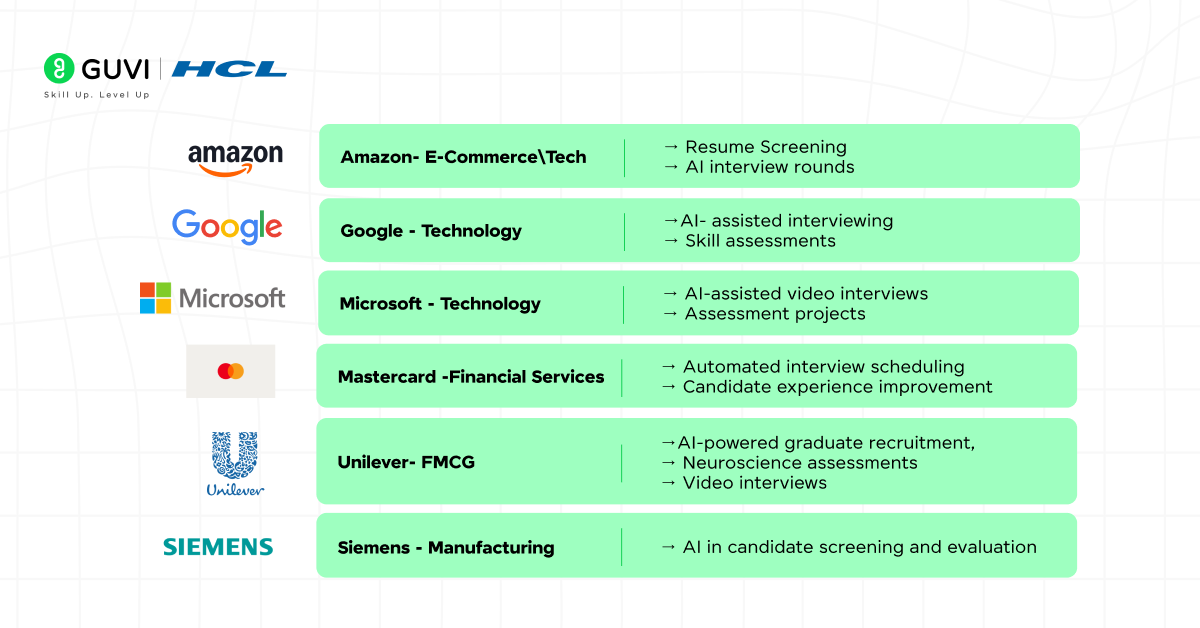
| Company | Industry | AI Recruitment Usage |
| Amazon | E-commerce/ Tech | Resume screening, AI interview rounds |
| Technology | AI-assisted interviewing, skills assessments | |
| Microsoft | Technology | AI-assisted video interviews, assessment projects |
| Mastercard | Financial Services | Automated interview scheduling, candidate experience improvement |
| Unilever | FMCG | AI-powered graduate recruitment, neuroscience assessments, video interviews |
| Siemens | Manufacturing | AI in candidate screening and evaluation |
Steps to Win the AI Interview
This guide will teach you six easy ways to pass any AI screening and help you with your AI interview preparation. You’ll learn how to make your resume simple for ATS systems to read, understand the AI tools companies use, and improve your tone, speed, and body language during the interview.
Each step gives you practical tips based on how AI really evaluates candidates.
1. Optimize Your Resume for AI Screening
Before you even get to the video interview, you have to pass the resume scanning algorithm.
This means using the right keywords. Study the job description and mirror the language they use. If they say ‘project management,’ don’t say ‘coordinating tasks.’
AI is looking for exact matches. Include specific skills, certifications, and metrics (numbers are your friend →’ increased sales by 25%’ beats ‘improved sales’).
Keep your formatting clean and simple. Avoid fancy fonts or graphics, as they can confuse the scanner.
Start creating a resume that can pass the screening test, is ATS-friendly, and lets you build and customize your resume from scratch.
Create ATS-friendly resumes with HCL GUVI’s Free Resume Builder Tool now!
2. Research What the AI is Actually Looking For
Different companies use different AI platforms with different criteria. Before your interview, try to find out which platform they’re using (HireVue, Pymetrics, etc).
Look up what that specific AI evaluates. Some focus heavily on tone and confidence, others on word choice and structure.
Check if the company has posted anything about their hiring process online or ask the recruiter directly. The more you know about what the algorithm is measuring, the better you can prepare.
3. Master Your Delivery (Tone, Pace, and Body Language)
AI is analyzing ‘how’ you speak, not just what you say.
Speak clearly and at a moderate pace, not too fast (sounds nervous), not too slow (sounds unsure). Minimize filler words like ‘um,’ ‘like,’ and ‘uh.’
Practice your answers out loud multiple times until they sound natural but polished. Maintain eye contact with the camera the entire time you’re talking. Sit up straight, keep your shoulders back, and use some hand gestures (but not too much, as you don’t want to look chaotic).
Your facial expressions should match your words; smile when appropriate, and look serious when discussing challenges. Think of it like acting, where you’re performing with confidence and competence.
4. Structure Your Answers Using the STAR Method
AI loves structure because it’s easier to analyze.
Use the STAR method: Situation, Task, Action, Result. Start with the context, explain what you had to do, describe what you actually did, and finish with the measurable outcome.
Don’t ramble or go off on tangents. AI algorithms look for logical flow and clear problem-solving. Practice giving concise answers that hit all four parts.
Aim for 60-90 seconds per answer unless the platform gives you more time. This shows you can communicate efficiently, which is something AI values.
5. Prepare Your Environment and Technical Setup
Technical failures can tank your interview because AI doesn’t care about excuses; it only scores what it captures.
Test your setup beforehand: camera quality, lighting, audio, and internet connection. Sit in front of a plain, professional background (a wall is perfect). Make sure the lighting is in front of you, not behind you, so your face is clearly visible.
Wear professional clothes like you would for an in-person interview. Close all other tabs and apps so nothing distracts you or causes lag.
Have a glass of water nearby.
Do a practice run on the actual platform if possible. Technical issues won’t get you sympathy from an algorithm.
6. Practice, Record Yourself, and Iterate
This is non-negotiable. You need to practice your answers multiple times and watch yourself back. Record yourself answering common interview questions and watch the videos.
You’ll notice things like filler words, rushed pacing, lack of eye contact, or awkward body language that you didn’t realize you were doing. Keep practicing until you feel confident and natural. Have a friend or mentor watch your practice videos and give feedback.
The more you practice, the more comfortable you’ll be, and comfort shows on camera.
AI can tell the difference between someone who’s rehearsed and someone who’s winging it.
Pre-Interview Preparation
Research the Company Thoroughly
Don’t stop at reading the job description. Explore the company’s website, social media, recent news, and employee reviews. When you understand their culture, mission, and tone, your answers naturally become more aligned, and AI systems pick up on that authenticity. Genuine knowledge about the company shows through in your language and helps you stand out.
Set Up Your Tech Properly
Your environment impacts your score. Choose a quiet space with good lighting, a quality webcam, clear audio, stable internet, and a camera positioned at eye level. A clean, professional setup helps you appear confident and put together before you’ve even spoken a word.
During the Interview
Speak clearly and confidently
Maintain a natural pace and articulate your answers well. AI evaluates clarity, tone, and confidence, so avoid mumbling or sounding overly rehearsed. You want to sound like someone who knows what they’re talking about, not like you’re reading from a script.
Tip: Follow the STAR method—Situation, Task, Action, Result →To keep your answers focused and impactful.
Look into the camera
Eye contact with the lens creates a better engagement score and makes you appear more confident and connected. Yes, it feels weird staring at a little circle on your screen, but this one habit makes a real difference. Pin a sticky note next to your camera if it helps you remember to focus on the lens.
Show authentic energy
Your tone, expressions, and enthusiasm matter. AI systems recognize positive engagement, and humans reviewing your responses notice it too. Show that you genuinely want the role. Let your excitement come through naturally, not forced.
Stay on topic
Answer the question directly. A focused, relevant response scores higher than wandering off into unrelated details.
Technical Interview Tips
Master Core Concepts
For technical roles, strong fundamentals are essential. Practice data structures, algorithms, and problem-solving on platforms like LeetCode or HackerRank so you’re prepared for common challenges.
Think Out Loud
Explain your reasoning as you work through problems. AI evaluates your approach and decision-making process, not just the final code. Walk through your logic, explain why you chose a particular solution, and discuss potential trade-offs.
Test Your Code
Walk through test cases and consider edge cases. A functional solution is more important than a flashy but unfinished one. Run through potential problems in your head before you submit. Make sure your code actually works before you try to optimize it.
Optimize When Possible
If you finish early, refine your code for efficiency. Demonstrating improvement and optimization shows critical thinking and attention to detail. But don’t sacrifice a working solution for a potentially better one.
Post-Interview Actions
Reflect and Learn
Take a moment after each interview to note what went well and what could be better. Track patterns from your practice runs. Use your observations to improve future performance. Each interview is a learning opportunity.
Send a Thank-You Message
Within 24 hours, send a brief, thoughtful note that shows professionalism and reinforces your interest. Reference something specific from the conversation to make it personal. Keep it short and genuine, this keeps you on their radar.
Review Any Feedback
If the AI platform provides scoring or comments, use it. The insights can help you adjust your pacing, structure, or energy for the next round.
Keep Improving
Each interview strengthens your skills. Continue practicing, refining your resume, and polishing your delivery. Consistency is what sets successful candidates apart. The more you interview, the more comfortable you become, and that confidence shows.
Bonus Tips
Research the company and role thoroughly so your answers feel genuine, not robotic
Smile slightly, even when talking about challenges, this shows resilience
Answer the exact question asked; don’t go off on tangents
Show enthusiasm for the role and company
Remember! Remember!
AI is looking for patterns and consistency. Be authentic but strategic.
Key Takeaways
AI is transforming recruitment: Artificial intelligence now drives most hiring processes. Around 87% of companies use AI in recruitment, making it essential for candidates to understand how these systems work.
Traditional interviews are evolving: Many companies have replaced first-round human interviews with AI-powered video or chat assessments that analyze tone, confidence, and communication.
AI evaluates both content and delivery: It doesn’t just assess what you say, but how you say it.
Preparation matters more than ever: Understanding the company, structuring answers using the STAR method, and practicing delivery help you perform well under AI evaluation.
Technical setup can affect your score: Good lighting, clear audio, and a stable internet connection ensure the AI can capture your performance accurately.
Resume optimization is crucial: Use relevant keywords from the job description so your resume passes the AI screening filters.
AI vs. human interview differences: AI offers speed and consistency but lacks empathy and flexibility. There’s no chance to explain mistakes or appeal decisions.
Top companies using AI hiring: Major employers like Amazon, Google, Microsoft, Unilever, and Siemens already use AI to screen and evaluate candidates.
Practice makes perfect: Record yourself, review your tone and pacing, and refine your delivery. AI systems reward confidence, clarity, and structure.
Be authentic, yet strategic: AI looks for consistency and confidence. Stay genuine but align your responses with the company and its values.
Frequently Asked Questions
1. What is an AI interview?
An AI interview is a digital interview where artificial intelligence evaluates your responses instead of a human recruiter. It analyzes your voice, facial expressions, word choice, and overall communication to predict how well you fit the role.
2. How does AI evaluate candidates in interviews?
AI uses algorithms to assess your tone, confidence, pace, eye contact, and even body language.
It also looks for structured answers and relevant keywords. The system compares your responses with data from other applicants to generate a score.
3. Why do companies use AI in recruitment?
AI saves time by screening thousands of candidates quickly and consistently.
4. Can AI interviews reject me automatically?
Yes. If your resume or interview score doesn’t meet the set criteria, you can be filtered out automatically before a human recruiter reviews your application.
5. Do AI systems understand emotions or context?
Some advanced platforms can detect emotions like confidence or stress, but AI cannot fully understand personal context or storytelling like human interviewers can.
6. How do I make my resume AI-friendly?
Use clear formatting, standard fonts, and keywords from the job description. Avoid graphics or fancy templates that could confuse the AI scanner.
Success Stories

About the Author
Salini Balasubramaniam
A curious, information-savvy writer loves to turn deep insights into authentic and engaging content that connects. With experience in writing for brands and driving audience engagement, I believe that words can make a powerful difference.
View all posts by Salini Balasubramaniam
Connect with me @










Did you enjoy this article?