


Artificial Intelligence and Machine Learning Articles
Getting Started with LangChain Prompt Templates in 2026
Cursor 2.0: Trending AI Model Explained In-Depth
Creating Custom Swag Merchandise Using Generative AI
Create a Recipe with ChatGPT: A Guide to AI-Assisted Cooking


Get In Touch For Details! Request More Information
Top 10 Applications of AI in Healthcare: From Diagnosis to Patient Care
Feb 11, 2026 8 Min Read 6415 Views
(Last Updated)
A recent report from The Economic Times shared how AI saved the life of a pregnant woman and her unborn child. She asked ChatGPT about jaw tightness, received an urgent warning to check her blood pressure, and was advised to seek emergency care. Doctors found she had preeclampsia, a life-threatening condition that required immediate delivery.
This real example shows how artificial intelligence in healthcare is moving beyond theory and proving its value in critical situations. Right from faster diagnoses to personalized treatments, AI in healthcare is changing the way we experience medicine. But what does this mean for patients and the future of healthcare?
Read further to find out how AI is revolutionizing healthcare in 2026. Explore the incredible breakthroughs already saving lives and the challenges still ahead.
- 80 percent of hospitals now use AI to streamline patient care and operational workflows?
- A method combining trained detection dogs with AI breath analysis can screen for multiple cancers from exhaled breath?
- For every dollar spent on AI in healthcare, organizations receive about $3.20 back on average, with payback often achieved in just 14 months?
- Hospitals in New Jersey lead the U.S. in AI use, with almost 49 percent reporting active adoption.
Table of contents
- What is Artificial intelligence in Healthcare?
- Top 10 Applications of AI in Healthcare
- Improved Diagnosis Accuracy
- Predictive Healthcare
- Faster Drug Development
- Better Medical Imaging
- Personalized Treatment
- Virtual Health Assistants
- Reduced Administrative Work
- Assistance in Surgery
- Improved Patient Monitoring
- Lower Healthcare Costs
- Top Technologies Behind AI in Healthcare
- Machine Learning in Clinical Practice
- Natural Language Processing for Health Records
- Computer Vision for Medical Imaging
- Robotics in Surgery and Rehabilitation
- Predictive Analytics for Preventive Care
- Generative AI in Healthcare
- Real-World Impact: Companies Leading AI in Healthcare
- Qure.ai: Closing Diagnostic Gaps
- NHS and AI Stroke Analysis Tool
- OpenAI and Healthcare Apps
- Ambient Listening and AI Scribes in Clinics
- Sword Health: Digital Therapy for MSK Conditions
- Insilico Medicine: AI-Led Drug Design
- Challenges of AI in Healthcare
- Data Privacy Concerns
- Lack of Standardization
- Limited Clinical Trust
- High Implementation Costs
- Ethical and Legal Questions
- Future of AI in Healthcare
- AI-Driven Early Detection Through Genomics
- Real-Time Hospital Resource Forecasting
- Intelligent Clinical Trials
- Precision Mental Health Support
- Integration With Personalized Nutrition and Lifestyle Plans
- Quick Quiz
- Bottom Line
- FAQs
- Can AI support rural healthcare where doctors are scarce?
- How is AI being used in emergency departments?
- Can AI help reduce medical supply shortages?
- What role does AI play in nursing care?
- How does AI support global health research?
What is Artificial intelligence in Healthcare?
AI in healthcare refers to the use of advanced algorithms and machine learning models that analyze complex medical data and support clinical decisions. It helps doctors identify patterns in imaging results, predict disease risks through patient records, and recommend treatment options tailored to individual needs.
Top 10 Applications of AI in Healthcare
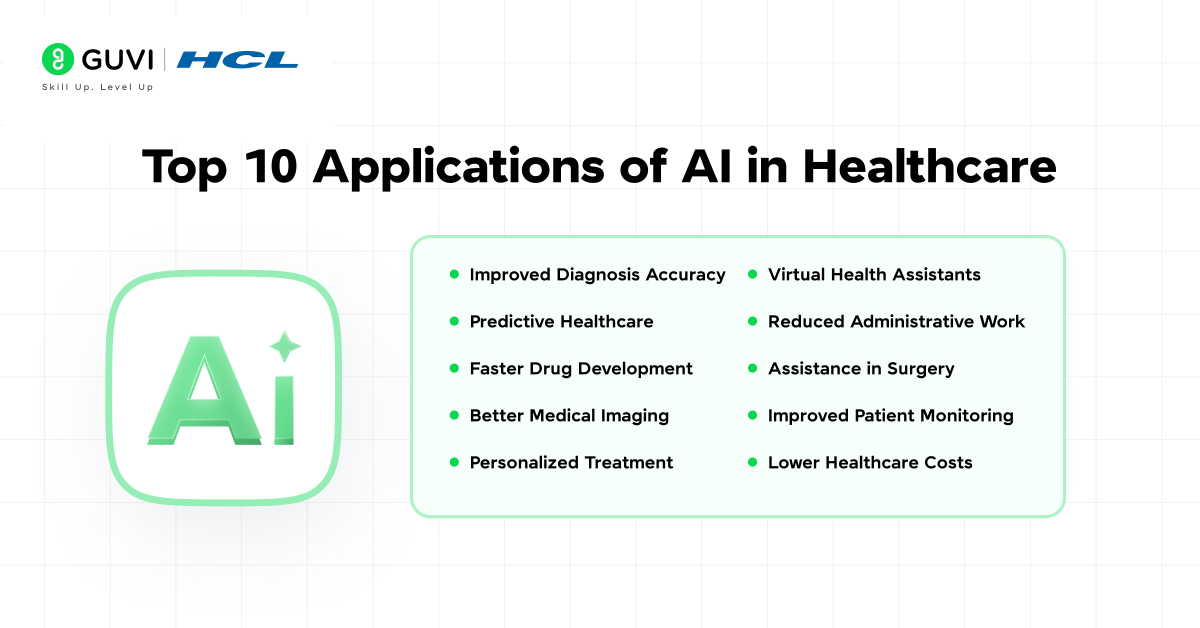
1. Improved Diagnosis Accuracy
Doctors depend on precise diagnosis to decide treatment, yet fatigue and time pressure often interfere. Intelligent systems support this process by reviewing medical scans and patient records with steady focus. They point to details that may be missed in busy clinics and help doctors act with greater certainty. Patients gain timely answers, which reduces anxiety and opens the way to earlier care.
Top Benefits
- Health conditions are identified before symptoms advance
- Diagnostic mistakes are reduced in both hospitals and clinics
- Medical scans are reviewed in less time
- Doctors receive additional confidence in their evaluations
- Patients are treated sooner with fewer delays
Top Tools
- IBM Watson Health analyzes clinical data and supports cancer and rare disease diagnosis.
- Qure.ai focuses on radiology by interpreting CT scans and X-rays with speed and accuracy.
- PathAI assists pathologists by analyzing tissue samples to reduce diagnostic errors.
- Aidoc specializes in medical imaging triage, particularly for emergency care.
- Caption Health uses AI-guided ultrasound to improve diagnosis in cardiovascular care.
Also Read: A Beginner’s Guide to Artificial Intelligence, LLMs, and Prompting
2. Predictive Healthcare
Doctors often struggle to act before illness becomes severe. Predictive AI in healthcare changes this by analyzing medical histories and lifestyle patterns to highlight patients at higher risk. Warning signs are spotted early, which allows treatment to begin before complications take hold. Patients receive care that protects long-term health instead of waiting for a crisis.
Top Benefits
- Risk patterns are identified before symptoms worsen
- Doctors prepare preventive plans with greater focus
- Emergency visits are reduced across hospitals
- Costs are lowered through fewer advanced treatments
- Patients feel supported with early guidance
Top Tools
- Health Catalyst provides predictive analytics for population health management.
- KenSci anticipates patient risks and helps in preventing hospital readmissions.
- Epic Systems Predictive Analytics uses patient records to forecast potential complications.
- Cerner Clairvia supports hospitals in predicting patient needs and resource allocation.
- Jvion offers clinical AI to identify patients most at risk of deterioration.

3. Faster Drug Development
Developing a new medicine often takes many years and involves heavy costs. Intelligent systems support researchers by testing ideas on computers first, which helps them see which treatments hold real promise. This process saves time and directs attention toward medicines more likely to succeed. Patients gain quicker access to options that once would have taken decades to reach them.
Top Benefits
- Promising treatments are identified in less time
- Research costs are lowered for companies and clinics
- Success rates improve during early stages of testing
- Clinical trials move forward with stronger focus
- Patients gain access to medicines sooner
Top Tools
- Insilico Medicine uses AI to generate drug candidates and accelerate trials.
- Atomwise applies deep learning for small-molecule drug discovery.
- BenevolentAI uses AI for biomedical data analysis to identify promising treatments.
- Exscientia designs drug molecules with AI-driven simulations.
- Recursion Pharmaceuticals automates experiments to identify new drug opportunities.
4. Better Medical Imaging
Medical imaging often reveals the earliest signs of disease, but details are sometimes too subtle for the human eye. Intelligent tools improve image clarity and highlight areas that require closer attention. Doctors receive stronger support, which reduces the chance of missed diagnoses and increases confidence during consultations. Patients benefit from clearer answers and fewer delays in treatment.
Top Benefits
- Images appear sharper for more reliable interpretation
- Abnormalities are spotted that might otherwise be missed
- Scan results are returned to patients more quickly
- Repeat tests are reduced across clinics and hospitals
- Timely treatment decisions improve health outcomes
Top Tools
- Arterys offers cloud-based imaging analysis for cardiology and oncology.
- Zebra Medical Vision provides algorithms for detecting a wide range of conditions.
- Viz.ai specializes in stroke detection through automated scan interpretation.
- Infervision focuses on lung disease detection using CT and X-ray images.
- Siemens Healthineers AI-Rad Companion supports radiologists with automated image interpretation.
Read More: The Ultimate Guide to Applications of Artificial Intelligence
5. Personalized Treatment
Every patient responds differently to treatment, and a single approach does not work for all. Personalized treatment uses health history and genetic information to tailor care for each person. Doctors recommend therapies that match the individual, which reduces trial and error. Patients feel treatment is designed for them, and recovery improves as a result.
Top Benefits
- Therapies are tailored to personal health profiles
- Medication choices are more accurate
- Complications from unsuitable treatments are reduced
- Recovery rates improve across complex conditions
- Patients gain trust in individualized care
Top Tools
- Tempus combines genomic sequencing with AI for tailored cancer treatments.
- Foundation Medicine provides genomic testing to guide personalized oncology care.
- Oncora Medical supports individualized radiation therapy planning.
- Freenome uses AI on blood tests for early detection and treatment personalization.
- IBM Watson for Oncology offers evidence-based treatment options tailored to patient profiles.
6. Virtual Health Assistants
Patients often leave the clinic with questions that arise later. Staff cannot always be available, and delays increase stress. Virtual health assistants and AI-powered chatbots provide quick responses and steady reminders through phones or computers. This continuous support helps patients manage health confidently between visits.
Top Benefits
- Patients access information at any time
- Missed doses of medicine decrease
- Routine questions are answered instantly
- Clinic phone lines receive fewer calls
- People take a more active role in daily care
Top Tools
- Babylon Health provides an AI-powered chatbot for initial symptom checking.
- Ada Health offers symptom assessment tools through its mobile app.
- Buoy Health guides patients to appropriate care using AI triage.
- Gyant integrates with hospitals to answer patient questions in real time.
- Sensely combines speech recognition and avatars for patient interaction.
7. Reduced Administrative Work
Hospitals and clinics carry heavy administrative loads that slow down care. Tasks such as billing or scheduling consume staff time that could be used with patients. Automated systems process this work quickly and consistently, which frees medical teams to focus on treatment.
Top Benefits
- Insurance claims are handled with fewer delays
- Patient records contain fewer errors
- Scheduling becomes easier for staff and patients
- Hospitals reduce clerical costs
- Doctors spend more time on direct care
Top Tools
- Olive AI automates repetitive administrative tasks in healthcare systems.
- RPA in UiPath Healthcare Solutions streamlines claims and billing processes.
- Nabla Copilot generates clinical notes automatically during consultations.
- Nuance Dragon Medical One transcribes clinical documentation with accuracy.
- AKASA Unified Automation reduces billing errors and automates revenue cycle management.
8. Assistance in Surgery
Operations demand steady control and focus. Supportive systems guide surgical tools and provide real-time feedback. Surgeons perform complex procedures with more accuracy, and patients recover faster as a result.
Top Benefits
- Higher precision in delicate operations
- Smaller surgical cuts that heal quickly
- Reduced risk of complications
- Less time required in operating rooms
- Recovery outcomes improve across patients
Top Tools
- Intuitive Surgical da Vinci System provides robotic-assisted surgical precision.
- Verb Surgical (Google and Johnson & Johnson) develops intelligent surgical platforms.
- Medtronic Hugo RAS offers robotic-assisted surgery with data-driven support.
- Zimmer Biomet ROSA specializes in robotic systems for orthopedic surgeries.
- Stryker Mako System assists in joint replacement surgeries with guided precision.
9. Improved Patient Monitoring
Chronic illnesses often require continuous oversight. Wearable devices and connected tools track vital signs and alert doctors when changes occur. Patients remain supported at home, while doctors maintain close awareness of their condition.
Top Benefits
- Alerts arrive immediately when health risks appear
- Long-term conditions are tracked more effectively
- Readmissions to hospital are reduced
- Patients maintain more independence
- Doctors and patients communicate more often
Top Tools
- Biofourmis uses wearables and AI for continuous monitoring of chronic conditions.
- Philips IntelliVue Guardian provides predictive monitoring in hospital settings.
- AliveCor Kardia offers AI-powered ECG monitoring at home.
- Current Health tracks vital signs and integrates with clinical teams.
- iRhythm Zio monitors heart rhythms for arrhythmia detection.
10. Lower Healthcare Costs
Medical care often places financial strain on both patients and providers. Intelligent systems cut costs by reducing duplication and improving efficiency. Hospitals deliver the same quality of care with fewer resources, and patients face smaller bills.
Top Benefits
- Shorter hospital stays reduce expenses
- Diagnostic tests are not repeated unnecessarily
- Medical staff are allocated more efficiently
- Insurance claims for advanced treatments decrease
- Patients access affordable care
Find out how AI in healthcare and beyond is transforming industries with our Artificial Intelligence & Machine Learning Course. This career-focused program offers mentor-led live classes, hands-on real-world projects, and a globally recognized certification that makes you stand out. With 1:1 mentorship from industry experts, an industry-aligned curriculum, and placement assistance, you’ll gain the skills to apply AI in healthcare, finance, automation, and other high-demand sectors. Start your journey today and turn your AI knowledge into impact-driven career growth! Enroll now to master AI & ML with HCL GUVI.
Top Technologies Behind AI in Healthcare
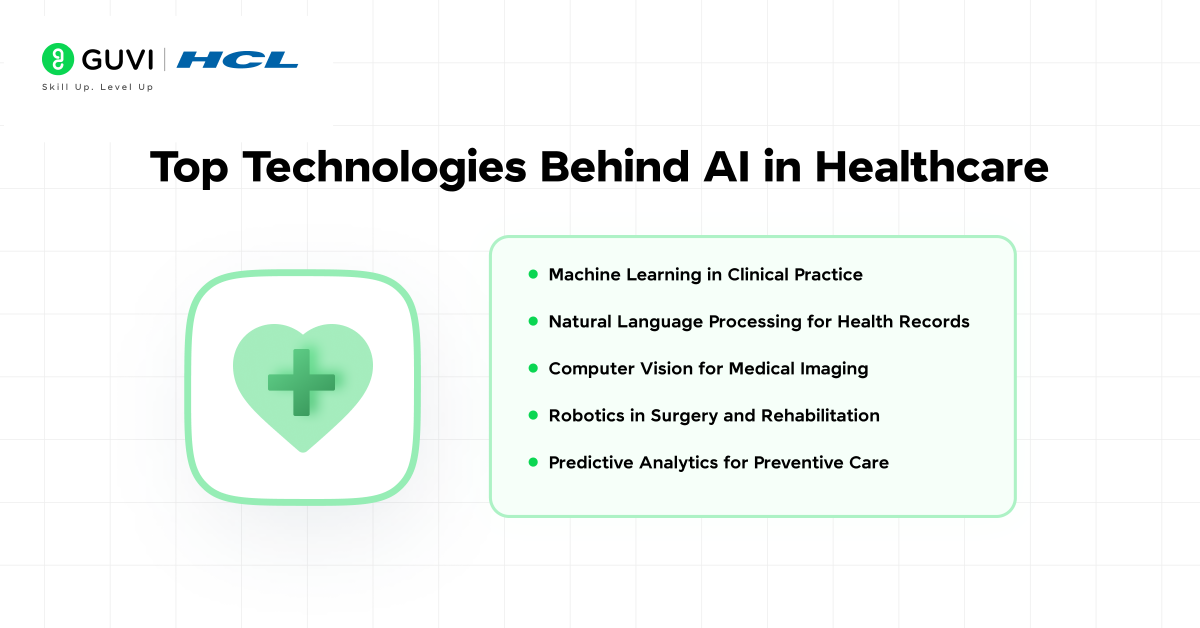
Here are the leading technologies that shape how artificial intelligence supports modern healthcare:
1. Machine Learning in Clinical Practice
Machine learning studies past medical records to identify recurring patterns. Doctors use these insights to predict health risks and choose treatment plans with greater precision. Hospitals improve planning because they can estimate patient needs more accurately.
2. Natural Language Processing for Health Records
Healthcare records contain a mix of structured notes and free text. Natural language processing reads and organizes this information into clear formats. Doctors access the right details faster, and patients receive care supported by more accurate documentation.
3. Computer Vision for Medical Imaging
Computer vision analyzes X-rays, CT scans, and MRI images with a level of detail that reduces missed signs. Radiologists use the results to confirm their assessments and to act quickly. Patients benefit from early detection and fewer repeat scans.
4. Robotics in Surgery and Rehabilitation
Robotic systems assist doctors during surgery by guiding instruments with consistent accuracy. In rehabilitation, similar tools support physical therapy by adjusting movements to each patient. Hospitals expand their ability to deliver care with precision across both treatment and recovery.
5. Predictive Analytics for Preventive Care
Predictive analytics reviews trends in patient history and community health data. Doctors act earlier by identifying individuals at higher risk. Clinics lower emergency visits because many conditions are managed before they become severe.
Generative AI in Healthcare
Generative AI is gaining momentum across hospitals and patient care services. This specialized AI can create new content such as clinical notes and draft treatment recommendations. It can also simulate drug interactions. This helps medical staff save time and focus on human interaction.
Key Applications of Generative AI in Healthcare
- Drafting clinical notes from doctor–patient conversations
- Summarizing large medical records for faster review
- Creating patient education material in simple terms
- Simulating potential drug interactions during research
- Generating personalized treatment options for complex cases
- Supporting multilingual translation in global healthcare systems
Top Tools
- LeanTaaS iQueue optimizes scheduling of operating rooms and infusion centers.
- Truveta provides health system data to reduce redundant testing.
- Optum AI Solutions helps hospitals manage resources and control spending.
- Change Healthcare AI RCM automates revenue cycle management to cut costs.
- Cerner HealtheIntent improves efficiency through population health data insights.
Real-World Impact: Companies Leading AI in Healthcare
Here are real companies making measurable contributions in healthcare with artificial intelligence:
1. Qure.ai: Closing Diagnostic Gaps
Qure.ai has been recognized as a top innovator for its work in diagnostic imaging. The company develops tools that interpret scans and assist doctors in areas with few radiologists. This support brings faster diagnosis and better access to care in underserved regions.
2. NHS and AI Stroke Analysis Tool
All 107 stroke centers in England now use an AI system that reviews CT brain scans in less than a minute. Treatment times have dropped from 140 minutes to 79, and the number of patients with little or no long-term disability has risen from 16 percent to nearly half.
3. OpenAI and Healthcare Apps
OpenAI is expanding into healthcare with plans to build new applications for doctors and patients. The company has created a dedicated team to develop safe and regulated tools that apply language technology directly to medical settings.
4. Ambient Listening and AI Scribes in Clinics
Hospitals such as Stanford, Mass General Brigham, and the University of Michigan Health now use digital scribes to record doctor-patient conversations. These systems reduce documentation time from 90 minutes to under 30 and allow doctors to spend more time with patients.
5. Sword Health: Digital Therapy for MSK Conditions
Sword Health offers digital physical therapy programs for musculoskeletal conditions. The system uses wearable sensors and voice-guided exercise tools to support rehabilitation. The company also runs programs in pelvic health and multilingual therapy, and its valuation reached three billion dollars in 2024.
6. Insilico Medicine: AI-Led Drug Design
Insilico Medicine has developed new drug candidates in as little as 46 days using advanced design systems. Several of these candidates are now in mid-stage clinical trials. It demonstrates that drug development timelines can be shortened while still moving into human testing.
Challenges of AI in Healthcare
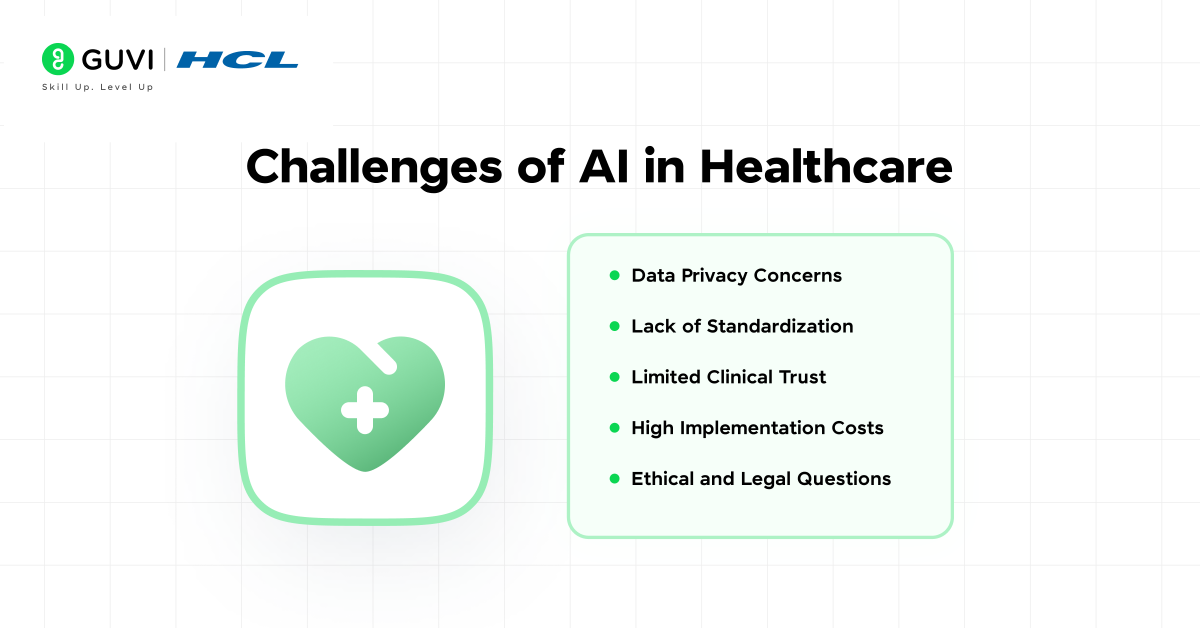
Below are the main challenges that limit how artificial intelligence is used in healthcare today:
1. Data Privacy Concerns
Healthcare records hold highly sensitive information. Storing and sharing this data for analysis increases risks of breaches. Patients worry about who has access to their details, and hospitals face strict responsibilities for protecting them.
2. Lack of Standardization
Medical data comes from many systems that do not always connect well. Records may differ in format, which creates obstacles for accurate analysis. Doctors lose valuable time correcting information instead of focusing on patient care.
Also Read: Major Differences Between Big Data and Data Science
3. Limited Clinical Trust
Doctors value experience and training, but many hesitate to rely fully on automated recommendations. A lack of transparency makes it difficult to see how some decisions are reached. This gap reduces trust and slows adoption in daily practice.
4. High Implementation Costs
Installing new systems requires large investments in software, hardware, and training. Smaller clinics often cannot afford these changes, which widens the gap between well-funded hospitals and those with fewer resources.
5. Ethical and Legal Questions
Using intelligent systems raises difficult questions about responsibility. If a diagnosis is incorrect, it is unclear whether blame falls on the doctor, the hospital, or the system provider. Legal frameworks are still catching up, leaving uncertainty for patients and professionals.
Future of AI in Healthcare
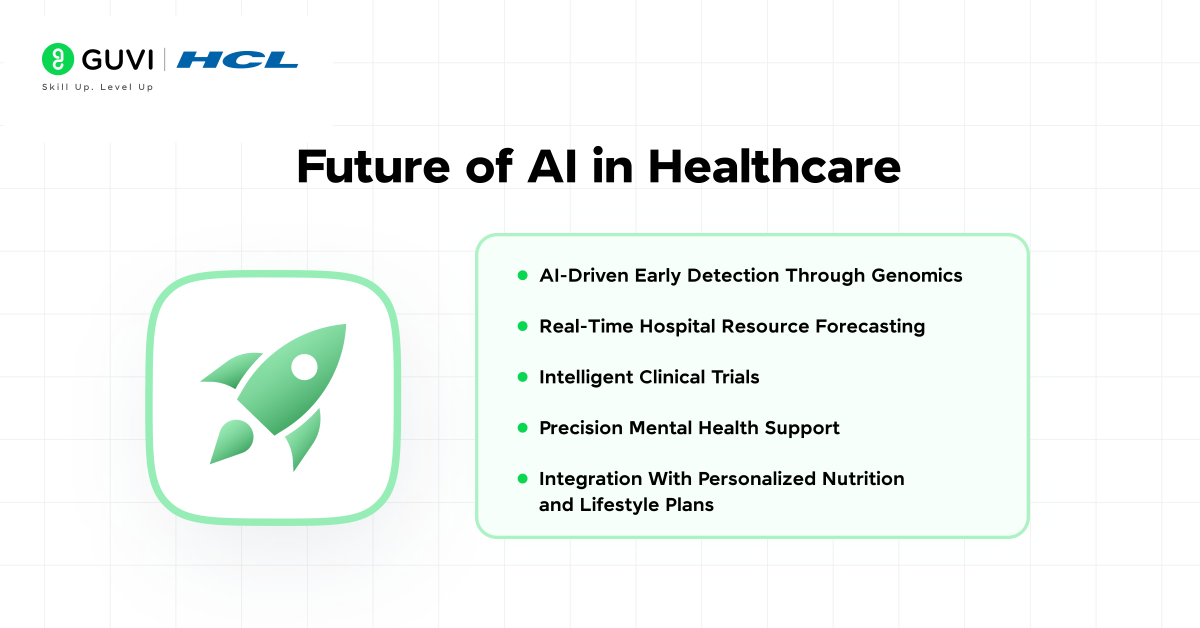
Following are future advancements that are shaping how artificial intelligence will influence healthcare in the years ahead:
1. AI-Driven Early Detection Through Genomics
Genetic sequencing is becoming more affordable, and future systems will connect genomic data with patient records. Doctors will identify inherited risks with greater clarity and prepare personalized preventive plans long before symptoms emerge. This shift will give patients more control over lifelong health management.
2. Real-Time Hospital Resource Forecasting
Hospitals will use advanced forecasting systems that study admission trends and regional health data. Beds and equipment will be allocated in advance rather than adjusted during crises. This planning will reduce overcrowding and shorten delays in emergency departments.
3. Intelligent Clinical Trials
Clinical trials are often slow because of recruitment and monitoring challenges. Future platforms will match patients with trials faster by comparing eligibility automatically. Progress will be tracked in real time, which means results reach doctors and regulators with fewer delays.
4. Precision Mental Health Support
Artificial intelligence will expand beyond physical health and support psychiatry more directly. Speech patterns, sleep cycles, and activity levels will be monitored with consent to identify early signs of depression or anxiety. Doctors will intervene earlier, and patients will receive tailored therapies that match their needs.
5. Integration With Personalized Nutrition and Lifestyle Plans
Future healthcare will extend beyond hospitals by connecting intelligent systems with nutrition and lifestyle guidance. Individual health data will link directly with meal planning and exercise programs. Doctors will monitor progress remotely and adjust recommendations quickly, creating a full-circle care approach.
Quick Quiz
Test your knowledge about AI in healthcare with these quick questions:
1. What percentage of hospitals currently use AI to streamline patient care and workflows?
- A) 40%
- B) 60%
- C) 80%
- D) 95%
2. How much return on investment do healthcare organizations report for every dollar spent on AI?
- A) $1.80
- B) $2.50
- C) $3.20
- D) $4.00
3. Which U.S. state leads in hospital adoption of AI at nearly 49%?
- A) California
- B) Texas
- C) New Jersey
- D) Florida
4. What is one major challenge slowing the adoption of AI in healthcare?
- A) Too many available doctors
- B) High implementation costs
- C) Lack of patient interest
- D) Overuse of robotics
Quiz Answers
- C) 80%
- C) $3.20
- C) New Jersey
- B) High implementation costs
Bottom Line
Artificial intelligence in healthcare is already reshaping patient care. It is redefining medical research and hospital operations. From stroke diagnosis in England to new drug trials designed in weeks, real-world examples prove its value. Patients gain faster answers and hospitals manage resources more effectively. Challenges remain around privacy and cost, but the progress is undeniable. The future points toward a system where care feels more personalized and more affordable.
FAQs
1. Can AI support rural healthcare where doctors are scarce?
Yes. AI tools can review scans and basic test results in clinics that lack specialists. This reduces the need for long travel and brings diagnostic support closer to communities.
2. How is AI being used in emergency departments?
Hospitals are piloting systems that prioritize patients based on vital signs and risk factors. This allows staff to treat the most urgent cases sooner and reduce overcrowding.
3. Can AI help reduce medical supply shortages?
Yes. Predictive tools track hospital usage patterns and forecast demand for supplies such as oxygen or surgical equipment. This helps hospitals order the right stock before shortages occur.
4. What role does AI play in nursing care?
AI-powered systems assist nurses by monitoring patient vitals and alerting them to sudden changes. This reduces the burden of constant manual checks and allows nurses to focus on direct care.
5. How does AI support global health research?
AI allows researchers from different countries to analyze patterns across large groups without sharing private patient data. This speeds up international collaboration and improves outcomes in global health crises.
Success Stories

About the Author
Vaishali
I'm a seasoned writer with four years of experience across technical, non-technical, and just about every genre or niche you can imagine. Adaptable and curious, I enjoy exploring new topics and making information engaging and easy to understand. Fueled by a steady stream of tea, I approach each project with creativity, reliability, and genuine enthusiasm for storytelling.
View all posts by Vaishali
Connect with me @














Did you enjoy this article?