


Artificial Intelligence and Machine Learning Articles
How to Build Agentic AI with LangChain and LangGraph in 2026
Google ADK Visual Agent Builder: Build Your First AI Agent


Get In Touch For Details! Request More Information
AI Career Paths for Non-Coders: What Roles Can You Get if You Learn AI Without Programming
Jan 31, 2026 4 Min Read 2696 Views
(Last Updated)
AI is opening new pathways for people who want to build strong careers without learning programming. With practical no-code tools and user-friendly AI platforms, individuals from marketing, design, management, writing, operations, and business strategy can now explore AI career paths for non-coders with confidence. This shift allows beginners and non-technical professionals to enter the AI space faster and more smoothly than ever before.
The growing demand for AI jobs without programming has created opportunities across business, content, analytics, and product roles. This blog helps you understand AI roles for non-technical people, explains how to build a learn AI without coding, and guides you through AI career options without coding that match your strengths, interests, and future goals.
Quick Answer
You can start AI careers for non-coders by choosing roles like AI project manager, prompt engineer, no-code data analyst, AI trainer, content creator, or workflow automation specialist. These ai jobs without a programming focus on creativity, communication, and problem-solving instead of technical coding skills.
Table of contents
- AI Career Opportunities For Non-Coders
- AI Project Manager
- Prompt Engineer
- No-Code Data Analyst
- AI Content Creator
- AI Product Strategist
- AI Trainer And Data Labeling Specialist
- Workflow Automation Specialist
- AI Ethics And Compliance Analyst
- 💡 Did You Know?
- Conclusion
- FAQs
- Can I get an AI job without programming skills?
- Do companies hire non-coders for AI roles?
- What skills should a non-coder learn for AI?
- Are no-code AI tools enough to start a career?
- Is AI a good career choice for beginners?
AI Career Opportunities For Non-Coders
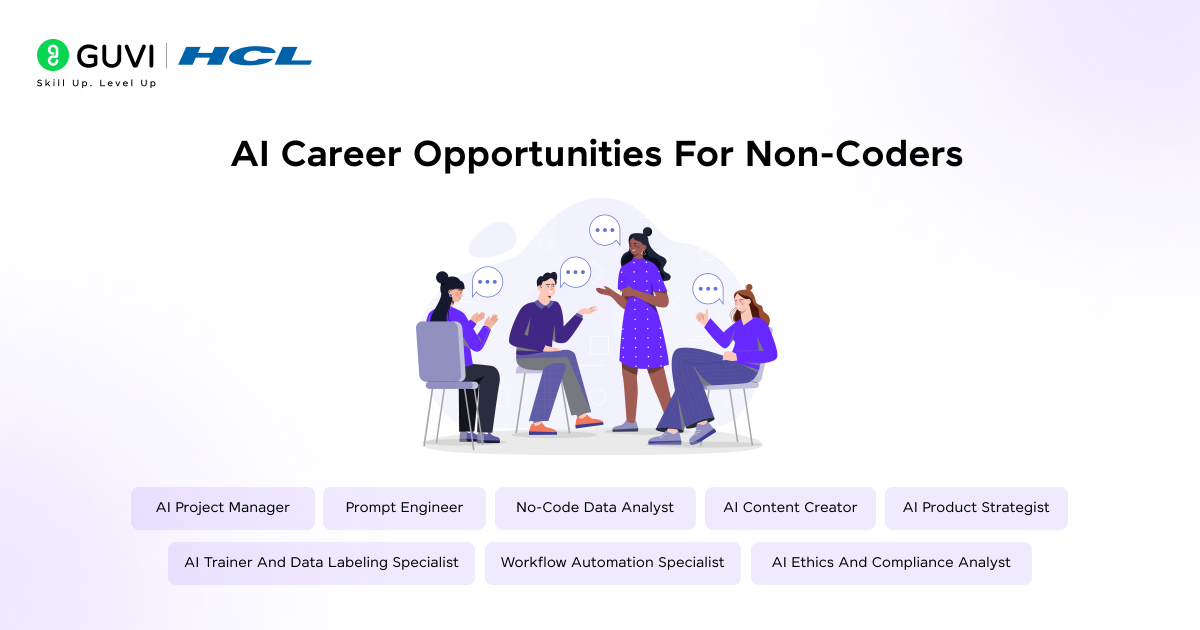
AI adoption is rapidly expanding across industries, creating strong demand for AI careers for non-coders who can contribute using creativity, analysis, communication, and strategic decision-making rather than programming. These roles help businesses use AI effectively through planning, content creation, research, data interpretation, automation, and ethical monitoring. The roles covered in this section are:
1. AI Project Manager
2. Prompt Engineer
3. No-Code Data Analyst
4. AI Content Creator
5. AI Product Strategist
6. AI Trainer And Data Labeling Specialist
7. Workflow Automation Specialist
8. AI Ethics And Compliance Analyst.
1. AI Project Manager
Role Description:
An AI project manager leads AI initiatives by connecting business requirements with practical outcomes. This role focuses on defining clear objectives, aligning multiple teams, managing expectations, and ensuring AI tools solve real business needs. It is a top choice among AI roles for non-technical people because success depends on communication, planning, and strategic thinking rather than programming.
Responsibilities:
- Convert business problems into structured project requirements
- Coordinate data teams, designers, and decision-makers
- Track progress, identify risks, and maintain timelines
- Ensure every feature delivers user value
Skills Required:
Leadership, communication, documentation, and critical thinking.
Salary range:
₹22.8L – ₹25L/yr ( Glassdoor ) , ₹6.2 L – ₹9 L/yr ( Ambitionbox )
Tips:
Study AI workflows, learn project tools, and practice writing concise requirement briefs.
2. Prompt Engineer
Role Description:
A prompt engineer designs instructions that guide AI tools to produce accurate, creative, and context-aware outputs. The role involves constant experimentation, pattern analysis, and refining prompt structures. It is one of the fastest-growing ai jobs without programming because it relies on writing skill, curiosity, and logic rather than code.
Responsibilities:
- Create and refine prompt frameworks
- Test variations to improve model accuracy
- Build prompt libraries for different use cases
- Support teams by optimizing AI interactions
Skills Required:
Writing clarity, creativity, and analytical thinking.
Salary range:
₹4L – ₹8L/yr ( Glassdoor )
Tips:
Practice prompt variations daily and study how different models respond to different instructions.

3. No-Code Data Analyst
Role Description:
A no-code data analyst uses dashboards, spreadsheets, and AI-powered analytics to extract insights without writing code. You interpret patterns, analyze performance metrics, and support business decisions through visual data exploration. This role is ideal for AI opportunities; for beginners who want analytical work without programming.
Responsibilities:
- Build dashboards and interpret data visually
- Track KPIs and identify performance trends
- Present insights to teams for decision-making
- Use no-code tools for exploration and reporting
Skills Required:
Numerical reasoning, data literacy, and communication.
Salary range:
₹11.6 L – ₹12.4 L/yr ( Glassdoor )
Tips:
Learn dashboard tools, practice with sample datasets, and understand business metrics like ROI.
4. AI Content Creator
Role Description:
An AI content creator uses AI tools to craft blogs, social posts, visuals, scripts, and long-form content. Instead of coding, the role relies on creativity, storytelling, editing, and understanding what content performs well. It is one of the most accessible non-coding tech jobs for writers, marketers, designers, and editors.
Responsibilities:
- Generate content drafts using AI tools
- Edit and refine outputs for clarity and engagement
- Create visuals, captions, or scripts
- Maintain tone, accuracy, and brand consistency
Skills Required:
Creativity, editing, storytelling, and audience insight.
Salary range:
₹9.49 L/yr ( Glassdoor )
Tips:
Build a portfolio using AI tools and study trending content formats.
5. AI Product Strategist
Role Description:
An AI product strategist shapes AI product direction by studying user needs, analyzing competition, and planning long-term features. You determine what should be built, why it matters, and how it fits market expectations. This makes it a strong AI business role for people who enjoy research and planning.
Responsibilities:
- Conduct user research and market analysis
- Define product goals and feature requirements
- Prioritize features with cross-functional teams
- Align AI capabilities with customer expectations
Skills Required:
Research, product thinking, communication, analytical reasoning.
Salary range:
₹60.1 L – ₹65.1 L/yr ( Glassdoor )
Tips:
Study popular AI products, analyze feature decisions, and learn basic UX principles.
6. AI Trainer And Data Labeling Specialist
Role Description:
An AI trainer improves model accuracy by labeling data, reviewing predictions, identifying bias, and correcting errors. This role forms the foundation of all AI systems and is a strong entry path for AI analyst jobs because it requires observation rather than coding.
Responsibilities:
- Label datasets such as text, images, or audio
- Evaluate model predictions and correct inaccuracies
- Identify recurring errors or bias
- Maintain consistent annotation standards
Skills Required:
Attention to detail, logical thinking, and patience.
Salary range:
₹2 L – ₹6 L/yr ( Glassdoor ) , ₹6 L – ₹8 L/yr ( Glassdoor )
Tips:
Learn annotation techniques and explore open-source datasets for practice.
7. Workflow Automation Specialist
Role Description:
A workflow automation specialist uses no-code automation platforms to replace repetitive tasks with automated systems. You connect apps, create triggers, optimize operations, and save teams significant time. It is one of the most practical AI career options without coding for people who enjoy building efficient systems.
Responsibilities:
- Design and test automated workflows
- Integrate tools and apps for smooth data transfer
- Identify inefficiencies and automate repetitive tasks
- Improve team productivity using no-code tools
Skills Required:
Problem solving, system thinking, organization.
Salary range:
₹11.6 L – ₹12.4 L/yr ( Glassdoor )
Tips:
Start with simple automations and gradually build multi-step workflow systems.
8. AI Ethics And Compliance Analyst
Role Description:
An AI ethics and compliance analyst ensures that AI systems are safe, transparent, fair, and aligned with ethical guidelines. You evaluate AI outputs, identify risks, study decision-making patterns, and create policies that ensure responsible AI use. This role is growing quickly as companies prioritize responsible AI development.
Responsibilities:
- Test models for fairness and accuracy
- Identify bias or harmful patterns
- Document risks and compliance requirements
- Create guidelines for safe and responsible AI usage
Skills Required:
Critical thinking, research, judgment, and policy awareness.
Salary range:
₹3 L – ₹40 L/yr ( Glassdoor )
Tips:
Study global AI regulations and analyze real-world cases of biased AI systems.
The Artificial Intelligence and Machine Learning course with IIT-M Pravartak certification from HCL GUVI helps non-coders build a strong understanding of AI and ML concepts. It focuses on practical applications, showing how AI can be used in analytics, automation, content creation, and decision-making. Hands-on projects make it easy to gain real-world experience without heavy coding. The certification adds credibility and prepares for a future-ready career in AI.
💡 Did You Know?
- Many AI-driven roles today require critical thinking more than technical coding skills.
- Non-coders contribute significantly to AI projects by improving workflows, communication, and creative direction.
- Companies increasingly prefer professionals who can combine domain knowledge with AI understanding rather than relying solely on programmers.
Conclusion
AI is no longer limited to programmers or technical specialists. With no-code and low-code tools, it becomes possible to explore roles in analytics, automation, strategy, content creation, and AI ethics. Strong analytical thinking, creativity, and domain expertise are enough to contribute meaningfully. This makes it easier to build a future-ready career in AI without writing a single line of code.
To take this knowledge to the next level, start applying AI tools to real tasks and real problems. Experiment with workflows, automations, and prompt techniques that improve personal or professional efficiency. Explore advanced ideas like AI-powered decision-making and structured problem-solving. This steady, hands-on practice helps unlock more impactful opportunities in the AI space.
FAQs
1. Can I get an AI job without programming skills?
Yes, many roles, such as prompt engineer, AI trainer, strategist, and content creato,r do not require coding.
2. Do companies hire non-coders for AI roles?
Yes, companies need people who understand business needs, manage projects, analyze outcomes, and create content using AI tools.
3. What skills should a non-coder learn for AI?
Analytical thinking, communication, prompt writing, problem solving, workflow design, and a basic understanding of AI concepts.
4. Are no-code AI tools enough to start a career?
Yes, many non-technical roles rely entirely on no-code platforms, especially for automation, content, and insights.
5. Is AI a good career choice for beginners?
Yes, the field is expanding quickly, offering strong opportunities for beginners from both technical and non-technical backgrounds.
Success Stories

About the Author
Jebasta
I translate the language of data into stories that anyone can understand. As a writer with a data science background, I simplify analytics, AI, and decision-making so beginners and enthusiasts can confidently explore the world of data.
View all posts by Jebasta
Connect with me @













Did you enjoy this article?