


Python Articles
Freelancing as a Python Developer: Getting Your First Client
Common Python Mistakes Beginners Make And How to Fix Them
Python Best Practices: Writing Clean, Maintainable Code Like a Pro
How to Build a Python Developer Portfolio That Gets You Hired


Get In Touch For Details! Request More Information
Securing Your Python Environment on Custom OS Images
Mar 12, 2026 6 Min Read 834 Views
(Last Updated)
What if the biggest security risk in your Python application is not your code, but the operating system image it runs on? Many teams harden their Python logic, scan dependencies, and secure APIs, yet unknowingly deploy those applications on custom OS images that introduce hidden vulnerabilities. When Python environments inherit insecure defaults, outdated packages, or compromised build pipelines, even well-written applications become attack surfaces. Securing Python starts long before the first line of code executes.
Read this blog to understand how to secure your Python environment at the OS image level and prevent risks before deployment.
Quick Answer: Securing Python on custom OS images requires hardening the base OS, verifying interpreter integrity, isolating runtimes, locking dependencies, and enforcing least privilege. Controlling image build pipelines, secrets, patching, and runtime policies prevents inherited vulnerabilities from turning secure Python code into a system-wide attack surface.
Table of contents
- What Are Custom OS Images and How Do They Impact Python Security?
- Common Security Threats to Python Environments on Custom Images
- Python Supply-Chain Attacks via Base Images
- Privilege Escalation Risks in Custom OS Builds
- Dependency Tampering and Binary Replacement Threats
- Persistence Mechanisms Targeting Python Runtimes
- How to Harden Base OS Images for Secure Python Deployments?
- Choosing Minimal OS Distributions for Python Workloads
- Removing Unnecessary Packages and Services
- Applying OS Hardening Benchmarks to Python Images
- Choosing Secure and Supported Python Versions for Custom OS Images
- Risks of Running End-of-Life Python Versions
- Verifying Python Interpreter Source and Integrity
- Aligning Python Versioning with OS Patch Cycles
- Isolating Python Runtimes Safely on Custom Operating System Images
- Using Virtual Environments for Python Runtime Isolation
- Preventing Cross-Project Dependency Contamination
- Securing Virtual Environment Paths and Permissions
- Preventing System Python and Application Python Conflicts
- Risks of Modifying System Python on Custom Images
- Installing the Application Python Independently of the OS
- Enforcing Clear Boundaries Between OS and App Python
- Controlling PATH and Environment Inheritance
- Securing Python Dependencies in Custom OS Image Builds
- Protecting Against Python Supply-Chain Attacks in Custom Images
- Locking, Verifying, and Auditing Python Packages at Image Build Time
- Securing Environment Variables and Configuration for Python Apps
- Monitoring Python Runtime Integrity and Detecting Tampering
- Maintaining Patch Hygiene for Python and OS Components
- Common Mistakes When Securing Python on Custom Operating Systems
- Best Practices Checklist for Securing Python on Custom OS Images
- Conclusion
- FAQs
- Should Python security controls be applied differently for container images versus VM-based OS images?
- How often should custom OS images be rebuilt for Python security?
- Can application-level security tools compensate for insecure OS images?
What Are Custom OS Images and How Do They Impact Python Security?
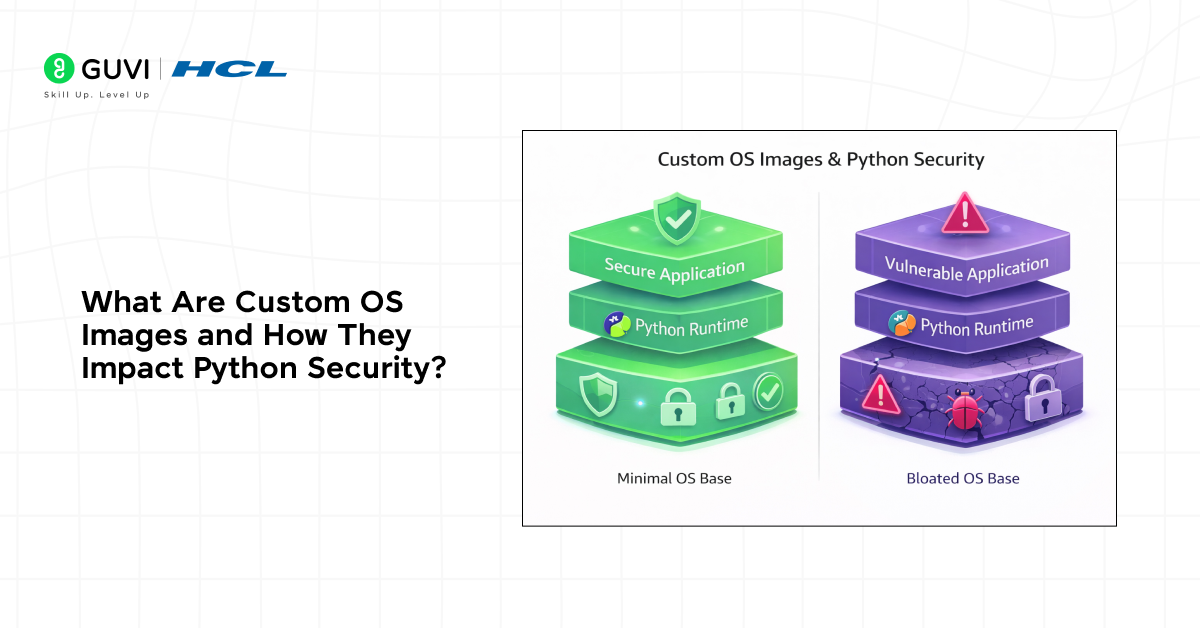
Custom OS images are preconfigured operating system builds that bundle the base OS, system packages, security settings, and, often, the Python runtime into a reusable template for deployment across environments. These images directly shape Python security because the interpreter, libraries, file permissions, users, and system services Python relies on are inherited from the image at launch. If a custom OS image contains outdated packages, insecure defaults, excessive privileges, or unverified binaries, every Python application running on it inherits those weaknesses automatically.
Common Security Threats to Python Environments on Custom Images
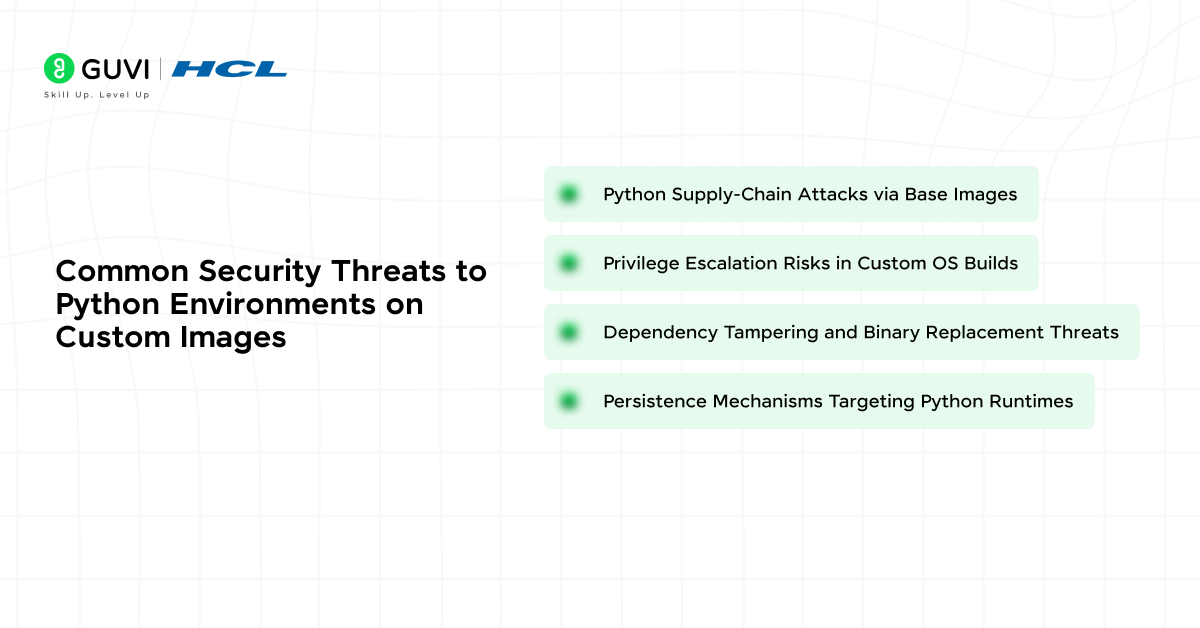
1. Python Supply-Chain Attacks via Base Images
Base images act as the first trust anchor for Python environments. A compromised base image can introduce altered system libraries, modified Python interpreters, or malicious startup scripts before application code executes. Python loads these components at runtime, allowing malicious logic to operate beneath application-level controls.
Image registries and mirrors also become attack vectors when image provenance is not verified, which leads to silent propagation of compromised Python runtimes across development, testing, and production environments.
2. Privilege Escalation Risks in Custom OS Builds
Custom OS images often carry excessive privileges due to default users, permissive sudo rules, or misconfigured file ownership. Python processes running with elevated privileges gain broader access to system resources, sensitive configuration files, and runtime secrets.
A single vulnerable Python dependency can exploit these privileges to escape intended execution boundaries, which increases the blast radius of any security flaw. Privilege escalation becomes persistent when elevated access is embedded directly into the image configuration.
3. Dependency Tampering and Binary Replacement Threats
Python environments rely on system libraries, shared objects, and interpreter binaries supplied by the OS image. Malicious actors target these components because they sit outside Python package managers and dependency scanners.
Replaced binaries or modified shared libraries alter Python runtime behavior in subtle ways, which bypasses application-level integrity checks. Python applications continue to function as expected, which delays detection and allows compromised runtimes to remain active for extended periods.
4. Persistence Mechanisms Targeting Python Runtimes
Custom OS images provide an attractive surface for persistence mechanisms that survive application redeployments. Startup scripts, scheduled tasks, and altered environment variables allow malicious code to reinitialize with every Python process launch.
Python applications inherit these mechanisms automatically, which allows persistence to spread across services using the same image. Security controls applied at the application layer fail to detect these mechanisms because the threat resides within the OS image itself.
Secure Python beyond code, start with the OS.
Explore HCL GUVI’s Python Hub to learn how hardened OS images, isolated runtimes, and locked dependencies protect Python applications from hidden risks in production.
How to Harden Base OS Images for Secure Python Deployments?
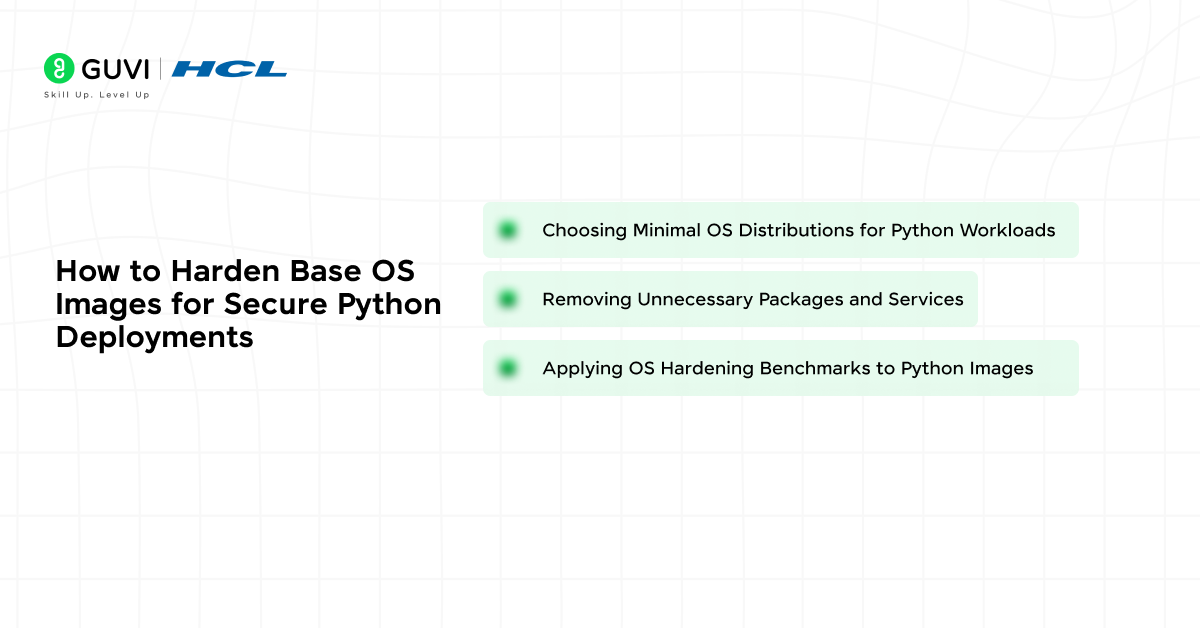
Here is how to harden base OS images to create a controlled, predictable, and secure foundation for Python deployments:
1. Choosing Minimal OS Distributions for Python Workloads
Minimal OS distributions reduce the number of system packages available to Python processes. Fewer installed components result in fewer exploitable libraries, services, and binaries. Python runtimes benefit from clearer dependency management, which simplifies security reviews and runtime monitoring. A focused OS footprint also improves auditability because security teams evaluate fewer moving parts.
2. Removing Unnecessary Packages and Services
Custom images frequently accumulate unused tools, legacy services, and debugging utilities over time. Each unused component expands the attack surface available to Python workloads. Removing these packages restricts lateral movement opportunities and reduces exposure to dormant vulnerabilities. Python processes are then executed in an environment aligned strictly with operational requirements.
3. Applying OS Hardening Benchmarks to Python Images
Security benchmarks provide standardized guidance for user permissions, service configuration, and system access controls. Applying these benchmarks to Python OS images enforces consistent security baselines across environments. Python runtimes benefit from controlled filesystem access, restricted process capabilities, and hardened network defaults. Consistency across images also improves incident response and compliance verification.
Choosing Secure and Supported Python Versions for Custom OS Images
1. Risks of Running End-of-Life Python Versions
End-of-life Python versions no longer receive security patches or vulnerability fixes. Known flaws remain exploitable and accumulate over time. Custom OS images that embed these versions distribute risk across every deployed workload. Security teams lose the ability to remediate issues through updates, which forces reliance on compensating controls that remain incomplete.
2. Verifying Python Interpreter Source and Integrity
Python interpreters included in OS images must originate from trusted and verifiable sources. Unsigned or modified binaries introduce uncertainty into runtime behavior. Verification through checksums, signatures, and controlled repositories confirms that the interpreter matches expected builds. Trusted interpreter sources strengthen the overall integrity of Python execution environments.
3. Aligning Python Versioning with OS Patch Cycles
Python updates and OS security patches follow different release schedules. Alignment between these cycles prevents compatibility gaps and security regressions. Coordinated updates maintain consistent behavior across system libraries, runtime dependencies, and Python modules. This alignment supports predictable rebuild schedules for custom images and reduces operational risk.
Isolating Python Runtimes Safely on Custom Operating System Images
1. Using Virtual Environments for Python Runtime Isolation
Virtual environments create self-contained Python runtimes with isolated interpreters and dependency trees. Each Python process resolves libraries from a defined environment path, which prevents interference from system-level packages.
Runtime behavior remains consistent across deployments because dependency resolution stays confined to the environment boundary. This isolation simplifies failure analysis and recovery.
2. Preventing Cross-Project Dependency Contamination
Multiple Python applications often share the same OS image. Isolated environments prevent one project’s dependencies from influencing another, which avoids version conflicts and runtime ambiguity. Each workload executes against its own controlled dependency set, which stabilizes behavior during updates and scaling.
3. Securing Virtual Environment Paths and Permissions
Environment directories require restricted ownership and write permissions. Controlled access prevents unauthorized modification of installed packages and interpreter files. Python runtimes gain protection against dependency injection and environment tampering.
Preventing System Python and Application Python Conflicts
Clear separation between Operation System-level Python and application runtimes preserves platform stability and execution predictability.
1. Risks of Modifying System Python on Custom Images
System Python supports operating system tools and package managers. Changes to this interpreter affect core OS functionality and introduce instability. Python applications inherit unpredictable behavior when system-level dependencies shift outside controlled update paths.
2. Installing the Application Python Independently of the OS
Separate Python installations isolate application runtimes from OS dependencies. Application teams gain control over interpreter versions, build options, and patch cadence. OS stability remains intact while Python workloads operate within defined runtime boundaries.
3. Enforcing Clear Boundaries Between OS and App Python
Explicit path configuration prevents accidental interpreter crossover. Python processes resolve binaries and libraries from approved locations, which eliminates dependency shadowing and execution ambiguity.
4. Controlling PATH and Environment Inheritance
Environment inheritance must be restricted to prevent unintentional fallback to system Python. Explicit configuration preserves runtime clarity and avoids subtle execution errors.
Securing Python Dependencies in Custom OS Image Builds
- Pinning Exact Python Dependency Versions
Exact version pinning fixes dependency resolution to known states. Python environments gain repeatable behavior across builds, testing, and production. Auditability improves because dependency changes become explicit.

- Preventing Implicit Dependency Resolution
Implicit resolution allows package managers to select unexpected versions. Explicit dependency definitions prevent silent upgrades and compatibility drift.
- Freezing Transitive Dependency Graphs
Transitive dependencies introduce indirect risk. Freezing the full dependency graph prevents uncontrolled changes originating from nested packages.
Protecting Against Python Supply-Chain Attacks in Custom Images
- Typosquatting and Malicious Package Threats
Attackers publish packages with deceptive names that resemble trusted Python libraries. Python environments that rely on unrestricted registries remain exposed to accidental installation of malicious code.
- Using Trusted and Private Python Package Registries
Private registries limit dependency sources to reviewed publishers. Python installations draw only from controlled repositories, which reduces exposure to unknown or altered packages.
- Enforcing Dependency Allowlists and Trust Policies
Allowlists restrict installations to approved packages and versions. Trust policies enforce consistency across environments and block unauthorized dependencies.
- Restricting Network Egress During Builds
Build-time network access must remain limited to approved repositories. This restriction blocks unauthorized dependency retrieval paths.
Locking, Verifying, and Auditing Python Packages at Image Build Time
- Generating Deterministic Python Dependency Locks
Lock files capture complete dependency graphs. Python environments reproduce identical installations across builds, which supports consistency and forensic traceability.
- Verifying Package Hashes During Installation
Hash verification confirms package integrity during installation. Altered or corrupted packages fail validation before becoming part of the image.
- Scanning Python Dependencies for Known Vulnerabilities
Security scans detect known weaknesses within installed packages. Image promotion decisions rely on verified risk visibility.
- Capturing Dependency Metadata for Audits
Metadata retention enables traceability across builds. Security reviews gain historical visibility into dependency composition.
Securing Environment Variables and Configuration for Python Apps
- Preventing Accidental Exposure of Python Environment Variables
Environment variables frequently carry sensitive values. Access restrictions prevent leakage through logs or process inspection.
- Using Secure Defaults for Python Configuration
Secure defaults limit permissive behavior when configuration values are absent. Python applications operate within constrained parameters.
- Validating Configuration Inputs at Runtime
Input validation prevents malformed or malicious values from influencing execution. Runtime stability improves as a result.
- Centralizing Configuration Governance
Centralized control prevents configuration drift across environments. Runtime behavior remains consistent and auditable.
Monitoring Python Runtime Integrity and Detecting Tampering
Integrity monitoring validates that deployed runtimes remain unchanged and trustworthy.
- File Integrity Monitoring for Python Binaries and Libraries
Integrity controls track checksums and metadata for Python executables and shared libraries. Unauthorized modifications trigger alerts before compromised runtimes persist. Tampering attempts become visible shortly after occurrence.
- Detecting Unexpected Changes in Python Environments
Stable environments reflect a predictable filesystem and configuration state. Unexpected changes indicate compromise or operational drift. Detection enables rapid containment before broader impact.
- Monitoring Memory and Process State Consistency
Python process memory patterns remain consistent under normal operation. Abnormal memory behavior signals injection attempts or runtime manipulation. Visibility into process state strengthens runtime defense.
- Alerting on Suspicious Runtime Modifications
Alerts correlate integrity violations with execution context. Security teams receive actionable signals rather than isolated events. Eventually, response prioritization improves as a result.
Maintaining Patch Hygiene for Python and OS Components
Patch discipline prevents known weaknesses from persisting across environments, enabling Python developers to maintain predictable runtimes across development and production systems.
- Coordinating OS and Python Patch Cycles
Python updates depend on underlying system libraries. Aligned patch cycles prevent compatibility issues and runtime regressions. Security coverage remains consistent across layers.
- Rebuilding Images Instead of Patching in Place
Immutable rebuilds eliminate configuration drift. Each deployment starts from a verified baseline that includes updated components. Runtime state remains predictable and auditable.
- Validating Patch Impact Before Promotion
Testing verifies interpreter behavior, dependency compatibility, and application stability after updates. Security fixes reach production without introducing operational failures.
- Tracking Patch Coverage Across Environments
Visibility into patch status prevents uneven security posture. Gaps between environments become measurable and correctable. Risk exposure remains controlled.
Common Mistakes When Securing Python on Custom Operating Systems
- Treating Custom OS Images as Static Artifacts
Custom images often remain unchanged after initial creation. Vulnerabilities accumulate as dependencies age and system libraries fall behind security updates. Python runtimes inherit these weaknesses across deployments. Risk increases silently because deployments appear consistent despite outdated foundations.
- Mixing Development and Production Python Images
Development images frequently contain debugging tools, relaxed permissions, and expanded network access. Reusing them in production exposes unnecessary attack surface. Python workloads operate with broader privileges than required, which weakens runtime control and complicates incident containment.
- Ignoring Dependency and Image Drift
Dependencies and system components change over time. Untracked drift causes divergence between the expected and actual runtime state. Python behavior becomes unpredictable across environments. Security teams lose confidence in enforcement and recovery paths.
Secure Your Python Code: From OS Image to Runtime Integrity. Join HCL GUVI’s IITM Pravartak-Certified Python Programming Course and learn how to build secure, production-ready Python environments from the ground up. Gain an industry-recognized certification with 100% online, self-paced learning, lifetime access, and a dedicated forum for instant doubt resolution. Practice security-focused coding and deployment on 4 gamified platforms, all at an affordable fee and safeguard your Python apps before they ever reach production. Start Securing Python Like a Pro.
Best Practices Checklist for Securing Python on Custom OS Images
- Pre-Build Security Hardening Checklist
Base images require minimal packages, restricted users, and hardened permissions. Python installation paths must remain controlled and isolated. Build inputs should originate from verified sources. These steps establish a secure baseline before dependencies are introduced.
- Build-Time Python Security Validation
Dependency locks, hash verification, and vulnerability scans validate runtime integrity during image creation. Python interpreters and libraries must match approved versions. Validation failures should block image promotion and trigger review.
- Runtime Monitoring and Governance Checklist
Runtime controls must enforce least privilege, integrity monitoring, and centralized logging. Governance policies should define ownership, approval flow, and rebuild cadence. Continuous visibility maintains confidence in deployed Python environments.
Conclusion
Python security on custom operating systems depends on disciplined image design, controlled dependency handling, and enforced runtime boundaries. OS images shape execution behavior long before application code runs. Secure builds, verified dependencies, monitored runtimes, and structured governance together prevent silent risk propagation. Strong foundations allow Python workloads to scale reliably without sacrificing trust.
FAQs
Should Python security controls be applied differently for container images versus VM-based OS images?
Yes. Containers require stricter runtime isolation and immutable filesystem enforcement, while VM-based images rely more on OS-level hardening, user separation, and system service control.
How often should custom OS images be rebuilt for Python security?
Custom OS images should be rebuilt on a fixed cadence aligned with OS and Python patch releases, and immediately after critical vulnerability disclosures affecting system libraries or runtimes.
Can application-level security tools compensate for insecure OS images?
No. Application-level controls cannot detect compromised system binaries, startup scripts, or kernel-level risks introduced by insecure OS images. Image security must be addressed first.
Success Stories

About the Author
Vaishali
I'm a seasoned writer with four years of experience across technical, non-technical, and just about every genre or niche you can imagine. Adaptable and curious, I enjoy exploring new topics and making information engaging and easy to understand. Fueled by a steady stream of tea, I approach each project with creativity, reliability, and genuine enthusiasm for storytelling.
View all posts by Vaishali
Connect with me @










Did you enjoy this article?