


Full Stack Development Articles
Claude for Architecture and Engineering Documentation
Freelancing as a Python Developer: Getting Your First Client


Get In Touch For Details! Request More Information
Modern Backend Architecture Trends: What Full-Stack Developers Need to Know
Mar 12, 2026 6 Min Read 2957 Views
(Last Updated)
How does your backend hold up when millions of users start hitting refresh at once? That question defines the difference between a hobby project and a production-grade system. Modern backend architecture is no longer about spinning up a few routes and a database connection; it’s about building a robust, scalable system. It now demands fault tolerance and intelligent design choices that align with the growing complexity of web applications. From microservices and serverless platforms to edge computing and event-driven pipelines, today’s backend decisions shape performance and long-term maintainability.
In this blog, you’ll explore the key backend architecture trends redefining how full-stack developers build, deploy, and scale modern web applications.
Quick Answer:
Modern backend architecture has evolved toward distributed, event-driven, and AI-integrated systems built for scalability, reliability, and speed. Full-stack developers must master modular design, DevOps, and observability while leveraging microservices, serverless computing, and edge deployments to create efficient, future-ready applications that handle real-world scale seamlessly.
- Kubernetes is used by 96% of cloud-native organizations, which highlights its role as the backbone for managing microservices in modern backend architectures.
- Edge computing can reduce latency by up to 90%, which is why modern backends increasingly combine centralized APIs with edge-based request handling.
- 70% of enterprises use event-driven architecture in at least part of their backend, which highlights the move toward asynchronous and non-blocking system design.
Table of contents
- The Shift in Backend Architecture
- Core Principles of Modern Backend Design
- Decoupling and Modularity
- Observability and Resilience
- Security and Compliance
- Key Backend Architecture Trends
- Microservices and Service Mesh
- Serverless Architectures
- API-First and GraphQL Ecosystems
- Edge Computing and CDN Integration
- Event-Driven and Async Architectures
- AI-Integrated Backends
- What Full-Stack Developers Should Focus On?
- Essential Tools and Frameworks
- Languages
- Frameworks
- Infrastructure Tools
- Databases
- Monitoring
- Common Pitfalls in Modern Backend Systems
- Conclusion
- FAQs
- Is serverless suitable for enterprise applications?
- How do microservices impact full-stack development workflows?
- Which backend framework is best for scalability?
- How does AI integration change backend design?
- What is the best way to learn backend architecture principles today?
The Shift in Backend Architecture
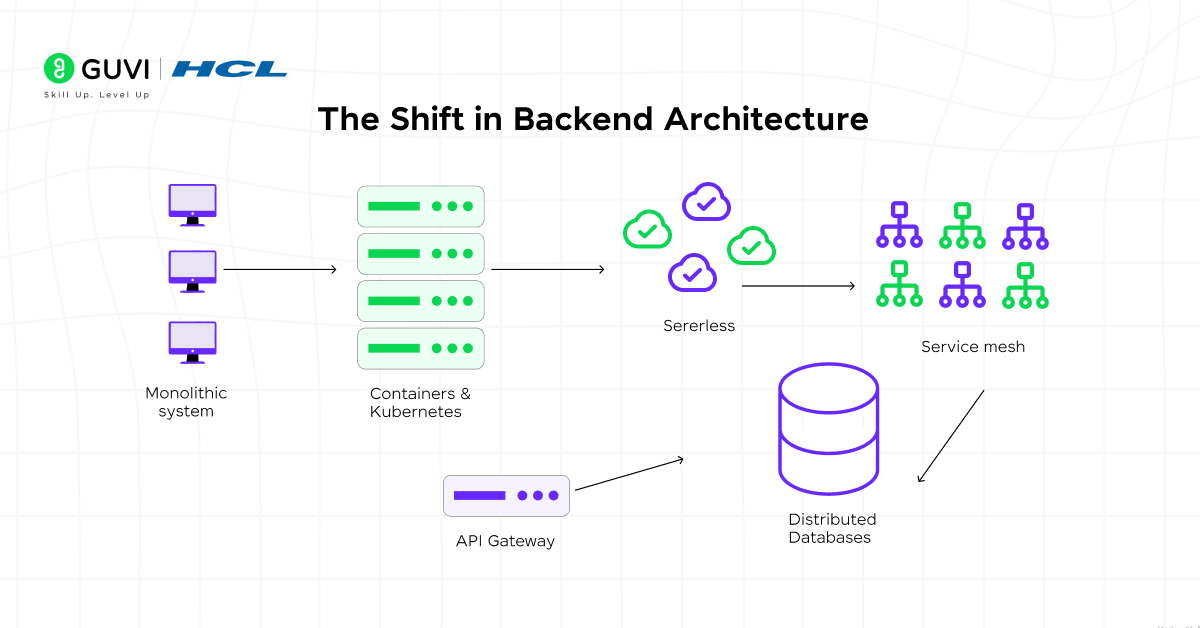
The backend architecture has evolved from static and single-unit systems to distributed and service-oriented models. Earlier monolithic designs bundled every component, from authentication to data handling, into one deployable unit. Modern systems rely on modular structures that separate functions into independent services. These services communicate through APIs, which improves scalability and simplifies updates. The shift toward cloud-based infrastructure has accelerated this transition, which allows developers to deploy specific modules without affecting the entire application.
Real-time data processing and global access patterns have further shaped backend design. Systems must now manage concurrent requests efficiently while maintaining consistency across distributed environments. Event-driven and microservice architectures have emerged as practical solutions. They allow full-stack developers to build responsive applications that process data streams and user actions in real time without blocking performance.
Core Principles of Modern Backend Design
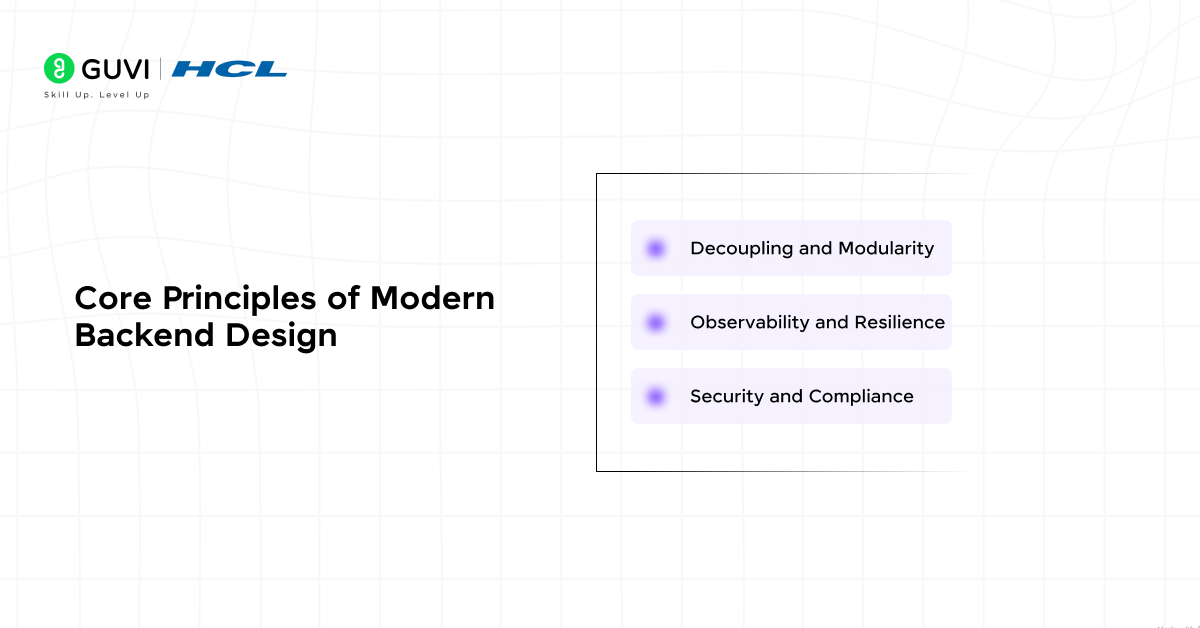
1. Decoupling and Modularity
Modern backends are built around modular components that function independently. Decoupling ensures that one service’s failure does not impact others. Developers can scale services based on usage patterns and deploy updates with minimal disruption. This principle supports flexible architectures that adapt as projects grow in scope and complexity.
2. Observability and Resilience
A reliable system must provide visibility into its internal state. Logging and metrics collection are essential for identifying issues before they affect users. Observability pairs with resilience mechanisms such as circuit breakers and graceful degradation. Together, they help maintain uptime even when external dependencies fail.
3. Security and Compliance
Security is embedded throughout modern backend workflows. Role-based access control defines who can access data and operations. Encryption protects communication and storage layers. Compliance with standards such as GDPR or HIPAA safeguards user trust and meets legal requirements. Secure API design also prevents unauthorized data exposure across services.
Key Backend Architecture Trends
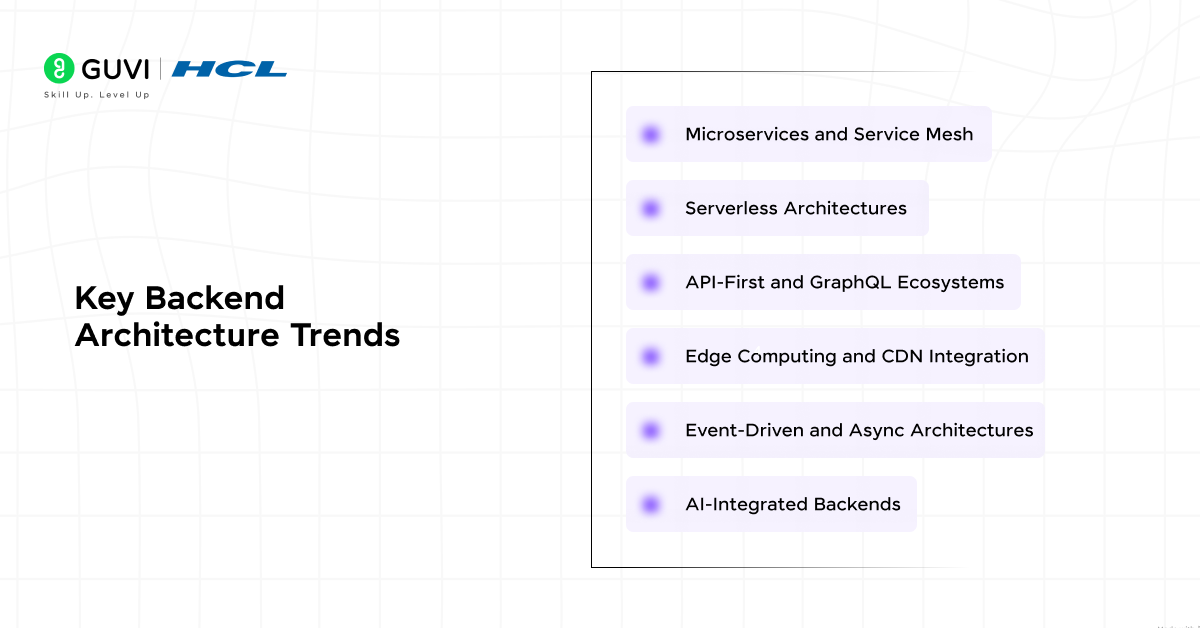
1. Microservices and Service Mesh
Microservices architecture divides applications into smaller, independent services that communicate through APIs. Each service manages a specific function, such as authentication or payments. This structure contrasts with monolithic systems, where all components share a single codebase and deployment pipeline. Microservices allow independent scaling and deployment, which improves development speed and system reliability.
A service mesh complements this design by managing communication between services through a dedicated infrastructure layer. It handles routing, load balancing, authentication, and observability without modifying the application code. This layer enhances visibility and control across distributed services.
The key advantages include isolation and faster deployment cycles. Teams can update one service without redeploying the entire application, which reduces downtime. However, microservices introduce complexity through inter-service communication and distributed debugging. Maintaining observability becomes essential because errors may occur across multiple services rather than in one system.
2. Serverless Architectures
Serverless architecture changes how applications are deployed and scaled. Platforms such as AWS Lambda, Google Cloud Functions, and Azure Functions handle execution automatically when triggered by an event or request. Developers upload functions, and the platform provides infrastructure as needed. This removes the burden of managing servers and scaling rules.
Serverless systems work best for event-driven workflows. Common uses include lightweight APIs, automation tasks, image processing, or background data synchronization. Each function runs independently and shuts down after execution, which reduces idle resource costs.
Cost and performance considerations depend on usage volume and execution time. Serverless provides excellent elasticity for workloads with unpredictable demand, but it can be less efficient for long-running or compute-heavy processes. Cold starts with initial latency when a function is triggered after inactivity. It remains a design concern for time-sensitive applications.
3. API-First and GraphQL Ecosystems
Modern backend systems adopt an API-first approach where services are designed as consumable APIs before building interfaces. This ensures clear boundaries between backend logic and client applications. REST APIs remain widely used, but new patterns such as GraphQL and gRPC are gaining ground.
GraphQL allows clients to specify exactly what data they need, which reduces over-fetching and redundant network calls. It provides flexible query structures that make integration easier for frontend frameworks like React, Next.js, or Flutter. Full-stack developers can build richer user experiences by querying multiple data sources through a single endpoint.
In contrast, gRPC provides high-performance communication between services using binary serialization. It suits internal microservices or real-time streaming APIs. These evolving protocols support faster iteration cycles and better developer collaboration between frontend and backend teams.
4. Edge Computing and CDN Integration
Edge computing distributes computation closer to the end user. Platforms such as Cloudflare Workers, Vercel Edge Functions, and AWS CloudFront Functions execute code at global edge locations rather than centralized servers. This structure minimizes network latency and improves response times for users across different regions.
Integrating edge functions with CDNs allows data caching, routing, and request handling to occur at the network edge. This approach benefits applications that rely on real-time or location-aware processing, such as live analytics dashboards, multiplayer games, and geo-personalized content delivery.
Edge computing also supports hybrid deployments where certain operations, such as authentication or request validation, occur at the edge while complex business logic remains in centralized APIs. The outcome is faster delivery with reduced infrastructure load.
5. Event-Driven and Async Architectures
Event-driven design structures systems around producers that emit events and consumers that react to them. Technologies such as Apache Kafka, RabbitMQ, and Redis Streams act as brokers to manage this flow. Each service reacts to specific events without tight coupling to others.
This model supports asynchronous processing, which improves throughput and fault isolation. Chat systems, notification engines, and analytics pipelines rely heavily on this pattern. When a user sends a message, an event triggers updates across multiple services such as storage, delivery, and analytics.
Common design patterns include CQRS (Command Query Responsibility Segregation), pub/sub messaging, and eventual consistency. These patterns help manage distributed data updates across systems. Developers must design carefully to handle event ordering, retries, and deduplication since data may arrive in unpredictable sequences.
6. AI-Integrated Backends
AI integration has become a central trend in backend architecture. Applications now include machine learning inference APIs that provide language processing, image recognition, or recommendation features. These APIs can be hosted externally or within the same backend environment.

Modern systems often combine RESTful endpoints with large language model (LLM) APIs and vector databases such as Pinecone or Weaviate. These components manage contextual search and semantic embeddings, which improve personalization and content retrieval.
AI integration changes how developers think about scalability and data flow. Backends must handle heavy inference workloads, asynchronous calls, and caching strategies for repeated queries. Hybrid pipelines that mix AI inference with traditional APIs create new performance and observability challenges. Full-stack developers now design systems that can route, queue, and process intelligent responses efficiently while keeping cost and response time under control.
What Full-Stack Developers Should Focus On?
- Balancing Frontend Velocity with Backend Complexity: Developers must maintain rapid interface delivery without creating backend bottlenecks. Efficient coordination between both layers prevents performance issues and maintains deployment consistency.
- Mastering Deployment Environments and API Contracts: Understanding how APIs communicate across staging, production, and containerized setups ensures predictable behavior. Stable API contracts prevent versioning errors and cross-service failures.
- Building Practical DevOps and MLOps Competence: Familiarity with CI/CD pipelines, automated testing, and monitoring bridges development with reliable deployment. Exposure to MLOps workflows strengthens collaboration with data and AI teams.
- Developing Cloud Orchestration Skills: Knowledge of cloud services like AWS, GCP, and Azure helps manage distributed workloads efficiently. Developers should learn to configure scaling policies, networking, and storage provisioning.
- Learning Distributed Systems and Data Flow: Understanding event propagation and consistency models improves reliability at scale. Skills in asynchronous processing and fault tolerance prepare developers for high-demand and data-intensive applications.
Essential Tools and Frameworks
A well-rounded full-stack engineer must be proficient in modern backend tools and frameworks that support modularity and maintainability.
Languages
- Node.js: Ideal for building non-blocking, event-driven APIs that scale easily.
- Go: Provides high concurrency performance with minimal resource usage.
- Python: Excellent for rapid prototyping and data-driven systems through its mature libraries.
- Rust: Offers memory safety and strong performance for systems that require security and reliability.
Frameworks
- FastAPI: Asynchronous Python framework designed for speed and type safety.
- NestJS: Modular Node.js framework built with TypeScript, supporting microservice patterns.
- Spring Boot: Enterprise-grade Java framework with integrated security and configuration management.
- Django: High-level Python framework with ORM and robust admin capabilities.
Infrastructure Tools
- Docker: Simplifies environment setup and isolates dependencies.
- Kubernetes: Orchestrates containerized workloads across clusters with automated scaling.
- Terraform: Provides infrastructure as code for consistent environment provisioning.
Databases
- PostgreSQL: Reliable relational database with strong transactional guarantees.
- MongoDB: Document-oriented store suited for flexible schemas.
- Redis: In-memory key-value store used for caching and message queues.
- Vector Stores (e.g., Pinecone, Weaviate): Specialized databases for AI and semantic search applications.
Monitoring
- Prometheus: Collects time-series metrics for backend systems.
- Grafana: Visualizes performance data and alert thresholds.
- OpenTelemetry: Standardized observability framework for distributed tracing and logs.
Build scalable, production-grade web systems with our Full Stack Development Course, powered by IIT-M Pravartak certification. Learn to architect backends that handle real-world scale using Node.js, Docker, and Kubernetes, while mastering microservices, APIs, and serverless deployments. Through mentor-led sessions and hands-on projects, you’ll design systems that balance performance, reliability, and cost efficiency, the very foundations of modern backend architecture. Elevate your full-stack career by mastering the backend trends that power the web’s next generation.
Common Pitfalls in Modern Backend Systems
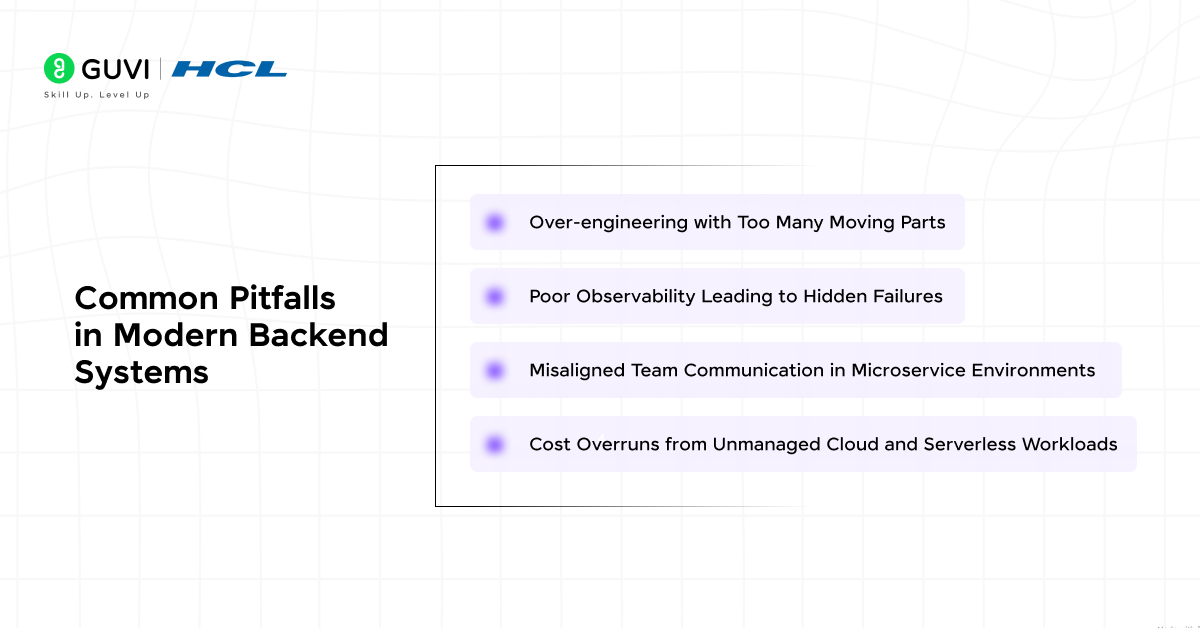
- Over-engineering with Too Many Moving Parts
Excessive abstraction or unnecessary microservices often increase coordination overhead. Teams that split systems prematurely may struggle with debugging and slower iteration. Simpler modular structures can meet most needs before full microservice adoption becomes necessary.
- Poor Observability Leading to Hidden Failures
Lack of structured logging, metrics, or tracing often results in delayed diagnosis of production issues. In distributed systems, silent failures in one service can cascade through others. Comprehensive monitoring pipelines prevent downtime and reduce recovery time.
- Misaligned Team Communication in Microservice Environments
Multiple teams managing independent services require consistent API documentation, versioning, and shared schemas. Miscommunication during updates can break integrations and reduce deployment confidence. Cross-team coordination and shared CI/CD validation reduce these risks.
- Cost Overruns from Unmanaged Cloud and Serverless Workloads
Serverless and cloud resources scale automatically, but untracked invocations or idle containers can increase expenses. Teams need usage analytics and clear deployment policies to maintain financial control while scaling operations efficiently.
Conclusion
Modern backend architecture has shifted from monolithic setups to distributed, event-driven, and cloud-native systems that prioritize scalability, reliability, and performance. Full-stack developers must understand modular design, automation, and observability to build production-grade systems. Those who master these backend principles gain the ability to deliver scalable and intelligent applications.
FAQs
1. Is serverless suitable for enterprise applications?
Yes, serverless architecture fits many enterprise use cases where scalability, automation, and cost optimization matter. Platforms like AWS Lambda and Google Cloud Functions handle auto-scaling and infrastructure management, allowing teams to focus on business logic. It works best for event-driven workloads, APIs, and microservices.
2. How do microservices impact full-stack development workflows?
Microservices allow full-stack developers to work on independent, modular services without breaking entire systems. This improves deployment speed and fault isolation. However, it also adds complexity through service orchestration, inter-service communication, and observability requirements. Proper CI/CD and API versioning become essential.
3. Which backend framework is best for scalability?
Frameworks like NestJS, Spring Boot, and FastAPI are widely used for scalable backend systems. NestJS excels in modular microservices with TypeScript, Spring Boot supports enterprise-grade Java applications, and FastAPI offers high performance for Python-based APIs with async support. The right choice depends on language preference and ecosystem needs.
4. How does AI integration change backend design?
AI integration introduces new layers in backend architecture, including model serving, vector databases, and API orchestration for inference. Backends now need to handle asynchronous requests, caching of predictions, and real-time data streaming. This trend is leading to hybrid systems combining traditional APIs with AI-driven endpoints.
5. What is the best way to learn backend architecture principles today?
Start with core web fundamentals: APIs, databases, and authentication. And, then study real-world patterns like REST, GraphQL, and microservices. Build small projects using frameworks such as Express, Django, or Go Fiber. Learning DevOps tools like Docker, Kubernetes, and CI/CD pipelines also helps understand how modern backends operate in production.
Success Stories

About the Author
Vaishali
I'm a seasoned writer with four years of experience across technical, non-technical, and just about every genre or niche you can imagine. Adaptable and curious, I enjoy exploring new topics and making information engaging and easy to understand. Fueled by a steady stream of tea, I approach each project with creativity, reliability, and genuine enthusiasm for storytelling.
View all posts by Vaishali
Connect with me @






























Did you enjoy this article?