


Java Articles
Kafka Streams Tutorial: Build Your First Data Pipeline
What is ArrayList in Java: A Complete Guide
What is HashMap in Java: How It Works, Methods, and Examples


Get In Touch For Details! Request More Information
The Future of the JVM: Why Java Isn’t the Only Game in Town
Feb 24, 2026 6 Min Read 1197 Views
(Last Updated)
The Java Virtual Machine has been a foundation of modern software development for decades, supporting everything from enterprise systems to cloud-based applications. While Java introduced the JVM, the platform has evolved into a flexible, multi-language runtime that goes far beyond a single programming language.
This blog covers the future of the JVM development, why Java is no longer the only option, and how multiple JVM languages, frameworks, and tools are shaping modern applications. It is useful for students, developers, architects, and professionals who want to understand JVM trends, language choices, and long-term career relevance.
Quick Answer
The JVM’s future extends beyond Java. Languages like Kotlin, Scala, and Groovy run on the JVM, offering modern syntax, better productivity, and specialized capabilities while maintaining the performance, security, and stability the JVM is known for.
Table of contents
- Why The JVM Still Matters Today
- The Limits Of Java As A Language
- JVM Languages Beyond Java
- Kotlin
- Scala
- Groovy
- Clojure
- JRuby
- Jython
- Polyglot Development On The JVM
- Why Polyglot Development Makes Sense On The JVM
- How Teams Use Multiple JVM Languages In Practice
- Operational And Team-Level Benefits
- The Role Of Frameworks And Tooling
- 💡 Did You Know?
- Conclusion
- FAQs
- Is Java becoming obsolete on the JVM?
- Can multiple JVM languages be used in the same project?
- Why do developers choose Kotlin or Scala over Java?
- Is the JVM still relevant compared to newer runtimes?
Why The JVM Still Matters Today
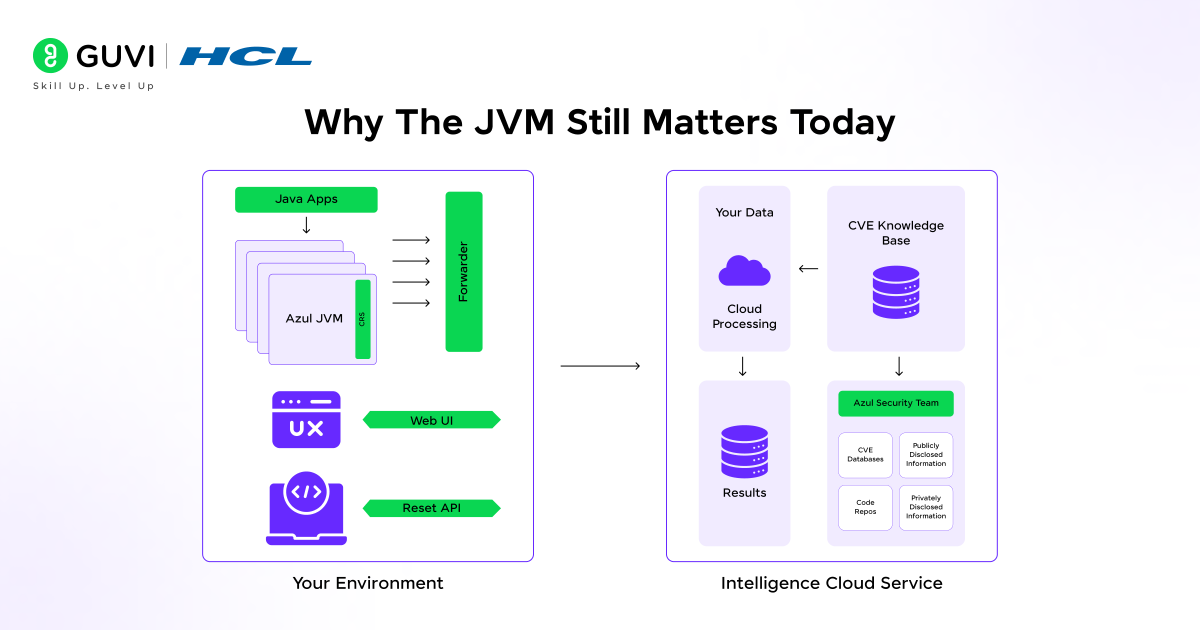
The JVM continues to be a core part of modern software development because it balances reliability, flexibility, and long-term sustainability better than most runtimes. Over the years, it has proven its ability to handle evolving application demands, from monolithic enterprise systems to cloud-native and distributed architectures. Its design allows organizations to modernize without rewriting everything from scratch, making it a dependable choice even as technologies change.
- Stability And Performance
The JVM is trusted for long-running and mission-critical applications due to its mature garbage collection, optimized memory management, and predictable performance under heavy workloads. These capabilities ensure applications remain responsive and reliable even at scale, which is why many enterprises continue to build and maintain core systems on the JVM. - Platform Independence
JVM-based applications follow the write-once, run-anywhere principle, allowing the same code to run across different operating systems without modification. This simplifies deployment, reduces environment-specific issues, and makes scaling applications across servers and cloud platforms far more manageable. - A Language-Agnostic Runtime
The JVM has evolved beyond being a Java-only environment into a universal runtime for multiple languages. Developers can select languages that best suit specific problems while still leveraging the same libraries, tools, and infrastructure, giving teams flexibility without sacrificing consistency. - Mature Ecosystem And Tooling
Decades of development have created a rich ecosystem of libraries, frameworks, build tools, and monitoring solutions. This maturity reduces development risk, accelerates problem-solving, and provides strong community and enterprise support. - Strong Backward Compatibility
The JVM is known for maintaining backward compatibility across versions, allowing older applications to run reliably on newer JVM releases. This protects long-term investments and enables gradual modernization instead of forced rewrites. - Proven Scalability For Enterprise Systems
From financial platforms to large-scale cloud services, the JVM has consistently demonstrated its ability to scale. Its threading model, performance optimizations, and integration with modern infrastructure make it suitable for handling growing user and data demands.
Do check out HCL GUVI’s Master Java Course, which focuses on building strong core and advanced Java programming skills through structured learning and hands-on practice. Since this blog discusses the future of JVM and its growing ecosystem, strengthening your Java fundamentals through this course helps you better understand how JVM-based systems evolve and scale.
The Limits Of Java As A Language
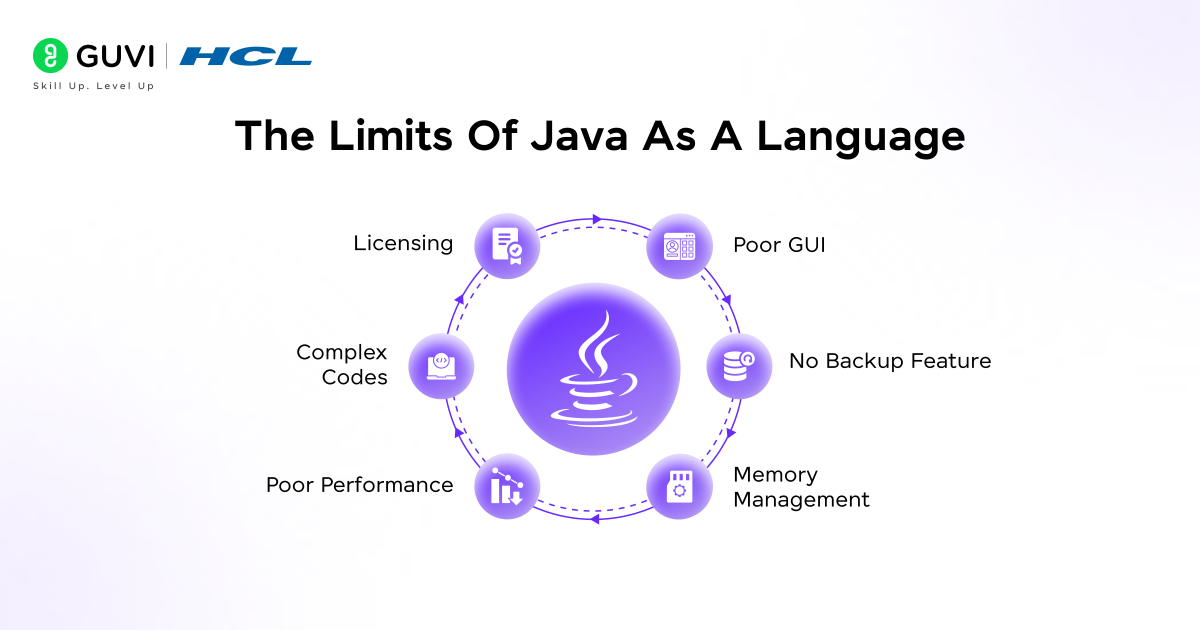
While Java remains reliable and widely used, its original design decisions were made for a very different era of software development. As applications have become more complex, distributed, and fast-moving, certain limitations of Java have become more apparent. These challenges are not about Java being outdated, but about how newer JVM languages address modern development needs more effectively.
- Verbosity And Boilerplate Code
Java often requires more lines of code to achieve relatively simple functionality. This verbosity can slow down development, reduce readability, and increase maintenance effort, especially in large codebases. - Limited Expressiveness For Modern Paradigms
Although Java has added functional features over time, expressing functional programming concepts, immutability, and concise data transformations can still feel cumbersome compared to newer JVM languages. - Slower Innovation Adoption
Java evolves cautiously to maintain stability and backward compatibility. While this is a strength, it also means that modern language features and syntactic improvements tend to arrive later than in alternative JVM languages. - Developer Productivity Constraints
The need for explicit typing, extensive configuration, and repetitive patterns can reduce developer productivity. Teams focused on rapid iteration often prefer languages that minimize friction and boilerplate. - Null Handling And Runtime Errors
Java’s approach to null values can lead to runtime exceptions if not carefully managed. Newer JVM languages provide safer, more expressive mechanisms to handle nullability by design. - Concurrency Complexity
Managing concurrency in Java can be complex and error-prone, especially for beginners. While modern updates have improved this area, alternative JVM languages often provide higher-level abstractions that simplify concurrent and asynchronous programming.

JVM Languages Beyond Java
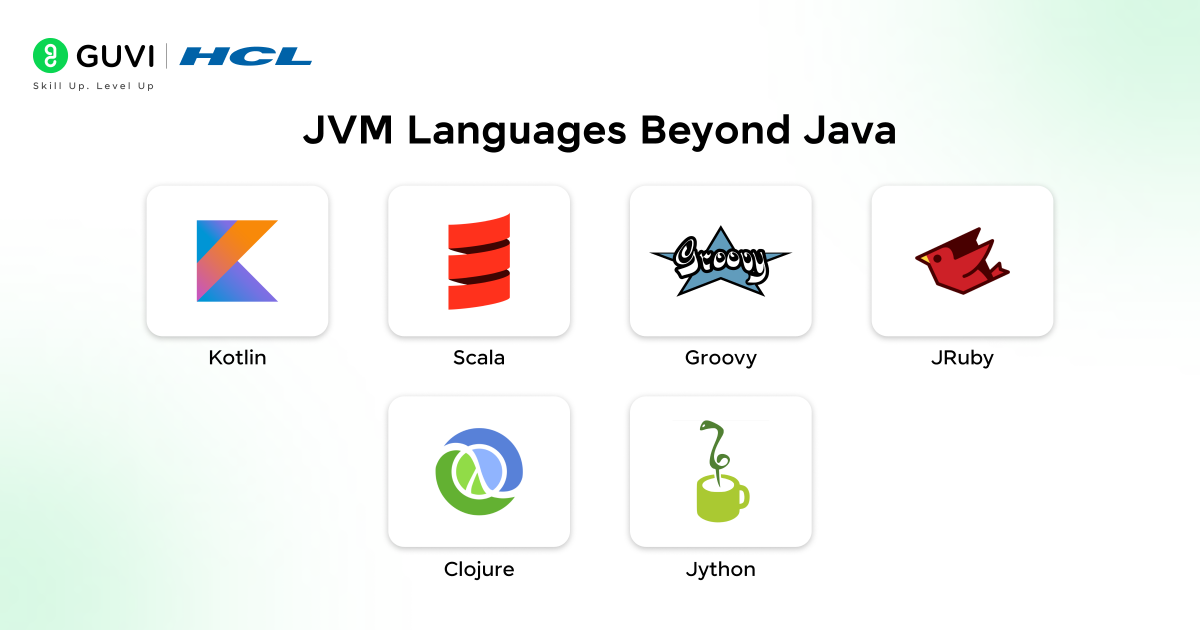
1. Kotlin
Kotlin was created to modernize JVM development by reducing Java’s verbosity and improving code safety. It helps developers write cleaner, more expressive code while remaining fully interoperable with existing Java applications. Because Kotlin can be adopted gradually, teams can modernize JVM systems without rewriting entire codebases. Today, it is widely used for building maintainable, future-ready JVM applications.
- How It Is Used
Kotlin is widely used for backend services, Android applications, and modern JVM systems that prioritize concise and expressive code. - Where It Fits Best
It fits best in teams modernizing Java applications or starting new JVM projects that demand faster development cycles. - Future Of Kotlin On The JVM
Kotlin is expected to play a major role in the future of the JVM due to strong ecosystem growth and tooling support.
2. Scala
Scala was designed to bring functional programming capabilities to the JVM while still supporting object-oriented design. It allows developers to express complex logic using powerful abstractions that reduce code duplication and improve clarity. Scala encourages immutability and composability, which helps manage complexity in large systems. Despite a steeper learning curve, it remains influential in advanced JVM development.
- How It Is Used
Scala is commonly used in data processing, stream processing, and large-scale distributed systems. - Where It Fits Best
It fits best in analytics platforms, big data systems, and services with complex domain logic. - Future Of Scala On The JVM
Scala will continue to shape the future of JVM in specialized areas like distributed and data-intensive computing.
3. Groovy
Groovy focuses on simplicity and flexibility, offering a relaxed syntax while staying fully compatible with Java. It enables developers to write code quickly with minimal boilerplate, which is useful in fast-moving environments. Groovy is often used alongside Java rather than as a full replacement. Its dynamic nature makes it valuable in supporting roles within JVM ecosystems.
- How It Is Used
Groovy is frequently used for scripting, testing, automation, and build configuration. - Where It Fits Best
It fits best in DevOps workflows, CI pipelines, and scenarios that require rapid iteration. - Future Of Groovy On The JVM
Groovy will remain relevant in the future of JVM as a supporting language for automation and tooling.
4. Clojure
Clojure is a functional JVM language that emphasizes immutability and simple, predictable state management. Its design helps developers build systems that are easier to reason about, especially under concurrency. By minimizing mutable state, Clojure reduces common sources of runtime bugs. This makes it suitable for reliable and scalable JVM systems.
- How It Is Used
Clojure is used in applications that require strong concurrency handling and consistent data processing. - Where It Fits Best
It fits best in event-driven systems, parallel processing, and data transformation pipelines. - Future Of Clojure On The JVM
Clojure will continue influencing the future of JVM through functional programming and concurrency models.
5. JRuby
JRuby allows Ruby code to run on the JVM, combining Ruby’s expressive syntax with JVM scalability. It enables Ruby developers to access Java libraries without switching runtimes. This makes JRuby useful in hybrid environments where Ruby and Java coexist. Its adoption is focused rather than mainstream.
- How It Is Used
JRuby is used in applications that want Ruby productivity with JVM threading and memory management. - Where It Fits Best
It fits best for teams migrating Ruby applications or integrating Ruby logic into JVM systems. - Future Of JRuby On The JVM
JRuby will remain a niche but practical option in the future of JVM for Ruby-centric teams.
6. Jython
Jython brings Python code to the JVM, allowing Python scripts to interact directly with Java libraries and systems. It is mainly used as a scripting and integration language rather than for full-scale applications. Jython helps avoid introducing a separate runtime in JVM-heavy environments. Its usage is purpose-driven and limited.
- How It Is Used
Jython is mainly used for scripting, automation, and integration alongside JVM systems. - Where It Fits Best
It fits best in environments that require Python scripting without leaving the JVM. - Future Of Jython On The JVM
Jython will remain relevant in specific integration scenarios within the future of JVM.
Do check out HCL GUVI’s LearnHub page, where you can practice coding through hands-on exercises and real-world problems across multiple programming concepts. As this blog highlights how JVM skills evolve beyond theory, regular practice on LearnHub helps reinforce core ideas and build practical confidence in modern development workflows.
Polyglot Development On The JVM
Polyglot development on the JVM refers to the practice of using multiple programming languages within the same application or ecosystem while running on a single JVM runtime. Instead of being restricted to one language, teams can choose different JVM languages based on specific requirements such as performance, readability, functional programming needs, or rapid development. This approach allows organizations to modernize parts of their systems gradually while continuing to rely on the JVM’s stability, tooling, and infrastructure.
1. Why Polyglot Development Makes Sense On The JVM
The JVM is uniquely suited for polyglot development because all JVM languages compile to the same bytecode and share the same runtime. This means different languages can coexist in a single project without introducing performance penalties or deployment complexity. Teams can adopt newer languages incrementally, reducing risk while improving developer productivity.
- Shared Runtime And Bytecode
All JVM languages run on the same bytecode, ensuring consistent performance, memory management, and garbage collection. - Incremental Modernization
Organizations can modernize legacy Java systems by introducing newer JVM languages without rewriting existing code. - Reduced Technology Lock-In
Teams are not forced to choose a single language forever and can evolve their stack as requirements change.
2. How Teams Use Multiple JVM Languages In Practice
In real-world systems, polyglot JVM development often follows a pragmatic pattern rather than mixing languages randomly. Different JVM languages are selected for different layers or responsibilities within the same system.
- Java For Core And Legacy Systems
Java is commonly used for stable, long-running core services that require reliability and backward compatibility. - Kotlin Or Scala For New Features
Newer services or modules often use Kotlin or Scala to benefit from concise syntax and modern language features. - Groovy Or Scripting Languages For Automation
Groovy and similar JVM languages are frequently used for build scripts, testing, and automation tasks.
3. Operational And Team-Level Benefits
Beyond code-level advantages, polyglot development also provides operational and organizational benefits for teams working at scale.
- Unified Tooling And Observability
Monitoring, logging, debugging, and deployment tools remain consistent across languages. - Easier Team Collaboration
Different teams can use languages they are most productive in while still contributing to the same JVM-based system. - Lower Operational Overhead
Running multiple languages on a single runtime reduces infrastructure complexity compared to managing multiple runtimes.
The Role Of Frameworks And Tooling
The future of JVM development is strongly shaped by the frameworks and tooling that support it. While the JVM provides a stable runtime and multiple languages add flexibility, it is frameworks and tools that transform JVM-based applications into production-ready systems. As the future of JVM continues to move toward cloud-native, scalable, and multi-language architectures, robust tooling ensures consistency, performance, and long-term maintainability across projects.
- Multi-Language Framework Compatibility
Modern JVM frameworks are built to support multiple JVM languages, reinforcing the future of JVM as a polyglot platform. This compatibility allows teams to adopt new languages without redesigning architectures or disrupting existing systems. - Build Tools And Dependency Management
Build tools play a critical role in the future of JVM development by standardizing compilation, dependency resolution, and packaging. They simplify managing large codebases and ensure smooth collaboration across teams using different JVM languages. - Unified Testing Ecosystem
A mature testing ecosystem supports the future of JVM applications by enabling reliable unit, integration, and performance testing. These tools help maintain code quality and stability regardless of the JVM language in use. - Production-Grade Observability And Monitoring
Observability tools are essential to the future of JVM systems, offering deep insights into performance, memory usage, and runtime behavior. Since monitoring operates at the JVM level, it provides consistent visibility across all JVM languages. - Cloud-Native And Microservices Enablement
Frameworks and tooling drive the future of JVM adoption in cloud-native and microservices environments. They enable efficient containerization, scalable deployments, and reactive architectures suited for modern infrastructure. - Long-Term Maintainability And Ecosystem Stability
The future of JVM depends on long-term maintainability. Decades of enterprise usage have produced stable, well-documented tools that reduce operational risk and support sustainable application growth.
💡 Did You Know?
- The JVM supports dozens of programming languages beyond Java
- Many large-scale data platforms rely on Scala running on the JVM
- JVM applications can mix multiple languages without runtime performance loss
Conclusion
The future of JVM development is no longer defined by Java alone. As the JVM continues to evolve into a multi-language, cloud-ready platform, developers and organizations gain the flexibility to choose the right language, framework, and tooling for each problem. This shift makes the JVM more relevant than ever, especially for building scalable, maintainable, and long-lasting software systems.
To take this knowledge to the next level, developers should explore JVM languages beyond Java, understand when to use each one, and experiment with polyglot development in real projects. Learning how JVM frameworks, tooling, and runtime features work together will help you design better systems, make informed technology decisions, and stay aligned with the future of JVM-driven software development.
FAQs
1. Is Java becoming obsolete on the JVM?
No. Java continues to be widely used and actively developed, but it now shares the JVM with other languages that offer modern capabilities.
2. Can multiple JVM languages be used in the same project?
Yes. A single JVM project can include Java, Kotlin, Scala, and Groovy while sharing libraries, tooling, and infrastructure.
3. Why do developers choose Kotlin or Scala over Java?
These languages reduce boilerplate, improve readability, and support modern programming paradigms more naturally.
4. Is the JVM still relevant compared to newer runtimes?
Yes. The JVM remains one of the most stable, scalable, and high-performance runtimes, especially for enterprise and cloud-based systems.
Success Stories

About the Author
Jebasta
I translate the language of data into stories that anyone can understand. As a writer with a data science background, I simplify analytics, AI, and decision-making so beginners and enthusiasts can confidently explore the world of data.
View all posts by Jebasta
Connect with me @












Did you enjoy this article?