


Interview Articles
Wipro Elite NTH Interview Experience 2026: What Candidates Say
Wipro HR Interview Questions for Elite NTH 2026: How to Answer Them - Best Guide
Wipro Technical Interview Questions 2026: Most Asked Questions and Answers


Get In Touch For Details! Request More Information

How to Handle a Technical Interview When the HR Interviewer Isn’t Technical
Mar 12, 2026 5 Min Read 2000 Views
(Last Updated)
Have you ever been in a technical interview where the person across the table doesn’t understand your code but still decides whether you move forward? It’s a common scenario that often catches candidates off guard. When the interviewer isn’t technical, the challenge is not your knowledge, it’s how clearly and confidently you can communicate it.
If you learn how to balance clarity with confidence, you can turn even a non-technical conversation into a strong first impression. Read on to understand how to handle such interviews with ease and authenticity.
Table of contents
- Comprehending the HR Interviewer’s Perspective
- What HR Interviewers Look for in Technical Candidates
- Communication Clarity
- Attitude and Professionalism
- Collaboration and Culture Fit
- Growth Potential
- How to Explain Technical Concepts to Non-Technical Interviewers?
- Start With a Simple Analogy
- Replace Jargon With Clear, Defined Terms
- Describe Your Problem-Solving Process Step by Step
- Apply the STAR Method for Structured Clarity
- Emphasize Outcomes and Business Impact
- Demonstrate Communication and Soft Skills for Tech Professionals
- Common Scenarios and How to Handle Them
- When Asked a Technical Question, the HR May Not Fully Understand
- How to Build Confidence in Non-Technical Conversations?
- Practice Simplifying Explanations With Diverse Audiences
- Record Mock Answers and Review Delivery
- Prepare Two Versions of Each Project Explanation
- Maintain Positive Body Language and Calm Confidence
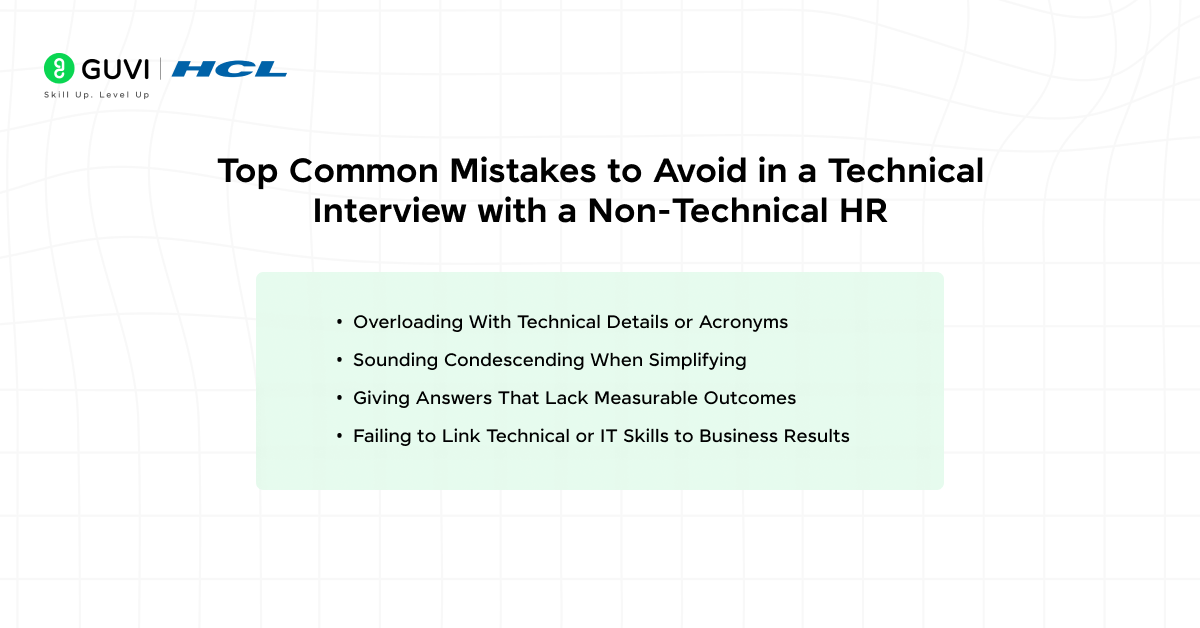
- Top Common Mistakes to Avoid in a Technical Interview with a Non-Technical HR
- Overloading With Technical Details or Acronyms
- Sounding Condescending When Simplifying
- Giving Answers That Lack Measurable Outcomes
- Failing to Link Technical or IT Skills to Business Results
- Final Preparation Tips Before the Interview
- Review Your Resume for Clarity
- Rehearse a 60-Second Project Summary
- Prepare 2-3 Stories That Show Teamwork and Communication
- Study the Company’s Product or Service
- Stay Calm and Treat It as a Conversation
- Conclusion
- FAQs
- How can I tell if my HR interviewer understands the technical details I’m explaining?
- What should I do if an HR interviewer asks a question that doesn’t make technical sense?
- How do I highlight my technical expertise without overwhelming a non-technical interviewer?
Comprehending the HR Interviewer’s Perspective
When an HR professional conducts a technical interview, their goal is not to test your coding syntax or algorithm depth. They focus on how you explain what you do, how you solve problems, and how you work with others. HR interviewers evaluate qualities that predict long-term success, including communication clarity and adaptability under pressure. They listen for how you connect technical work to practical outcomes rather than how deeply you describe the code itself. Even when the interviewer is not technical, your ability to tell a coherent story about your skills and decisions often matters more than how complex your answers are.
What HR Interviewers Look for in Technical Candidates
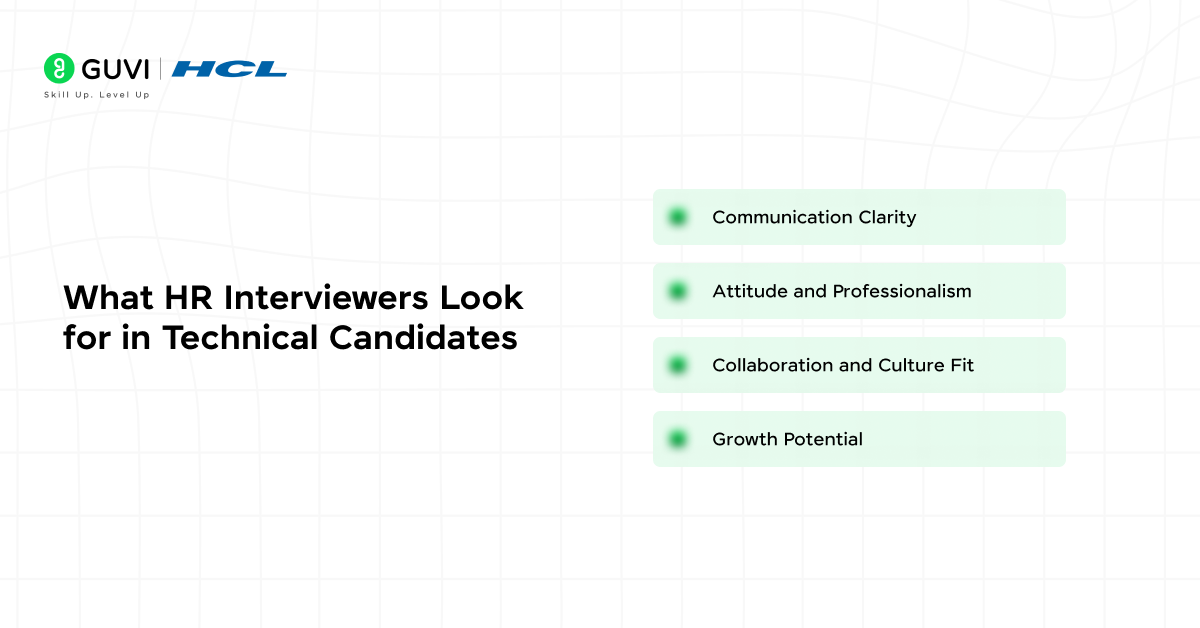
1. Communication Clarity
HR professionals look for candidates who can explain technical topics such as the fundamentals of machine learning and deep learning in plain and structured language. They value your proficiency to translate complex ideas into terms that non-technical teams or clients can understand. This skill shows that you can bridge communication gaps between engineers, stakeholders, and users.
2. Attitude and Professionalism
When HR interviewers ask open-ended or ambiguous questions, they observe how calmly and logically you respond. They assess your patience and proficiency to remain composed under uncertain scenarios. Professionalism also shows through how you deal with follow-ups and discuss past challenges without blaming others.
3. Collaboration and Culture Fit
Technical expertise matters, but your ability to work well with diverse teams determines long-term success. HR interviewers look for signs that you respect others’ input and contribute to group goals. Mentioning collaborative experiences with developers or product managers shows that you understand how technical work fits within a broader mission.
4. Growth Potential
Recruiters usually prioritize curiosity and adaptability over years of experience. They look for candidates who show initiative in learning new tools or methodologies. Discussing how you stay updated through courses, open-source contributions, or self-projects reflects a strong growth mindset and long-term value to the organization.
How to Explain Technical Concepts to Non-Technical Interviewers?
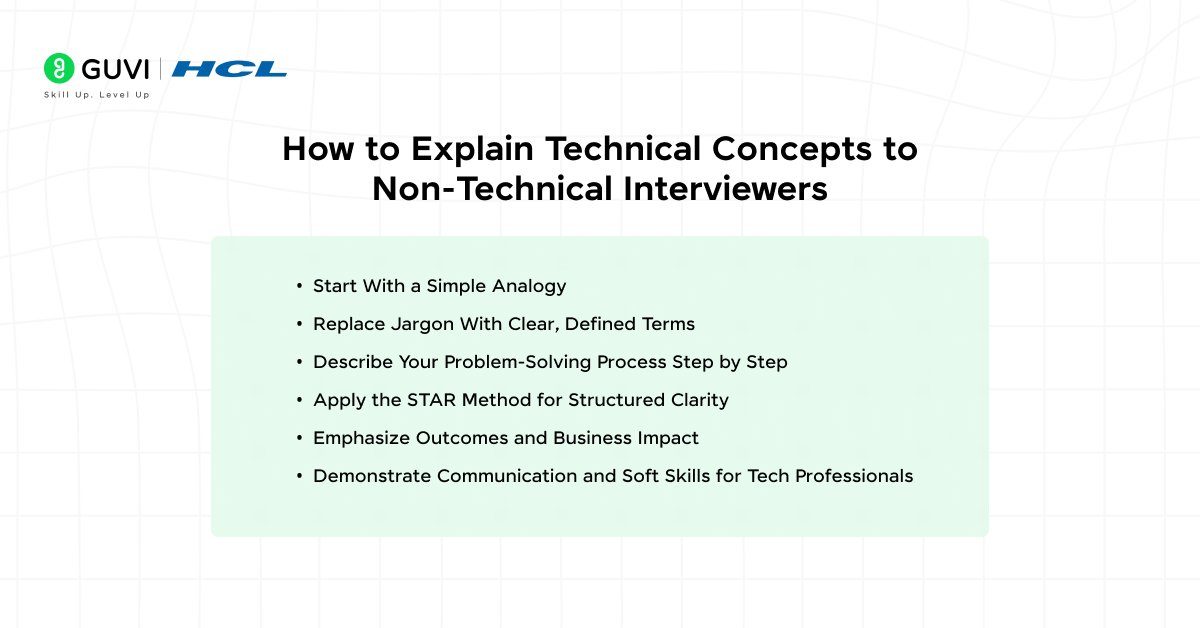
1. Start With a Simple Analogy
Begin your explanation with a relatable comparison that connects a technical process to an everyday activity. For example, explain that an API works like a waiter who takes an order from a customer, communicates with the kitchen, and delivers the meal back.
This analogy helps non-technical interviewers visualize how systems exchange data through structured requests and responses. You can also compare a database server’s index to a book’s table of contents to show how it speeds up searches within large datasets.
2. Replace Jargon With Clear, Defined Terms
Use technical vocabulary thoughtfully. When you mention concepts such as front-end, back-end, or data pipeline, add short, clear explanations. For instance, say the front-end handles what users see and interact with, while the back-end development manages business logic, data storage, and server communication. Defining terms demonstrates mastery and ensures that the interviewer can follow your reasoning without feeling excluded from the discussion.
3. Describe Your Problem-Solving Process Step by Step
Explain your technical reasoning in plain terms rather than focusing on syntax or frameworks. Outline how you identify problems and implement solutions. You might say that you debugged an issue by checking system logs, performing unit tests, or using version control tools such as Git to trace changes. Mentioning processes like CI/CD pipelines or automated deployment testing shows practical experience while keeping your explanation structured and logical.
4. Apply the STAR Method for Structured Clarity
Organize your examples using the Situation, Task, Action, Result framework. Describe what the challenge was, what your responsibility involved, what steps you took, and what the outcome achieved.
For example, you could explain how you improved documentation consistency using Confluence and Jira integration, which reduced revision delays and improved cross-team collaboration. The STAR format gives your response clarity and narrative flow, making your process easy to follow.
5. Emphasize Outcomes and Business Impact
Conclude your explanation by highlighting measurable results such as reduced downtime or improved customer satisfaction. Link your technical contributions to organizational value, like how optimizing a data query improved system response time or how better documentation lowered onboarding effort for new developers. Showing awareness of business goals makes your technical expertise more relatable to non-technical interviewers.
6. Demonstrate Communication and Soft Skills for Tech Professionals
Show patience and confidence while explaining complex ideas. HR professionals pay attention to how effectively you communicate under pressure and adapt your message to your audience. Clear articulation and respectful tone indicate professional maturity. These qualities strengthen your impression as a technical expert who can collaborate across teams and represent technical concepts with authority.
Common Scenarios and How to Handle Them
When Asked a Technical Question, the HR May Not Fully Understand
Keep your response concise and outcome-focused. Summarize the technical logic in a few clear steps, then shift the focus to its real-world impact. For example, instead of describing every line of code, explain that your algorithm reduced server response time by 40 percent or improved data consistency across systems.
This approach shows that you understand both the technical function and its business value, which helps HR assess your communication and impact-oriented mindset.
- When the HR Misinterprets a Technical Term
Handle the moment with patience and professionalism. Avoid direct correction; instead, reframe the concept naturally within your answer. For instance, if an interviewer confuses API endpoints with a user interface, respond with empathy by saying, “That’s a common mix-up, the interface I built connects applications rather than users.” This method keeps the tone collaborative and reflects emotional intelligence.
- When Asked About Tools or Programming Languages
HR interviewers often focus less on syntax and more on decision-making. Explain why you selected specific tools, frameworks, or languages, and how they solved particular project challenges. You might say, “We used Python for its data-processing efficiency and strong library support” or “I chose Git to maintain version control and enable smooth collaboration.” Focusing on reasoning and outcomes shows you can make informed technical choices that align with project goals.
- When Asked About Teamwork in a Project
Highlight your communication and collaboration across teams. Describe how you previously worked with developers, designers, or product managers to align technical requirements with user needs.

Mention examples such as writing technical documentation for non-engineering teams or using tools like Jira or Slack to coordinate updates. HR interviewers want to see that you understand the human side of technical work, including adaptability and clarity in shared environments.
How to Build Confidence in Non-Technical Conversations?
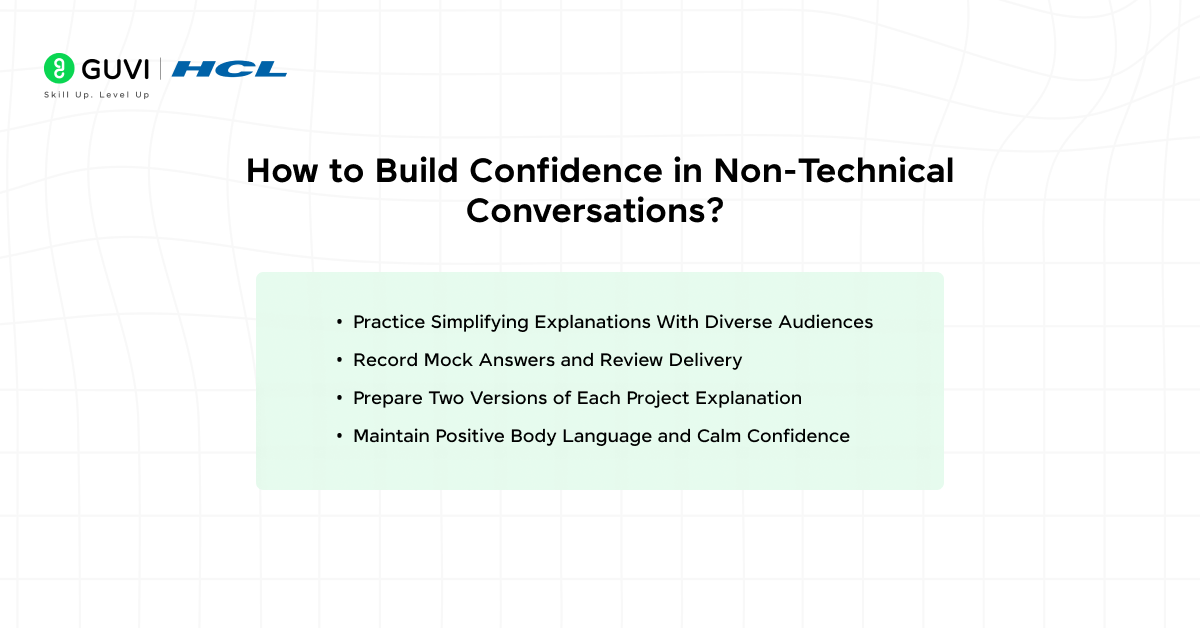
1. Practice Simplifying Explanations With Diverse Audiences
Share your project explanations with peers who work outside your field, such as marketing or operations professionals. Their questions help you identify areas where your explanations can be clearer and more relatable. This practice builds adaptability in communication.
2. Record Mock Answers and Review Delivery
Record short mock interviews where you explain one project or concept in plain language. Listen for pacing, tone, and overuse of jargon. Make small adjustments to improve clarity and flow. This self-review helps you sound confident and natural during real interviews.
3. Prepare Two Versions of Each Project Explanation
Create one version that uses detailed technical terms for peer-level discussions and another simplified version that focuses on problem-solving and outcomes. This dual preparation allows you to switch effortlessly depending on the interviewer’s background.
4. Maintain Positive Body Language and Calm Confidence
Your tone and posture communicate confidence even before your words do. Keep your shoulders relaxed, maintain eye contact, and use a composed voice. A steady presence helps HR interviewers trust your communication skills and professionalism, especially in moments of ambiguity.
Top Common Mistakes to Avoid in a Technical Interview with a Non-Technical HR
1. Overloading With Technical Details or Acronyms
Using too many technical terms can confuse non-technical interviewers and weaken your message. Replace excessive jargon with short, clear explanations that emphasize what the technology accomplishes rather than how it works. Keep your language simple enough that any listener can grasp the purpose and impact of your work.
2. Sounding Condescending When Simplifying
Simplifying does not mean speaking down to the interviewer. Avoid phrases that imply correction or superiority. Instead, approach every explanation as a shared conversation. Use empathy and professional tone to make complex ideas understandable without diminishing the interviewer’s perspective.
3. Giving Answers That Lack Measurable Outcomes
Interviewers want to see tangible results. Avoid ending your responses with vague statements. Instead, mention clear outcomes such as improved system performance or better documentation usability. Quantifying your results demonstrates accountability and real-world effectiveness.
4. Failing to Link Technical or IT Skills to Business Results
Concentrating only on code or tools without explaining business relevance weakens your impact. Always connect your technical achievements to company goals such as user retention, operational efficiency, or cost reduction. This connection shows you understand how your work drives value beyond development.
Sharpen your interview skills with our Interview Preparation Course, designed to help you communicate your technical expertise clearly, handle non-technical HR rounds confidently, and present yourself as a standout candidate. Get realistic mock interviews, communication strategy training, and insider tips to boost your chances of landing the job.
Final Preparation Tips Before the Interview
1. Review Your Resume for Clarity
Simplify technical descriptions in your resume so that any interviewer can understand your achievements and technical skills assessment easily. Replace dense tool lists with short, action-focused summaries that highlight measurable outcomes. For example, write “Optimized API integration to reduce data retrieval time by 30%” instead of adding long lists of programming languages or frameworks.
2. Rehearse a 60-Second Project Summary
Prepare a short explanation of your main projects focusing on the problem, your contribution, and the result. This brief summary helps you stay composed when the interviewer asks about your experience early in the conversation.
3. Prepare 2-3 Stories That Show Teamwork and Communication
Select examples where you collaborated with diverse teams, handled feedback effectively, or explained technical challenges to non-technical stakeholders. These stories reflect maturity, adaptability, and confidence. They are qualities that HR professionals highly value.
4. Study the Company’s Product or Service
Research the organization’s products, audience, and mission. Understanding their environment allows you to tailor your examples and show genuine interest. Mentioning relevant tools, frameworks, or challenges they face adds depth and credibility to your answers.
5. Stay Calm and Treat It as a Conversation
Your mindset sets the tone for the technical interview. Focus on connection and not perfection. Maintain calm posture, smile naturally, and listen actively. When you view the interview as a two-way dialogue, your confidence and authenticity shine through.
Conclusion
Handling a technical interview round with a non-technical HR interviewer is less about demonstrating deep code knowledge and more about showing how clearly and confidently you can translate complexity into value. Every answer should reflect a balance of technical understanding and professional empathy.
When you explain processes with structure, connect skills to outcomes, and maintain composure under questioning, you show that you can work seamlessly across teams. Preparation and genuine curiosity turn every HR-led technical discussion into an opportunity to demonstrate both expertise and emotional intelligence.
FAQs
1. How can I tell if my HR interviewer understands the technical details I’m explaining?
You can gauge understanding by observing verbal and non-verbal cues such as follow-up questions, nods, or clarification requests. If the interviewer seems unsure, adjust your explanation using simpler terms or analogies.
2. What should I do if an HR interviewer asks a question that doesn’t make technical sense?
Stay calm and avoid pointing out the error directly. Reframe the question in a way that connects to your expertise. This method demonstrates respect, clarity, and strong interpersonal awareness.
3. How do I highlight my technical expertise without overwhelming a non-technical interviewer?
Focus on outcomes and impact rather than on deep technical details. Explain what problem you solved, why your approach mattered, and what results you achieved. Mention metrics or improvements such as faster processing time or better user experience.
Success Stories

About the Author
Vaishali
I'm a seasoned writer with four years of experience across technical, non-technical, and just about every genre or niche you can imagine. Adaptable and curious, I enjoy exploring new topics and making information engaging and easy to understand. Fueled by a steady stream of tea, I approach each project with creativity, reliability, and genuine enthusiasm for storytelling.
View all posts by Vaishali
Connect with me @












Did you enjoy this article?