


Career Articles
Capgemini Exceller Technical Assessment 2026: AI + Technical - Best Guide
Cognizant GenC Elevate Exam Pattern & Syllabus for Freshers 2026 - Best Guide
Capgemini Exceller Placement Papers and Solutions 2026 - Best Guide
How to Pass the Accenture Recruitment Process 2026/27: The Complete Guide


Get In Touch For Details! Request More Information

How to Restart or Redirect Your Career When You Have 10+ Years of Experience in a Different Field: A Complete Guide
Feb 11, 2026 5 Min Read 1427 Views
(Last Updated)
To redirect your career after 10+ years in a particular field can feel challenging and uncertain. Many experienced professionals worry about whether their skills are still relevant, how employers will perceive a career change, or how to successfully navigate the transition. This blog provides a comprehensive guide with actionable steps for switching careers, helping you plan a strategy, bridge skill gaps, and confidently move into a new field.
This guide is ideal for professionals with 10+ years of experience looking to switch careers, pivot to new roles, or explore growth opportunities in a different domain. By following the steps outlined here, you will learn how to leverage your existing experience, gain relevant skills, network effectively, and position yourself as a strong candidate, ultimately achieving a successful career transition.
Quick Answer
When you redirect your career, start by identifying your transferable skills, researching your target industry, and upskilling with relevant courses or practical projects. Gain hands-on experience, tailor your resume, network strategically, and prepare thoroughly for interviews to ensure a smooth and successful career transition.
Table of contents
- Understanding the Challenges of Switching Fields Mid-Career
- Skills May Not Directly Transfer
- Employer Perception Of Career Change
- Updating Knowledge Of A New Industry
- Networking Challenges In A New Domain
- Adjusting To New Hiring Expectations
- How to Successfully Restart or Redirect Your Career
- Identify Transferable Skills
- Research Your Target Field
- Upskill Strategically
- Gain Relevant Experience
- Revamp Your Resume
- Network Effectively
- Prepare for Interviews
- Stay Persistent
- How to Redirect Your Career: A Step-by-Step Example
- Step 1: Identify Transferable Skills
- Step 2: Research the Target Industry
- Step 3: Upskill Strategically
- Step 4: Gain Relevant Experience
- Step 5: Revamp Resume and Online Presence
- Step 6: Network in the Target Field
- Step 7: Apply and Prepare for Interviews
- Conclusion
- FAQs
- Q1. Can I switch industries after 10+ years in one field?
- Q2. How should I explain my career switch to employers?
- Q3. Do I need courses before applying?
- Q4. How important is networking in a new field?
- Q5. How long does it usually take to switch fields?
Understanding the Challenges of Switching Fields Mid-Career
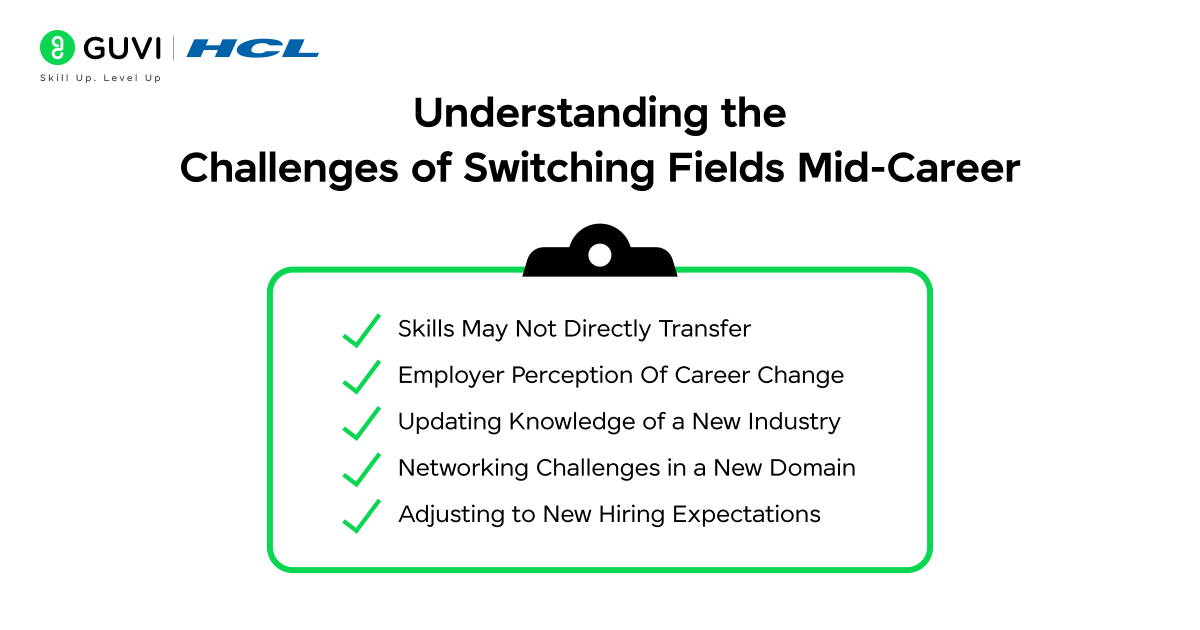
Redirecting your career after a decade in one field comes with unique obstacles that many mid-career professionals underestimate. Understanding these challenges not only prepares you mentally but also helps you build a strategic plan that improves your chances of breaking into a new industry. Below is a clear list of the core challenges you are likely to face so you can address them with confidence.
- Skills May Not Directly Transfer
- Employer Perception Of Career Change
- Updating Knowledge of a New Industry
- Networking Challenges in a New Domain
- Adjusting to New Hiring Expectations
1. Skills May Not Directly Transfer
To redirect your career often means that some of your technical or domain-specific skills may not match the expectations of your new industry. While your experience is valuable, the relevance of your current skills depends on how closely your previous work aligns with your target field.
Key Points:
- Transferable Skills: Leadership, communication, teamwork, analytical thinking
- Skill Gaps: Technical abilities or domain knowledge not used in your previous field
Tip: Identify transferable skills and back them up with a strong example that proves their impact. For instance, if you manage projects, show how that experience supports roles in operations, HR, or business management.
2. Employer Perception Of Career Change
Employers may hesitate when reviewing applications from candidates switching careers. They may question your stability, commitment, or whether the transition is well thought out.
Key Points:
- Concerns: Commitment to the new field, ability to adapt, long-term stability
- Your Advantage: Diverse experience that brings new perspectives
Tip: Craft a clear, concise narrative explaining why you’re switching careers and how your background enhances your potential in the new role. Clarity reduces employer hesitation.
3. Updating Knowledge Of A New Industry
Every industry has its own standards, tools, and trends. Entering a new field without updated knowledge can make you appear unprepared, even if you have strong experience elsewhere.
Key Points:
- Knowledge Gap: Lack of awareness of current trends and tools
- Learning Curve: Time required to build a foundational understanding
Tip: Stay updated by taking short courses, attending workshops, joining online communities, and working on beginner-friendly projects that help you understand the industry’s features and expectations.
4. Networking Challenges In A New Domain
Your existing professional network may not be helpful in your new field. When switching careers, you must intentionally build new relationships with people who understand the industry you want to enter.
Key Points:
- Limited Contacts: Few connections in the new field
- Networking Need: Establish credibility and visibility
Tip: Actively connect with professionals on LinkedIn, attend industry webinars, participate in discussions, and join communities. Networking accelerates your entry into unfamiliar industries.
5. Adjusting To New Hiring Expectations
Every industry has its preferred resume format, keywords, and interview style. Entering a new domain means adapting to a different set of hiring norms.
Key Points:
- Resume Differences: Format, keywords, and role expectations
- Interview Differences: Competency-based, scenario-based, or technical questions
Tip: Tailor your resume for your new field, highlight transferable skills, include relevant keywords, and practice answering industry-specific interview questions using strong example-driven responses.
How to Successfully Restart or Redirect Your Career
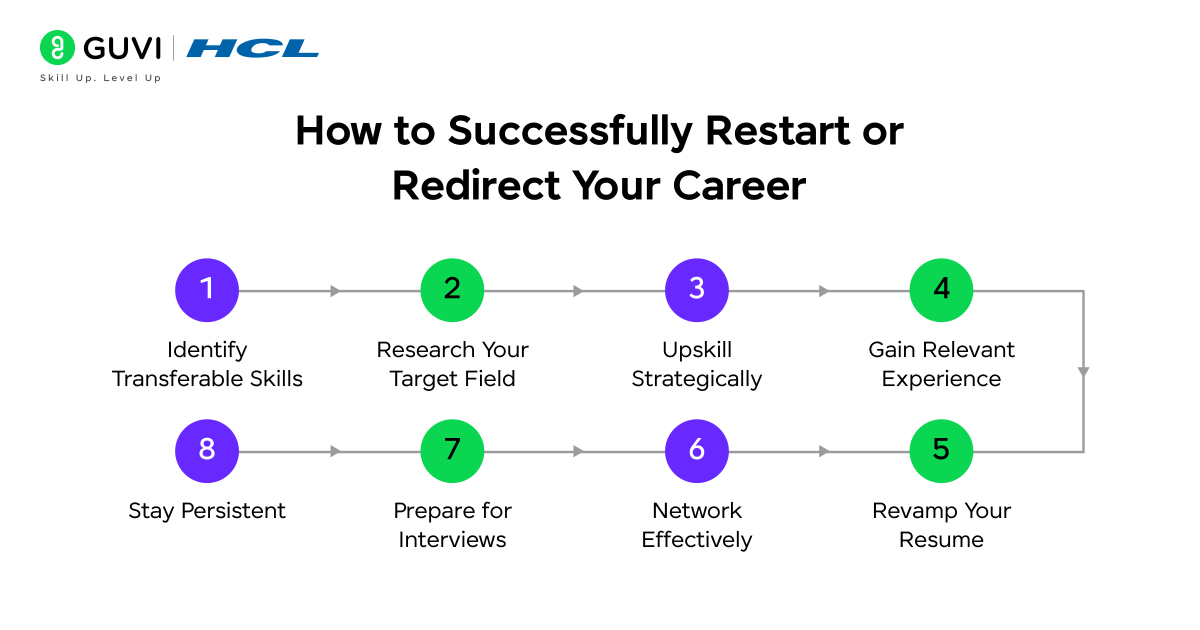
Switching careers after 10+ years in one field requires a clear plan, practical steps, and consistent effort. This section outlines the essential actions you must take to make your transition smooth, strategic, and effective. Below is an overview of the steps you will follow before we explore each one in depth.
- Identify Transferable Skills
- Research Your Target Field
- Upskill Strategically
- Gain Relevant Experience
- Revamp Your Resume
- Network Effectively
- Prepare for Interviews
- Stay Persistent
1. Identify Transferable Skills
Many of the abilities you developed over 10+ years can directly support your new career path. These transferable skills help employers understand the value you bring, even without industry experience.
Key Points:
- Examples: Leadership, project management, communication, problem-solving, analytical thinking
- Impact: Helps bridge the gap between your past role and the new field
Tip: Create a detailed list of your skills and match each one to the expectations of your target role. Use specific examples to prove your capability.
2. Research Your Target Field
A successful career switch begins with understanding your new industry. Research ensures you know what employers expect and which skills matter most.
Key Points:
- Industry Insight: Common job roles, responsibilities, and growth opportunities
- Skill Requirements: Tools, technologies, or soft skills needed to perform well
Tip: Study job descriptions, follow industry blogs, and explore trends. This helps you identify exactly what you must learn before applying.
3. Upskill Strategically
When switching careers, the key is to build skills that directly support your transition. Focused upskilling shortens your learning curve and strengthens your credibility.
Key Points:
- Learning Paths: Short courses, certifications, workshops
- Practical Learning: Hands-on projects or assignments
Tip: Choose learning programs that include real-world projects so you gain skills you can showcase in your portfolio or resume.

4. Gain Relevant Experience
Even small amounts of practical experience help you stand out when switching careers. Employers value proof that you can apply what you’ve learned.
Key Points:
- Opportunities: Freelancing, volunteering, part-time work, micro-projects
- Outcome: Builds confidence and demonstrates initiative
Tip: Apply your new skills by working on personal projects or offering help to small businesses or nonprofits.
5. Revamp Your Resume
Your resume should highlight your strengths in a way that aligns with your target role. When switching careers, the focus shifts from past job titles to relevant strengths.
Key Points:
- Resume Strategy: Emphasize transferable skills and new learning
- Customization: Tailor content to match job descriptions
Tip: Rewrite your resume using a combination of functional and chronological styles to showcase your capabilities effectively.
6. Network Effectively
Networking plays a major role in switching careers. Connecting with the right people opens doors to mentorship, referrals, and opportunities.
Key Points:
- Networking Channels: LinkedIn, industry events, online communities
- Benefits: Insights, guidance, and visibility in the new field
Tip: Send brief, personalized messages when reaching out. Building relationships over time increases your chances of being recommended.
7. Prepare for Interviews
Interviewers will want to know why you are switching careers and how your experience fits their needs. Proper preparation helps you answer confidently.
Key Points:
- Common Questions: Motivation for change, relevant skills, adaptability
- Strong Responses: Focus on learning agility and real examples
Tip: Practice explaining your career change in one clear, confident narrative. Show how your background strengthens your new path.
8. Stay Persistent
Career redirection takes time, but consistent effort leads to long-term success. Many professionals succeed simply because they stay committed.
Key Points:
- Reality: Transitioning may take months
- Mindset: Consistency, patience, resilience
Tip: Track your progress weekly and update your learning plan as you grow. Small steps accumulate into big results.
How to Redirect Your Career: A Step-by-Step Example
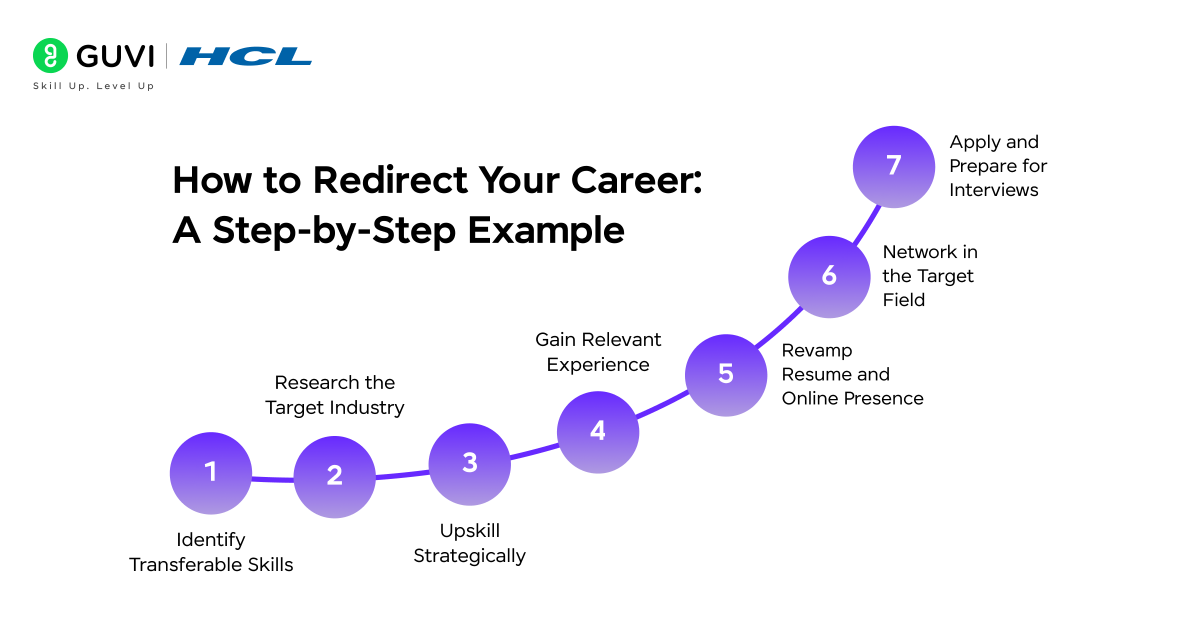
Career redirection becomes easier to understand when you see a concrete example. Consider Ravi, who spent 12 years in mechanical engineering but wanted to move into project management in the renewable energy sector.
Step 1: Identify Transferable Skills
Ravi’s skills in team management, project execution, budgeting, and client coordination were highly transferable to project management roles.
Step 2: Research the Target Industry
He studied the renewable energy sector, learning about industry standards, project lifecycles, and required tools.
Step 3: Upskill Strategically
Ravi completed a short certification in renewable energy project management and learned relevant software like MS Project and Primavera.
Step 4: Gain Relevant Experience
He volunteered for a local renewable energy project, which gave him hands-on exposure and a tangible example to showcase to employers.
Step 5: Revamp Resume and Online Presence
Ravi updated his resume to highlight transferable skills and the volunteer project, and adjusted his LinkedIn profile to reflect his career pivot.
Step 6: Network in the Target Field
He connected with industry professionals, attended webinars, and joined LinkedIn groups, which helped him learn about job openings and get referrals.
Step 7: Apply and Prepare for Interviews
Ravi prepared for interviews by practicing answers about his career switch and demonstrating how his past experience added value to the new role.
Outcome: Within 8 months, Ravi secured a project management role in renewable energy, successfully redirecting his career while leveraging his prior experience.
Do check out the HCL GUVI’s Interview Preparation Course, which helps you build confidence, improve communication, and master interview strategies. It teaches practical answer frameworks, common interview patterns, and techniques to make a strong first impression which is perfect for anyone switching careers and preparing for new-field interview.
Conclusion
Restarting or redirecting your career after 10+ years in a different field is challenging but achievable. By identifying transferable skills, researching your target industry, upskilling, gaining practical experience, revamping your resume, networking effectively, and preparing thoroughly, you can successfully transition into a new career.
Your experience is a strength. With focus, persistence, and strategic planning, you can create exciting new opportunities and advance in a field you are passionate about.
FAQs
Q1. Can I switch industries after 10+ years in one field?
Yes. Your experience is valuable. Focus on transferable skills and demonstrate learning and adaptability.
Q2. How should I explain my career switch to employers?
Be honest and confident. Highlight your motivation, transferable skills, and readiness for the new role.
Q3. Do I need courses before applying?
Upskilling is highly recommended. Focus on relevant skills that match industry requirements.
Q4. How important is networking in a new field?
Networking is crucial. It helps you learn, gain referrals, and find opportunities faster than cold applications.
Q5. How long does it usually take to switch fields?
It varies, but mid-career transitions typically take 6–12 months depending on your learning, experience, and networking efforts.
Success Stories

About the Author
Jebasta
I translate the language of data into stories that anyone can understand. As a writer with a data science background, I simplify analytics, AI, and decision-making so beginners and enthusiasts can confidently explore the world of data.
View all posts by Jebasta
Connect with me @










Did you enjoy this article?