


Career Articles
Accountant vs Data Analyst Salary in India After Switching Careers - Best Guide
Finance Managers: Could Data Science Be Your Next Career Move?
Insurance Claims Executive to Data Analyst: Is It a Good Switch?
Banking Executive (Loans, KYC) to Data Analyst: Skills and Career Path


Get In Touch For Details! Request More Information
If you are planning to switch careers, there is so much running through your mind right now! You may be worried about not having “relevant experience”.
You’re already feeling the peer pressure of “How can I catch up with my peers who are already ahead?” And these thoughts are normal. But your resume can help you handle all this.
Switching careers is a big move, and your resume is your first shot at making it happen. A career change resume is different because you might not have years of experience in your new field yet. Instead of listing old job titles, you need to show off the skills you already have and how they connect to your new goal.
In this guide, we’re breaking down everything you need to know about career-change resumes. You’ll learn what makes them different, show you which sections to include, and give you real strategies to stand out even though you’re new to the industry.
And…..let’s do this!
Quick Answer
Use a Hybrid resume format to lead with a strong Professional Summary that explicitly states your career transition and highlights your top transferable skills. Prioritize new field certifications and personal projects.
• You’re 3.5× more likely to land an interview if your resume headline exactly matches the job title.
• You’re 1.9× more likely to get invited to interview if you include a cover letter.
• Roughly 94% of recruiters use LinkedIn to find potential candidates.
• You’re 2.5× more likely to score your dream interview if you list your highest degree.
• Resumes with an exact job-title match show a 300% increase in interview rates.
• Adding a relevant certification can triple the number of interview invitations you receive.
Create Your Resume in Minutes to Stand Out
Table of contents
- TL;DR Summary
- What Is the Salary Difference Between Accountants and Data Analysts in India?
- What Can Accountants Earn After Switching to Data Analytics in India?
- Why Can a Data Analyst Earn More Than an Accountant?
- Will Switching from Accounting to Data Analytics Reduce Your Salary?
- Which Skills Help Accountants Move into Data Analytics?
- Can Accountants Move from Data Analytics into Data Science?
- Which Certification Can Help Accountants Switch to Data Analytics?
- What Mistakes Should You Avoid When Switching Careers?
- What Is the Best Course for Accountants Switching to Data Analytics?
- Conclusion
- Frequently Asked Questions
- Is a data analyst salary higher than an accountant's salary in India?
- Can an accountant become a data analyst without a technical degree?
- Will I have to start at a lower salary after switching?
- Which data analyst role is best for accountants?
- Do accountants need Python to become data analysts?
- Can an accountant move directly into data science?
- Does finance experience help in a data analyst career?
- Which is better for long-term growth: accounting or data analytics?
What factors should to consider when writing a career change resume
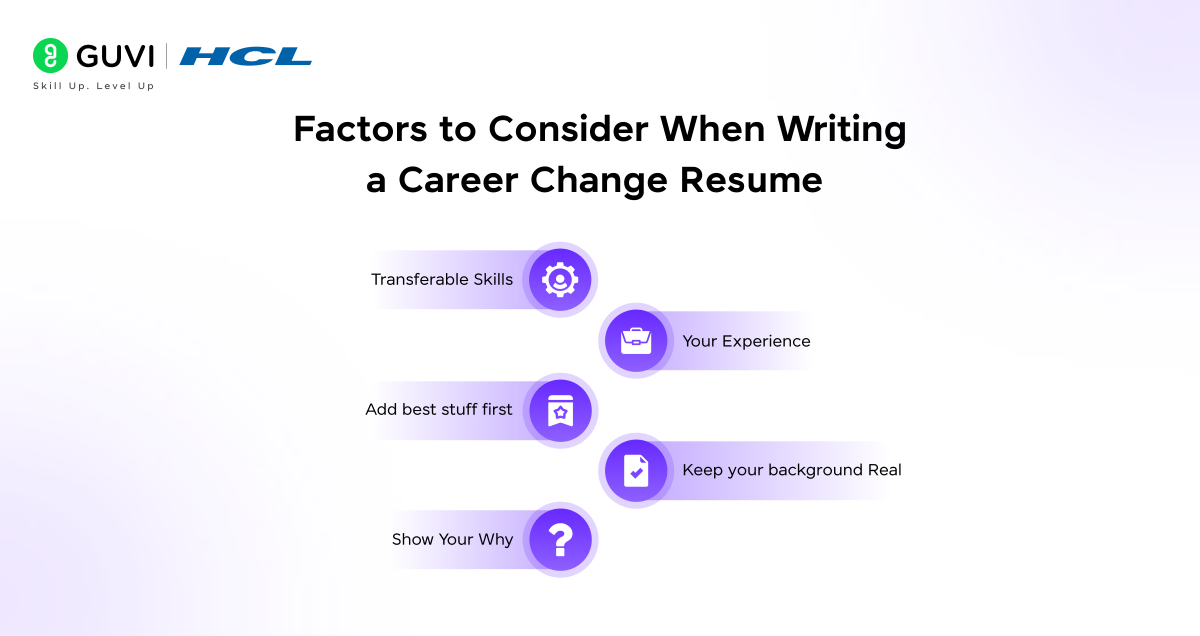
When changing careers, the difference is your background. You need to ensure a balance between your experience and your new career. Many skills are transferable across different jobs and industries. Here are a few points to consider before you start writing your career change resume.
Your transferable skills matter most: These are the skills that work everywhere. Some skills are useful no matter what job you do. Things like communication, solving problems, working with a team, and being a leader are important in almost every job.
Even if you’ve never done your new job before, you probably used these skills somewhere.
Put these skills front and center on your resume because they show you can fit the job.
Reframe your experience: Change how you talk about your past job. Don’t just say what you did. Instead, explain “how“ and “what“ you did in your old job connects to the current job.
Put the best stuff first: Start your resume with the things that matter most for the new job. If you took a class in this field, did a project, or did volunteer work and put that near the top. Save your past job experience that doesn’t really connect for later.
Keep it real about your background: Keep your past job there. Your last job isn’t useless. You can still include it on your resume, but organize in a way that actually matters for this job stand out more.
Show your why: Explain why you’re making the change. This tells the hiring manager why you’re doing this and shows that you have a real reason for the switch.
The big picture: Your resume should tell the story of why you’re the right person, even though you come from a different background.
But before we dive in. If you plan to learn skills that top tech companies look for? Master the MERN Full Stack with HCL GUVI’s AI-powered course. Learn JavaScript, React, Node.js, and MongoDB through simple, guided lessons. Build real projects and create a strong portfolio to boost your chances of getting hired.
Key Sections to Include in a Career Change Resume
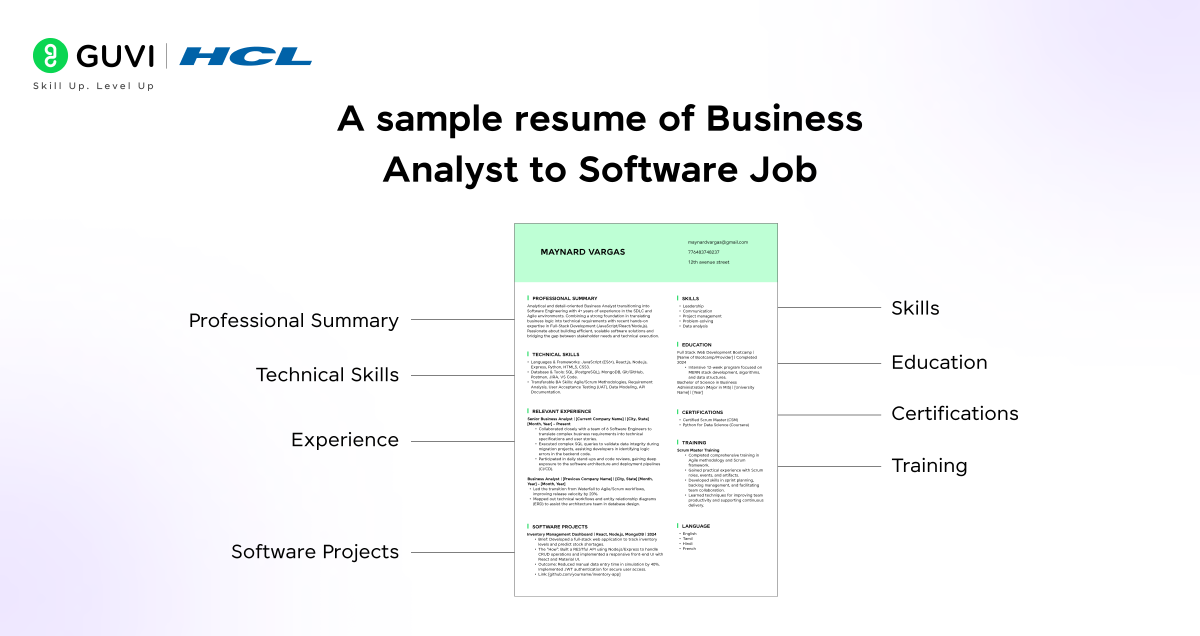
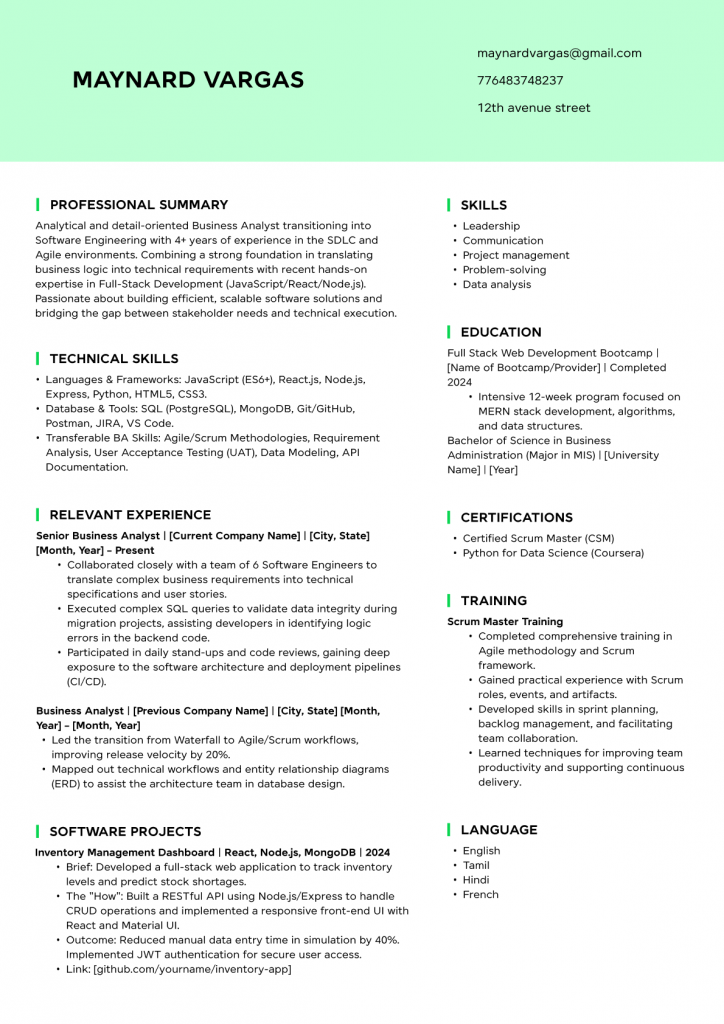
1. Contact Information
Purpose: Make it easy for recruiters to reach you
Include
- Full name (at the top, in larger font)
- Professional email address
- Phone number
- LinkedIn profile URL
- City/State (full address not necessary)
- Portfolio or personal website link (if applicable)
2. Professional Summary (or Career Objective)
Purpose: Immediately communicate why you’re switching careers and what value you bring. And add a career goal that connects to your current path.
For career changers, this section is crucial. Keep it 3-4 lines
State your career transition clearly
- Highlight transferable skills relevant to the new role
- Show enthusiasm for the new field
- Mention any relevant training or certifications
Example: Results-driven marketing professional transitioning into UX design with 5+ years of experience in user research, A/B testing, and digital strategy. Completed Google UX Design Certification and passionate about creating intuitive, user-centered digital products.
3. Skills Section
Purpose: Showcase abilities relevant to your target role
For career changers, emphasize:
- New field skills: Technical skills specific to your new career (coding languages, design software, certifications gained)
- Transferable skills: Leadership, communication, project management, problem-solving, data analysis
- Industry-specific software or tools relevant to the new role
Organize skills by relevance, put new field skills first.

Example:
UX/UI Design: Figma, Adobe XD, Wireframing, Prototyping
Technical: HTML, CSS, JavaScript basics
Core Competencies: User Research, Design Thinking, Stakeholder Management, Communication
4. Relevant Experience
Purpose: Show how your background prepares you for the career change
Key strategy for career changers: Don’t list every responsibility. Instead, highlight accomplishments that demonstrate skills needed in your new field.
Structure each role with:
- Job title | Company | Dates
- 3-4 bullet points focusing on achievements (not duties)
Reframe your bullets: Use action verbs and quantify results where possible. Focus on responsibilities that align with the new career.
Examples by transition type:
- Career to Tech: Emphasize problem-solving, learning complex systems, process improvement, and data analysis
- Career to Design: Highlight user feedback incorporation, visual thinking, cross-functional collaboration
- Career to Project Management: Showcase coordination, timeline management, team leadership
5. Education & Certifications
Purpose: Demonstrate formal training in your new field
Include:
- Degree(s): Major university degrees with graduation dates
- Relevant Certifications: Bootcamps, online courses, certifications specific to new career (put these first if recent)
- Relevant Coursework: Only if space allows and is directly applicable
Example:
Google UX Design Certificate | Coursera | Completed 2024
Product Management Certification | General Assembly | 2023
Bachelor of Arts in Communications | State University | 2015
6. Projects & Portfolio
Purpose: Demonstrate practical skills and work in your new field
Include:
- Project name and brief description
- Your specific role and contributions
- Technologies or tools used
- Outcome or lessons learned
- Link to live project or GitHub repository (if applicable)
Example: Mobile App Redesign Project | Personal Portfolio | 2024 Redesigned onboarding flow for a fitness app, reducing drop-off by 28% through user testing and iterative design. Created wireframes, prototypes in Figma, and conducted usability testing with 15 users.
Resume Tips for Career Changers
Length: Keep to one page if possible (max two if extensive experience in a similar field)
Order matters: Place your most relevant sections first. Consider putting certifications before traditional work experience if recent and highly relevant.
Keywords: Scan job descriptions for keywords and mirror that language in your resume (especially in skills and summary)
Dates: Clearly show dates for recent training, certifications, and projects to demonstrate active learning
Formatting: Use clean, readable formatting with consistent spacing, bullet points, and font. Avoid graphics or colors that don’t reproduce well
Tailor each application: Adjust your professional summary and highlight different skills/projects based on each specific job posting
Tl; DR – How to Write a Career change Resume
- Match the job title in your resume headline so recruiters instantly see the fit.
- Start with a strong Professional Summary that explains your career shift and highlights your top transferable skills.
- Put the most relevant stuff first, such as certifications, projects, freelance work, or coursework related to the new field.
- Highlight transferable skills (communication, leadership, problem-solving, teamwork).
- Reframe old experience to match the new role and focus on achievements, not duties.
- Add certifications and recent training to instantly boost credibility in a new field.
- Keep the resume clean, simple, and tailored for every job application.
Concluding Notes….
Yes, changing careers is a big step. Getting your resume ready is the first step you’re ready for the new beginning.
Your story, your skills, and your drive all matter more than you think. A well-crafted career change resume can help you bridge the gap between where you are now and where you want to go next.
You’ve got this.
Frequently Asked Questions
1. What is the best resume format for a career change?
The combination format is the best for a career change resume.
2. How do I write a career change resume with no experience in the new field?
Focus on transferable skills like leadership, problem-solving, and data analysis instead of specific job titles. Use projects & portfolio sections to prove your new technical abilities through bootcamps, volunteer work, and self-directed learning.
3. How long should a career change resume be?
For most career changers, a one-page resume is ideal. Recruiters spend very little time scanning resumes.
4. What should I put in the professional summary if I am switching industries?
Your professional summary acts as your “elevator pitch.” It should clearly state your career transition, highlight your top 1-2 transferable skills, and express your enthusiasm for the new field.
5. Do I really need to tailor my resume for every application?
Yes. When writing a career change resume, tailoring is critical. Scan the specific job description for keywords and make it ATS-friendly.
Success Stories

About the Author
Salini Balasubramaniam
A curious, information-savvy writer loves to turn deep insights into authentic and engaging content that connects. With experience in writing for brands and driving audience engagement, I believe that words can make a powerful difference.
View all posts by Salini Balasubramaniam
Connect with me @












Did you enjoy this article?