


Career Articles
Is Forward Deployed Engineering a Real Engineering Discipline?
Wipro Technical Interview Questions 2026: Most Asked Questions and Answers


Get In Touch For Details! Request More Information
How to Get an Internship at Google: A Practical Guide for Engineering Students
Sep 09, 2026 10 Min Read 12096 Views
(Last Updated)
Getting an internship at Google can feel like aiming for the stars, but it’s more achievable than most students think. In recent years, Google has received hundreds of thousands of internship applications from students around the world, and many engineering students have landed their dream roles. What makes the difference is not luck but early preparation, building the right skills, and understanding how the process really works.
In this blog, we’ll show you step by step how to get an internship at Google in a way that feels doable. From coding rounds to resume-building, we’ll walk through what a Google internship for engineering students usually involves and give you practical tips to improve your chances of success.
Table of contents
- Google Internship in India 2026: Programs such as STEP and SWE Intern
- Google STEP Internship
- Google Software Engineering Intern
- Google Internship Programs, Eligibility, Application Timeline, and CTC
- Types of Google Internships for Engineering Students
- Software Engineering Intern (SWE)
- Google STEP Internship (Student Training in Engineering Program)
- AI/ML Research Intern
- Data Science or Analytics Intern
- Site Reliability Engineering (SRE) Intern
- UX Engineer or Technical Writer Intern
- Eligibility Criteria & Application Timelines
- When Should You Apply?
- Step-by-Step Roadmap to Getting Selected
- Strengthen Your Core CS Skills
- Build Real-World Projects
- Practice for Google’s Online Assessments
- Prepare for Interviews (Technical + Behavioral)
- Craft a Resume That Gets Noticed
- Apply Through the Right Channels
- How to Apply for a Google Internship (Without Missing a Deadline)
- Start with Google’s Official Careers Site
- Leverage Referrals (If You Know Someone at Google)
- Set Alerts and Track Openings
- 4. What Happens After You Apply?
- Google Internship Interview Process: Rounds, Topics, and Timeline
- Application and Resume Screening
- Online Assessment
- Recruiter Discussion
- Technical Interviews
- Behavioural Evaluation and Final Decision
- Pro Tips to Improve Your Chances
- Start Early, Not When Everyone Else Does
- Contribute to Open Source or Public Projects
- Use LinkedIn the Right Way
- Track, Don’t Guess
- Don't Ignore the Behavioral Round
- Accept That Rejections Are Part of It
- Google Internship Application Mistakes to Avoid
- Applying Without Checking Eligibility
- Using the Same Resume for Every Role
- Listing Skills Without Evidence
- Depending Entirely on a Referral
- Beginning DSA Preparation After Receiving the Test
- Coding Silently During the Interview
- Ignoring Edge Cases
- Applying Through Unofficial Links
- Google vs Microsoft vs Amazon Intern Program Comparison
- Alternative Internships Similar to Google for Indian Students
- Microsoft Explore and University Internships
- Amazon SDE Internship
- Atlassian Early Careers Internship
- Adobe University Internship
- Salesforce Futureforce
- NVIDIA University Recruiting
- Wrapping Up
- Frequently Asked Questions
- I’m in my first year. Is this too early to start figuring out how to get an internship at Google?
- Can I apply for a Google internship if I haven’t done any previous internships?
- How important is GPA when applying for a Google internship?
- What should I focus on first if I’m serious about how to get an internship at Google?
- Do I need to know advanced system design for a Google internship?
Google Internship in India 2026: Programs such as STEP and SWE Intern
Students targeting Google internships in India during the 2026 cycle mainly watched for two engineering routes: STEP and the Software Engineering Intern program. Both were paid opportunities, but their eligibility requirements and expected coding depth were different.
Google STEP Internship
The Student Training in Engineering Program, commonly called STEP, is designed for students who are still early in their technical degrees. Indian postings generally target students in their first or second year. However, the eligible graduation batch may change with each listing.
STEP focuses on guided engineering work and close mentorship. Applicants need basic programming knowledge, but Google may not expect the same level of technical experience required from regular SWE Intern candidates.
Google Software Engineering Intern
The Software Engineering Internship is usually better suited to pre-final-year students with strong data structures and algorithms skills. Interns work on real engineering projects and write production-level code under the guidance of experienced team members.
Google’s summer engineering internships commonly run for around 10 to 12 weeks. Indian roles may be based in Bengaluru, Hyderabad, Pune, or another location mentioned in the official job posting.
Google Internship Programs, Eligibility, Application Timeline, and CTC
| Google Internship Program | Who It Is For | When to Apply | CTC or Stipend |
|---|---|---|---|
| Google STEP | Early-year Bachelor’s students, commonly in the first or second year, with basic programming knowledge | Start checking between August and December for the following summer cycle. Exact dates depend on the official listing | Google does not publish one fixed India CTC. STEP is paid, but the stipend depends on the role, location, and offer |
| Google SWE Intern | Pre-final-year Bachelor’s or Master’s students with strong coding and problem-solving skills | Openings commonly appear between July and October for the next summer. Some roles may open later | Google does not publish one standard internship CTC. Public reports for 2025 mentioned broad monthly stipend estimates ranging from ₹70,000 to ₹2,00,000 |
Note: Internship offers usually mention a monthly stipend rather than an annual CTC. The final amount may differ according to the location, role, program, and internship duration. Students should rely on their official offer letter instead of unverified social media estimates.
Types of Google Internships for Engineering Students
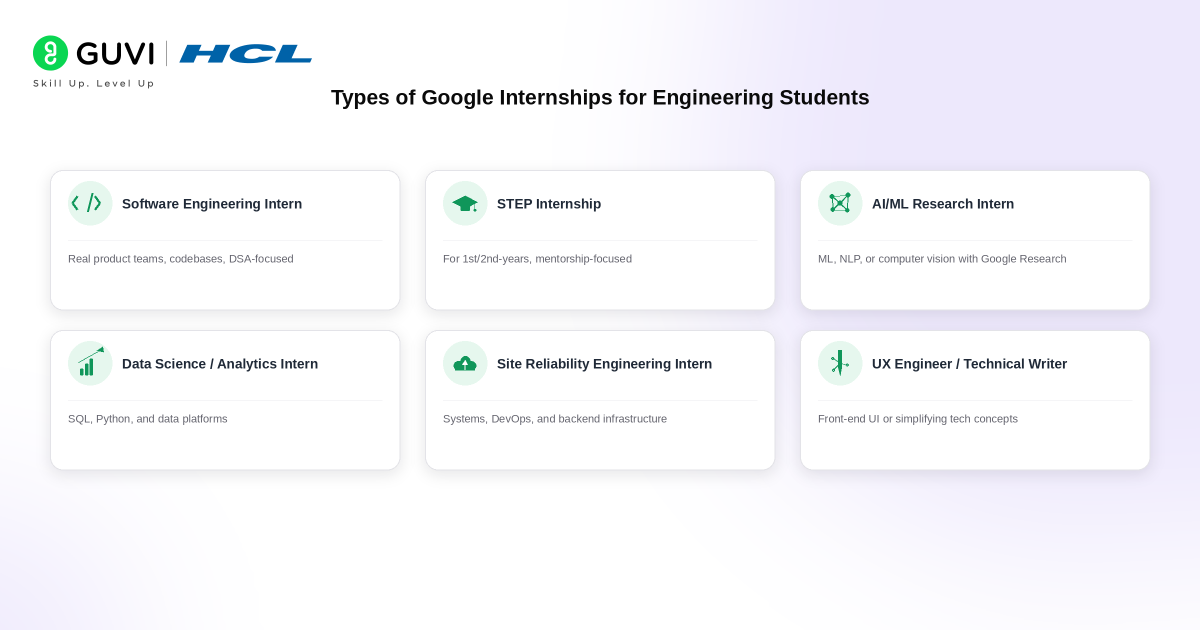
Google offers a variety of internship roles for tech students, depending on your year of study, skills, and area of interest. While most people know about the summer Software Engineering Internship, there are other opportunities worth exploring too which include early-stage programs designed specifically for second-year students.
Here are some of the common tech-focused roles offered through a Google internship for engineering students:
1. Software Engineering Intern (SWE)
This is the most popular internship role and is open to students in their final or pre-final year of a technical degree. You’ll typically work on real product teams, contribute to codebases, and collaborate with senior engineers. Strong skills in data structures, algorithms, and problem-solving are essential.
2. Google STEP Internship (Student Training in Engineering Program)
Designed for first or second-year students from underrepresented groups in tech, the STEP internship is offered in India and several other countries. It focuses on mentorship and development rather than just technical contribution. This is a great opportunity for students who are still early in their coding journey but eager to grow.
3. AI/ML Research Intern
If you’re into machine learning, natural language processing, or computer vision, this role lets you work with Google Research teams. You’ll need a strong foundation in Python, stats, and ML frameworks. Having published research or contributing to open-source projects can give you an edge.
4. Data Science or Analytics Intern
This role is ideal for those who love working with data, metrics, and visualizations. Expect to work with tools like SQL, Python, and data platforms. A background in statistics or experience with analytics projects will help you stand out.
5. Site Reliability Engineering (SRE) Intern
As an SRE intern, you’ll work on keeping Google’s systems reliable and scalable. This is a mix of software engineering and system administration. Students interested in DevOps, Linux systems, and backend infrastructure are a good fit.
6. UX Engineer or Technical Writer Intern
While slightly outside the traditional CS path, these roles still fall under the tech umbrella. A UX Engineer builds user-facing components with strong front-end skills, while a Technical Writer intern simplifies complex tech concepts for users or developers.
Eligibility Criteria & Application Timelines
Before diving into prep mode, it’s important to understand if you’re eligible and when to actually apply. Google looks for more than just good grades. Skills, curiosity, and problem-solving ability matter just as much.
Here’s what typically makes you eligible for a tech internship at Google:
- You should be currently enrolled in a Bachelor’s, Master’s, or dual-degree program in Computer Science, Engineering, or a related technical field.
- STEP (India): Open for 1st and 2nd-year students from underrepresented backgrounds in tech
- SWE Intern: Open for pre-final or final year students (depending on the posting)
- Some roles may require prior project work or open source contributions, or competitive programming, especially in AI/ML or research-focused internships.
- Strong command over data structures, algorithms, and problem-solving
- Ability to write clean, efficient code in one or more languages (commonly C++, Java, Python, or Go)
- Good communication and teamwork skills
When Should You Apply?
Application timelines can vary slightly each year, but here’s what the norm has been in the past:
| Internship | Application Window | Internship Period | Notes |
| STEP (India) | Usually opens in November | May–July (next year) | Limited to India, 1st or 2nd-year students |
| SWE Intern (India/Global) | Tends to open from August to October | May–July (next year) | Some postings may close earlier if filled |
| AI/ML, SRE, Data Internships | Varies by team/location | Often Summer or rolling | Check Google Careers regularly for updates |
Note: The timelines mentioned above are based on past cycles and may shift slightly each year. It’s a good idea to start checking the Google Careers site and internship job boards by late July, especially if you’re targeting a Summer internship.
Step-by-Step Roadmap to Getting Selected
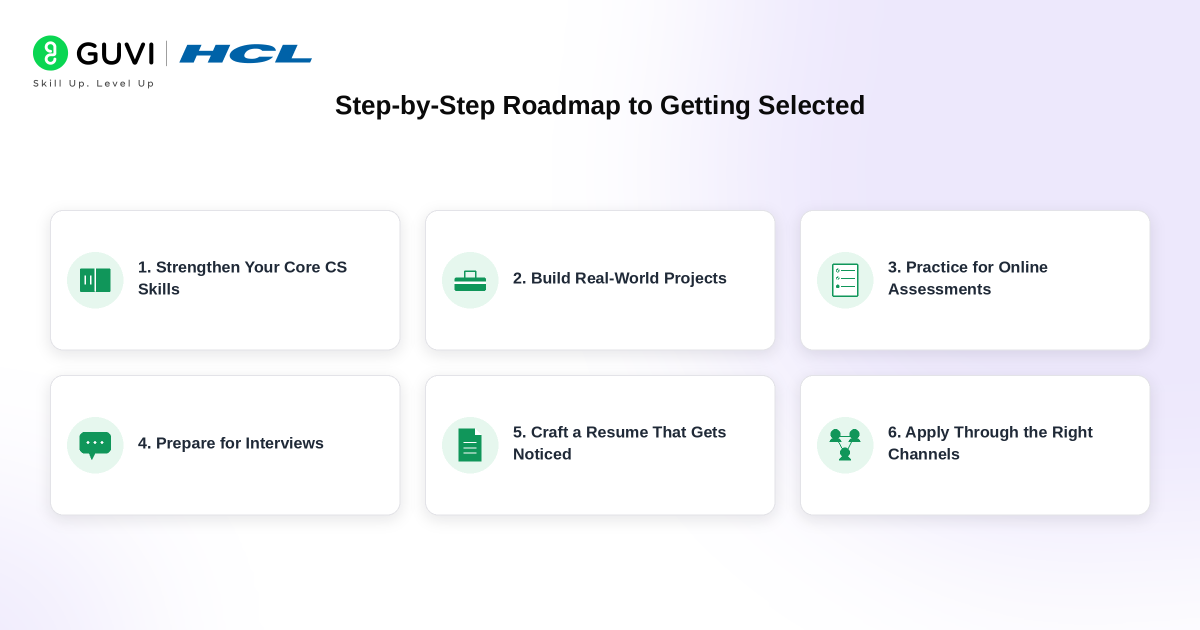
Landing a Google internship takes more than just good grades or luck. It’s about building solid fundamentals, standing out through your work, and preparing with intention. Here’s a deeper look at each step you should focus on if you’re serious about how to get an internship at Google:
1. Strengthen Your Core CS Skills
This is non-negotiable. Google’s selection process heavily emphasizes data structures and algorithms (DSA), along with a strong understanding of CS fundamentals.
- Start with basics like arrays, strings, linked lists, trees, and graphs. Then move into advanced topics like DP, heaps, and tries.
- Use platforms like CodeKata, LeetCode, or InterviewBit to practice. You can start with easy problems, but don’t get stuck there for too long.
- Track your improvement by maintaining a spreadsheet or joining peer challenges.
- Focus on problem-solving speed and clarity, not just correctness.
Tip: Try to implement common problems in more than one way as this can help develop deeper intuition.
2. Build Real-World Projects
Google values candidates who can apply their knowledge in practical ways. Projects can often speak louder than your GPA.
- Start with small personal projects that solve a real problem; e.g., a weather app, portfolio site, or task tracker.
- Participate in hackathons, open-source contributions, or mini-projects from HCL GUVI’s Zen Class or self-paced programs.
- Prioritize clean code, good UI (if applicable), and meaningful functionality.
- Upload everything to GitHub. Include a clear README, screenshots, and maybe even a short demo video or blog post.
Tip: One well-documented project is more valuable than five half-finished ones.
3. Practice for Google’s Online Assessments
Before getting to interviews, most applicants must clear one or more online coding rounds; these are timed and often intense.
- Expect 2–3 medium to hard-level coding questions (on platforms like CodeSignal or HackerRank).
- Google may also include MCQs on time complexity, recursion, or logic puzzles.
- Practice solving problems within 30–45 minute windows to simulate the test environment.
Tip: Don’t skip edge case testing. Google looks at how you handle tricky inputs and optimize for performance.
4. Prepare for Interviews (Technical + Behavioral)
Once shortlisted, you’ll typically go through 2–3 rounds of technical interviews, and possibly one behavioral round.
- Each round usually starts with a coding prompt, so you’ll need to explain your approach out loud, solve it in real-time, and handle follow-up questions.
- Be ready to answer questions like:
- How would you improve this solution?
- What if the input size doubles?
- How would you improve this solution?
- In behavioral rounds, they might ask about a time you resolved conflict, worked under pressure, or failed and bounced back.
- Use the STAR method (Situation, Task, Action, Result) to structure your answers.
Tip: Mock interviews with friends or platforms like Pramp can help reduce nervousness. Moreover, freshers can even consider joining HCL GUVI’s Interview Preparation Toolkit for Freshers Course, which is a self-paced program and can help you practice some really tough questions, build confidence, and get interview-ready.
5. Craft a Resume That Gets Noticed
Your resume should tell a story that doesn’t simply list tools or technologies.
- Limit it to one page, and lead with impact (e.g., “Built a quiz app used by 2,000+ users”).
- Highlight project outcomes, leadership roles, and competitive achievements (like ranking in coding contests).
- Include links to GitHub, CodeKata, HCL GUVI Zen profiles, or a personal website.
- Avoid fillers. Don’t list every course you’ve taken; show what you’ve done with what you’ve learned.
Tip: Use action words like “Built,” “Led,” “Improved,” “Contributed,” instead of “Responsible for…”
6. Apply Through the Right Channels
Google doesn’t always announce internship openings loudly, so you need to be proactive.
- Regularly check the Google Careers site, especially around July to November.
- Use LinkedIn to connect with past Google interns or employees. If you’ve worked with someone in a project or community, don’t hesitate to ask for a referral.
- Join tech communities or HCL GUVI’s Discord/CodeKata leaderboard, where early links and discussions are often shared informally.
- Make sure your resume is ready before roles open, as some positions may close within days.
Tip: Keep a tracker of internships applied to, deadlines, and referral status to stay organized.
Want to explore more ways to land internships and freelance gigs? Check out our beginner-friendly, self-paced course on how to get freelancing and internship opportunities.
How to Apply for a Google Internship (Without Missing a Deadline)
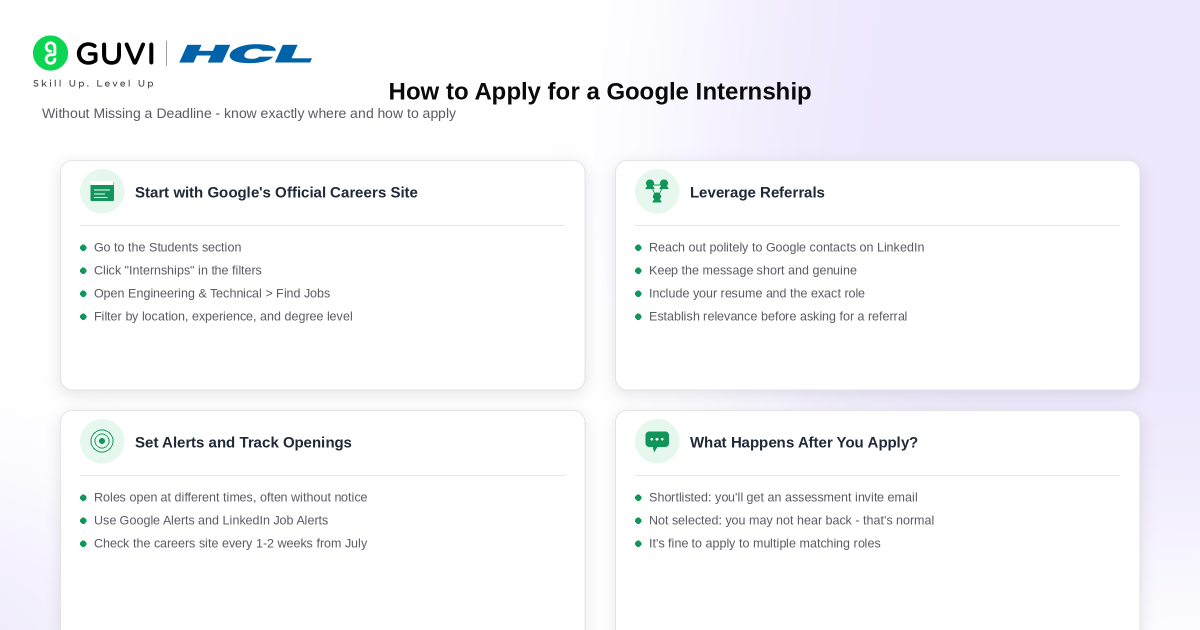
Once your resume is ready and your prep is on track, the next step is knowing exactly where and how to apply. Google doesn’t always make a big announcement when internship roles open, which is why staying alert and knowing where to look matters a lot.
1. Start with Google’s Official Careers Site
All official internship roles are listed on Google Careers
Here’s how to find them faster:
- Head to the Students section
- Click on “Internships” in the filters
- Head to the Engineering & Technical Section and click on “Find Jobs”.
- Filter by location (India, Singapore, etc.), experience ( set to intern & apprentice), degree level, etc.
Tip: Roles often mention the expected graduation year, so make sure you match that before applying. Additionally, you can also visit their page on the website, which mentions how to prepare for the hiring process.
2. Leverage Referrals (If You Know Someone at Google)
While it’s not mandatory, a referral can help your application get noticed sooner. If you’ve worked with someone who now works at Google (via open source, internships, or college networks), consider reaching out politely on LinkedIn.
- Keep your message short and genuine. Include your resume and clearly mention which role you’re applying for.
- Don’t ask for a referral without first establishing some relevance or context.
3. Set Alerts and Track Openings
- Google doesn’t open all internship roles at once. Some might appear in August, others in October, and they often close without notice.
- Use tools like Google Alerts, LinkedIn Job Alerts, or internship-tracking spreadsheets shared in communities.
- Keep checking the careers site every 1–2 weeks once July begins.

4. What Happens After You Apply?
- If shortlisted, you’ll get an email inviting you to online assessments.
- If not selected, you may not get a response at all, and that’s normal.
- It’s okay to apply to multiple roles, as long as they match your background
Note: Don’t wait for a reply to start preparing. Many students apply early, but start late.
Google Internship Interview Process: Rounds, Topics, and Timeline
Google does not follow one identical internship interview process for every candidate. The number of stages may change according to the program, location, and hiring team. A typical STEP or SWE internship process may include the following stages.
1. Application and Resume Screening
Recruiters review the candidate’s degree, graduation year, projects, technical skills, and role eligibility. A referral may improve application visibility, but it does not replace the screening process.
2. Online Assessment
Some Indian internship drives include an online coding assessment. Candidates may receive two or more programming questions that test logic, data structures, algorithms, and time complexity.
Google may skip this stage for some campus hiring or recruiter-led applications.
3. Recruiter Discussion
A recruiter may contact the candidate to confirm availability, graduation details, preferred programming language, and interview schedule.
Students should be prepared to explain their strongest project and their individual contribution in simple language.
4. Technical Interviews
Candidates commonly face two technical interviews. Each interview may last around 45 minutes, although the exact duration and format can vary.
The candidate may be expected to clarify the problem before coding. They should explain their approach, write a working solution, and test it using suitable edge cases.
Common interview topics include:
- Arrays, strings, hash maps, and linked lists
- Trees, graphs, recursion, and dynamic programming
- Sorting, searching, and time complexity
- Clean coding and debugging
- Boundary conditions and edge-case handling
Advanced system design is generally not the main focus of an undergraduate internship interview. However, students may need to explain the design decisions used in their projects.
5. Behavioural Evaluation and Final Decision
Google also evaluates communication, teamwork, learning ability, and openness to feedback. Behavioural questions may appear during a recruiter discussion or as part of a technical interview.
A complete internship hiring process may take around four to ten weeks. Team availability or project matching can make the process longer. Candidates should continue applying to other companies until they receive a written offer.
Pro Tips to Improve Your Chances
You don’t need to be the smartest person in your batch to land a Google internship, but you do need to be strategic. These simple but effective tips can help you stay ahead of the crowd.
1. Start Early, Not When Everyone Else Does
Don’t wait until the final year to “get serious.” If you’re in 2nd or 3rd year, this is the best time to start prepping for internships like STEP or SWE. Early starters have more time to build projects and learn from rejections.
2. Contribute to Open Source or Public Projects
Google values real-world experience. Contributing to open-source projects (on GitHub or through events like Hacktoberfest) shows initiative, teamwork, and code quality — all of which stand out during shortlisting.
3. Use LinkedIn the Right Way
Connect with past Google interns, and not just recruiters. Read their posts, check what kind of projects they worked on, and how they framed their application journey. Many share valuable tips or early links.
4. Track, Don’t Guess
Internship listings open and close fast, especially at Google. Use a simple Notion board or spreadsheet to track where you’ve applied, which roles are still open, and when to follow up. It keeps your process stress-free and focused.
5. Don’t Ignore the Behavioral Round
Even technical interns go through HR-style interviews. Be ready to talk about teamwork, conflict, failure, and learning. Apart from taking the smarter route, you also need to be coachable and collaborative.
6. Accept That Rejections Are Part of It
Even if you do everything right, you might not get selected, and that’s okay. Every attempt builds your prep, confidence, and portfolio. A lot of people get into Google after an initial rejection.
As you work on how to get an internship at Google, consider building your full‑stack skills while still strengthening your tech foundation with HCL GUVI’s MERN Full Stack Development Course with AI Integration. You’ll work on real projects, get mentor support, receive IITM Pravartak certification, and much more!
Each application helps you understand your weaknesses. Use the experience to improve your resume, coding ability, and interview confidence.
Google Internship Application Mistakes to Avoid
A strong candidate can still lose an opportunity because of an inaccurate or rushed application. The following mistakes are common during competitive internship cycles.
Applying Without Checking Eligibility
Google internship listings usually mention the required graduation year, degree, and location. Applying for an unsuitable batch may lead to an automatic rejection.
Using the Same Resume for Every Role
A resume for an SWE internship should highlight coding projects and measurable technical outcomes. A research internship resume should give greater importance to publications, experiments, or relevant coursework.
Listing Skills Without Evidence
Recruiters value proof more than a long list of technologies. Connect every important skill to a project, coding achievement, open-source contribution, or practical result.
Depending Entirely on a Referral
A referral may help recruiters notice an application, but it does not guarantee an assessment or interview. Resume quality, eligibility, and relevant experience still matter.
Beginning DSA Preparation After Receiving the Test
Online assessment invitations may arrive with limited notice. Regular timed practice is safer than trying to learn important topics after receiving the invitation.
Coding Silently During the Interview
Interviewers need to understand the candidate’s reasoning. Explain the approach before writing code and mention the expected time complexity.
Ignoring Edge Cases
A solution that works only for the sample input may fail during evaluation. Test empty inputs, duplicate values, large numbers, and boundary conditions whenever relevant.
Applying Through Unofficial Links
Use Google Careers or a verified campus placement channel. Fake internship pages may collect personal data or ask students to pay an application fee. Google does not charge candidates for internship applications.
Google vs Microsoft vs Amazon Intern Program Comparison
Google, Microsoft, and Amazon offer valuable engineering internships, but their early-career programs have different structures. The most suitable option depends on the student’s academic year, technical preparation, and preferred work environment.
| Comparison Factor | Microsoft | Amazon | |
| Main student programs | STEP and Software Engineering Intern | Explore Microsoft and University Internships | Software Development Engineer Intern |
| Best suited for | STEP suits early-year students. SWE suits students with stronger DSA knowledge | Explore suits students in the first or second year. Standard internships suit later-year students | Students with strong coding fundamentals who can work in a fast-paced engineering environment |
| Typical duration | Around 10 to 12 weeks for summer engineering internships | Explore Microsoft in India commonly runs for eight weeks. Other internships vary | Indian SDE postings may offer three-month or six-month internships |
| Main selection focus | Problem-solving, coding clarity, and communication | Coding fundamentals, collaboration, and learning potential | Coding, data structures, algorithms, and object-oriented design |
| Internship experience | Work on a Google engineering project with mentorship | Explore software engineering roles or contribute to a product team | Build software for customer-facing systems and work with experienced engineers |
| Best preparation strategy | Practise DSA and explain solutions clearly | Strengthen CS fundamentals and prepare behavioural examples | Improve timed coding ability and understand object-oriented design |
No company guarantees a full-time conversion after the internship. Performance, business requirements, team demand, and available headcount can influence the final decision.
Alternative Internships Similar to Google for Indian Students
Google receives far more applications than it can accept. Students should prepare a wider internship list instead of depending on one company.
1. Microsoft Explore and University Internships
Explore Microsoft is designed for students who are early in their degree. The India program commonly runs for eight weeks and introduces participants to different software engineering responsibilities.
Students in later academic years can track Microsoft’s standard university internships.
2. Amazon SDE Internship
Amazon’s Software Development Engineer Internship focuses on coding, data structures, algorithms, and object-oriented design. The internship duration may vary according to the location and job posting.
3. Atlassian Early Careers Internship
Atlassian offers student and graduate opportunities in India. Software engineering interns receive technical guidance and contribute to practical projects with experienced teams.
4. Adobe University Internship
Adobe recruits interns across engineering, research, design, and business functions. Technical students can search for software engineering, machine learning, data science, or research roles.
5. Salesforce Futureforce
Salesforce hires interns through its Futureforce university program. Summer internships generally run for around eight to twelve weeks, depending on the role and location.
6. NVIDIA University Recruiting
NVIDIA offers internships in software, hardware, artificial intelligence, research, and systems engineering. Many internships run for at least 12 weeks, though the final duration depends on the posting.
Students can also track internships at Indian product companies and funded startups. Smaller companies may provide broader responsibilities and faster practical learning because interns often work closely with core engineering teams.
Wrapping Up
A Google internship challenges you to step up, think deeper, and code better. It pushes you beyond textbook learning and into solving real problems with real teams. And even if you don’t get in right away, the preparation will still move you closer to the kind of opportunities you’re aiming for.
So don’t wait until the deadlines are around the corner. Start building now, apply boldly, and treat every application as part of your growth. The skills you gain while preparing will stay with you, wherever you go next.
Frequently Asked Questions
1. I’m in my first year. Is this too early to start figuring out how to get an internship at Google?
Not at all. In fact, starting early on gives you a huge advantage. It gives you time to explore core subjects, build projects, and gradually improve in coding challenges, all of which play a key role in how to get an internship at Google.
2. Can I apply for a Google internship if I haven’t done any previous internships?
Yes, you can. Google doesn’t require prior internship experience, but you should be able to demonstrate your skills through personal projects, coursework, or open-source contributions.
3. How important is GPA when applying for a Google internship?
GPA can be a factor, but it’s not the only thing that matters. Strong coding skills, project work, and how you perform in assessments carry more weight than just academic scores.
4. What should I focus on first if I’m serious about how to get an internship at Google?
Start with data structures and algorithms. That’s the foundation of most coding assessments. From there, work on projects, build your resume, and follow timelines closely. Understanding how to get an internship at Google is about building these habits early.
5. Do I need to know advanced system design for a Google internship?
Not necessarily. For intern-level roles, basic understanding of how systems work (like client-server models or database design) is useful, but deep system design is usually expected at SDE/full-time levels.
Success Stories

About the Author
Vaishali
I'm a seasoned writer with four years of experience across technical, non-technical, and just about every genre or niche you can imagine. Adaptable and curious, I enjoy exploring new topics and making information engaging and easy to understand. Fueled by a steady stream of tea, I approach each project with creativity, reliability, and genuine enthusiasm for storytelling.
View all posts by Vaishali
Connect with me @















Did you enjoy this article?