


Artificial Intelligence and Machine Learning Articles
Finance Manager to Data Analytics: Career Growth, Salary and Seniority
How to Evaluate LLM Outputs in Production Deployments
AI/ML Skills Gap 2026: Why Companies Can't Find Job-Ready Talent
20 AI/ML Interview Questions Recruiters Can Use Without a Tech Background - Best Guide

Get In Touch For Details! Request More Information
The Ultimate Guide to Applications of Artificial Intelligence in 2026
Feb 12, 2026 5 Min Read 5268 Views
(Last Updated)
Applications of artificial intelligence are transforming virtually every industry today, with generative AI alone estimated to contribute up to $4.4 trillion annually in global revenues by 2023. You might already interact with AI daily through digital assistants, search engines, social media platforms, and online shopping experiences. According to McKinsey, nearly every industry could see a 30% boost in productivity by adopting AI technologies.
Across various sectors, including healthcare, finance, education, and retail, artificial intelligence is reshaping how you live and work. From analyzing thousands of transactions to flag suspicious activity to detecting cyber threats in military networks, the uses of artificial intelligence continue to expand rapidly.
In this beginner-friendly guide, you’ll discover the most impactful applications of artificial intelligence that are changing our world, with straightforward explanations and real examples of how these technologies work in practice. Let’s begin!
Table of contents
- Top Applications of Artificial Intelligence
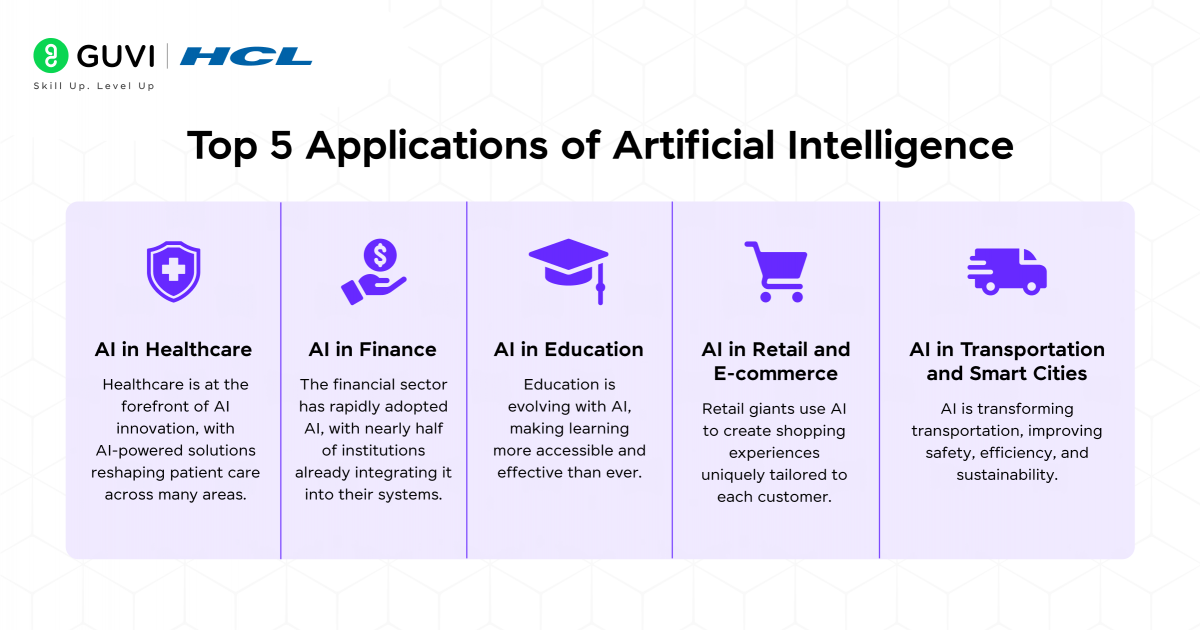
- 1) AI in Healthcare: Smarter Diagnosis and Patient Care
- 2) AI in Finance: Automation and Risk Management
- 3) AI in Education: Personalized and Scalable Learning
- 4) AI in Retail and E-commerce: Personalization at Scale
- 5) AI in Transportation and Smart Cities
- Concluding Thoughts…
- FAQs
- Q1. What are the key applications of AI in 2026?
- Q2. How is AI transforming healthcare?
- Q3. What role does AI play in financial services?
- Q4. How is AI personalizing the retail experience?
- Q5. What advancements has AI brought to transportation and urban planning?
Top Applications of Artificial Intelligence
AI has rapidly evolved from experimental technology to become deeply embedded in our everyday lives. Let’s discuss the most important ones at length:
1) AI in Healthcare: Smarter Diagnosis and Patient Care
Healthcare today stands at the forefront of artificial intelligence innovation, with AI-powered solutions reshaping patient care across multiple dimensions. Medical professionals increasingly rely on these technologies to enhance diagnosis accuracy, streamline treatments, and improve overall patient outcomes.
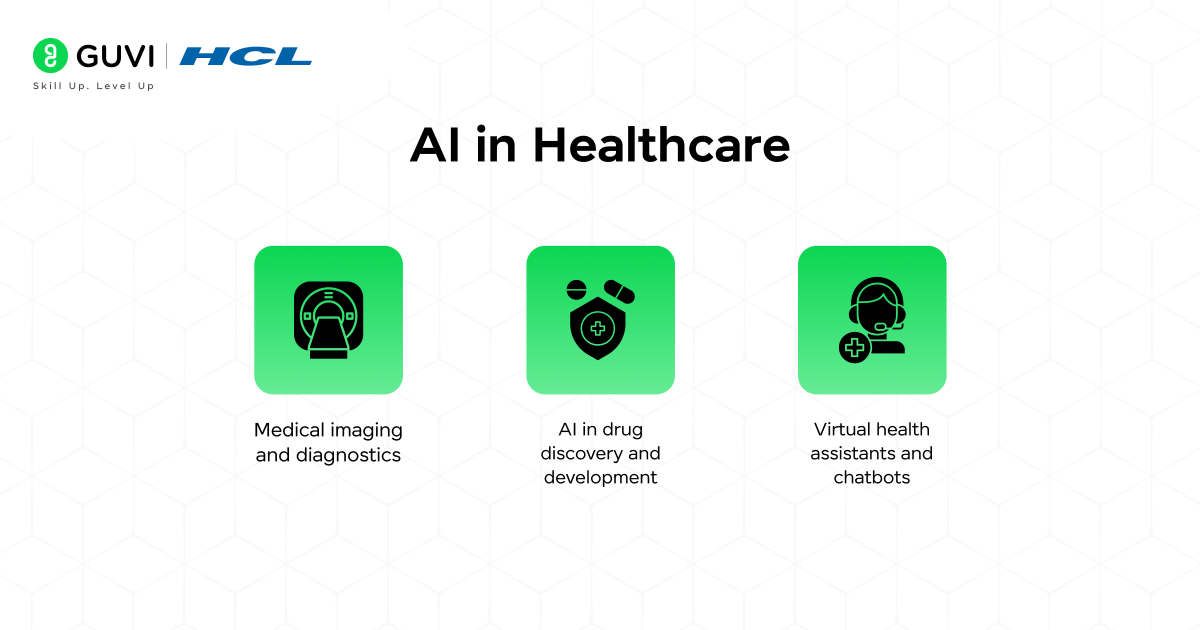
a) Medical imaging and diagnostics
- AI has become a game-changer in medical imaging analysis. These sophisticated systems can detect subtle abnormalities that human eyes might miss, enhancing diagnostic accuracy and efficiency.
- Through machine learning algorithms, AI rapidly analyzes complex radiological data like X-rays, MRIs, and CT scans with remarkable precision. Specifically, one study found AI software was “twice as accurate” as professionals at examining brain scans of stroke patients.
- The integration of AI into diagnostic imaging delivers tangible benefits beyond accuracy. First, it significantly speeds up image interpretation, reducing diagnostic time. Second, it enables consistent analysis regardless of practitioner fatigue or oversight. Third, it excels at identifying early-stage diseases through pattern recognition that traditional methods might overlook.
b) AI in drug discovery and development
- The pharmaceutical industry has witnessed an acceleration in research and development through applications of artificial intelligence. The FDA has recognized the significant increase in drug application submissions using AI components over recent years. These systems analyze vast datasets to identify potential drug candidates, predict their effects, and streamline development processes.
- AI algorithms effectively evaluate how patients might react to medical treatments by extracting data from electronic health records. Through this capability, healthcare providers can anticipate treatment responses, determine appropriate dosages, and assess prognoses. Consequently, the technology enables the identification of personalized treatment plans tailored to individual patients.
c) Virtual health assistants and chatbots
- AI-powered chatbots function as virtual health assistants (VHAs), offering continuous, personalized support through real-time conversations and tailored advice. These digital assistants provide patients with 24/7 access to essential health information and services, significantly improving the convenience and accessibility of care.
- Remarkably, one healthcare system reported 45% of their virtual assistant interactions happened outside business hours, demonstrating the need for round-the-clock access.
2) AI in Finance: Automation and Risk Management
The financial sector has witnessed a rapid acceleration in AI adoption, with nearly half of financial institutions already integrating AI into their systems. In fact, 93% of these organizations plan to invest in AI technologies within the next 2-5 years. This surge in implementation is reshaping how financial services operate, particularly in risk management and automation.
a) Fraud detection and prevention
- AI excels at identifying suspicious financial activities by analyzing millions of transactions in real-time. Unlike traditional methods, AI systems can learn to recognize the difference between legitimate transactions and potential fraud through pattern recognition. Indeed, these systems monitor transactions 24/7, catching trends that human agents might overlook.
- Companies like American Express have improved fraud detection by 6% using advanced AI models, while PayPal has enhanced real-time fraud detection by 10%.
b) AI-powered investment advisors
- Financial firms now use AI to manage client relationships and deliver personalized investment advice. For instance, AI-powered chatbots provide 24-hour service, answering frequently asked questions and handling routine tasks like appointment scheduling. Capital One implemented an AI assistant called Eno as early as 2017, which analyzes data to generate insights and anticipate customer needs.
- Furthermore, AI helps investment advisors identify areas of risk in client portfolios more efficiently. This technology enables advisors to align portfolios with clients’ risk tolerance levels and reduce potential losses.
c) Credit scoring and underwriting
- Traditional credit scoring relies on limited financial indicators, often failing to capture a complete picture of potential borrowers. AI-powered systems enhance this process by incorporating alternative data sources like utility payments, rent history, and banking transaction patterns. This approach provides a more comprehensive view of creditworthiness, especially for individuals with limited credit histories.
- AI credit assessment doesn’t just expand the pool of eligible borrowers—it also streamlines the underwriting process. Tasks that once took days or weeks can now be completed in minutes.
Machine learning algorithms simultaneously analyze hundreds of variables, identifying subtle patterns that human underwriters might miss.
3) AI in Education: Personalized and Scalable Learning
Education continues to evolve with cutting-edge applications of artificial intelligence, making learning more accessible and effective than ever before. Recent studies show that AI-enabled adaptive learning systems deliver learning content tailored to individual student needs, addressing specific learning problems.
a) Adaptive learning platforms
- AI-powered adaptive learning platforms personalize educational experiences based on individual learner progress and preferences. These systems analyze learner behavior, track progress, and adjust content dynamically to meet specific needs.
- Currently, these platforms can help students master concepts four times faster than traditional methods. Notably, AI algorithms identify weak areas in knowledge, creating personalized study schedules with scientifically optimized spacing between reviews.
b) AI tutors and virtual assistants
- Virtual AI tutors offer personalized guidance without giving direct answers. Khanmigo, for instance, challenges students to think critically by asking questions like “What do you think is the next step?” rather than providing solutions.
- This approach has proven effective, with 57% of students finding AI virtual teaching assistants useful in answering questions. Furthermore, these AI tutors help students gain a deeper understanding through interactive exercises such as chatting with historical characters or refining arguments.
c) Automated grading and feedback
AI-powered grading systems streamline assessment processes with remarkable efficiency. These tools provide:
- Immediate, detailed feedback on assignments
- Consistent evaluations free from human bias
- Pattern recognition to identify common student misconceptions
One educator reported that a task normally taking an hour was completed in 15 minutes using AI rubric generation.
AI is full of surprising stories and milestones that shaped the technology we use today:
The First AI Program Was Written in 1951: Christopher Strachey created a checkers-playing program, marking one of the earliest real implementations of AI on the Ferranti Mark I computer.
AI Once Beat a World Chess Champion: In 1997, IBM’s Deep Blue defeated Garry Kasparov, the reigning world chess champion—a landmark moment proving machines could outperform humans in complex strategic games.
These fun facts show how AI has evolved from simple rule-based programs to systems capable of mastering creativity, strategy, and even human-like conversation!

4) AI in Retail and E-commerce: Personalization at Scale
Retail giants are harnessing the potential of artificial intelligence to create shopping experiences that feel uniquely tailored to each customer. These applications of artificial intelligence enable retailers to analyze vast amounts of data and deliver personalization at an unprecedented scale.
a) Product recommendations using AI
- AI-powered recommendation systems analyze customer data, including past purchases, browsing behavior, and preferences, to suggest products customers are likely to purchase. These intelligent systems drive an average of 44% of repeat purchases worldwide.
- Through machine learning algorithms, retailers can identify patterns across thousands of shopping sessions to recommend complementary products or introduce customers to new items they might enjoy.
- First, this boosts customer satisfaction by making shoppers feel understood. Next, it improves engagement by keeping customers on websites longer. Finally, it enhances customer retention, as 56% of online shoppers are more likely to return to sites offering personalized recommendations.
b) Inventory and demand forecasting
- Advanced AI forecasting tools analyze multiple data sources—historical sales, weather patterns, economic indicators, and seasonal trends—to predict future demand with remarkable accuracy. This capability allows retailers to optimize inventory levels, reducing both stockouts and excess inventory costs.
- Beyond basic forecasting, AI can detect irregularities in inventory patterns that might indicate issues requiring attention. Through these applications of artificial intelligence, businesses have achieved 4.8% revenue increases while simultaneously reducing manufacturing and logistics costs by nearly 20%.
c) AI chatbots for customer service
- Retail chatbots now automate up to 80% of routine support tasks, providing instant responses to customer queries 24/7. These intelligent assistants collect customer information upfront, adding relevant tags to incoming tickets so human agents have proper context when needed.
- Companies implementing AI-powered customer service report 90% faster complaint resolution. During interactions, chatbots gather valuable data about customer preferences and pain points, generating actionable insights that businesses can use to improve overall shopping experiences.
5) AI in Transportation and Smart Cities
Transportation systems are undergoing radical change through applications of artificial intelligence that improve safety, efficiency, and sustainability. From autonomous vehicles to intelligent traffic control, these innovations are creating smarter, more connected cities.
a) Self-driving vehicles and route optimization
- Level 4 autonomous vehicles are now expanding in logistics and commercial operations as regulations evolve to support this technology. These self-driving systems leverage AI to navigate complex urban environments safely.
- Route optimization AI significantly enhances efficiency—reducing travel times, cutting fuel costs, and minimizing empty miles from 30% to between 10-15%. Presently, AI-powered tools can optimize routes with 120 stops in just seconds, detect objects, balancing parameters like urgent deliveries and distance.
b) AI in traffic management systems
- AI-based traffic signal control reduces congestion by dynamically adjusting green time allocation based on real-time conditions. In Denmark, this approach has improved average waiting times by 5-10%.
- Additionally, systems in Prague use AI to create green waves for busy directions while ensuring other routes receive adequate service. These intelligent systems prioritize different transportation modes like buses and trams according to current traffic demands.
c) AI-powered logistics and delivery
Logistics companies use AI to analyze large volumes of customer data, identifying trends and predicting future demand. Subsequently, this enables:
- Real-time tracking with precise ETAs
- Proactive problem resolution for delays
- Grouping of nearby deliveries to reduce trips
- Dynamic rerouting when unexpected issues arise
Elevate your AI journey with HCL GUVI’s intel and IIT-M Pravartak-certified Artificial Intelligence & Machine Learning Course—a 5‑month, mentor‑led course packed with live classes, hands‑on projects (like gesture recognition and NER systems), and global certification to help you launch a career in AI, ML, Generative AI, and MLOps in 2026.
Concluding Thoughts…
Artificial intelligence has undoubtedly changed how you interact with technology across every aspect of life. Throughout this guide, you’ve seen how applications of artificial intelligence stretch far beyond simple automation, creating entirely new possibilities for businesses and individuals alike.
The rapid growth of AI adoption speaks volumes—from 55% to 78% of organizations within just one year. This explosion of implementation comes as no surprise when you consider the tangible benefits AI delivers.
Therefore, understanding these applications of artificial intelligence now gives you a valuable advantage regardless of your field. Whether you’re a healthcare professional, educator, financial advisor, or retail entrepreneur, AI tools can help you work more efficiently and deliver better results.
Above all, AI technology works best when it enhances human capabilities rather than replacing them. Good Luck!
FAQs
Q1. What are the key applications of AI in 2026?
AI is being widely used across various sectors including healthcare for smarter diagnosis, finance for risk management, education for personalized learning, retail for customer experience enhancement, and transportation for optimizing traffic and logistics.
Q2. How is AI transforming healthcare?
AI is revolutionizing healthcare through improved medical imaging analysis, accelerated drug discovery, virtual health assistants, and predictive analytics for disease prevention. These applications are enhancing diagnostic accuracy and personalizing patient care.
Q3. What role does AI play in financial services?
In finance, AI is crucial for fraud detection, providing personalized investment advice, enhancing credit scoring and underwriting processes, and enabling automated decision-making in trading. These applications are improving risk management and operational efficiency.
Q4. How is AI personalizing the retail experience?
AI in retail offers personalized product recommendations, accurate inventory and demand forecasting, AI-powered chatbots for customer service, and dynamic pricing strategies. These tools create tailored shopping experiences and optimize business operations.
Q5. What advancements has AI brought to transportation and urban planning?
AI is driving the development of self-driving vehicles, optimizing routes for efficiency, improving traffic management systems, enhancing logistics and delivery services, and contributing to smart infrastructure and energy management in cities.
Success Stories

About the Author
Jaishree Tomar
A recent CS Graduate with a quirk for writing and coding, a Data Science and Machine Learning enthusiast trying to pave my own way with tech. I have worked as a freelancer with a UK-based Digital Marketing firm writing various tech blogs, articles, and code snippets. Now, working as a Technical Writer at GUVI writing to my heart’s content!
View all posts by Jaishree Tomar
Connect with me @











Did you enjoy this article?