


Software Development Articles
How to Read and Understand System Design Diagrams?
System Engineer Roles and Responsibilities: 12 Proven Duties for Growth
SAP Consultant Roles and Responsibilities: 12 Proven Duties for Growth and Success
Network Engineer Roles and Responsibilities: 12 Essential Duties for Success


Get In Touch For Details! Request More Information
What is the Software Development Life Cycle (SDLC)?
Mar 11, 2026 5 Min Read 3286 Views
(Last Updated)
Have you ever wondered what actually goes into building an app you use every day? It’s not just brilliant ideas and late-night coding sessions, it’s a carefully structured process that takes software from a rough concept to a fully functioning product.
That process has a name: the Software Development Life Cycle, or SDLC. Whether you’re a student trying to crack your next interview, a fresher stepping into the tech world, or a professional looking to sharpen your fundamentals, understanding SDLC is non-negotiable.
In this article, you’ll learn what SDLC is, how each phase works, which model suits which project, and the best practices that keep real-world teams on track. So, without further ado, let us get started!
Quick Overview:
SDLC is a structured 7-phase framework that guides software teams from idea to deployment. The phases are: Planning → Requirements → Design → Development → Testing → Deployment → Maintenance.
Table of contents
- What Is the Software Development Life Cycle (SDLC)?
- Why is SDLC Important?
- The 7 Phases of the Software Development Life Cycle
- Phase 1: Planning & Requirement Analysis
- Phase 2: Defining Requirements (SRS)
- Phase 3: System Design
- Phase 4: Development (Coding)
- Phase 5: Testing & QA
- Phase 6: Deployment
- Phase 7: Maintenance
- What are the Popular SDLC Models: Which One Should You Use?
- Waterfall Model
- Agile Model
- Spiral Model
- V-Model (Verification & Validation Model)
- SDLC Models at a Glance
- What are the SDLC Best Practices You Should Follow
- What is the Future of SDLC: What's Changing?
- Conclusion
- FAQs
- What is the main goal of SDLC?
- What is the difference between SDLC and STLC?
- Which SDLC model is best for beginners or small projects?
- How long does the SDLC process take?
- What skills do you need to work effectively within an SDLC team?
What Is the Software Development Life Cycle (SDLC)?
The Software Development Life Cycle (SDLC) is a structured framework that software teams follow to plan, design, build, test, deploy, and maintain software systematically and with quality control built in at every stage.
Think of it as a project blueprint. Without it, development becomes chaotic, with missed deadlines, buggy releases, and products that don’t match what the user actually wanted.
SDLC solves that by breaking a complex process into clear, manageable phases so every stakeholder, from developers to clients, stays aligned from day one to deployment.
According to the Standish Group’s CHAOS Report, projects that follow a structured development process are 2.5x more likely to succeed than those that don’t.
Why is SDLC Important?
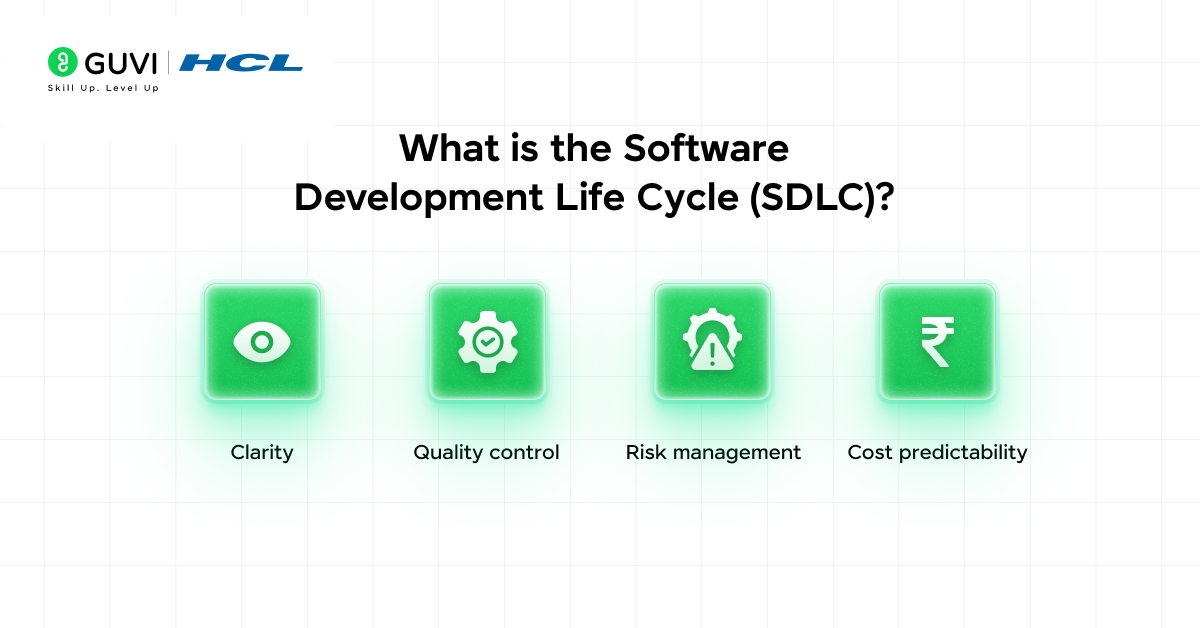
SDLC isn’t just a theoretical concept, it’s what separates amateur projects from production-grade software. Here’s what it actually gives you:
- Clarity: Everyone on the team knows what’s being built, why, and by when.
- Quality control: Testing isn’t an afterthought; it’s baked into the process.
- Risk management: Potential problems get spotted during planning, not after launch.
- Cost predictability: Timelines and budgets are estimated early, so surprises are minimized.
Read More: Proven 2026 Software Development Roadmap
The 7 Phases of the Software Development Life Cycle
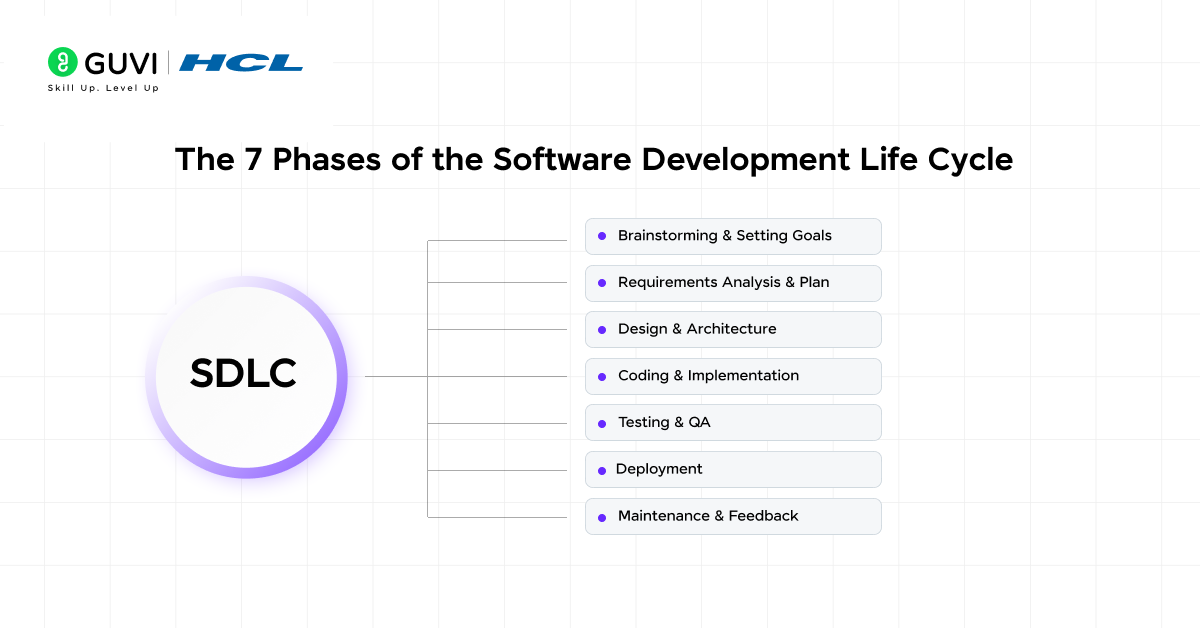
SDLC breaks the entire development journey into sequential phases, each with a specific goal and a defined output. Here’s how it flows from start to finish.
Phase 1: Planning & Requirement Analysis
This is where everything begins. Before a single line of code is written, the team defines what is being built and why. Stakeholders, project managers, and senior engineers come together to conduct feasibility studies, technical, financial, and operational, and set the project scope.
- Key activities: Feasibility study, resource allocation, cost estimation, risk identification
- Output: Project Plan, Feasibility Report
Phase 2: Defining Requirements (SRS)
Once the plan is approved, the team gets granular. Every functional and non-functional requirement is documented in a Software Requirement Specification (SRS) document, essentially the “contract” between the client and the development team.
- Key activities: Gathering requirements from clients and end-users, documenting use cases
- Output: SRS Document
- Key players: Business Analysts, Product Owners
Phase 3: System Design
Requirements are now translated into a technical blueprint. This phase happens at two levels — High-Level Design (HLD), which covers overall architecture and technology stack, and Low-Level Design (LLD), which gets into component logic, API interfaces, and database schemas.
- Output: Design Document Specification (DDS)
- Key players: System Architects, Lead Developers
Phase 4: Development (Coding)
This is the phase most people picture when they think of software development. Developers write code based on the design documents, usually split into modules for easier management and parallel progress.
- Tools commonly used: Git (version control), VS Code / IntelliJ (IDEs), Jira (task tracking)
- Output: Source code, executable software
- Key players: Frontend, Backend, and Full Stack Developers
Phase 5: Testing & QA
Coded software is handed off to the QA team, whose job is simple: find every bug before the user does. Testing happens across multiple levels to ensure the product works correctly, securely, and at scale.
| Test Type | What It Checks |
| Unit Testing | Individual functions and components |
| Integration Testing | How modules interact with each other |
| System Testing | End-to-end application behavior |
| User Acceptance Testing (UAT) | Whether it meets real business needs |
- Output: Bug Reports, Test Cases, Quality Report
- Key players: QA Engineers, Testers
Phase 6: Deployment
Once QA signs off, the software goes live. In modern teams, this is automated through CI/CD pipelines (Continuous Integration / Continuous Deployment), making releases faster and more reliable than ever.
- Key activities: Production environment setup, deployment, smoke testing
- Output: Live Application
- Key players: DevOps Engineers, Release Managers
Phase 7: Maintenance
The SDLC doesn’t end at launch, that’s a common misconception. Post-deployment, the team monitors performance, fixes bugs, patches security vulnerabilities, and rolls out new features based on user feedback.
- Output: Patches, Updates, New Versions
- Key players: Support Engineers, Backend Developers
On average, software maintenance accounts for 60–80% of total software costs over a product’s lifetime. Building it right from Phase 1 directly reduces how much you spend here.
What are the Popular SDLC Models: Which One Should You Use?
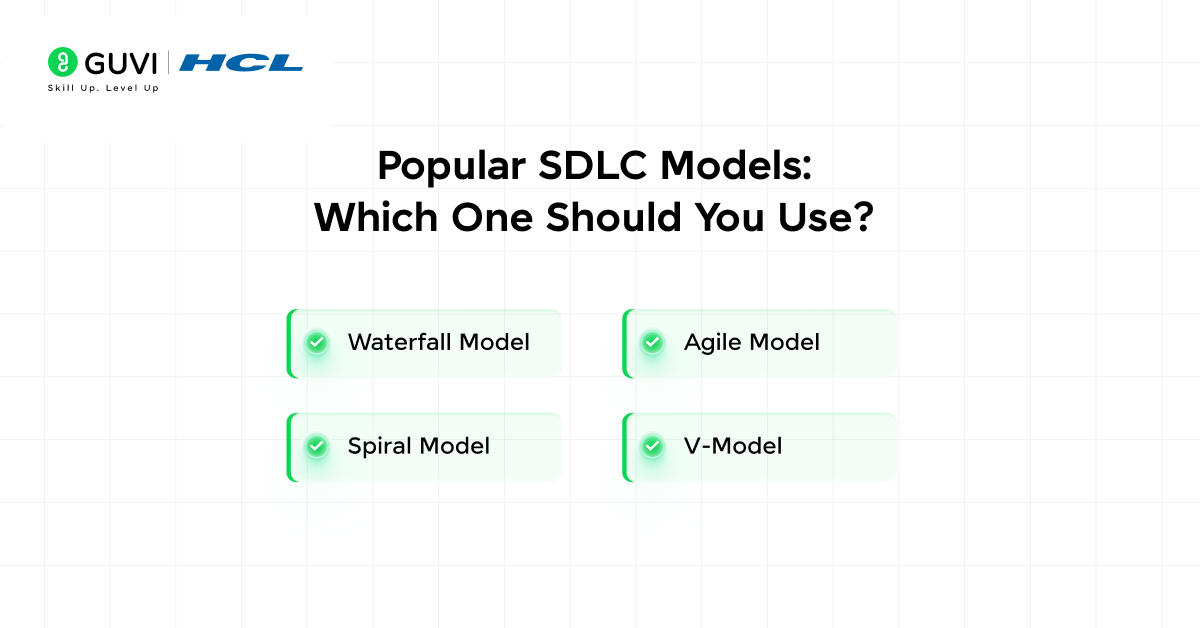
Not all software projects are built the same way. SDLC models define how you move through those 7 phases: sequentially, iteratively, or in parallel. Choosing the right model can make or break a project. Here are the 4 most widely used ones.
1. Waterfall Model
The Waterfall model is the oldest and most straightforward approach. You complete one phase fully before moving to the next, like water flowing downward; there’s no going back upstream. Every requirement is locked in upfront, and the team follows the plan from start to finish.
It works beautifully when you know exactly what you’re building. The problem? In real-world software development, requirements change, and the waterfall model doesn’t handle change well. If a client changes their mind in Phase 4, you’re in trouble.
- Best for: Government systems, banking software, infrastructure projects, anywhere requirements are fixed and documented from day one
- Avoid if: Your project is exploratory, or the client is likely to change requirements mid-way
- Real-world example: Building a payroll system for a large organization where compliance rules are fixed and well-documented
2. Agile Model
Agile is the dominant model in modern software development, and for good reason. Instead of delivering everything at the end, Agile breaks the project into small cycles called sprints (typically 2–4 weeks). At the end of each sprint, you have a working, testable piece of software. Feedback is gathered, adjustments are made, and the next sprint begins.
Agile thrives on collaboration between developers, designers, testers, and clients, all working together continuously rather than handing off documents between isolated teams. Frameworks like Scrum and Kanban operate within the Agile model to give teams a practical day-to-day structure.
- Best for: Startups, product companies, mobile apps, SaaS platforms, any project where requirements evolve and speed to market matters
- Avoid if: You’re working on a heavily regulated project that demands extensive documentation upfront (e.g., medical devices, defense systems)
- Real-world example: A startup building a food delivery app: features ship fast, user feedback shapes the next sprint, and the product improves continuously

3. Spiral Model
The Spiral model is what you use when the stakes are high and you can’t afford to get it wrong. It combines elements of both Waterfall (structured phases) and iterative development (repeating cycles), with one critical addition: formal risk analysis at every loop.
Picture a spiral, each loop represents a complete cycle of planning, risk analysis, engineering, and evaluation. The software grows more complete with each loop, and at every turn, the team asks: “What could go wrong, and how do we prevent it?” It’s thorough, deliberate, and expensive, but for the right project, it’s worth every rupee.
- Best for: Large-scale, high-risk, long-duration projects, aerospace software, healthcare systems, defense technology
- Avoid if: You have a small team, a tight budget, or a short timeline. The overhead of constant risk analysis isn’t worth it for simple projects.
- Real-world example: Developing software for a hospital’s patient management system where a bug could have life-or-death consequences
4. V-Model (Verification & Validation Model)
The V-Model is best understood as a waterfall with a testing mirror. Every development phase on the left side of the “V” has a corresponding testing phase on the right side, planned simultaneously. So while developers are writing code in the Development phase, QA engineers are already preparing test cases for that exact code.
This parallel planning means bugs are caught far earlier, and the product that comes out the other end is significantly more reliable. The tradeoff? It’s rigid. Once a phase is signed off, going back to change requirements is painful and costly.
- Best for: Projects where quality and reliability are non-negotiable: medical devices, aviation software, safety-critical embedded systems
- Avoid if: Your project needs flexibility or is likely to evolve during development
- Real-world example: Software controlling an aircraft’s autopilot system, every line of code needs a verified test before it ever gets close to a real aircraft
SDLC Models at a Glance
| Model | Flexibility | Speed | Best Use Case | Cost of Change |
| Waterfall | Low | Slow | Fixed, well-documented requirements | High |
| Agile | High | Fast | Evolving requirements, fast delivery | Low |
| Spiral | Medium | Medium | High-risk, complex, long-term projects | Medium |
| V-Model | Low | Slow | Safety-critical, quality-first systems | High |
Summary: If you’re building something with changing requirements, go Agile. If requirements are locked and compliance matters, go Waterfall or V-Model. If the project is complex, expensive, and high-risk, Spiral is your safety net.
What are the SDLC Best Practices You Should Follow
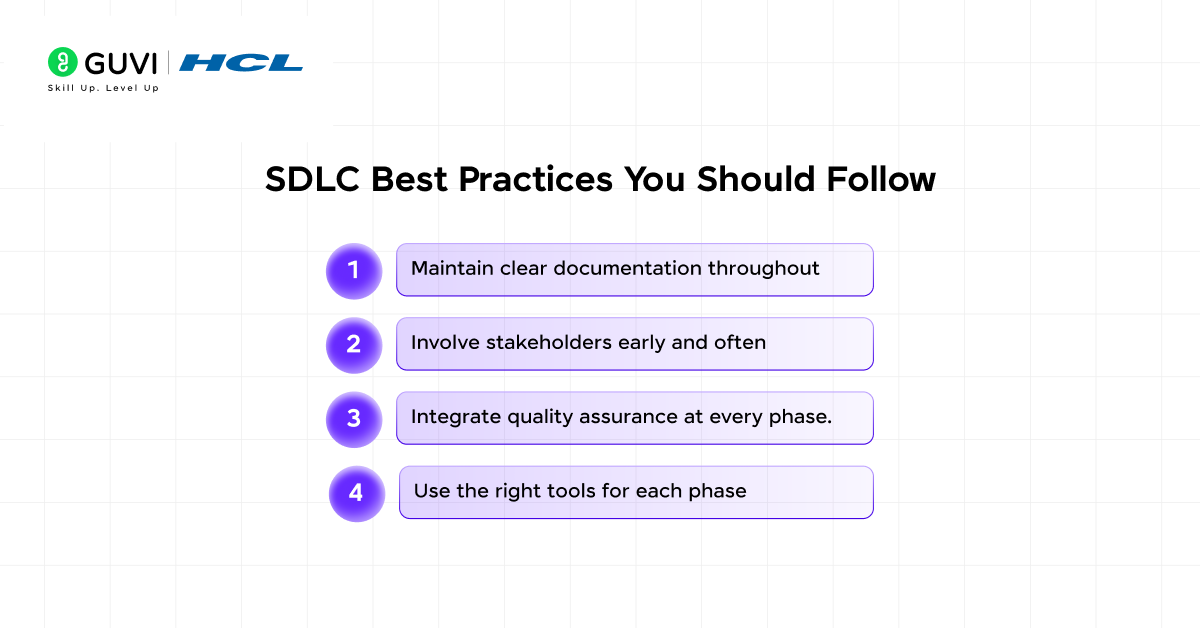
Knowing the phases and models is only half the job. How you execute within those phases is what separates good teams from great ones.
- Maintain clear documentation throughout. Documentation isn’t just for Phase 2, it should live and grow across every phase. It helps new team members onboard faster and prevents knowledge from walking out the door.
- Involve stakeholders early and often. Don’t wait until the UAT phase to show clients what you’ve built. Early feedback loops prevent costly reworks and ensure the final product actually solves the right problem.
- Integrate quality assurance at every phase. QA isn’t a Phase 5 activity, it’s a mindset. Run code reviews during development, validate designs before coding, and test assumptions during planning.
- Use the right tools for each phase. Jira for project tracking, GitHub for version control, Selenium or Postman for testing, Jenkins for CI/CD, the right toolset amplifies every phase of the SDLC.
What is the Future of SDLC: What’s Changing?
SDLC isn’t static; it’s evolving fast. Two shifts are worth knowing right now.
- First, DevSecOps is integrating security directly into every SDLC phase instead of bolting it on at the end, meaning vulnerabilities are caught earlier and fixed more cheaply.
- Second, AI-assisted development tools like GitHub Copilot and Cursor are accelerating the coding phase significantly, letting developers write and review code faster than ever.
These aren’t future trends, they’re already standard practice in modern software teams.
If you’re serious about mastering software development along with AI and want to apply it in real-world scenarios, don’t miss the chance to enroll in HCL GUVI’s IITM Pravartak and MongoDB Certified Online AI Software Development Course. Endorsed with NSDC certification, this course adds a globally recognized credential to your resume, a powerful edge that sets you apart in the competitive job market.
Conclusion
In conclusion, the Software Development Life Cycle is the foundation on which every software project, big or small, is built. From the first planning meeting to the last maintenance patch, SDLC gives your team a shared language, a clear process, and a quality bar that keeps everyone accountable.
If you’re entering the software world, understanding SDLC isn’t just exam prep; it’s the mental model that’ll help you collaborate, communicate, and build better. Pick the right model for your project, follow the phases with discipline, and treat quality as a habit rather than a checkpoint. That’s how great software gets made.
FAQs
1. What is the main goal of SDLC?
The main goal of SDLC is to produce high-quality software that meets user requirements, is delivered on time, and stays within budget, through a structured, repeatable process.
2. What is the difference between SDLC and STLC?
SDLC (Software Development Life Cycle) covers the entire software development process, from planning to maintenance. STLC (Software Testing Life Cycle) is a subset that focuses specifically on the testing activities within SDLC.
3. Which SDLC model is best for beginners or small projects?
Agile is a great starting point for small, evolving projects. For a very small project with clear requirements, even a lightweight Waterfall approach works well.
4. How long does the SDLC process take?
It depends entirely on project scope; a small app might take 4–8 weeks; a complex enterprise system can take 1–3 years. Agile breaks this down into shorter sprint-based deliveries.
5. What skills do you need to work effectively within an SDLC team?
Communication, problem-solving, domain knowledge relevant to your role (coding, testing, design, project management), and familiarity with tools like Jira, Git, and CI/CD platforms.
Success Stories

About the Author
Lukesh S
A professional content writer who has experience in freelancing and now working as a Technical Content Writer at HCL GUVI having sound knowledge in Blog Writing and Creative Writing!
View all posts by Lukesh S
Connect with me @







Did you enjoy this article?