


Data Structure Articles
Sliding Window Technique: Explained with Examples
Two Pointer Technique: Problems and Applications

Get In Touch For Details! Request More Information

What are Data Structures and Algorithms? Beginner Guide with Examples (2026)
Jul 23, 2026 4 Min Read 11088 Views
(Last Updated)
What are DSA, in short? Data structures are the ways you organize and store data (arrays, stacks, trees). Algorithms are the step-by-step logic you use to work with that data. Together, they decide how fast and how well your code performs, which is exactly why every top tech company tests for them.
In this article, we’ll uncover what data structures and algorithms are, why they matter, and how you can start mastering them to become a more effective problem-solver and engineer. So, without further ado, let us get started!
Table of contents
- TL;DR Summary
- What Are Data Structures?
- What Are Algorithms?
- Common Data Structures at a Glance
- Why DSA Is Important for Getting a Job at Top Companies
- DSA vs Programming Languages: What Comes First?
- DSA Roadmap for Beginners
- Common Mistakes Beginners Make
- Conclusion
- FAQs
- What are data structures and algorithms in simple words?
- Do I need to learn a programming language before DSA?
- Which data structure should I learn first?
- Is DSA only useful for interviews?
- How long does it take to learn DSA as a beginner?
- Can I learn DSA without a computer science degree?
- What's the difference between time complexity and space complexity?
TL;DR Summary
- A data structure organizes and stores data so you can access it efficiently.
- An algorithm is the step-by-step logic used to process that data and solve a problem.
- Data structures and algorithms work as a pair: the structure holds the data, the algorithm acts on it.
- Companies like Google, Amazon, and Microsoft test DSA in interviews because it shows how you think, not just how you code.
- You don’t need a specific programming language to start DSA. You need the concepts first, then apply them in any language.
What Are Data Structures?
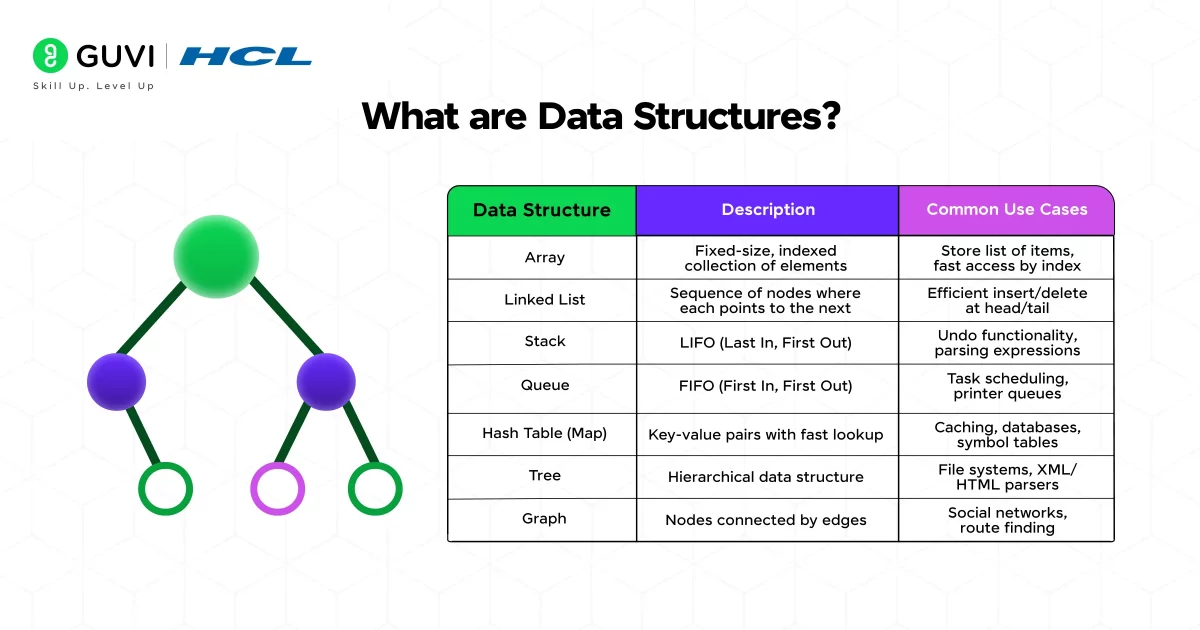
A data structure is a way to store and arrange data so your program can use it efficiently. Think of it like choosing the right container for a job.
- A stack works like a pile of plates. You only add or remove from the top.
- A queue works like a line at a ticket counter. First person in, first person served.
- A hash map works like a labeled filing cabinet. You look things up by a key, not by searching one by one.
Picking the right one changes how fast your app runs. Use the wrong structure, and even simple tasks slow down as your data grows.
What Are Algorithms?
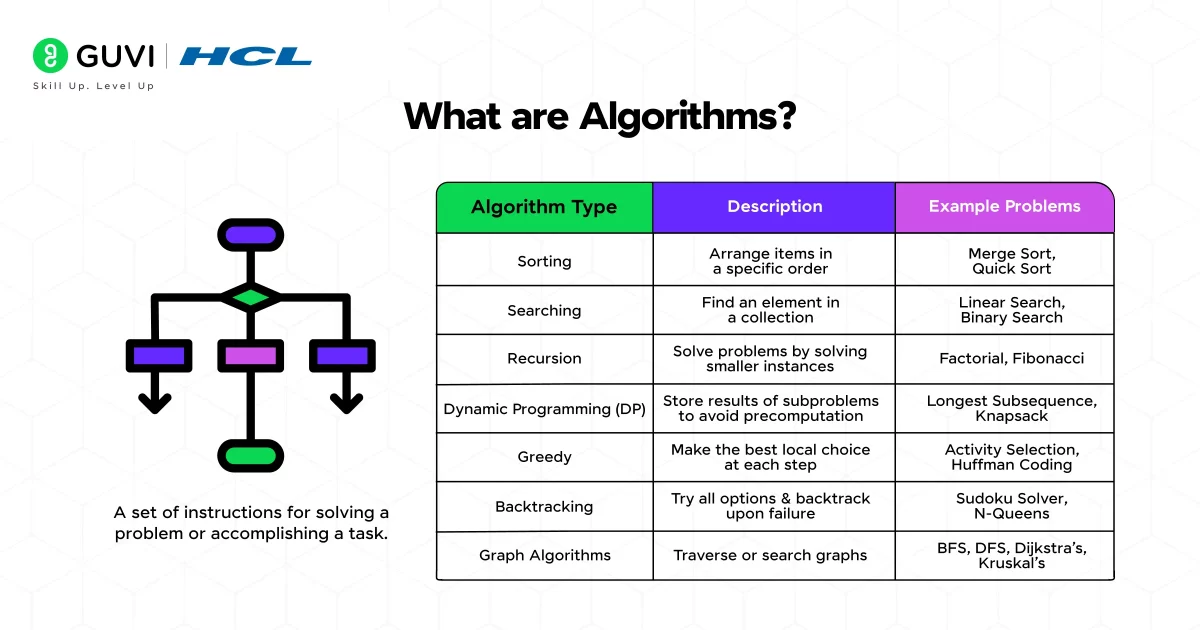
An algorithm is the set of steps you follow to solve a problem or complete a task. If the data structure is the container, the algorithm is the instruction manual for using it.
You already use algorithms daily without noticing. Sorting your contacts alphabetically, searching for a song in a playlist, or finding the fastest route home all rely on one.
A good algorithm should be:
- Correct – it works for every valid input, not just the easy cases
- Efficient – it doesn’t waste time or memory
- Scalable – it still performs well as data grows
- Easy to follow – so others (and future you) can maintain it
Common Data Structures at a Glance
| Data Structure | Used For | Time Complexity (Search) | Real Example |
|---|---|---|---|
| Array | Storing ordered items with fast index access | O(n) | Storing daily stock prices |
| Linked List | Frequent insertions and deletions | O(n) | Browser’s back and forward history |
| Stack | Last-in, first-out tasks | O(n) | Undo feature in a text editor |
| Queue | First-in, first-out tasks | O(n) | Print job scheduling |
| Hash Map | Fast lookups by key | O(1) average | Autocomplete suggestions |
| Tree | Hierarchical data | O(log n) | File folders on your computer |
| Graph | Connected data and networks | O(V+E) | Instagram’s “suggested for you” feed |
Notice how the choice always ties back to the problem. There’s no single “best” data structure, only the one that fits the job.
Why DSA Is Important for Getting a Job at Top Companies
Recruiters at product-based companies rarely ask you to build a full app in an interview. They ask you to solve a DSA problem on a whiteboard or a coding platform, and here’s why.
- It tests how you break down a problem, not just whether you can type code.
- It shows whether you can write solutions that stay fast as data scales from 100 rows to 100 million.
- It reveals your understanding of trade-offs, like choosing speed over memory or the reverse.
- It’s language-agnostic, so companies can evaluate candidates from different backgrounds fairly.
This is exactly why interview rounds at companies like Google, Amazon, and most Indian product startups lean so heavily on DSA rounds before they even look at your resume’s tech stack.
DSA vs Programming Languages: What Comes First?
This confuses a lot of beginners, so let’s clear it up.
A programming language is the tool you use to write code. DSA is the thinking behind what you write. You can learn a language and still write inefficient code if you don’t understand DSA.
Here’s a simple way to decide your order:

- If you’ve never written a line of code, learn one language first (Python is a common beginner choice) until you’re comfortable with loops, functions, and basic syntax.
- Once you can write simple programs, start DSA using that same language instead of jumping to a new one.
- Don’t wait to “master” a language before touching DSA. Basic fluency is enough.
DSA concepts themselves don’t change across languages. An array behaves the same whether you write it in Python, Java, or C++. Only the syntax changes.
DSA Roadmap for Beginners

You don’t need to learn everything at once. Follow this order to avoid overwhelm.
- Complexity basics – Understand Big O notation before anything else. It tells you how to measure if code is actually efficient.
- Arrays and strings – The foundation almost every other structure builds on.
- Linked lists, stacks, and queues – Learn how data moves and connects.
- Searching and sorting – Binary search, merge sort, and quick sort come up constantly in interviews.
- Trees and hash maps – Move into hierarchical data and fast lookups.
- Graphs and recursion – Tackle these once the basics feel natural.
- Dynamic programming and greedy algorithms – Save these for last since they build on everything above.
Google Search, Uber’s routing system, and your Instagram feed all run on data structures and algorithms working in milliseconds behind the scenes. Every time an app feels “instant,” there’s a well-chosen data structure making that happen.
Common Mistakes Beginners Make
- Jumping straight to hard problems: Many beginners try LeetCode “hard” questions too soon. Start easy, and build pattern recognition first.
- Memorizing instead of understanding: Copying a solution without knowing why it works won’t help in a live interview.
- Skipping complexity analysis: A working solution isn’t the same as an efficient one. Always check the time and space cost.
- Learning DSA and a new language at the same time: This doubles the learning curve. Get comfortable with syntax first.
Start small, stay consistent, and give yourself time to build the pattern recognition that makes DSA click. Want structured guidance instead of figuring it out alone? HCL GUVI’s Data Structures and Algorithms Course with Python covers DSA across Python, Java, C, and JavaScript with IIT-M Pravartak certification.
Conclusion
Data structures and algorithms aren’t just interview material. They’re the foundation for writing software that actually scales. Once you understand how to organize data and process it efficiently, you start thinking like an engineer, not just someone who follows tutorials.
FAQs
What are data structures and algorithms in simple words?
Data structures are ways to store data efficiently. Algorithms are the steps used to process that data and solve problems.
Do I need to learn a programming language before DSA?
You need basic comfort with one language, like writing loops and functions, before starting DSA. You don’t need to master it first.
Which data structure should I learn first?
Start with arrays and strings. They’re the base for almost every other structure you’ll learn later.
Is DSA only useful for interviews?
No. DSA affects how well real software performs, from app load times to how systems handle millions of users.
How long does it take to learn DSA as a beginner?
With 1 to 2 hours of daily practice, most beginners build a solid foundation in 3 to 4 months.
Can I learn DSA without a computer science degree?
Yes. DSA is concept-based, not degree-based. Consistent practice matters more than your educational background.
What’s the difference between time complexity and space complexity?
Time complexity measures how fast your code runs as input grows. Space complexity measures how much memory it uses.
Success Stories

About the Author
Lukesh S
A professional content writer who has experience in freelancing and now working as a Technical Content Writer at HCL GUVI having sound knowledge in Blog Writing and Creative Writing!
View all posts by Lukesh S
Connect with me @








Did you enjoy this article?