


Career Articles
Capgemini Exceller Placement Papers and Solutions 2026 - Best Guide
Accenture Selection Process 2026: Full 6-Stage Guide to Crack Every Round
Accenture ASE 2026: Assessment Pattern, Rounds & the Best Preparation Guide
Accenture ASE & Advanced ASE Interview Experience 2026: Complete Guide


Get In Touch For Details! Request More Information
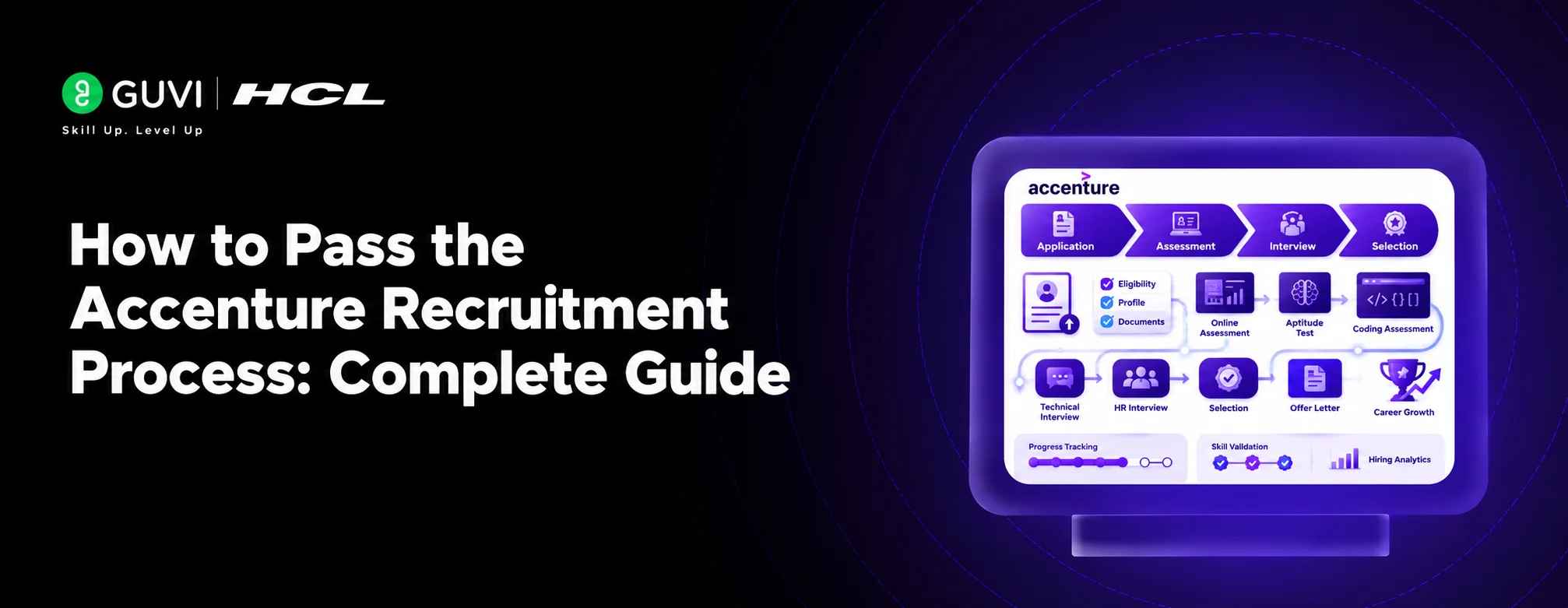
How to Pass the Accenture Recruitment Process 2026/27: The Complete Guide
Sep 16, 2026 7 Min Read 19 Views
(Last Updated)
Table of contents
- TL;DR
- What Is the Accenture Recruitment Process 2026/27?
- How to Clear the Accenture Recruitment Process 2026/27
- Find the Right Accenture Job
- Application and Resume Screening
- Online Assessment
- Technical Interview
- Behavioural or HR Interview
- Final Selection and Offer
- How to Prepare for Each Accenture Recruitment Process Round?
- Build Your Technical Foundation
- Practice Under Time Pressure
- Prepare Your Project Explanation
- Practice Communication
- Accenture Assessment Preparation Strategy
- What Does Accenture Look for in a Technical Assessment?
- A Simple Assessment Practice Framework
- How to Handle Coding Questions?
- Accenture Interview Preparation Strategy
- Use the STAR Method for Behavioural Questions
- Prepare for “Why Accenture?”
- Prepare for Project-Based Questions
- Accenture Recruitment Process 2027: How Should Freshers Prepare?
- 6-12 Months Before Applying
- 3 Months Before Applying
- 1 Month Before the Process
- A 30-Day Accenture Preparation Plan
- Accenture Hiring Process vs Your Preparation Strategy
- Real-World Examples of Accenture Recruitment Process
- Example 1: Software Engineering Fresher
- Example 2: Business-Oriented Candidate
- Common Mistakes to Avoid in Accenture Recruitment Process
- Preparing From Random Question Lists
- Ignoring Your Resume
- Treating Coding as the Entire Process
- Memorising Interview Answers
- Ignoring Assessment Instructions
- Build Job-Ready Skills With HCL GUVI
- Concluding Thoughts
- Frequently Asked Questions
- What is the Accenture recruitment process 2026?
- Is the Accenture hiring process the same for every role?
- How can I prepare for Accenture recruitment 2026?
- What should I study for Accenture assessment preparation?
- How should I prepare for an Accenture technical interview?
- How can I improve my Accenture interview preparation?
- How long does an Accenture technical assessment take?
- Can I retake an Accenture assessment?
- What should I do if I am preparing for Accenture recruitment 2027?
- Does Accenture charge candidates for recruitment?
TL;DR
The Accenture recruitment process 2026/27 varies by role, experience level, and hiring program. Key points include:
- Apply for a suitable Accenture role and submit a targeted resume.
- Complete profile screening and shortlisting.
- Take an online assessment if required, which may test coding, logical reasoning, problem-solving, or role-specific skills.
- Attend one or more technical interviews, depending on the position.
- Complete a behavioural or HR interview focused on communication, teamwork, motivation, and role fit.
- Receive the final selection decision and offer if successful.
- Prepare by studying the job description, practising relevant technical skills, solving timed assessment questions, and preparing clear project-based and behavioural answers.
- Some Accenture assessments typically take 30-90 minutes, but the exact format, duration, and requirements are confirmed in the assessment invitation.
A strong Accenture application is not built in a single day or decided by one coding test. It is shaped by how well you understand the role, apply your skills, explain your thinking, and respond to real workplace situations.
The Accenture recruitment process 2026/27 can vary depending on the position, experience level, and hiring programme. Some roles may include online assessments, while others may focus more on interviews, technical discussions, or role-specific evaluations. Technical assessments can test problem-solving, logical reasoning, applied technical knowledge, and coding skills.
This guide breaks down the Accenture recruitment process, explains what to expect at each stage, shares practical assessment and interview preparation strategies, highlights common mistakes, and includes a 30-day Accenture preparation plan.
What Is the Accenture Recruitment Process 2026/27?
The Accenture recruitment process is the series of screening, assessment, interview, and selection activities used to evaluate candidates for a specific Accenture role.
The exact process depends on the job. Accenture’s official recruiting page describes the journey as application confirmation, application review, recruiter contact, interviews, skills assessment where applicable, and an offer for selected candidates.
For students and freshers, the process can commonly be understood through these stages:
| Stage | What You Can Expect | How to Prepare |
| 1. Application | Resume and eligibility screening | Tailor your resume to the job |
| 2. Shortlisting | Recruiter reviews your profile | Highlight relevant skills and projects |
| 3. Online Assessment | Technical, cognitive, coding, or role-related assessment where applicable | Practise timed questions |
| 4. Technical Interview | Skills, projects, programming, and problem-solving | Revise fundamentals and projects |
| 5. Behavioural/HR Interview | Communication, motivation, teamwork, and role fit | Prepare structured answers |
| 6. Final Selection | Offer and joining-related communication | Verify all documents and details |
Important: These six stages are a Accenture Recruitment Process and framework, not a guaranteed six-round pattern. Accenture says the number of interviews depends on the role, and some positions may include an online activity to assess technical skills, strengths, or decision-making.
How to Clear the Accenture Recruitment Process 2026/27
1. Find the Right Accenture Job
Your preparation should start before you submit the application.
Accenture recruits across areas such as technology, consulting, operations, AI and analytics, cybersecurity, digital engineering, and other business functions.
Its careers site also separates opportunities for students, early-career professionals, experienced professionals, and other career stages.
Before applying, check:
- Job title
- Required degree or qualification
- Graduation year
- Experience requirements
- Technical skills
- Location
- Job responsibilities
- Application deadline
- Any role-specific assessment requirements
For example, a software engineering role may require programming and technical knowledge, while a business-oriented position may place greater emphasis on analytical, communication, and domain skills.
2. Application and Resume Screening
After applying, Accenture confirms receipt of your application and reviews your profile against the role.
Recruiters may also identify other potential opportunities that match your profile. However, Accenture states that you need to submit a separate application if you want to apply for another recommended role.
What Should Your Resume Highlight?
Keep your resume focused on evidence rather than a long list of skills.
Include:
- Relevant technical skills
- Academic projects
- Internships
- Certifications
- GitHub or portfolio links
- Achievements
- Problem-solving experience
- Relevant extracurricular activities
Instead of writing:
Good knowledge of Java and databases.
Show evidence:
Built a Java-based student management application using OOP concepts and MySQL.
That gives the interviewer something concrete to discuss later.
3. Online Assessment
Depending on the role, you may be asked to complete an online assessment.
Accenture explains that technical assessments are designed around job-relevant skills and can evaluate areas such as problem-solving, logical reasoning, applied technical knowledge, and coding.
The assessment format is not necessarily identical for every candidate.
Some assessments are completed online in one sitting, with the invitation specifying the available testing time. Many technical assessments take approximately 30-90 minutes, depending on the assessment and proficiency level.
What Should You Practice?
For technical roles, focus on:
- Programming fundamentals
- Data structures and algorithms
- Problem-solving
- Debugging
- Object-oriented programming
- SQL and databases
- Basic computer science concepts
- Role-specific technologies
For non-technical roles, focus on the skills explicitly mentioned in the job description.
4. Technical Interview
If your profile progresses, you may be invited to an interview.
Interviews can take place by phone, video, or in person, and the number of interviews depends on the role.
For technical positions, expect questions connected to your actual skills rather than trying to memorise hundreds of unrelated questions.
Topics to Revise
| Area | What to Prepare |
| Programming | Syntax, logic, functions, debugging |
| DSA | Arrays, strings, sorting, searching, basic complexity |
| OOP | Classes, objects, inheritance, polymorphism |
| DBMS | Keys, joins, normalization, SQL queries |
| Projects | Architecture, your contribution, challenges, results |
| Web Development | HTML, CSS, JavaScript, APIs, frameworks if relevant |
| Cloud/AI | Fundamentals relevant to the job description |
The most important rule is simple: know your resume.
If you mention a project, be ready to explain why you built it, what technology you used, what went wrong, and how you solved the problem.
5. Behavioural or HR Interview
The next stage may focus more on communication, motivation, teamwork, adaptability, and behavioural situations.
Typical questions include:
- Tell me about yourself.
- Why do you want to join Accenture?
- Why are you interested in this role?
- Tell me about a challenging project.
- Describe a time you worked in a team.
- How do you handle deadlines?
- Tell me about a mistake you made and what you learned.
- Where do you see yourself in the next few years?
Avoid giving memorised answers.
A better approach is to prepare three to five real experiences from your college, internship, projects, volunteering, or previous work and use them to answer different behavioural questions.
6. Final Selection and Offer
If you complete the required stages, Accenture may contact you with an offer and information about the next steps.
The official recruitment journey confirms that selected candidates are contacted with an offer and that recruiters may continue communicating with candidates throughout the process.
Always check communication through official Accenture channels.
Accenture also warns candidates about recruitment scams and states that no one is required to pay for employment at Accenture.
Accenture’s name was created from the phrase “Accent on the future,” reflecting the company’s focus on technology, innovation, and business transformation.
How to Prepare for Each Accenture Recruitment Process Round?
The biggest mistake candidates make is preparing for everything at once.
Instead, divide your Accenture preparation into four areas.
Build Your Technical Foundation
Start with the fundamentals required for your target role.
For software-related roles, revise:
- One programming language
- Data structures
- Algorithms
- OOP
- DBMS and SQL
- Computer fundamentals
- Your project technologies
Do not jump directly into difficult coding problems if you are still struggling with basic concepts.
Practice Under Time Pressure
Knowing how to solve a problem is different from solving it within a fixed time.
During your Accenture assessment preparation, practise with a timer.
Track:
- Questions attempted
- Questions solved
- Time per question
- Mistakes
- Topics where you repeatedly lose time
Then use the results to decide what to practise next.
Prepare Your Project Explanation
Your project can become one of your strongest interview advantages.
Prepare a two-minute explanation covering:
Problem → Solution → Technology → Your Contribution → Challenge → Result
For example:
I built a student management application to simplify student record management. I used Java for the application logic and MySQL for data storage. I handled the database integration and validation logic. One challenge was preventing duplicate records, so I added validation before database insertion.
This sounds much stronger than simply listing technologies.
Practice Communication
Technical knowledge will not help much if you cannot explain your thinking.
During practice, answer questions aloud.
Focus on:
- Speaking clearly
- Avoiding unnecessary jargon
- Explaining your reasoning
- Giving specific examples
- Admitting when you do not know something
- Asking clarifying questions when needed
Accenture Assessment Preparation Strategy
What Does Accenture Look for in a Technical Assessment?
Accenture’s technical assessments are intended to understand how candidates apply their skills to real-world scenarios. Assessments can evaluate problem-solving, logical reasoning, applied technical knowledge, and approaches to coding problems.
That means your goal should not be to memorise answers.
You should be able to:
- Understand the problem
- Break it into smaller parts
- Select an appropriate approach
- Write or explain a solution
- Test your solution
- Identify edge cases
- Manage time
A Simple Assessment Practice Framework
Use this four-step method:
Learn → Practice → Time → Review
Learn: Understand the concept.
Practice: Solve questions without looking at solutions.
Time: Repeat similar questions under a timer.
Review: Identify why you got questions wrong.
This cycle is more useful than simply solving hundreds of random questions.
How to Handle Coding Questions?
When you receive a coding problem:
- Read the complete question.
- Identify the input and output.
- Work through a small example.
- Think of a simple solution first.
- Check time and space complexity.
- Consider edge cases.
- Test your solution before submitting.
If you get stuck, do not immediately switch to another question without understanding why.

Record the problem and revisit it later.
Accenture Interview Preparation Strategy
Use the STAR Method for Behavioural Questions
For experience-based questions, use:
- Situation: What happened?
- Task: What was your responsibility?
- Action: What did you do?
- Result: What happened because of your action?
For example, if asked about teamwork, do not simply say:
I am a good team player.
Explain the situation, your role, what you did, and the outcome.
Prepare for “Why Accenture?”
Your answer should connect three things:
Your skills + the role + Accenture
Research the job description and identify what genuinely interests you about the opportunity.
Accenture currently describes opportunities across technology, AI and analytics, cybersecurity, consulting, operations, and digital engineering, among other areas.
That gives candidates several areas they can research before an interview.
Prepare for Project-Based Questions
Expect questions such as:
- Why did you choose this technology?
- What was your role?
- What was the hardest part?
- How did you test the application?
- What would you improve?
- Did you work individually or as a team?
- What did you learn?
The interviewer is not only checking whether the project exists.
They are checking whether you understand what you built.
Accenture Recruitment Process 2027: How Should Freshers Prepare?
If you are targeting Accenture recruitment 2027, do not wait until the application opens to start preparing.
Use the months before recruitment to build a strong foundation.
6-12 Months Before Applying
Focus on:
- One programming language
- DSA fundamentals
- SQL
- OOP
- Communication
- Resume building
- Two or three meaningful projects
- GitHub or portfolio development
3 Months Before Applying
Increase practice intensity.
Work on:
- Timed coding
- Aptitude and logical reasoning
- Mock interviews
- Resume-based questions
- Technical fundamentals
- Company-specific research
1 Month Before the Process
Shift from learning to simulation.
Complete:
- Full-length mock assessments
- Coding practice under time limits
- Technical interview simulations
- HR interview practice
- Resume review
- Accenture role and job description research
A 30-Day Accenture Preparation Plan
| Days | Focus | What to Do |
| 1-7 | Fundamentals | Programming, OOP, SQL, basic DSA |
| 8-14 | Problem Solving | Arrays, strings, searching, sorting, logic |
| 15-20 | Assessment Practice | Timed questions and mock assessments |
| 21-24 | Projects | Prepare project explanations and technical questions |
| 25-27 | Interviews | Technical and behavioural mock interviews |
| 28-29 | Company Research | Role, responsibilities, Accenture, industry |
| 30 | Final Simulation | Complete one full mock process |
Do not spend all 30 days learning new topics.
The final week should primarily be about practice, revision, and confidence.
Accenture Hiring Process vs Your Preparation Strategy
The recruitment process and your preparation process are two different things.
| Accenture Hiring Process | Your Preparation |
| Application screening | Build a targeted resume |
| Assessment | Practise role-specific questions |
| Technical evaluation | Revise fundamentals and projects |
| Interviews | Practise structured answers |
| Behavioural evaluation | Prepare real experiences |
| Final selection | Keep documents and communication ready |
This distinction matters because you cannot control exactly which stages Accenture will use for a particular role. You can control how prepared you are for the skills those stages are likely to evaluate.
Real-World Examples of Accenture Recruitment Process
Example 1: Software Engineering Fresher
Suppose a B.Tech graduate applies for an entry-level software role.
The candidate has:
- Java
- SQL
- DSA
- Two academic projects
- A GitHub portfolio
Instead of spending weeks memorising HR questions, the candidate should first make sure they can explain their projects and solve basic programming problems under time pressure.
That preparation directly supports both assessment and interview performance.
Example 2: Business-Oriented Candidate
Consider a graduate applying for a business or operations-related role.
The candidate may not need the same level of coding preparation as a software engineering applicant.
Instead, preparation should focus on:
- Analytical reasoning
- Excel or relevant tools
- Communication
- Business understanding
- Situational questions
- Role-specific knowledge
The lesson is simple: prepare for the job you are applying for, not an imaginary Accenture test.
Accenture operates in more than 120 countries, giving employees opportunities to work with clients across different markets and industries.
Common Mistakes to Avoid in Accenture Recruitment Process
1. Preparing From Random Question Lists
Problem: You solve hundreds of unrelated questions without understanding the role.
Fix: Start with the job description and prepare the skills it actually requires.
2. Ignoring Your Resume
Problem: You list technologies that you cannot explain during the interview.
Fix: Only include skills you can discuss with examples.
3. Treating Coding as the Entire Process
Problem: You prepare only programming questions.
Fix: Prepare technical, behavioural, communication, and role-specific skills.
4. Memorising Interview Answers
Problem: Your answers sound rehearsed and generic.
Fix: Prepare real experiences and use them to build flexible answers.
5. Ignoring Assessment Instructions
Problem: You start an assessment without checking the time limit or technical requirements.
Fix: Accenture recommends reviewing the assessment instructions, planning uninterrupted time, and ensuring a stable internet connection before starting.
Build Job-Ready Skills With HCL GUVI
If your preparation reveals gaps in programming, full-stack development, projects, or interview readiness, structured learning can help you build those skills instead of preparing randomly.
HCL GUVI’s Zen Class Software and AI Engineer Programme includes hands-on software engineering learning, coding practice, industry-focused projects, AI-assisted development, portfolio guidance, and interview preparation support.
The current programme offers Full Stack and Backend Engineering tracks and includes one-on-one mock interview support.
Explore HCL GUVI’s Zen Class Software and AI Engineer Programme
Choose structured training if you need support building the technical foundation and projects that you can confidently discuss during an Accenture placement process.
Concluding Thoughts
The best way to approach the Accenture recruitment process 2026/27 is to stop treating it as one exam and start treating it as a complete hiring journey.
The exact stages can vary by role, but strong preparation usually comes down to understanding the job, building relevant technical skills, practising assessments under time pressure, and preparing clear interview answers.
Accenture itself highlights job-relevant skills, problem-solving, technical knowledge, and human interaction throughout its recruitment process.
Whether you are preparing for Accenture recruitment 2026 or targeting Accenture recruitment 2027, start early, practise consistently, and make your preparation match the role you want.
Frequently Asked Questions
1. What is the Accenture recruitment process 2026?
The process can include application screening, an online assessment where applicable, interviews, and final selection. Accenture states that the exact number of interviews and assessments depends on the role.
2. Is the Accenture hiring process the same for every role?
No. Accenture’s recruitment process varies based on the position and its requirements. Some roles may include online assessments, while interview formats and the number of interviews can also differ.
3. How can I prepare for Accenture recruitment 2026?
Start by studying the job description, then prepare the technical or functional skills required for the role. Add timed assessment practice, project revision, resume-based questions, and mock interviews to your Accenture preparation plan.
4. What should I study for Accenture assessment preparation?
For technical roles, focus on programming, problem-solving, logical reasoning, coding, and role-relevant technical concepts. The exact assessment content should be confirmed from the assessment invitation you receive.
5. How should I prepare for an Accenture technical interview?
Revise your programming fundamentals, DSA, OOP, SQL, and other role-specific concepts. You should also be able to explain every project, technology, and achievement mentioned on your resume.
6. How can I improve my Accenture interview preparation?
Practise technical and behavioural questions aloud. Prepare real examples from projects, internships, academics, or work and structure experience-based answers using the STAR method.
7. How long does an Accenture technical assessment take?
Accenture says some technical assessments typically take approximately 30–90 minutes, although the actual duration depends on the assessment and is specified in the invitation.
8. Can I retake an Accenture assessment?
Accenture currently states that candidates who do not pass an assessment must wait at least 90 days before retaking the same assessment.
9. What should I do if I am preparing for Accenture recruitment 2027?
Start with programming or role-specific fundamentals, build relevant projects, improve communication, practise assessments, and complete mock interviews well before recruitment begins. Do not wait for the official application window to start preparing.
10. Does Accenture charge candidates for recruitment?
No. Accenture explicitly warns about recruitment fraud and states that no one is required to pay for employment at Accenture.
Success Stories

About the Author
Hashmithaa
Hi, I’m Hashmithaa — a content writer with a love for words. Writing isn’t just what I do; it’s how I connect, communicate, and create meaning in a noisy digital world. And if my words help someone make a better decision, learn something new, or feel more confident, then I’ve done my job well.
View all posts by Hashmithaa
Connect with me @








Did you enjoy this article?