


Cyber Security Articles
How to Perform a Basic Penetration Test on Your Web App
Falco Runtime Security Tutorial: Catch Attacks as They Happen
What is Salting in Cybersecurity: Protect Passwords Better
CTF (Capture the Flag) for Beginners: How to Start Your Cybersecurity Journey


Get In Touch For Details! Request More Information
Malware Analyst Skills You Need to Succeed in Cybersecurity
Aug 10, 2026 3 Min Read 660 Views
(Last Updated)
Behind some of the world’s biggest cyber investigations, a Malware Analyst works like a digital detective, uncovering hidden code, tracking attackers, and revealing how threats operate before they spread further.
From uncovering sophisticated attacks like Stuxnet to dissecting thousands of new malware samples discovered every day, the role demands far more than technical knowledge. The right skills can turn raw data into answers that protect businesses, governments, and millions of users worldwide.
Table of contents
- TL;DR Summary
- Malware Analyst: Definition & Responsibilities
- Main Responsibilities of a Malware Analyst
- Malware Analyst Skills Needed for Cybersecurity
- Malware Analysis
- Static Analysis
- Dynamic Analysis
- Reverse Engineering
- Assembly Language
- Programming
- Operating Systems
- Networking
- Debugging
- Scripting
- Conclusion
- FAQs
- How long does it take to become a Malware Analyst?
- Which programming language should beginners learn first for Malware Analysis?
- Does Malware Analysis require strong mathematical skills?
- Which industries hire Malware Analysts?
- Can Malware Analysts work remotely?
- Which certifications are useful for aspiring Malware Analysts?
TL;DR Summary
- Malware Analysts study malicious software to understand how it works, how it spreads, and the damage it can cause.
- Core Malware Analyst skills include Malware Analysis, Static Analysis, Dynamic Analysis, Reverse Engineering, Programming, Networking, and Debugging.
- Knowledge of programming fundamentals, operating systems, and problem-solving helps analysts investigate and respond to cyber threats more effectively.
- Tools such as IDA Pro, Ghidra, Wireshark, Cuckoo Sandbox, and x64dbg are commonly used in malware analysis workflows.
Malware Analysts helped uncover Stuxnet in 2010, the cyberweapon that infected over 200,000 computers worldwide.
Malware Analyst: Definition & Responsibilities
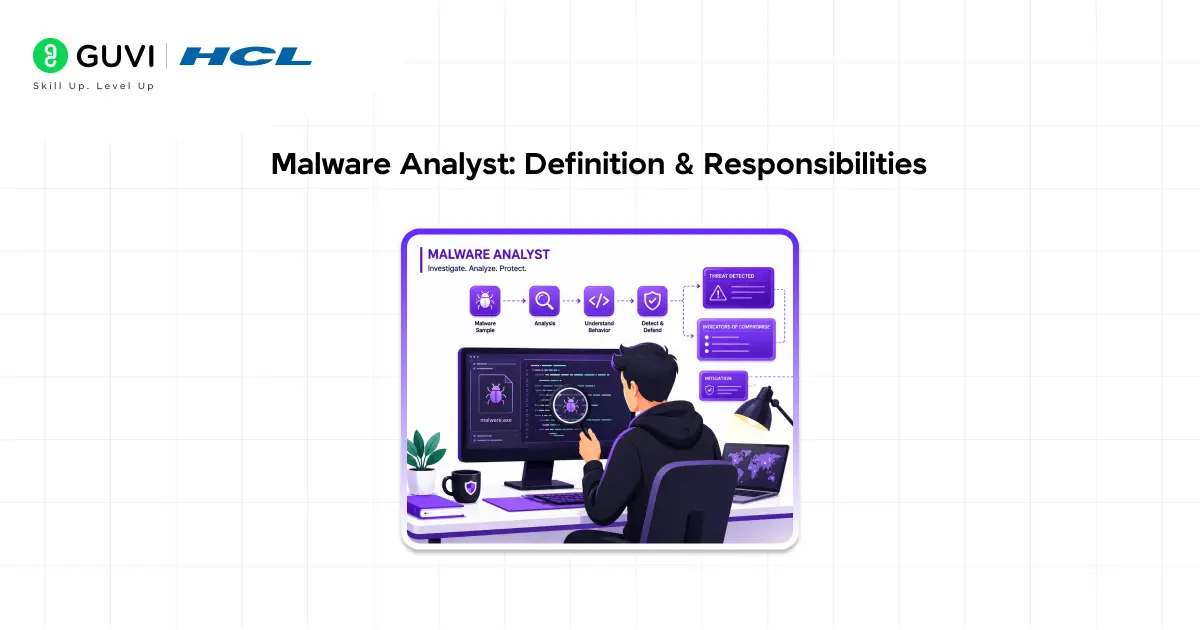
A Malware Analyst is a cybersecurity professional who studies harmful software to understand how it works, how it spreads, and the problems it can cause. Their work helps organisations stop cyber threats and improve security.
Note:
Malware is harmful software designed to steal data, damage systems, spy on users, or gain unauthorised access to devices.
Main Responsibilities of a Malware Analyst
- Study malware to understand what it does.
- Find out how malware enters and spreads through systems.
- Examine malicious code to discover how it works.
- Investigate malware attacks and identify their impact.
- Share findings with security teams to help prevent future attacks.
- Keep track of new malware threats and attack techniques.
Also Read: How To Become a Cybersecurity Analyst?
Kickstart your cybersecurity journey with HCL GUVI’s Cyber Security and Ethical Hacking Course for beginners. Get hands-on with ethical hacking, learn how real attacks work, and build the skills you need to break into cybersecurity.
Malware Analyst Skills Needed for Cybersecurity
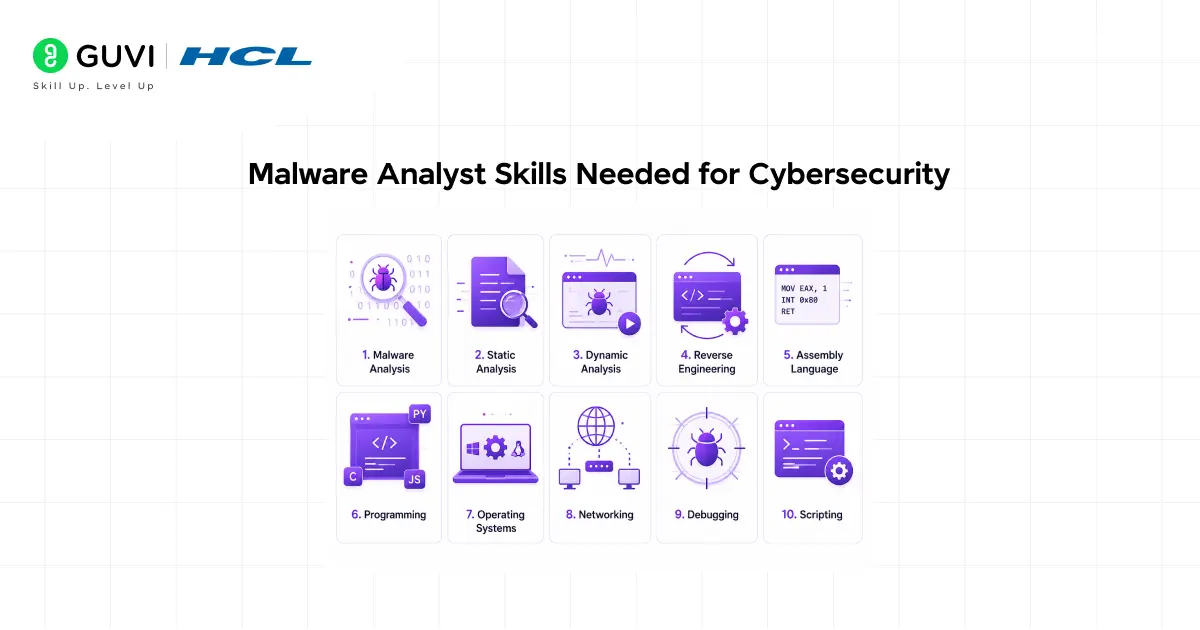
The following are some of the most important skills for a Malware Analyst in cybersecurity. Developing these skills helps professionals identify, analyse, and respond to malware threats more effectively:
1. Malware Analysis
Malware Analysis is the process of examining malicious software to understand what it does, how it infects systems, and the damage it can cause.
A Malware Analyst uses this skill to identify how a threat operates, discover the techniques attackers use, and determine the best way to stop the malware from spreading or causing further harm.
Since malware analysis is a core part of the role, strong malware analysis skills help analysts respond to cyber threats faster and more effectively.
Tools and Technologies:
- IDA Pro
- Ghidra
- Cuckoo Sandbox
- Wireshark
- Procmon
- Process Explorer
- VirusTotal
2. Static Analysis
Static Analysis involves studying a malware file without running it. Instead of executing the program, a Malware Analyst examines its code, structure, strings, and hidden components to uncover clues about its purpose and behaviour.
This approach helps analysts safely gather information about a threat, identify suspicious functions, and detect malware before it can interact with a system.
Tools and Technologies:
- IDA Pro
- Ghidra
- PEview
- Detect It Easy
- strings
- HxD
- YARA
3. Dynamic Analysis
While Static Analysis examines a file without running it, Dynamic Analysis takes the opposite approach by observing malware while it is active in a controlled environment.
By watching how the malware behaves, a Malware Analyst can see which files it modifies, which processes it creates, and whether it tries to communicate with external servers.
This gives analysts a clearer picture of the threat’s real-world behaviour and impact.
Tools and Technologies:
- Cuckoo Sandbox
- Procmon
- Process Explorer
- Wireshark
- Regshot
- FakeNet-NG
4. Reverse Engineering
Some malware is designed to hide its true purpose, making it difficult to detect through normal inspection.
Reverse Engineering helps a Malware Analyst break down the program and understand exactly how it works internally.
By studying the malware’s code and logic, analysts can uncover hidden features, identify attack techniques, and develop better defences against similar threats in the future.
Tools and Technologies:
- IDA Pro
- Ghidra
- x64dbg
- OllyDbg
- Radare2
- dnSpy

5. Assembly Language
Malware often communicates in Assembly Language behind the scenes, especially after it has been compiled into machine code.
A Malware Analyst who understands Assembly can read low-level instructions and see exactly what the malware is telling the computer to do.
This makes it easier to uncover hidden actions, bypass obfuscation techniques, and understand complex threats that cannot be analysed through high-level code alone.
Tools and Technologies:
- IDA Pro
- Ghidra
- x64dbg
- OllyDbg
- NASM
6. Programming
A Malware Analyst needs a good understanding of programming basics and the ability to solve complex problems.
Skills such as variables, loops, functions, and logic make it easier to understand how malware works, while strong problem-solving skills help analysts uncover hidden behaviours and investigate sophisticated threats.
Tools and Technologies:
- Python
- C
- C++
- PowerShell
- Visual Studio Code
- PyCharm
7. Operating Systems
Malware behaves differently depending on the operating system it targets.
By understanding how operating systems manage files, processes, memory, and permissions, a Malware Analyst can more effectively identify suspicious activity and determine how a threat gains access to or maintains control over a system.
Tools and Technologies:
- Windows
- Linux
- Sysinternals Suite
- Process Explorer
- Procmon
8. Networking
Many types of malware communicate with external servers to send stolen data, receive commands, or download additional malicious files.
Networking knowledge helps a Malware Analyst track this communication, identify suspicious connections, and understand how malware interacts with other systems across a network.
Tools and Technologies:
- Wireshark
- TCPView
- FakeNet-NG
- NetworkMiner
9. Debugging
Some malware hides its behaviour until specific conditions are met, making it difficult to understand through normal analysis.
Debugging allows a Malware Analyst to pause the program, inspect its actions step by step, and observe exactly what happens at different stages of execution.
This makes it easier to uncover hidden functionality and analyse sophisticated threats.
Tools and Technologies:
- x64dbg
- OllyDbg
- WinDbg
- IDA Pro
10. Scripting
Scripting helps a Malware Analyst automate repetitive tasks and speed up investigations.
Instead of performing the same actions manually, analysts can use scripts to collect data, process files, and analyse large amounts of information more efficiently.
Tools and Technologies:
- Python
- PowerShell
- Bash
- Perl
- Visual Studio Code
- PyCharm
Cybersecurity skills are becoming more valuable with every new threat. With HCL GUVI’s Cybersecurity Bundle Course (6 courses), you can gain practical experience, understand modern attack techniques, earn recognised certifications, and build the expertise needed for a career in cybersecurity. Start learning today and take a step toward becoming an industry-ready professional.
Conclusion
As cyber threats continue to evolve, the demand for skilled Malware Analysts will keep growing. Developing these skills takes time, but they are essential for uncovering threats, understanding attacks, and protecting organisations from malware. For those who enjoy cybersecurity and problem-solving, it is a challenging and rewarding career path.
FAQs
How long does it take to become a Malware Analyst?
The timeline varies, but many professionals spend several months to a few years building the required cybersecurity and malware analysis skills.
Which programming language should beginners learn first for Malware Analysis?
Python is often the preferred starting point because of its simplicity and widespread use in cybersecurity.
Does Malware Analysis require strong mathematical skills?
Basic logical thinking and problem-solving skills are more valuable than advanced mathematics for most malware analysis tasks.
Which industries hire Malware Analysts?
Banks, technology companies, government agencies, healthcare organisations, and cybersecurity firms regularly hire Malware Analysts.
Can Malware Analysts work remotely?
Many organisations offer remote and hybrid opportunities, especially for experienced professionals.
Which certifications are useful for aspiring Malware Analysts?
Certifications in cybersecurity, reverse engineering, and malware analysis can help strengthen technical knowledge and improve job prospects.
Success Stories










Did you enjoy this article?