


Digital Marketing Articles
What is Performance Marketing? Complete Guide for 2026
What is the Voice of the Customer and Why Does it Matter
What is A/B Testing in Marketing? A Beginner’s Guide to Smarter Campaign Optimization
What is Lead Nurturing in Marketing? A Practical Guide for Beginners


Get In Touch For Details! Request More Information
Account-Based Marketing Skills: A Practical Guide for Digital Marketers
Sep 02, 2026 4 Min Read 704 Views
(Last Updated)
Most marketing campaigns chase leads. Account-based marketing does the smarter thing: it chooses the right companies first, studies who makes the buying decision, and then builds campaigns around their real business needs.
ABM is not about sending one email to a long list and hoping someone replies. It is closer to a focused sales and marketing play where every account gets sharper research and better messaging. For digital marketing professionals, ABM skills are useful because they connect campaign work with pipeline, revenue, and real B2B buying behavior.
This blog explains the key account-based marketing skills, how to learn them, where they are used, and why they matter for anyone planning to grow in B2B marketing.
Table of contents
- TL;DR
- What are Account-Based Marketing (ABM) Skills?
- Top 5 Account-Based Marketing Skills
- Target Account Selection
- Buying Committee Mapping
- Intent Data Analysis
- Personalized Campaign Execution
- Account-Level Performance Tracking
- Account-Based Marketing Tools
- Companies Hiring Professionals with Account-Based Marketing Skills
- Conclusion
- FAQs
- What are account-based marketing skills?
- Why is ABM important in B2B marketing?
- Which tools are used for account-based marketing?
- Is account-based marketing good for beginners?
- How do you measure ABM success?
TL;DR
- ABM targets high-value B2B accounts instead of every lead.
- Key skills include account selection, intent data, personalization, and tracking.
- Tools like HubSpot, Salesforce, 6sense, Demandbase, and GA4 support ABM.
- ABM is useful in SaaS, IT, fintech, cybersecurity, healthtech, and consulting.
- Strong ABM connects digital marketing with pipeline, revenue, and win rate.
What are Account-Based Marketing (ABM) Skills?
Account-based marketing skills include identifying high-value target accounts, mapping decision-makers, using CRM and intent data, and creating personalized campaigns for each account. ABM professionals should know tools like HubSpot, Salesforce, LinkedIn Sales Navigator, Apollo, 6sense, or Demandbase to score accounts, track engagement, align with sales teams, and measure pipeline impact through metrics like opportunity creation, deal velocity, win rate, and revenue contribution.
- ABM is now a core part of B2B marketing, with 70% of companies using some form of account-based marketing tactics.
Top 5 Account-Based Marketing Skills
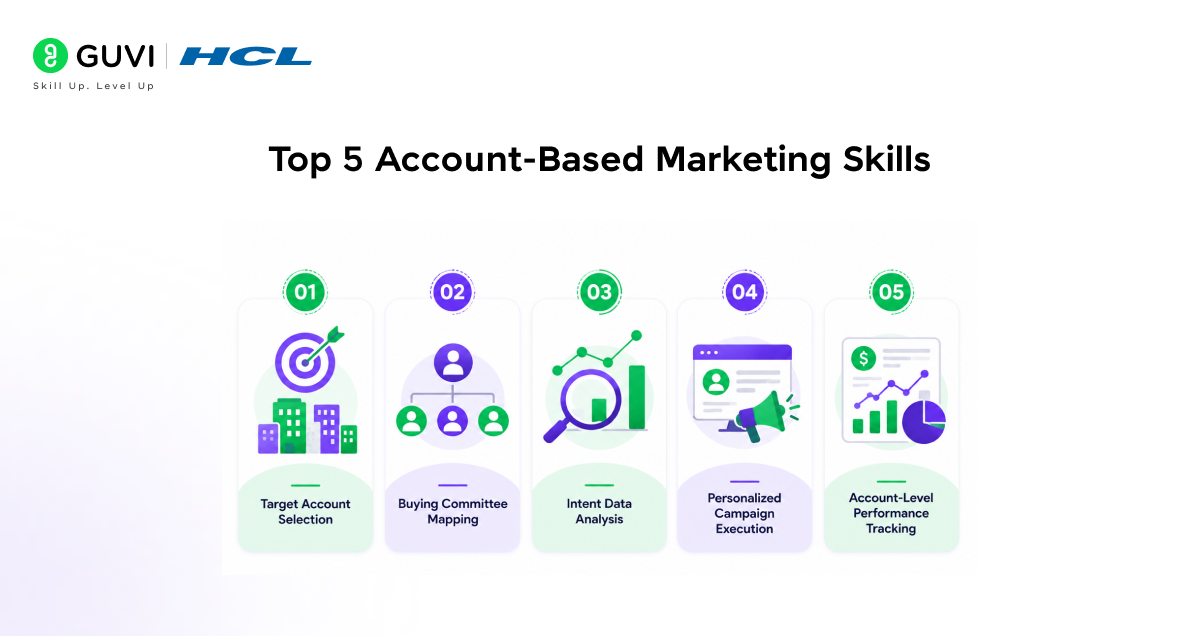
1. Target Account Selection
Target account selection is the base of every ABM campaign. The goal is to focus on companies that are more likely to buy, not every lead that enters the funnel. Marketers need to study company size, industry, revenue, funding activity, hiring signals, technology stack, pain points, and past CRM engagement before building an account list.
Key Skills
- Identifying accounts that match the ideal customer profile
- Using firmographic and technographic data for account research
- Scoring accounts based on revenue potential and product fit
- Studying hiring, funding, expansion, and competitor signals
- Aligning target accounts with sales goals and pipeline priorities
How to Learn
- Study ideal customer profile creation
- Learn account scoring in HubSpot or Salesforce
- Practice account research using LinkedIn Sales Navigator
- Build sample account lists for SaaS, IT, finance, or healthcare brands
- Review B2B case studies that show how enterprise sales teams choose accounts
2. Buying Committee Mapping
ABM does not work well when marketers speak to only one contact inside a company. Most B2B deals involve decision-makers, finance teams, technical evaluators, procurement teams, department heads, and end users. A strong ABM marketer knows who matters, what each person cares about, and what proof they need before the deal moves ahead.
Key Skills
- Finding decision-makers, influencers, users, and budget owners
- Mapping technical, financial, and operational stakeholders
- Understanding each person’s role in the buying process
- Creating different messages for different buyer personas
- Sharing account insights with the sales team before outreach
How to Learn
- Use LinkedIn Sales Navigator for stakeholder research
- Study common B2B buying committee structures
- Review CRM notes, sales calls, and account history
- Learn persona mapping for enterprise marketing
- Practice building account maps for real companies
3. Intent Data Analysis
Intent data helps marketers understand which accounts are already showing interest. These signals can come from website visits, content downloads, email engagement, LinkedIn activity, CRM behavior, review platforms, or third-party intent tools. This skill helps ABM teams focus on accounts that are closer to a buying conversation.
Key Skills
- Tracking account-level website visits and content engagement
- Reading buying signals from CRM, search, and social activity
- Prioritizing accounts based on active research behavior
- Separating casual engagement from strong buying intent
- Using intent data to time campaigns and sales outreach better
How to Learn
- Study the basics of intent data in B2B marketing
- Learn digital marketing tools like 6sense, Demandbase, Bombora, and HubSpot
- Review website analytics at the account level
- Practice lead scoring and account scoring models
- Study how content engagement connects with pipeline movement
4. Personalized Campaign Execution
Personalization in ABM means more than adding a company name to an email. In digital marketing, the message should connect with the account’s industry, business problem, role, and buying stage. Marketers should know how to create account-specific emails, LinkedIn ads, landing pages, case studies, webinars, and sales enablement content.
Key Skills
- Writing account-specific email and LinkedIn campaign copy
- Creating landing pages for high-value accounts
- Matching case studies with the account’s industry and problem
- Building campaigns for awareness, consideration, and sales support
- Keeping campaign messaging aligned with sales conversations
How to Learn
- Study B2B copywriting and sales messaging
- Analyze ABM campaigns from SaaS and enterprise brands
- Practice writing personalized email sequences
- Learn landing page personalization basics
- Turn common sales objections into campaign angles
- More than 90% of marketers report that ABM delivers higher ROI than traditional demand generation, with many seeing over 25% better conversions and 11% to 50% higher average deal sizes.

5. Account-Level Performance Tracking
ABM performance should not be judged only by clicks, impressions, or form fills. A good ABM marketer tracks whether target accounts are moving closer to revenue. Important metrics include account engagement, stakeholder activity, meetings booked, opportunities created, pipeline value, deal velocity, win rate, and revenue contribution.
Key Skills
- Tracking engagement across target accounts
- Measuring opportunity creation and pipeline influence
- Monitoring stakeholder activity inside priority accounts
- Connecting campaign data with CRM revenue data
- Reporting ABM impact through win rate, deal velocity, and revenue contribution
How to Learn
- Learn CRM reporting in HubSpot or Salesforce
- Study ABM metrics beyond traffic and clicks
- Build account-level dashboards
- Review campaign influence reports with sales data
- Compare engagement quality with pipeline outcomes
Account-Based Marketing Tools
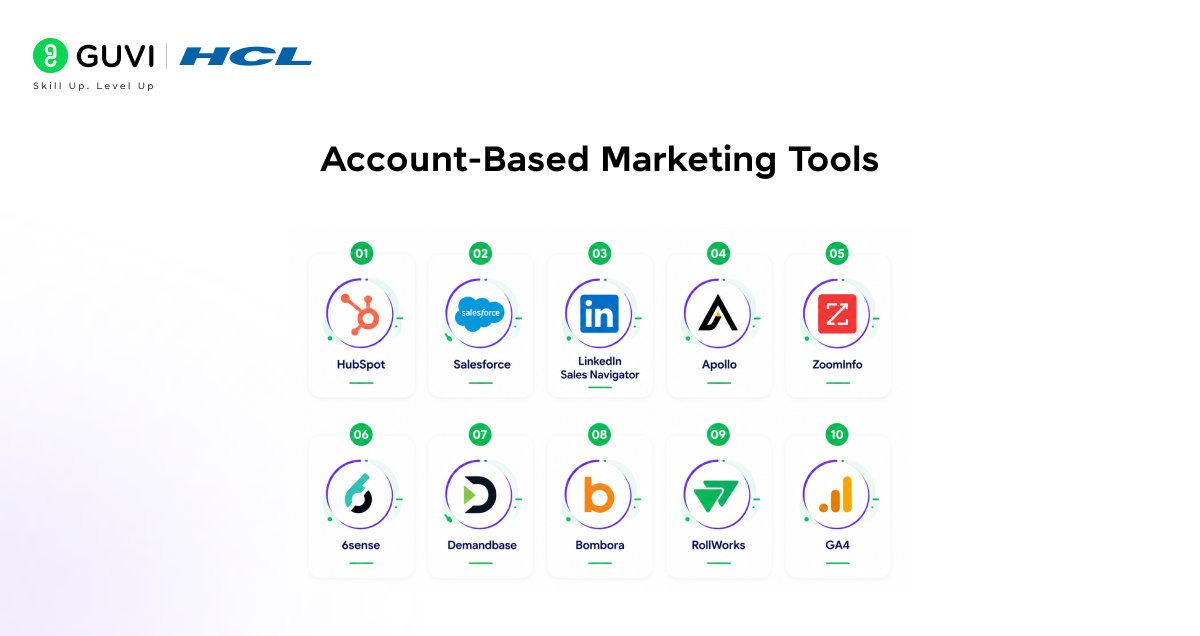
| Tool | Use Case |
| HubSpot | CRM, email campaigns, lead scoring |
| Salesforce | Pipeline tracking and revenue reporting |
| LinkedIn Sales Navigator | Account and decision-maker research |
| Apollo | Prospecting and outreach data |
| ZoomInfo | Company and contact intelligence |
| 6sense | Intent data and account scoring |
| Demandbase | ABM targeting and campaign management |
| Bombora | Topic-level buying intent data |
| RollWorks | Account-based advertising |
| GA4 | Website and campaign analytics |
Build industry-ready digital marketing skills with HCL GUVI’s Digital Marketing Course. Learn through a 100% online, self-paced format and earn a globally recognised certification. Get full lifetime access to course content, dedicated forum support to clear your doubts, access to 4 gamified practice platforms, and learn with confidence backed by a 7-Day Refund Policy.
Companies Hiring Professionals with Account-Based Marketing Skills
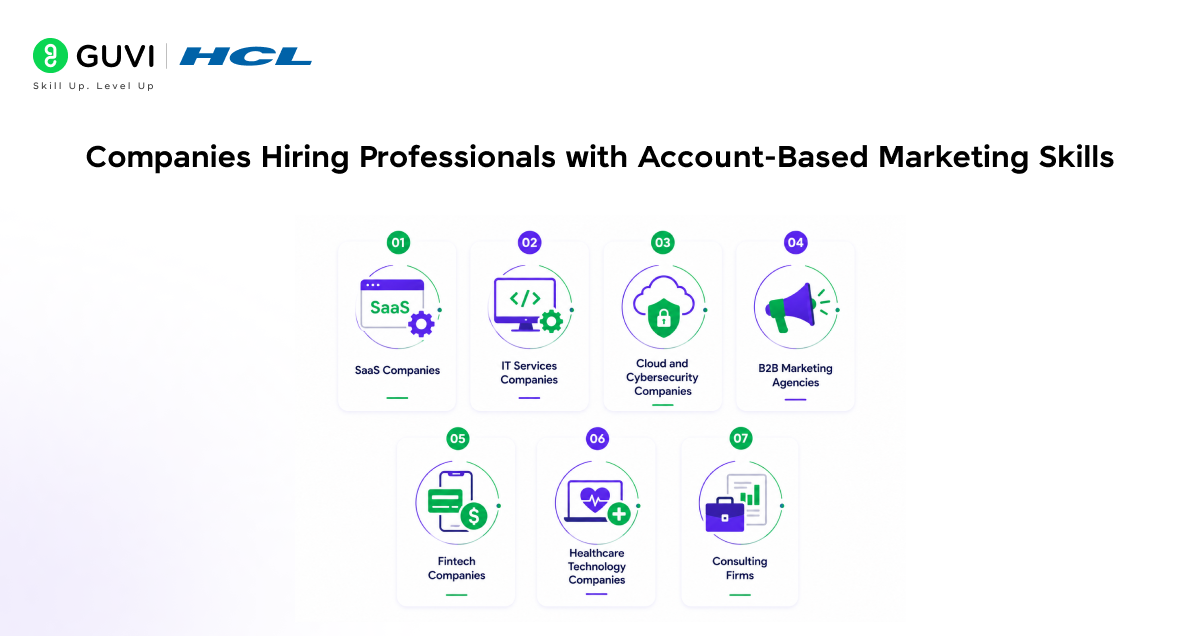
After learning account-based marketing, professionals can explore roles in B2B companies where sales cycles are longer, deal values are higher, and customer targeting needs strong research. ABM skills are especially useful in industries where marketing teams work closely with sales to reach specific accounts and decision-makers.
- SaaS Companies: SaaS brands hire ABM professionals to target enterprise accounts, personalize campaigns, support sales teams, and improve pipeline quality.
- IT Services Companies: IT service providers use ABM to reach CIOs, CTOs, procurement heads, and business leaders across large accounts.
- Cloud and Cybersecurity Companies: These companies need ABM skills to market complex technical solutions to decision-makers, security teams, and enterprise buyers.
- B2B Marketing Agencies: Agencies hire ABM specialists to build account lists, run LinkedIn campaigns, create personalized content, and manage client campaigns.
- Fintech Companies: Fintech brands use ABM to target banks, NBFCs, enterprises, and finance teams with specific product-led messaging.
- Healthcare Technology Companies: Healthtech companies need ABM marketers to reach hospitals, clinics, insurance firms, and healthcare decision-makers.
- Consulting Firms: Consulting companies use ABM to reach business leaders, CXOs, and department heads with industry-specific solutions.
Conclusion
Account-based marketing works best when marketers stop treating every lead the same. ABM needs strong account selection, clear research, stakeholder mapping, and messaging that addresses a company’s real business problem. Marketers use CRM data, intent signals, LinkedIn research, personalized content, and account-level reporting to support sales conversations.
These skills are highly valuable because B2B buying is usually complex. One deal may involve finance, IT, operations, leadership, and procurement. ABM helps marketers reach the right people with relevant proof and connect marketing efforts directly with pipeline and revenue.
FAQs
What are account-based marketing skills?
Account-based marketing skills include target account selection, buying committee mapping, intent data analysis, personalized campaign execution, CRM reporting, and sales alignment. These skills help marketers focus on high-value companies instead of running broad campaigns for every possible lead.
Why is ABM important in B2B marketing?
ABM is important because most B2B purchases involve several people and longer decision cycles. A single form fill or email click is rarely enough to close a deal. ABM helps marketing and sales teams focus on accounts with better fit, stronger buying signals, and higher revenue potential.
Which tools are used for account-based marketing?
Common ABM tools include HubSpot, Salesforce, LinkedIn Sales Navigator, Apollo, ZoomInfo, 6sense, Demandbase, RollWorks, and Bombora. Marketers also use GA4, CRM dashboards, email platforms, and ad platforms to track engagement and support account-level campaigns.
Is account-based marketing good for beginners?
Yes, beginners can learn ABM by starting with customer research, ideal customer profile creation, LinkedIn account research, CRM basics, and B2B email personalization. The best way to learn is to build sample account lists, map stakeholders, and study how real companies move from awareness to sales conversations.
How do you measure ABM success?
ABM success is measured through account engagement, stakeholder activity, meetings booked, opportunities created, pipeline value, deal velocity, win rate, and revenue contribution. Clicks and impressions can help, but they do not show the full business impact of an ABM campaign.
Success Stories

About the Author
Vaishali
I'm a seasoned writer with four years of experience across technical, non-technical, and just about every genre or niche you can imagine. Adaptable and curious, I enjoy exploring new topics and making information engaging and easy to understand. Fueled by a steady stream of tea, I approach each project with creativity, reliability, and genuine enthusiasm for storytelling.
View all posts by Vaishali
Connect with me @








Did you enjoy this article?