


Data Structure Articles
Sliding Window Technique: Explained with Examples
Two Pointer Technique: Problems and Applications


Get In Touch For Details! Request More Information
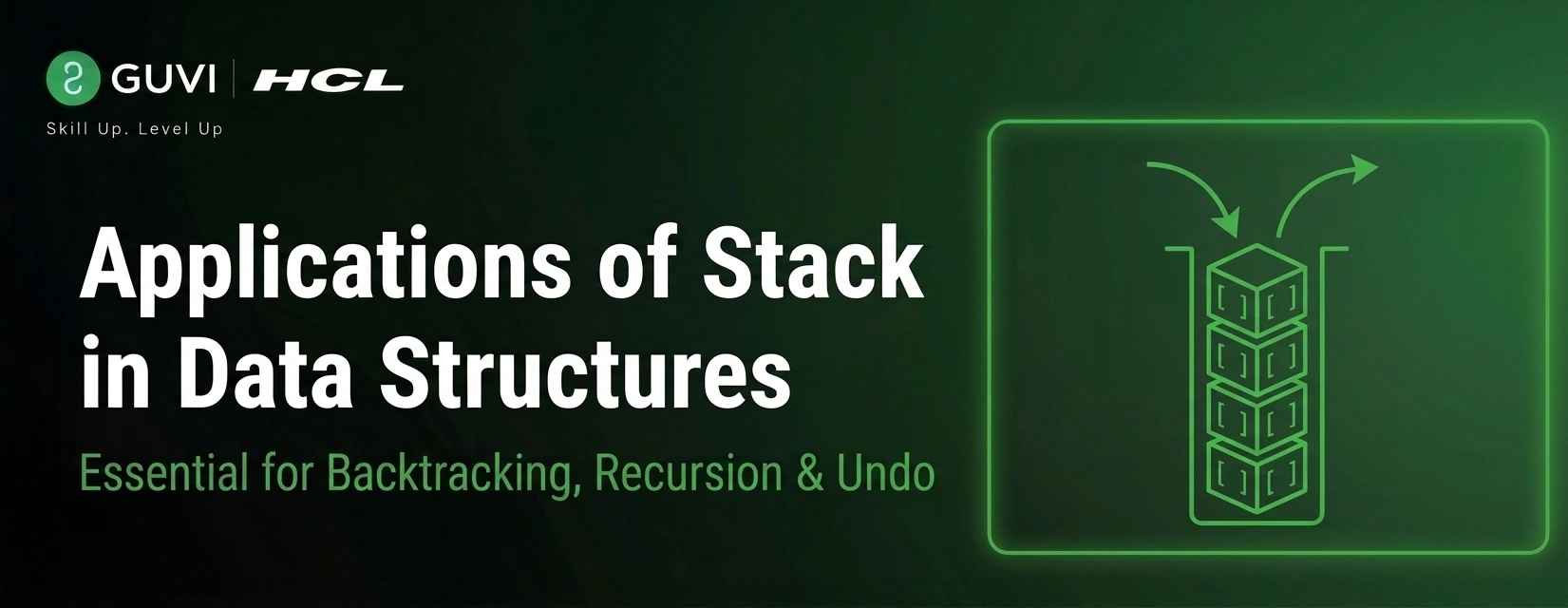
Applications of Stack in Data Structures
Jun 16, 2026 5 Min Read 1019 Views
(Last Updated)
Every time you use Undo (Ctrl+Z), navigate browser history, or execute a recursive function, you are using a stack in action. Its simple Last In, First Out (LIFO) behaviour makes it one of the most powerful and widely used data structures in computer science
Table of contents
- Quick TL;DR
- What is a Stack in DSA?
- Applications of Stack in Data Structures
- Expression Evaluation and Conversion
- Function Call Stack and Recursion Management
- Undo and Redo Operations
- Backtracking Algorithms
- Stock Span and Histogram Problems
- Summary: Applications of Stack at a Glance
- Conclusion
- FAQs
- What is the application of a stack in data structures?
- How is a stack used in expression evaluation?
- What is the call stack and how does it use a stack?
- How does a stack implement undo and redo?
- What is a monotonic stack and what are its applications?
Quick TL;DR
- A stack is a linear data structure that follows the Last In, First Out (LIFO) principle.
- It is widely used in function calls, expression evaluation, undo-redo operations, browser history, and backtracking algorithms.
- Understanding stacks is essential for mastering core computer science concepts.
What is a Stack in DSA?
A stack is a linear data structure that operates on the Last In, First Out (LIFO) principle. Think of it like a stack of plates you can only add a plate to the top and remove a plate from the top. You cannot access a plate in the middle without removing everything above it first.
A stack supports four core operations:
• Push: Add an element to the top of the stack
• Pop: Remove and return the top element
• Peek / Top: View the top element without removing it
• isEmpty: Check whether the stack has any elements
All four operations run in O(1) time constant time regardless of the stack’s size. This makes the stack exceptionally efficient for the problems it is designed to solve.
| # Stack implementation in Python stack = [] stack.append(10) # Push 10 → stack: [10] stack.append(20) # Push 20 → stack: [10, 20] print(stack[-1]) # Peek → 30 stack.pop() # Pop → stack: [10, 20] |
Read More: What is a Stack in Data Structures?
Check out HCL GUVI’s Data Structures & Algorithms Programme built for students and working professionals who want to crack top product-based company interviews with structured, hands-on learning.
Applications of Stack in Data Structures
The application of stack covers a surprisingly wide range of both theoretical problems and everyday software features. Here are the most important ones, with detailed explanations and code examples for each.
1. Expression Evaluation and Conversion
One of the most classic applications of a stack is evaluating and converting mathematical expressions. Compilers and calculators use stacks to handle operator precedence and parentheses correctly.
There are three forms of mathematical expressions:
• Infix: A + B (operator between operands how humans write it)
• Prefix (Polish notation): + A B (operator before operands)
• Postfix (Reverse Polish notation): A B + (operator after operands how computers evaluate it)
Computers prefer postfix because it eliminates the need for parentheses and operator precedence rules during evaluation. A stack is used both to convert infix to postfix and to evaluate the postfix expression.
| # Evaluate a postfix expression using a stack def evaluate_postfix(expression): stack = [] for token in expression.split(): if token.isdigit(): stack.append(int(token)) # push operands else: b = stack.pop() # right operand a = stack.pop() # left operand if token == ‘+’: stack.append(a + b) elif token == ‘-‘: stack.append(a – b) elif token == ‘*’: stack.append(a * b) elif token == ‘/’: stack.append(a // b) return stack[0] print(evaluate_postfix(‘5 1 2 + 4 * + 3 -‘)) # Output: 14 |
2. Function Call Stack and Recursion Management
Whenever a function is called, a stack frame containing local variables, parameters, and the return address is pushed onto the call stack. When the function completes, the frame is popped, and execution returns to the previous point. This stack-based mechanism enables recursion and explains why excessive recursion can lead to a stack overflow error.
| # Recursive factorial — each call adds a frame to the call stack def factorial(n): if n == 0: # Base case — start popping frames return 1 return n * factorial(n – 1) # Call stack when factorial(4) runs: # factorial(4) → factorial(3) → factorial(2) → factorial(1) → factorial(0) # Then unwinds: 1 → 1 → 2 → 6 → 24 |
In Python, the default recursion limit is typically set to around 1,000 function calls, after which a RecursionError is raised to prevent stack overflow. Similarly, in Java, each thread is allocated a fixed-size stack (commonly in the range of 512 KB to 1 MB, depending on the JVM and configuration). These limits exist because the call stack is stored in a finite memory region and is used to manage function calls, local variables, and execution context. If recursion or deep call chains exceed available stack space, it can lead to stack overflow errors, which is why iterative solutions or optimized recursion techniques are often preferred in performance-critical systems.
3. Undo and Redo Operations
- Every action the user performs is pushed onto the undo stack.
- When the user presses Ctrl+Z, the top action is popped from the undo stack, reversed, and pushed onto the redo stack.
- When the user presses Ctrl+Y, the top action is popped from the redo stack, re-applied, and pushed back onto the undo stack.
| class TextEditor: def __init__(self): self.text = ” self.undo_stack = [] self.redo_stack = [] def type(self, chars): self.undo_stack.append(self.text) # save current state self.redo_stack.clear() # new action clears redo self.text += chars def undo(self): if self.undo_stack: self.redo_stack.append(self.text) self.text = self.undo_stack.pop() def redo(self): if self.redo_stack: self.undo_stack.append(self.text) self.text = self.redo_stack.pop() |
Read More: Applications of Linked List Data Structures
4. Backtracking Algorithms
Backtracking algorithms which explore all possible paths and retreat when they hit a dead end, are a fundamental application of a stack. Problems like maze solving, N-Queens, Sudoku solving, and graph DFS (Depth First Search) all rely on a stack to remember which choices were made and in what order.
| # Depth First Search using an explicit stack def dfs(graph, start): visited = set() stack = [start] while stack: node = stack.pop() # process most recently added node if node not in visited: visited.add(node) print(node, end=’ ‘) for neighbour in graph[node]: if neighbour not in visited: stack.append(neighbour) graph = {‘A’: [‘B’, ‘C’], ‘B’: [‘D’], ‘C’: [‘D’, ‘E’], ‘D’: [], ‘E’: []} dfs(graph, ‘A’) # Output: A C E D B |

5. Stock Span and Histogram Problems
In competitive programming and financial applications, a monotonic stack is used to solve problems like the Stock Span Problem, Largest Rectangle in Histogram, and Next Greater Element efficiently, finding relationships between elements without comparing every pair.
| # Next Greater Element using a stack def next_greater(arr): result = [-1] * len(arr) stack = [] for i in range(len(arr)): while stack and arr[stack[-1]] < arr[i]: idx = stack.pop() result[idx] = arr[i] # arr[i] is the next greater for arr[idx] stack.append(i) return result print(next_greater([4, 5, 2, 10, 8])) # Output: [5, 10, 10, -1, -1] |
This O(n) solution using a stack replaces what would otherwise require an O(n²) nested loop a significant performance improvement for large datasets.
The monotonic stack is one of the most powerful and widely used patterns in competitive programming for solving range and nearest-greater/smaller element problems efficiently. It maintains elements in either increasing or decreasing order, allowing problems that would normally require nested loops to be solved in O(n) time. This technique appears in many classic problems such as Daily Temperatures, Trapping Rain Water, and Largest Rectangle in Histogram, where it helps compute relationships between elements without redundant comparisons. Recognizing when to apply a monotonic stack is a key skill for optimizing solutions in array and stack-based problems.
Summary: Applications of Stack at a Glance
| Application | How Stack Is Used | Real-World Example |
| Expression Evaluation | Push operands; pop and compute on operator | Scientific calculators, compilers |
| Balanced Parentheses | Push opening brackets; pop and match on closing | IDE syntax checkers, JSON validators |
| Function Call Management | Push stack frame on call; pop on return | All programming language runtimes |
| Undo / Redo | Undo stack + redo stack for state history | VS Code, Photoshop, Google Docs |
| Browser History | Back stack + forward stack for navigation | Chrome, Firefox, Safari |
| Backtracking / DFS | Push choices; pop and try next on dead end | Maze solvers, puzzle solvers, graph search |
| Memory Management | Stack frames allocated/freed automatically | OS thread stacks, local variable storage |
| Monotonic Stack Problems | Maintain sorted order to find next/prev greater | Stock span, histogram, rain water trapping |
Want to master stacks, queues, trees, graphs, and dynamic programming with real coding projects and interview prep? Check out HCL GUVI’s Data Structures & Algorithms Programme built for students and working professionals who want to crack top product-based company interviews with structured, hands-on learning.
Conclusion
From evaluating mathematical expressions and managing recursive function calls to powering the undo button in your favourite editor and solving complex graph problems, the application of the stack is everywhere in computer science. What makes the stack so valuable is its simplicity: just two core operations, push and pop, operating in O(1) time combined with the elegance of the LIFO principle, which maps perfectly onto a wide range of real-world problems.
FAQs
1. What is the application of a stack in data structures?
The applications of a stack include expression evaluation and conversion, balanced parentheses checking, function calls and recursion, undo-redo operations, browser navigation, backtracking algorithms such as DFS, call stack memory management, and solving monotonic stack problems like Next Greater Element
2. How is a stack used in expression evaluation?
A stack is used to convert infix expressions to postfix (Reverse Polish Notation) and then evaluate them. Operands are pushed onto the stack; when an operator is encountered, two operands are popped, the operation is performed, and the result is pushed back. This eliminates the need for parentheses during evaluation.
3. What is the call stack and how does it use a stack?
The call stack is a region of memory managed by the runtime that tracks active function calls. Each time a function is called, a stack frame containing its local variables, parameters, and return address is pushed. When the function returns, its frame is popped and execution resumes at the return address in the previous frame.
4. How does a stack implement undo and redo?
Undo-redo uses two stacks. Every user action is pushed onto the undo stack. Pressing Ctrl+Z pops the latest action from the undo stack, reverses it, and pushes it onto the redo stack. Pressing Ctrl+Y pops from the redo stack, reapplies the action, and pushes it back to the undo stack.
5. What is a monotonic stack and what are its applications?
A monotonic stack is a stack that maintains its elements in strictly increasing or decreasing order. It is used to solve problems like Next Greater Element, Stock Span, Largest Rectangle in Histogram, and Trapping Rain Water in O(n) time, replacing solutions that would otherwise require O(n²) nested loops.
Success Stories

About the Author
Vishalini Devarajan
An Aerospace Engineer turned content writer, I focus on making complex concepts easy to understand through well-structured, reader-friendly blogs. Whether it’s a technical topic or a non-technical one, I love creating content that is clear, engaging, and impactful.
View all posts by Vishalini Devarajan
Connect with me @













Did you enjoy this article?