


Artificial Intelligence and Machine Learning Articles
How to Stream Claude Responses with the API
Claude API Pricing Breakdown: Token Costs and Tiers


Get In Touch For Details! Request More Information
The Turing Test in AI: A Complete Beginner’s Guide
Jul 17, 2026 7 Min Read 342 Views
(Last Updated)
Imagine chatting online with someone whose replies feel natural and intelligent, only to learn it was a machine all along. That is the idea behind the Turing Test, a famous 1950 proposal by British mathematician Alan Turing that asks whether a machine can behave so convincingly like a human that we cannot tell the difference.
The test changed how people think about artificial intelligence by focusing on behavior rather than philosophy. Instead of asking whether machines truly “think,” it asks a more practical question: if a machine acts intelligently, should we treat it as intelligent? That idea has influenced chatbot design and AI evaluation ever since.
In this article, we will walk through everything you need to know about the Turing Test. We will cover who Alan Turing was, how the test works, what it has meant for AI over the decades, what has happened when modern AI systems faced it, and why the conversation around it is still very much alive today.
Table of contents
- Quick TL;DR
- Who Was Alan Turing?
- How the Turing Test Works
- Step 1: What the Turing Test Is
- Step 2: Why It Is Called the Imitation Game
- Step 3: How the Test Is Set Up
- Step 4: What the Judge Does
- Step 5: Turing’s Main Idea
- Step 6: Why It Matters
- Early Attempts: From ELIZA to Eugene Goostman
- Early Attempts at the Turing Test
- The ELIZA Effect
- Later Rule-Based Systems
- Eugene Goostman and Criticism
- How Modern AI Changed Everything
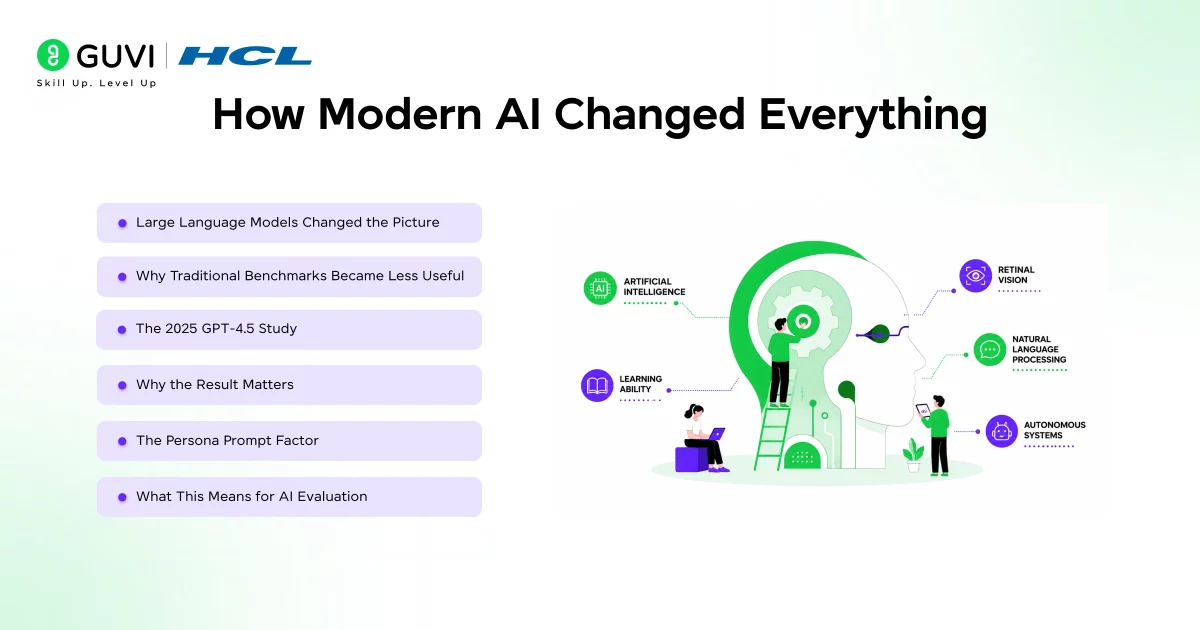
- Large Language Models Changed the Picture
- Why Traditional Benchmarks Became Less Useful
- The 2025 GPT-4.5 Study
- Why the Result Matters
- The Persona Prompt Factor
- What This Means for AI Evaluation
- The Chinese Room: The Most Famous Criticism
- Searle’s Challenge to the Turing Test
- The Chinese Room Thought Experiment
- Why Searle Rejected the Turing Test
- The Philosophical Implication
- Other Key Criticisms and Limitations
- Alternative Benchmarks That Emerged
- What the Turing Test Means for AI Today
- Conclusion
- FAQs
- What is the Turing Test?
- Why is it called the Imitation Game?
- Did early AI systems pass the Turing Test?
- Why is the Turing Test controversial?
- Is the Turing Test still useful today?
Quick TL;DR
- The Turing Test, proposed by Alan Turing in 1950, checks whether a machine can behave so human-like in conversation that people cannot tell it apart from a real person.
- Early systems like ELIZA and Eugene Goostman showed that machines could fool people, but often by using simple tricks or narrow personas rather than real intelligence.
- Modern large language models like GPT-4 and GPT-4.5 made the test more difficult by generating fluent, context-aware responses that sound genuinely human.
- The Turing Test has major critics, especially John Searle, who argued that passing the test does not prove a machine truly understands meaning.
- Many researchers now see the test as useful but limited because it measures conversation quality, not broader intelligence like reasoning, perception, or creativity.
- Today, the Turing Test remains historically important, but it is no longer considered enough on its own to judge true AI intelligence.
What Is the Turing Test in AI?
The Turing Test is a benchmark for machine intelligence proposed by Alan Turing in 1950. In the test, a human judge engages in a text-based conversation with both a human and a machine without knowing which is which. If the judge cannot reliably distinguish the machine from the human based on the conversation, the machine is considered to have passed the Turing Test.
Who Was Alan Turing?
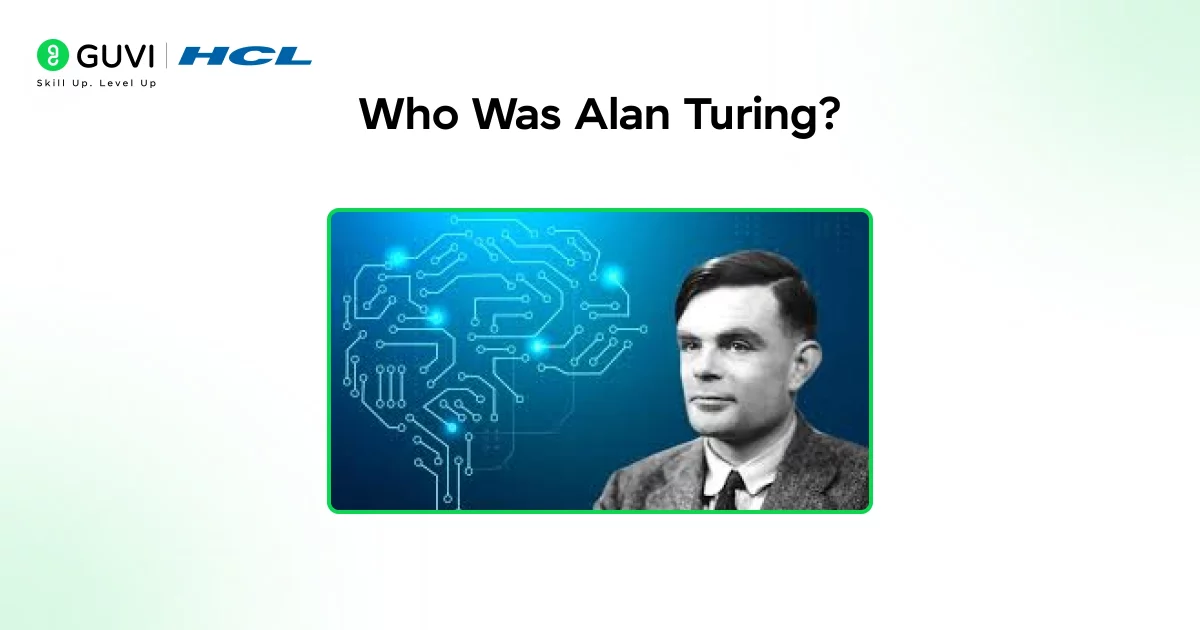
To understand the Turing Test, you have to understand the person who created it. Alan Turing was a British mathematician and computer scientist considered a founding figure in computer science and artificial intelligence.
- He developed fundamental concepts like the Turing machine, the basis for modern computers, and played a crucial role in breaking the Enigma code during World War II.
- Turing revolutionized computing with his stored-program concept, enabling machines to store and execute instructions.
- His code-breaking efforts during World War II further shaped his ideas on machine intelligence, demonstrating the potential of machines to solve complex problems. Turing also explored heuristic problem-solving in chess programs, accurately predicting that computers would excel at the game.
- By 1950, Turing had seen enough of what machines could do to believe that the question of machine intelligence deserved serious scientific attention.
- The paper he published that year, titled “Computing Machinery and Intelligence,” opened with a question that cut straight to the heart of the matter: “Can machines think?” Turing quickly noted that, given the difficulty of defining thinking, the question is “too meaningless to deserve discussion.”
- As is often done in philosophical debates, he proposed replacing it with a different question. That replacement became the Turing Test.

How the Turing Test Works
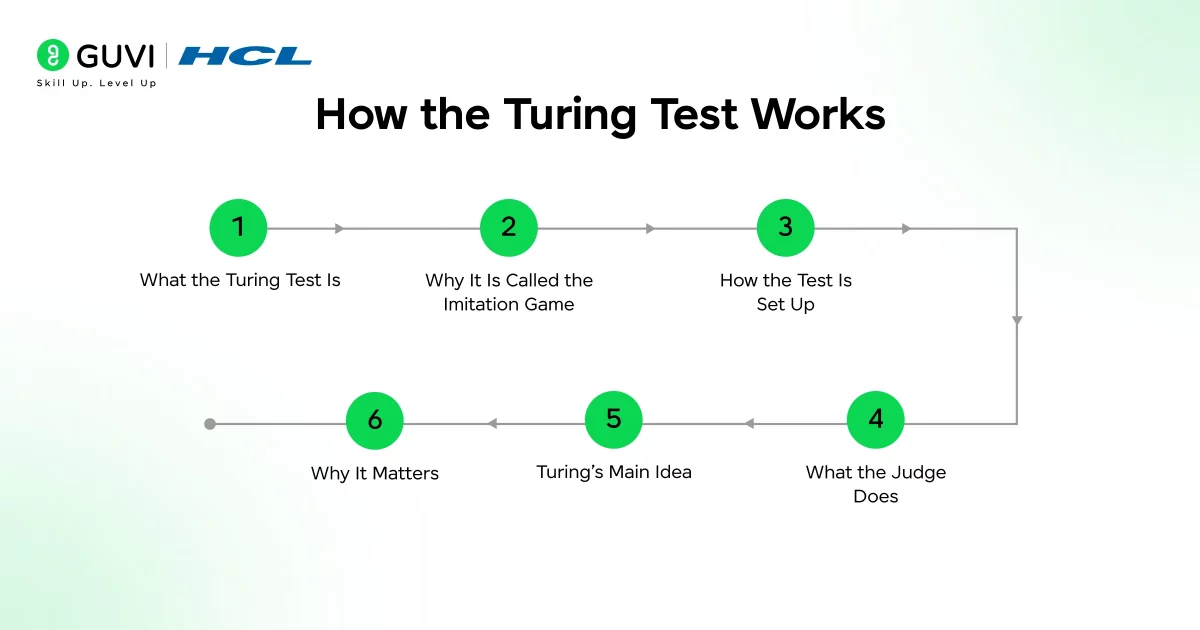
Step 1: What the Turing Test Is
The Turing Test is a thought experiment introduced by Alan Turing in 1950 to check whether a machine can communicate in a way that feels human. Instead of focusing on hardware or programming style, it looks at the machine’s outward behavior in conversation.
Step 2: Why It Is Called the Imitation Game
It is often called the Imitation Game because the machine is trying to imitate a human so well that an observer cannot tell the difference. The main idea is not just to answer questions, but to sound natural, logical, and convincing enough to be mistaken for a person.
Step 3: How the Test Is Set Up
The test uses a simple structure: a human judge holds text-based conversations with both a human and a machine. None of them can see each other, so the judge must rely only on the quality, tone, and consistency of the replies to make a decision.
Step 4: What the Judge Does
After chatting with both participants, the judge tries to identify which one is the real human. If the machine can repeatedly fool the judge, it is seen as having passed the test in a practical sense.
Step 5: Turing’s Main Idea
Turing wanted to move away from difficult philosophical questions like what it truly means to “think” or be conscious. His focus was more practical: if a machine behaves like an intelligent human in conversation, then that behavior should count as intelligence for all useful purposes.
Step 6: Why It Matters
This idea became important because it gave researchers a clear way to evaluate machine intelligence without debating abstract philosophy. It shaped the development of chatbots, conversational AI, and modern language systems by shifting attention toward real-world performance rather than hidden intent.
Early Attempts: From ELIZA to Eugene Goostman
1. Early Attempts at the Turing Test
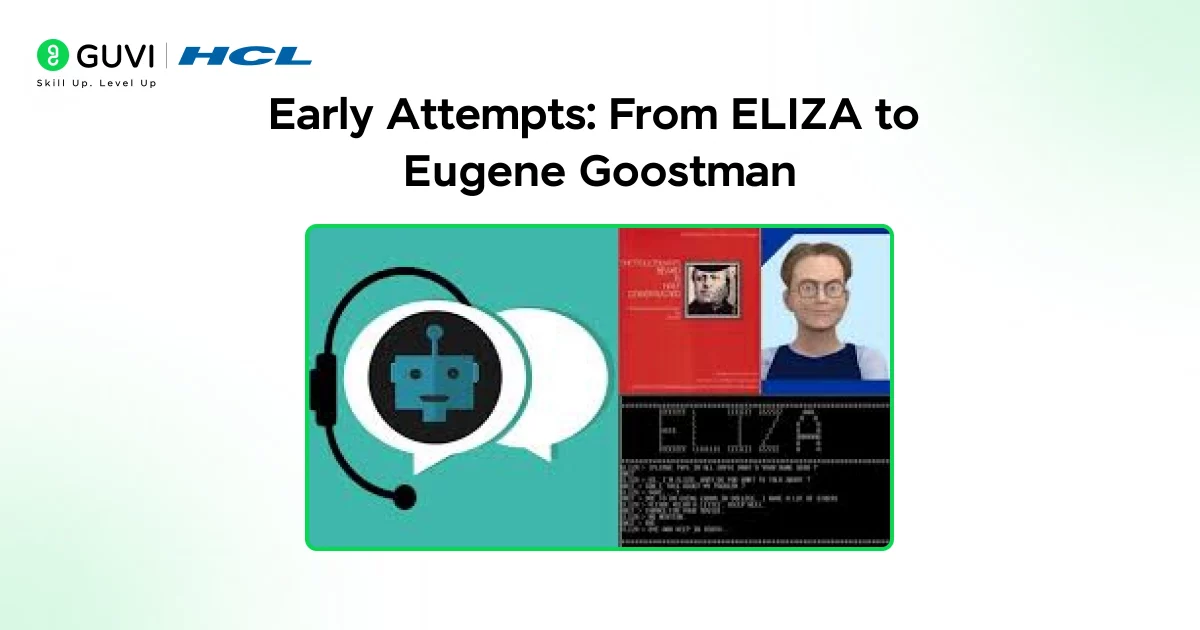
For decades after Turing proposed his test, no machine came close to passing it. The first serious attempt to attract widespread attention was ELIZA, a program created by Joseph Weizenbaum at MIT in 1966. ELIZA simulated a psychotherapist by reflecting the user’s own statements at them as questions, which made the conversation feel surprisingly natural to many people.
2. The ELIZA Effect
Some users became genuinely convinced they were talking to a real therapist, a reaction that later became known as the ELIZA effect. This showed that people could be emotionally influenced by even simple programs if the conversation matched their expectations. However, ELIZA was not truly intelligent; it was mostly exploiting human psychology rather than understanding meaning.
3. Later Rule-Based Systems
PARRY in 1972 and Eugene Goostman in 2014 also “passed” in limited settings by imitating humans with specific constraints, such as mental illness or a non-native child persona.
These were not modern AI models, but rule-based systems designed to take advantage of how judges interpreted unusual conversation behavior. Their success raised doubts about whether the Turing Test was measuring intelligence or just conversational trickery.
4. Eugene Goostman and Criticism
Eugene Goostman was built to impersonate a 13-year-old Ukrainian boy with limited English skills, so grammatical mistakes and gaps in knowledge could be explained by the persona. In 2014, it fooled a portion of judges in a competition, but critics argued that it had gamed the test rather than truly passed it.
The case reinforced a key criticism of the Turing test: a machine may appear human-like without actually demonstrating genuine intelligence.
How Modern AI Changed Everything
1. Large Language Models Changed the Picture
The arrival of large language models changed the Turing Test conversation fundamentally. These systems are trained on billions of words of human text, so they can generate fluent, contextually appropriate responses across a huge range of topics.
Unlike older rule-based programs, they create language from patterns learned during training, which gives them a much more human-like conversational ability.
2. Why Traditional Benchmarks Became Less Useful
Modern models such as GPT-4 can convincingly pass traditional forms of the Turing Test, which has made the benchmark feel both more impressive and less useful at the same time. If a system can imitate human conversation very well, the test no longer tells us much about deeper intelligence, reasoning, or understanding. That is why many researchers now see it as only one narrow way to judge AI.
3. The 2025 GPT-4.5 Study
A major milestone came in 2025 when researchers at UC San Diego published a study claiming that OpenAI’s GPT-4.5 had effectively passed the Turing Test. In the experiment, participants spoke with both a human and an AI, then guessed which was which. GPT-4.5 was mistaken for a human 73 percent of the time, while actual humans were correctly identified only 67 percent of the time.
4. Why the Result Matters
The study showed that GPT-4.5 outperformed earlier systems such as GPT-4.0, ELIZA, and LLaMA-3.1-405B in sounding human. Researchers noted that the model could pick up subtle language cues and convincingly imitate emotional or perceptual experiences. This made the result a landmark moment because it suggested that modern AI can sometimes appear more human than real people in controlled conversations.
5. The Persona Prompt Factor
There is an important detail that changes how the result should be read: GPT-4.5 performed much better when given persona prompts that told it to adopt a specific human-like identity.
Without those prompts, its win rate dropped to 36 percent, and GPT-4o without persona usage reached only 21 percent. This shows that part of the success came from careful steering, where the model was guided to present a believable daily life, relationships, and emotional states.
6. What This Means for AI Evaluation
These results suggest that passing the Turing test does not automatically mean a system has a true understanding or general intelligence.
It may simply mean the model is very good at acting like a believable conversational partner when properly prompted. As a result, the test remains historically important, but modern AI now requires broader ways to measure reasoning, reliability, and real-world usefulness.
One of the most influential criticisms of the Turing Test is that a machine may appear intelligent without actually understanding anything internally. This idea was famously explored through John Searle’s Chinese Room argument, which proposed that a system could manipulate symbols according to rules well enough to produce convincing conversation while still lacking genuine comprehension or consciousness. The thought experiment became one of the central debates in the philosophy of artificial intelligence and machine understanding.
The Chinese Room: The Most Famous Criticism
1. Searle’s Challenge to the Turing Test
Passing the Turing Test has never been a universally accepted definition of intelligence, and one of the strongest objections came from philosopher John Searle in 1980. In his paper Minds, Brains, and Programs, Searle argued, that a machine could imitate understanding without actually thinking in any meaningful sense.
2. The Chinese Room Thought Experiment
Searle’s Chinese room thought experiment imagines a person inside a room who does not know Chinese but follows a detailed rulebook to respond to Chinese characters passed in from outside.
To outsiders, the conversation appears fluent and intelligent, but the person inside is only matching symbols according to instructions. The key point is that the system can produce convincing output without any real understanding of meaning.
3. Why Searle Rejected the Turing Test
Searle’s main argument was that computers manipulate symbols syntactically, but they do not understand semantics. In other words, they can follow rules and generate correct-looking responses without grasping what those responses mean. Because of this, he concluded that the Turing Test proves only that a machine can imitate conversation, not that it can truly think.
4. The Philosophical Implication
This argument highlights a deep tension in AI philosophy: behavior that looks like understanding is not necessarily the same as actual understanding. A machine may produce perfect answers and still have no awareness of their meaning or context. From Searle’s perspective, the Turing Test measures output, not genuine intelligence.
Other Key Criticisms and Limitations
Beyond the Chinese Room, researchers have identified several other important limitations of the Turing Test as a benchmark.
- The Turing Test has been criticized for its narrow focus on language and behavior and its failure to capture the full range of human intelligence.
- Intelligence in humans involves perception, physical skill, creativity, emotional understanding, and embodied experience in the world. None of these are tested by a text-based conversation. A machine that could pass the Turing Test might still be completely unable to recognize a face, navigate a room, or understand the weight of grief.
- Critics argue that the test measures human gullibility more than a rigorous standard of intelligence. As AI technology advanced, many real-world chatbots proved skillful at mimicking humans, relying on massive text corpora and pattern-matching rather than genuine reasoning or self-awareness.
- There is also no universally agreed-upon standard for what counts as passing. The five-minute time limit in many test setups is short enough that an AI can avoid revealing its limitations. Given longer and deeper conversations on a wider range of topics, the same model might be identified as artificial much more easily.
Alternative Benchmarks That Emerged
Because of these limitations, researchers have proposed several alternative ways to evaluate AI intelligence that go beyond conversation alone.
- The Winograd Schema Challenge involves providing a machine with a sentence that contains an ambiguous pronoun and asking it to identify the referent.
- For example, the sentence “The city council refused the demonstrators a permit because they feared violence” contains an ambiguous pronoun. The machine is then asked to identify who “they” refers to. This test is designed to evaluate a machine’s ability to understand context and common-sense reasoning.
- The Lovelace Test, named after Ada Lovelace, evaluates a machine’s ability to generate new ideas and concepts by asking it to create something new, such as a piece of art or music, which is then evaluated for originality and creativity. Despite its limitations, the Turing test continues to provide value as an evaluative tool.
- It provides a simple and well-known method for assessing machine intelligence, establishes a benchmark for AI research, and offers a goal for researchers to strive toward, inspiring numerous studies and experiments aimed at developing machines that can pass the test, driving real progress in AI.
What the Turing Test Means for AI Today
The question of whether GPT-4.5 or any other modern AI has truly passed the Turing Test depends heavily on how strictly you define the test and what you believe the test actually measures. The Turing Test is also a moving target.
- There is no single definition or strict criterion. ChatGPT and other large language models fooled many people early on. But now, even the most advanced models can often be identified by those who are observant and experienced.
- Now that modern LLMs excel at generating convincing language, achieving high performance on a well-designed Turing test requires AI to demonstrate true human-level intelligence across diverse tasks, rather than merely mimicking human-like conversation.
- Our findings demonstrate that while AI may easily deceive users in simplistic settings, more comprehensive and structured tests reveal deeper limitations, reinforcing the relevance of the Turing Test as an important benchmark for evaluating general intelligence.
- The ability of modern large language models to engage in coherent and contextually appropriate conversations is remarkable, but it does not equate to true understanding, let alone consciousness.
- Being just a statistical model that reads tokens and outputs new tokens that happen to have very good grammar and meaningful content does not resolve the deeper questions about machine consciousness, as defined.
If you’re serious about understanding The Turing Test in AI, its history, how it works, its limitations, and its role in evaluating machine intelligence. Don’t miss the chance to enroll in HCL GUVI’s Artificial Intelligence & Machine Learning Course, co‑designed by Intel.
Conclusion
After more than seven decades, the Turing Test remains one of the most widely recognized ideas in artificial intelligence. Not because it is a perfect test, but because the question it asks has never become less important. Can machines think? Can they understand? And if a machine behaves as though it does, how should we treat it?
These questions are no longer purely philosophical. They affect how we design AI systems, how we regulate them, how we build trust with users who interact with them, and how we draw boundaries around what machines should and should not be allowed to do.
Every time a chatbot convincingly simulates empathy, every time a language model produces creative writing that surprises its readers, and every time a person wonders whether the entity they are talking to is real, they are living inside the question Alan Turing asked in 1950.
The test may not be the final word on machine intelligence. But as a lens through which to examine what intelligence even means, it has proven to be one of the most enduring and productive ideas in the history of science.
FAQs
1. What is the Turing Test?
It is a benchmark proposed by Alan Turing in 1950 to see whether a machine can converse so naturally that a human judge cannot tell it apart from another human.
2. Why is it called the Imitation Game?
It is called the Imitation Game because the machine is trying to imitate human conversation well enough to fool the judge.
3. Did early AI systems pass the Turing Test?
Some systems like ELIZA and Eugene Goostman fooled judges in limited settings, but critics argued they relied on tricks, personas, or expectations rather than true intelligence.
4. Why is the Turing Test controversial?
Critics say it measures behavior and language skill, not actual understanding, reasoning, or consciousness.
5. Is the Turing Test still useful today?
Yes, but only as one benchmark. Modern AI evaluation also needs tests for reasoning, reliability, creativity, and real-world problem-solving.
Success Stories

About the Author
Vishalini Devarajan
An Aerospace Engineer turned content writer, I focus on making complex concepts easy to understand through well-structured, reader-friendly blogs. Whether it’s a technical topic or a non-technical one, I love creating content that is clear, engaging, and impactful.
View all posts by Vishalini Devarajan
Connect with me @







Did you enjoy this article?