


Artificial Intelligence and Machine Learning Articles
Finance Manager to Data Analytics: Career Growth, Salary and Seniority
How to Evaluate LLM Outputs in Production Deployments
AI/ML Skills Gap 2026: Why Companies Can't Find Job-Ready Talent
20 AI/ML Interview Questions Recruiters Can Use Without a Tech Background - Best Guide

Get In Touch For Details! Request More Information
Predicate Logic in AI: FOL and Reasoning
Aug 18, 2026 5 Min Read 2983 Views
(Last Updated)
Artificial Intelligence is entering its era of reasoning. Pattern prediction alone is no longer sufficient, and systems must now combine it with reasoning, explanation, and consistency. This shift brings renewed focus to predicate logic.
Deep learning has achieved significant success, but its limitations are evident. While models generate fluent responses, they often fail at logical reasoning, leading to confident but incorrect conclusions.
At this point, First Order Logic becomes relevant as a reasoning engine that supplements modern AI systems.
In this article, you will understand predicate logic in AI, its role in reasoning, and why it is becoming essential in the rise of LLMs and hybrid AI systems.
Table of contents
- TL;DR
- Why Predicate Logic Still Matters Today
- Core Components of Predicate Logic
- First Order Logic and Knowledge Representation
- Inference Mechanisms in Predicate Logic
- Evolution of Inference Systems
- Knowledge Representation is Evolving
- Neuro-Symbolic AI: The New Standard
- LLMs and Predicate Logic Integration
- Core Problems Driving This Shift
- Real-World Applications
- Limitations of Predicate Logic
- Future of Predicate Logic in AI
- Practical Insight: How It All Comes Together
- Conclusion
- FAQs
- What is predicate logic in AI?
- What is the difference between predicate logic and propositional logic?
- Why is predicate logic important in modern AI?
- What is First Order Logic (FOL)?
- How is predicate logic used in real-world applications?
- What is neuro-symbolic AI?
TL;DR
- Predicate Logic extends propositional logic to represent relationships using predicates, variables, and quantifiers.
- It enables structured knowledge representation and logical inference in AI systems.
- Modern AI is shifting toward neuro-symbolic approaches that combine machine learning with logical reasoning.
- It acts as a verification layer to reduce hallucinations in Large Language Models.
- Future AI will rely on hybrid systems that combine prediction with reasoning.
What is Predicate Logic in AI?
Predicate Logic in AI is a formal system used to represent relationships between objects and reason about them using structured rules. It goes beyond simple true/false statements by expressing how entities are connected, making it essential for building systems that store knowledge, infer new facts, and make logical decisions.
Why Predicate Logic Still Matters Today
For a time, the AI space was entirely the realm of symbolic AI. Then came deep learning, pushing logic-based approaches to the sidelines.
However, the shift is reversing as AI systems are showing limitations in reasoning. AI models are often poor at validating the accuracy and consistency of their outputs, despite producing fluent and seemingly correct answers.
Predicate logic addresses this weakness by introducing deterministic, explainable, and verifiable reasoning. The key shift: logic and machine learning are now working as a team, not against each other.
Core Components of Predicate Logic
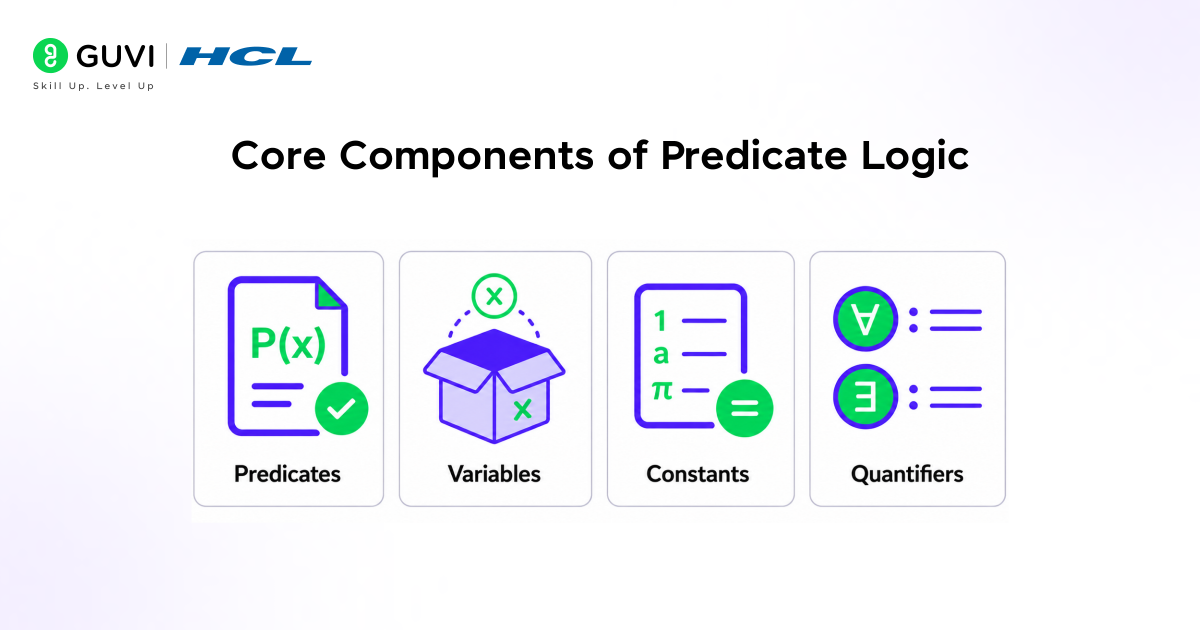
There are a few key building blocks to understand how predicate logic works.
- Predicates: relationships or properties that objects have; for example, WorksAt(Alice, CompanyX).
- Variables: generic entities; example, x in Employee(x).
- Constants: specific entities; example, Alice, Chennai, Server1.
- Quantifiers: describe scope; ∀ meaning “for all,” and ∃ meaning “there exists”.
These components form an extensible system, enabling the representation of structured knowledge, not merely atomic facts.
First Order Logic and Knowledge Representation
AI knowledge must be structured for reasoning, and predicate logic in First Order Logic makes this possible.
A knowledge base consists of both facts and rules, which together define how information is stored and inferred.
- Facts: actual known information.
- Rules: represent how concepts relate and imply one another.
Using inference, queries can then extract further knowledge that is not explicitly stated. For instance, in a system managing employees:
Employee(Rahul).
Manager(x) :- Employee(x), HasTeam(x).
This simple rule allows the AI to understand that if a person is an employee and has a team, they are automatically a manager. The explicit step of hand-coding the answer is not required.
The system derives it automatically.
To explore how predicate logic is integrated into actual AI architectures, check out the ebook.
Predicate logic plays a central role in knowledge representation in AI, where structured facts and rules are used to model real-world relationships and enable reasoning.
Inference Mechanisms in Predicate Logic
The core strength of predicate logic is its ability to derive new knowledge. This process is known as inference.
AI systems apply inference in multiple ways:
- Modus Ponens: Given a statement P → Q and an asserted fact P, the inference engine derives that Q must also be true.
- Universal Instantiation: If we know a property that holds for every entity, we can apply this property to a particular entity.
For example:
If the rule is ∀x (Developer(x) → LogicalThinker(x)), meaning “for all x, if x is a Developer then x is a LogicalThinker”.
And the fact is, Developer(Riya).
Then, the inference engine derives LogicalThinker(Riya).
It is deductive capability that distinguishes truly intelligent systems from purely statistical engines.
To explore how predicate logic is integrated into actual AI architectures, check out the ebook.
Evolution of Inference Systems
Traditional inference engines use logic like forward or backward chaining. Though effective in structured settings, they have significant limitations in terms of complexity and scale.
Current inference systems are shifting toward hybrid approaches that combine neural, probabilistic, and logical techniques.
- Neural inference for pattern recognition tasks.
- Probabilistic reasoning to handle uncertainty in real-world data.
- Logical constraints to enforce strict, provable rules and consistency.
This blended approach delivers the flexibility required by machine learning while maintaining the rigorous determinism of symbolic logic.
In practical AI systems, reasoning is part of a broader pipeline where models sense, interpret, and act, as explained in how AI systems work in real-world environments.
Knowledge Representation is Evolving
AI knowledge representation once was largely static and rule-based. Now it is evolving to become more dynamic.
Modern systems integrate multiple layers of representation to handle real-world complexity.
- Knowledge graphs represent complex, interlinked entities.
- Vector databases store information for semantic searches.
- Ontologies provide domain models to specify relationships and definitions.
Logic plays a dual role: as a structuring layer for knowledge and as a correctness-ensuring layer for reasoning.
Machine learning excels at prediction, and logic excels at justification and proof. They work in harmony.
Neuro-Symbolic AI: The New Standard
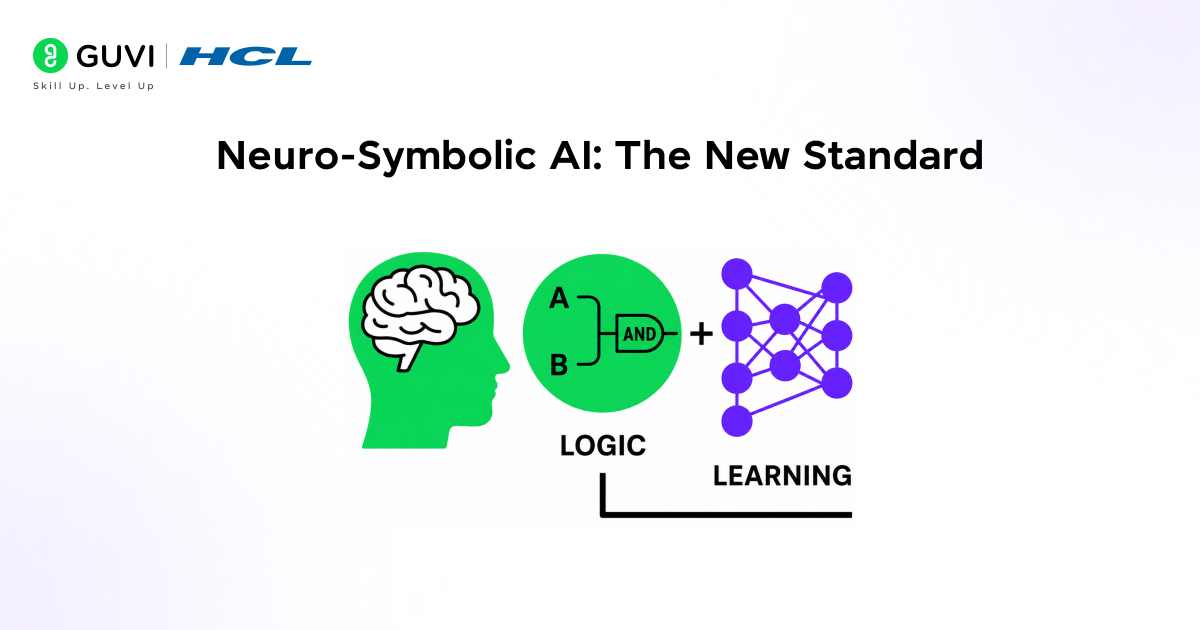
Neuro-symbolic AI is one of the most impactful trends today. The core idea behind these systems is to leverage neural networks for learning and predicate logic for reasoning.

This approach addresses a critical limitation of purely statistical AI, its lack of transparency and often unreliable reasoning processes.
Neuro-symbolic systems promise more interpretable, reliable, and constraint-aware AI:
- More interpretable and explainable AI.
- More reliable systems that can guarantee certain properties.
- Greater alignment with real-world constraints and rules.
This is why hybrid AI models are becoming a necessity for enterprise applications.
LLMs and Predicate Logic Integration
Large Language Models (LLMs) are highly powerful but have drawbacks. While these models generate text in a natural, human-like manner, their reasoning processes can be faulty.
This is being mitigated in modern LLMs by integrating them with predicate logic and natural language processing to convert unstructured language into logical forms that can be reasoned about more effectively.
The workflow is:
- Translate natural language into a structured logical form.
- Apply the reasoning rules of predicate logic.
- Validate the output before generating the final response.
Take the input: “Every engineer in the team knows Python.”
Logical form: ∀x (Engineer(x) → KnowsPython(x))
Core Problems Driving This Shift
Modern AI systems face three major problems:
- Hallucination of information.
- Non-explainability of the output.
- Logical inconsistency.
All three problems can be resolved by introducing predicate logic into the current architecture. They provide structure in reasoning, verification of truth, and transparency in how the reasoning occurred.
That is why logic is now making a comeback in AI.
Real-World Applications
Predicate logic has long been used and forms the foundation for systems that require precision. These include AI compliance systems, where it is used for rules in finance and legal areas, robotics decision-making and planning, knowledge graphs, explainable AI, and cybersecurity.
These systems prioritize precision over speed, which is why they rely heavily on predicate logic.
These concepts are widely applied in domains highlighted in real-world machine learning applications, where accuracy, consistency, and decision reliability are critical.
Modern AI systems in high-stakes domains like finance and medicine require logic-based validation layers to ensure reliability.
Even a single incorrect step can lead to millions in losses or life-threatening consequences.
This is why predicate logic is reemerging as a critical component in modern AI—providing structured reasoning and verifiable decision-making.
Limitations of Predicate Logic
Predicate logic is not the ideal solution.
- It is not suitable for dealing with uncertainty, as logic only deals with Boolean statements of true or false.
- It may become a very expensive process for larger systems.
- Some systems are undecidable, meaning that the system cannot be solved algorithmically.
This is why it has to be incorporated in machine learning, not as a stand-alone solution.
Future of Predicate Logic in AI
The future is not about choosing between logic and machine learning, but a combination of both. AI will move from highly predictive systems to ones capable of reasoning, explaining, and validating.
Predicate logic will play a major part as:
- A reasoning engine.
- A verification layer.
- The backbone of knowledge systems.
Hybrid systems will define the future of AI.
Practical Insight: How It All Comes Together
Consider a simplified example of hybrid reasoning.
# Pseudo logic + ML hybrid flow
if model_prediction == “High Risk”:
if not complies_with_rules(transaction):
reject_transaction()
The system uses machine learning to predict risk, but employs predicate logic to verify that it meets all regulations and denies it if it does not.
The combination brings both efficiency and accountability to the system.
With HCL GUVI’s Artificial Intelligence and Machine Learning course, you can build skills to develop intelligent systems using predicate logic and understand how machine learning and logic work together for accurate, explainable decisions.
Conclusion
Predicate logic is no longer outdated; it is a driving force behind reliable AI systems. While neural networks excel at prediction, logic ensures correctness and interpretability.
The real advancement lies in their integration. Neural networks alone are not enough, but when combined with logical reasoning, they enable truly intelligent and trustworthy systems.
FAQs
1. What is predicate logic in AI?
Predicate logic is a formal system used to represent relationships between objects and perform logical reasoning in AI systems.
2. What is the difference between predicate logic and propositional logic?
Propositional logic deals with simple true/false statements, while predicate logic represents relationships using variables and quantifiers.
3. Why is predicate logic important in modern AI?
It improves reasoning, explainability, and consistency, especially when combined with machine learning.
4. What is First Order Logic (FOL)?
First-order logic is a type of predicate logic that uses predicates, variables, and quantifiers to represent structured knowledge.
5. How is predicate logic used in real-world applications?
It is used in expert systems, knowledge graphs, robotics, compliance systems, and explainable AI.
6. What is neuro-symbolic AI?
Neuro-symbolic AI combines neural networks with symbolic reasoning to create systems that can both learn and reason effectively.
Success Stories

About the Author
Vishalini Devarajan
An Aerospace Engineer turned content writer, I focus on making complex concepts easy to understand through well-structured, reader-friendly blogs. Whether it’s a technical topic or a non-technical one, I love creating content that is clear, engaging, and impactful.
View all posts by Vishalini Devarajan
Connect with me @












Did you enjoy this article?