


Artificial Intelligence and Machine Learning Articles
AI/ML Skills Gap 2026: Why Companies Can't Find Job-Ready Talent
20 AI/ML Interview Questions Recruiters Can Use Without a Tech Background - Best Guide
How Industry-Backed AI/ML Bootcamps Are Changing the AI/ML Hiring Pipeline - Best Guide 2026
From IT Support to AI Engineer: A Realistic Career Switch Guide 2026


Get In Touch For Details! Request More Information

Face Recognition AI: How It Works, Methods, and Applications?
Jul 13, 2026 5 Min Read 1656 Views
(Last Updated)
How does your phone recognize your face in under a second, even in dim lighting? How do police identify a suspect from thousands of faces in a crowd?
The answer to both questions is the same: face recognition AI.
Face recognition is a form of artificial intelligence that identifies individuals based on their facial features. It’s not science fiction anymore; it’s running quietly in the background of your phone, your airport gate, and even your city’s traffic cameras.
In this article, you’ll get a clear breakdown of how face recognition AI actually works, the methods and models behind it, and where it’s being used in the real world today. Whether you’re a student, a developer, or simply curious about the technology around you, this guide covers it all.
Table of contents
- How Face Recognition AI Works?
- Step 1: Face Detection
- Step 2: Face Alignment
- Step 3: Feature Extraction (Face Embedding)
- Step 4: Face Matching
- AI/ML Pipeline for Facial Recognition
- Where is Face Recognition Technology Used Today?
- A Real-Life AI Case Study
- Limitations and Privacy Concerns
- Conclusion
- FAQs
- How does face recognition AI work?
- Does facial recognition work with eyes closed?
- What AI models are used in face recognition?
- Is face recognition AI accurate?
- Where is face recognition technology used?
How Face Recognition AI Works?
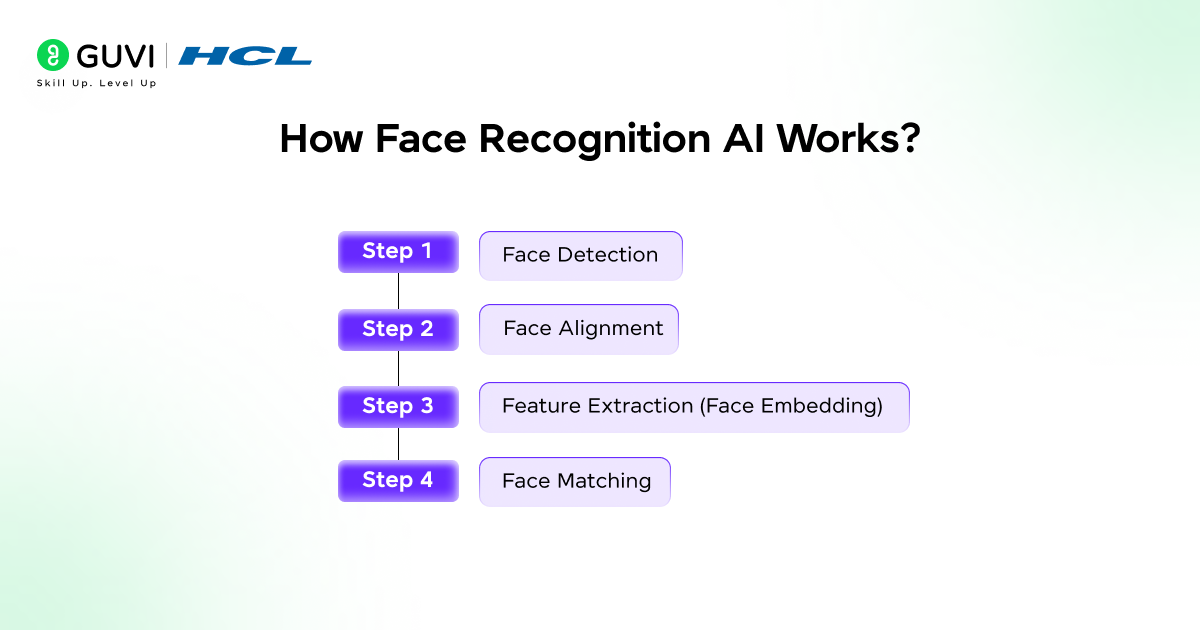
Face recognition AI doesn’t just “look” at a face the way you do. It follows a structured, multi-step process that converts a face into data, and then compares that data to find a match.
Here’s how each step works.
Step 1: Face Detection
Before anything else, the system needs to find a face in the image or video.
This step answers one simple question: Is there a face here?
Common detection methods include:
- Haar Cascades: Fast but less accurate, best for simple use cases
- HOG (Histogram of Oriented Gradients): Machine learning-based, more reliable
- CNN-based detectors: Deep learning-driven, significantly more accurate
- YOLO (You Only Look Once): Designed for real-time detection at high speed
Example: When you open your phone camera and a small box appears around your face, that’s face detection in action.
Step 2: Face Alignment
Once the face is detected, the system adjusts it to a standard position before moving forward.
It locates key facial landmarks, eyes, nose, and lips, and uses them to correct for:
- Tilted or rotated faces
- Different viewing angles
- Lighting inconsistencies
Example: Even if your head is slightly turned or tilted, the system normalizes it before processing. This step ensures the comparison that follows is accurate and consistent.
Face alignment can improve face recognition accuracy by up to 10–15%. Small corrections in angle and positioning make a significant difference in how accurately the system extracts and compares facial features.
Step 3: Feature Extraction (Face Embedding)
This is where the real intelligence happens.
Deep learning algorithms convert a face image into a numerical vector called a face embedding. Think of it as a unique numeric fingerprint for each face, no two people produce exactly the same one.
Here are the most widely used models for generating face embeddings:
- FaceNet: Assigns a numeric code to every face and groups similar faces together. The same person always gets the same code.
- VGG-Face: Analyzes fine details across the entire face, from eye shape to jaw contour.
- ArcFace: Considered best-in-class for accuracy. Rarely confuses two different people.
- DeepFace: Optimized for speed. Identifies faces very quickly with solid accuracy.
- ViT-Face: A newer model using Vision Transformers, designed for advanced recognition tasks.
Each model has its strengths depending on the use case, speed, accuracy, or handling difficult conditions like low lighting or partial occlusion.
Step 4: Face Matching
Once embeddings are extracted, the system compares them to identify or verify the person.
A useful way to understand this: imagine trying to tell identical twins apart. They look nearly the same, but small differences still exist. Face matching is about finding and measuring those differences.
Common similarity techniques include:
Euclidean Distance: Measures the straight-line distance between two face embeddings. The smaller the distance, the more similar the faces. With twins, this distance is very small, but never exactly zero, because the algorithm is trained to detect even the subtlest distinctions.
Cosine Similarity: Computes the angle between two embedding vectors. Two faces from the same person produce vectors pointing in nearly the same direction.
ML Classifiers (SVM, K-NN): Use trained machine learning models to classify an embedding into a known identity based on prior examples.
Softmax Classification: Assigns a probability score to each known person. For example: “Twin A → 85%, Twin B → 15%.” The highest probability wins.
The smaller the distance (or the higher the similarity score), the more confident the system is that it’s the same person.
Explore: Dataset for Face Recognition
The FBI’s facial recognition system, known as NGI (Next Generation Identification), can search a database of over 650 million photos in seconds. It uses embedding-based matching similar to the techniques described above.
AI/ML Pipeline for Facial Recognition
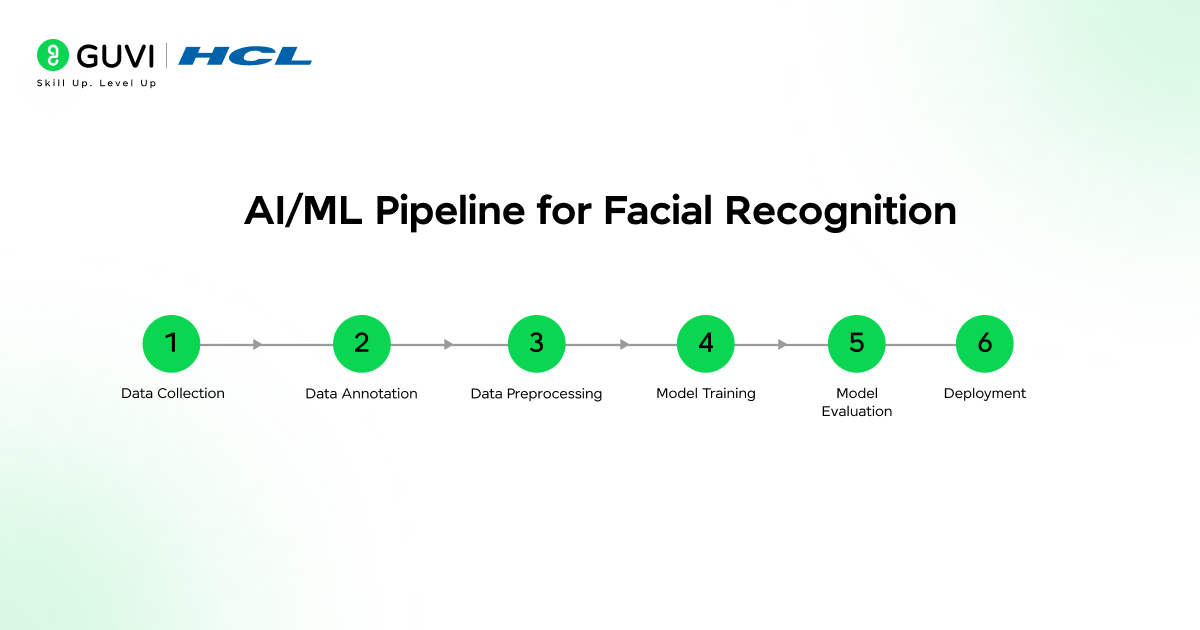
Building a face recognition system isn’t just about choosing a model. It involves a complete pipeline, from raw data to a working, deployable application.
Here’s how that pipeline is structured:
1. Data Collection
Everything starts with gathering face images, lots of them.
A strong dataset includes variety: different lighting conditions, angles, ages, expressions, and backgrounds. The more diverse the data, the better the system performs in real-world conditions.
2. Data Annotation
Each image needs to be labeled with the correct identity. Machine learning models learn from these labels, this is how the system learns who is who.
3. Data Preprocessing
Before training begins, images are cleaned and standardized. This includes resizing, normalizing pixel values, and correcting for lighting. Better quality input data directly leads to better accuracy.
4. Model Training
This is where the system learns. Deep learning models are trained on the preprocessed dataset using loss functions like Triplet Loss or ArcFace Loss, which teach the model to push different faces apart and pull the same faces together in the embedding space.
5. Model Evaluation
Before deployment, the model is tested on unseen data. Key metrics include accuracy, false acceptance rate (FAR), and false rejection rate (FRR).
This step ensures the system works reliably before it goes live.
6. Deployment
Once accuracy meets the required threshold, the model is optimized and integrated into real applications through:
- Model Compression: Quantization and pruning to make the model faster and lighter
- API Integration: REST APIs or on-device SDKs for real-time use
- Edge Deployment: Running on mobile devices, CCTV cameras, or IoT systems
- Real-Time Processing: Handling live video streams with minimal delay
This is the step where AI moves from a research project to something people actually use every day.

Explore: How to Restore Old Photos with Deep Latent Space Translation
Where is Face Recognition Technology Used Today?
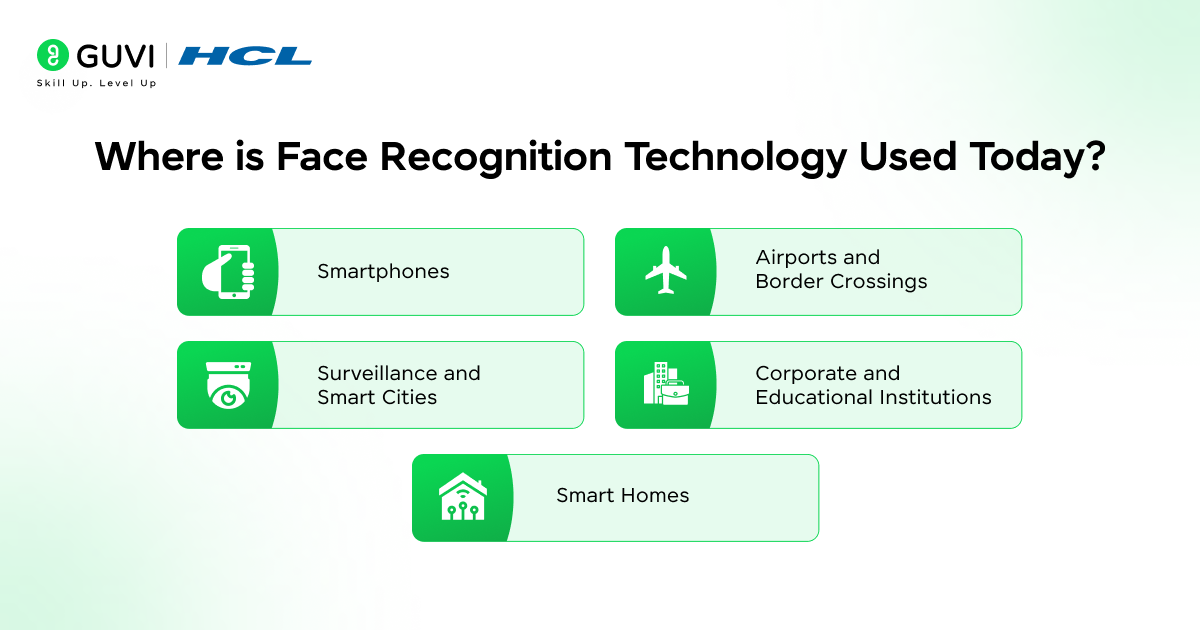
Face recognition has moved well beyond unlocking phones. Here’s where it’s making a real impact:
Smartphones: Used in iPhone Face ID, Samsung, and OnePlus devices. It authenticates payments and secures personal data — all with a single glance.
Airports and Border Crossings: Passengers can move through gates without showing a physical passport. Your face becomes the document. This significantly speeds up processing time and reduces queue lengths.
Surveillance and Smart Cities: CCTV systems integrated with face recognition can detect known offenders in public spaces in real time. This is being used in several cities to improve public safety and reduce response times.
Corporate and Educational Institutions: Face recognition-based attendance systems eliminate buddy punching, where one person checks in on behalf of another. Employees and students are verified automatically; no ID card required.
Smart Homes Smart door locks use face recognition to grant access. No keys, no passwords, your face is the credential.
China currently operates one of the largest face recognition networks in the world, with cameras covering public transport systems, residential areas, and retail spaces. The system can reportedly identify individuals within three seconds from a database of over a billion records.
A Real-Life AI Case Study
Sometimes the most compelling way to understand a technology is through a real example.
In Delhi, India, a body was discovered near the Geeta Colony flyover. Traditional identification methods, fingerprinting, DNA sampling, and dental records, all failed to identify the individual.
The Delhi Police then used AI-based face reconstruction. A digitally reconstructed image of the face was shared publicly. Within a short period, a member of the public recognized the face as his missing brother, allowing the police to close the case.
This case highlights something important: face recognition AI isn’t just a convenience tool. In the right circumstances, it can solve problems that no other technology can.
Limitations and Privacy Concerns
Face recognition AI is powerful, but it isn’t without its challenges.
- Accuracy gaps: Performance can drop significantly with poor lighting, occlusion (masks, glasses), or low-resolution images
- Bias in training data: Models trained on non-diverse datasets have shown higher error rates for certain demographic groups
- Privacy concerns: Mass surveillance using face recognition raises serious questions about consent, data storage, and potential misuse
- Security risks: Systems can potentially be fooled using high-quality photos or deepfakes if liveness detection isn’t implemented
Like any powerful technology, responsible use and strong regulation are essential to ensure face recognition AI serves people fairly and transparently.
If you’re serious about learning tools like GPT-OSS and want to apply them in real-world scenarios, don’t miss the chance to enroll in HCL GUVI’s Intel & IITM Pravartak Certified Artificial Intelligence & Machine Learning Course, co-designed by Intel. It covers Python, Machine Learning, Deep Learning, Generative AI, Agentic AI, and MLOps through live online classes, 20+ industry-grade projects, and 1:1 doubt sessions, with placement support from 1000+ hiring partners.
Conclusion
Face recognition AI has gone from a futuristic concept to a technology embedded in everyday life, from the phone in your pocket to the gate at an international airport.
Understanding how it works, from face detection through to embedding and matching, gives you a clearer picture of both its capabilities and its limits. As models continue to improve and deployment becomes more widespread, the conversations around accuracy, fairness, and privacy will only become more important.
Whether you’re building AI systems or simply using them, knowing what’s happening under the surface is always worth understanding.
I’m D Archana, a final-year Artificial Intelligence and Data Science student at Velammal Engineering College, Chennai passionate about machine learning, data analytics, and creative expression, with interests spanning technical innovation, blogging, design, and art.
FAQs
How does face recognition AI work?
It works through four steps: detecting a face in an image, aligning it to a standard position, extracting a unique numerical embedding, and comparing that embedding against stored data to find a match.
Does facial recognition work with eyes closed?
Generally, no. Most modern systems include liveness detection, which checks for natural eye movement and blinking. This prevents spoofing attempts using photos or static images.
What AI models are used in face recognition?
The most commonly used models include FaceNet, ArcFace, VGG-Face, DeepFace, and ViT-Face. Each offers different trade-offs between speed and accuracy.
Is face recognition AI accurate?
Modern systems achieve over 99% accuracy under good conditions. However, accuracy can drop with poor lighting, unusual angles, low image quality, or demographic groups underrepresented in training data.
Where is face recognition technology used?
It is used in smartphones, airports, surveillance cameras, corporate attendance systems, smart home devices, and law enforcement investigations.
Success Stories

About the Author
HCL GUVI
This article was selected and published as part of the HCL GUVI AI Blogathon 2026, an initiative designed to encourage students, AI enthusiasts, and aspiring tech writers to simplify complex AI concepts through impactful technical content. The contest recognized high-quality, original, and insightful AI-focused blogs, with selected authors receiving publication opportunities on the HCL GUVI blog platform along with official author credits and recognition.
View all posts by HCL GUVI
Connect with me @













Did you enjoy this article?