


Artificial Intelligence and Machine Learning Articles
Finance Manager to Data Analytics: Career Growth, Salary and Seniority
How to Evaluate LLM Outputs in Production Deployments
AI/ML Skills Gap 2026: Why Companies Can't Find Job-Ready Talent
20 AI/ML Interview Questions Recruiters Can Use Without a Tech Background - Best Guide


Get In Touch For Details! Request More Information

Introducing Replit Auth: Add Secure Login to Your App
Jun 24, 2026 5 Min Read 1272 Views
(Last Updated)
Adding a login to an application sounds simple. In practice, it is one of the most error-prone parts of any build. Developers have to handle password hashing, session management, token generation, OAuth flows, and security edge cases before a single user can sign in. Getting any one of these wrong creates real vulnerabilities.
AI agents building applications through vibe coding face the same problem at speed. Without a secure, integrated authentication layer, agents produce login systems that look complete but leave user accounts exposed. Passwords get stored incorrectly, sessions are not validated, and access controls are missing entirely.
Replit Auth solves this by providing a ready-to-use authentication system built directly into the Replit environment. The agent can add secure login to any application without writing authentication logic from scratch and without the security risks that come with it.
In this article, let us understand what Replit Auth is, how it works inside a Vibe coding workflow, what problems it prevents, and how to use it to add secure login to applications built with Replit Agent.
Table of contents
- TL;DR
- How AI Agents Handle Authentication Today
- The Real Problem: Authentication Mistakes Are Hard to Reverse
- The Shift: Secure Authentication Built Into the Environment
- How Replit Auth Works in a Vibe Coding Workflow
- Example: Protecting a route with Replit Auth
- Hidden Architecture: Auth and Database Working Together
- An Example: A Full Authentication Workflow with Replit Auth
- Why Authentication-First Vibe Coding Is More Effective
- Persistent Identity as a Crucial Enabler
- Why This Enables More Complete Autonomous Builds
- The Real Innovation: A Secure Foundation for Every Vibe-Coded App
- Conclusion
- What is Replit Auth?
- What authentication problems does Replit Auth prevent?
- How does Replit Auth work with Replit Databases?
- Does Replit Auth support social login or OAuth providers?
- Can I use Replit Auth outside of Replit?
TL;DR
1. Replit Auth is a built-in authentication system that adds secure login to Replit applications without custom auth logic.
2. It handles password security, session management, and user identity within the same project environment.
3. AI agents using Replit Auth produce login systems that are secure by default rather than insecure by accident.
4. The system integrates directly with Replit Databases, so user records are stored and accessed safely from the start.
5. Replit Auth authentication reduces the most common security mistakes in vibe-coded applications that involve user accounts.
What Is Replit Auth?
Replit Auth is a built-in authentication system available inside Replit projects that allows developers and AI agents to add secure user login without building authentication logic from scratch.
How AI Agents Handle Authentication Today
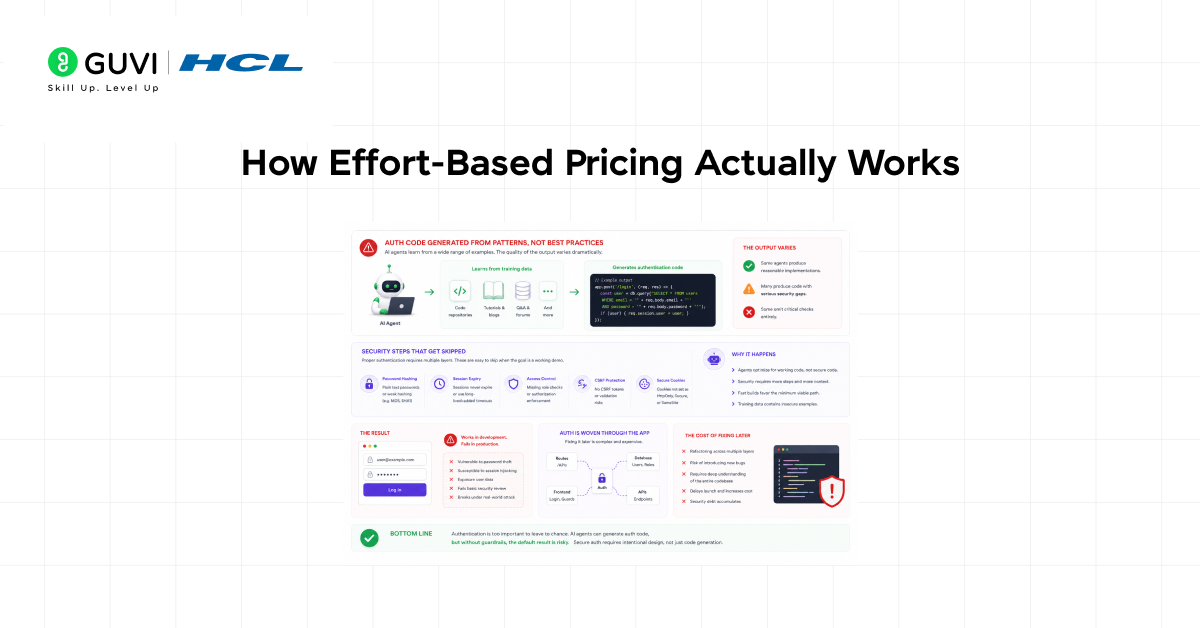
When an AI agent builds an application that requires user accounts, it typically generates authentication code from patterns in its training data. The output varies widely in quality. Some agents produce reasonable implementations. Many produce code that stores passwords in plain text, skips session expiry, or omits access control checks entirely.
The agent is not trying to produce insecure code. It is trying to produce working code quickly, and authentication done properly requires more steps than a fast build naturally includes. Input sanitization, bcrypt hashing, CSRF protection, and secure cookie configuration are each small and easy to skip when the goal is a functional demo.
The result is a login page that works during development and fails a basic security review the moment a real user is involved. Fixing authentication after the fact is expensive because authentication logic is woven through the entire application.
The Real Problem: Authentication Mistakes Are Hard to Reverse
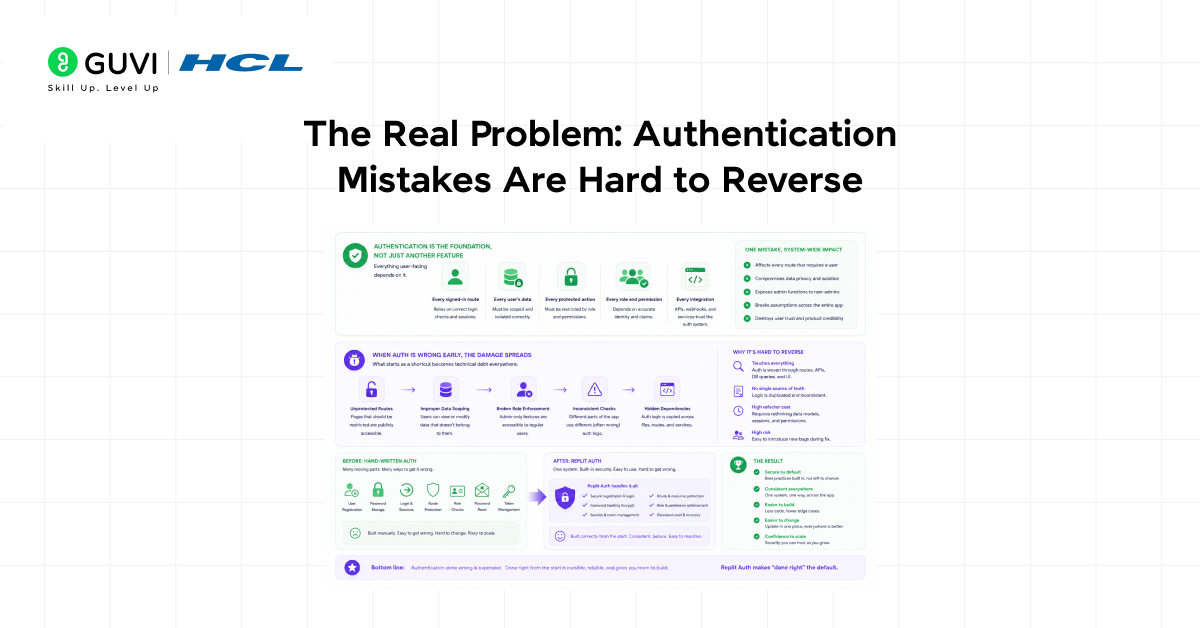
Authentication is not one feature among many. It is the foundation that every user-facing feature is built on. A mistake in the login system affects every route that requires a signed-in user, every record that belongs to a specific account, and every action that should be restricted by role.
When an agent gets authentication wrong early in the build, the damage spreads. Protected routes are not actually protected. User records are not properly scoped. Admin functions are accessible to regular users. These are not bugs that can be patched in a single commit. They require a review of every part of the application that touches user state.
Replit Auth prevents this class of problem entirely by replacing hand-written authentication logic with a system that handles security correctly from the start.
The Shift: Secure Authentication Built Into the Environment
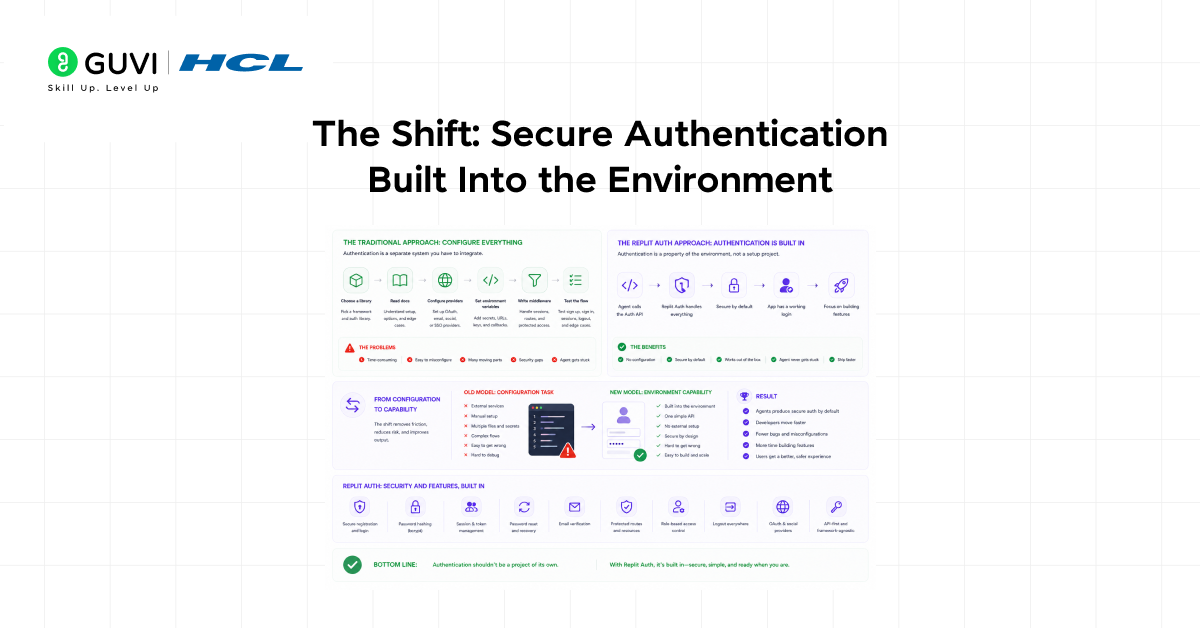
Traditional authentication integration means choosing a library, reading documentation, configuring providers, setting environment variables, writing middleware, and testing each part of the flow before a user can sign in. This is a reasonable process for an experienced developer with time to do it carefully.
For a vibe coding workflow, it creates a bottleneck. The agent either skips these steps and produces insecure code or gets stuck trying to configure external services that are not part of the project environment.
Replit Auth eliminates the bottleneck by making authentication a property of the environment rather than a configuration task. The agent calls the auth API, the system handles security, and the application has a working login without any of the configuration overhead.
How Replit Auth Works in a Vibe Coding Workflow
When Replit Auth is enabled in a project, the agent has access to authentication functions through the Replit Auth client. User signup, login, logout, and session retrieval are each available as straightforward function calls. The underlying security mechanics are handled by the system.
The current user is available in any part of the application through a single call. Routes can be protected by checking whether that call returns a valid user. User data is stored in Replit Databases automatically, so there is no separate step to configure user record storage.
Example: Protecting a route with Replit Auth
| import { getUser } from ‘@replit/auth’; export async function handler(req, res) { const user = await getUser(req); if (!user) { return res.status(401).json({ error: ‘Not authenticated’ }); } // User is verified, proceed with request const data = await getUserDashboardData(user.id); return res.status(200).json(data);} |
The agent generates this pattern as part of the normal build process. Route protection is consistent across the application because it always uses the same auth call rather than each route implementing its own session check.
Hidden Architecture: Auth and Database Working Together
Replit Auth is designed to work alongside Replit Databases. When a user signs up, their identity is stored in the project database automatically. When they log in, that identity is retrieved and verified. The developer does not need to write the user storage layer because it is managed by the auth system.
This integration means the agent can reference the authenticated user in database queries without a separate lookup step. The user object returned by Replit Auth includes the information needed to scope data correctly, so records are always associated with the right account.
The connection between authentication and data storage is handled at the environment level, which means it works correctly by default rather than requiring the developer to wire it together manually.
An Example: A Full Authentication Workflow with Replit Auth
A developer is building a task management application where each user should only see their own tasks. They ask the agent to add user accounts and ensure that tasks are scoped to the logged-in user. With Replit Auth available, the agent handles the entire flow in a single pass.
| import { getUser, loginUrl, logoutUrl } from ‘@replit/auth’;import Database from ‘@replit/database’; const db = new Database(); // Get the current authenticated userconst user = await getUser(req); if (!user) { return res.redirect(loginUrl);} // Store a new task scoped to this userawait db.set(`task:${user.id}:${Date.now()}`, JSON.stringify({ title: req. body.title, done: false, created_at: new Date().toISOString()})); // Retrieve only this user’s tasksconst keys = await db.list(`task:${user.id}:`);const tasks = await Promise.all( keys.map(async key => JSON.parse(await db.get(key)))); |
The agent writes auth-aware data access from the start. Every task is stored under the user’s ID and retrieved by that same ID. A user who is not authenticated is redirected to the login page before any data is accessed.
Applications that use an integrated authentication system from the start tend to have significantly fewer access control vulnerabilities at launch. This is because the agent never has to invent session management logic or devise its own user scoping patterns.

Why Authentication-First Vibe Coding Is More Effective
When authentication is added late in a build, every feature that was written without it has to be revised. Routes that were open now need protecting. Data that was global now needs to be scoped to a user. Logic that assumed a single user now needs to handle multiple accounts. The retrofit is slow and introduces new bugs.
Authentication-first vibe coding avoids this entirely. Because Replit Auth is available from the first build, the agent writes user-aware code consistently throughout the application. There is no retrofit because there is no period during which the application existed without authentication.
Persistent Identity as a Crucial Enabler
Real applications require users to be recognized across sessions. A user who logs in today should still be logged in tomorrow without signing in again. A user who creates a record in one session should see that record in the next. This requires persistent identity, not just a login function.
Replit Auth provides this persistence by maintaining user sessions and linking them to stored user records. The agent does not need to implement session renewal, token storage, or remember-me logic. The system handles it and exposes the current user through the same single call, regardless of how long ago they signed in.
This persistent identity is what makes vibe-coded applications with Replit Auth feel like real products rather than stateless demos.
Why This Enables More Complete Autonomous Builds
Without an integrated auth system, any application that requires user accounts hits a wall during autonomous development. The agent can build the interface and the data layer, but the moment it needs to associate data with a specific user, it either skips the association or produces insecure code to handle it.
Replit Auth removes that wall. The agent has everything it needs to build user-aware applications completely, from the login page to the last protected route, without stopping for external configuration or producing security gaps to fill in later.
This is what makes Replit Auth a genuine enabler of autonomous full-stack vibe coding rather than a convenience feature.
The Real Innovation: A Secure Foundation for Every Vibe-Coded App
Replit Auth is not just a login shortcut. It is part of a complete, integrated environment where authentication, data storage, and application code work together by design. The security properties that take experienced developers significant time to implement correctly are available to any agent building any application in Replit.
This integration is what separates Replit Auth from a third-party auth library. It is not a tool the developer configures and integrates. It is a property of the environment that the agent uses naturally, producing applications that are secure by default rather than by careful implementation.
To effectively build self-testing AI agents using Replit Agent, understanding how execution-based validation, REPL workflows, and iterative feedback loops interact is essential for creating reliable and scalable systems. Programs like HCL GUVI’s Artificial Intelligence and Machine Learning course can help build these skills through hands-on experience.
Conclusion
Replit Auth gives vibe-coded applications a secure authentication foundation without requiring the developer or the agent to implement authentication logic from scratch. Login, session management, and user identity are handled correctly from the first build, which means every feature built on top of them starts from a safe baseline.
Through its integration with the Replit environment and Replit Databases, Replit Auth makes it possible to build complete, user-aware applications autonomously without the security gaps that typically appear when authentication is treated as an afterthought. If an AI agent builds an application with users but without secure authentication, it will always produce something that cannot be trusted with real accounts. Reliable vibe coding with user data starts when authentication is part of the environment from the beginning.
FAQs
1. What is Replit Auth?
It is a built-in authentication system inside Replit projects that allows developers and AI agents to add secure user login without writing authentication logic from scratch or configuring external providers.
2. What authentication problems does Replit Auth prevent?
It prevents the most common authentication mistakes in vibe-coded applications, including plain-text password storage, missing session validation, unprotected routes, and user data that is not scoped correctly to individual accounts.
3. How does Replit Auth work with Replit Databases?
User identity created through Replit Auth is stored in Replit Databases automatically. The authenticated user object includes the information needed to scope database queries correctly without a separate user lookup step.
4. Does Replit Auth support social login or OAuth providers?
Replit Auth handles authentication within the Replit environment. For advanced provider integrations, such as Google or GitHub login, additional configuration is required beyond the built-in system.
5. Can I use Replit Auth outside of Replit?
Replit Auth is designed for the Replit environment. Applications deployed outside of Replit or that need to integrate with external identity infrastructure will need to migrate to a standalone authentication solution.
Success Stories

About the Author
Vishalini Devarajan
An Aerospace Engineer turned content writer, I focus on making complex concepts easy to understand through well-structured, reader-friendly blogs. Whether it’s a technical topic or a non-technical one, I love creating content that is clear, engaging, and impactful.
View all posts by Vishalini Devarajan
Connect with me @














Did you enjoy this article?