


Python Articles
Excel SQL Python for BPO Professionals Best Guide to Move Into Data Science
Go vs Python for Forward Deployed Engineering Workloads
Python for Forward Deployed Engineers: What You Actually Need to Know
Freelancing as a Python Developer: Getting Your First Client


Get In Touch For Details! Request More Information
Have you ever wondered how Python decides the fastest way to search data, sort numbers, or solve a problem step by step? Behind every such operation, there is an algorithm guiding Python on what to do and how to do it efficiently.
This blog explains what an algorithm in Python is in a simple, beginner-friendly way. You’ll learn the basic meaning of algorithms, how they work in Python, common examples, why they matter in real programs, and how beginners can start thinking algorithmically.
Quick Answer
An algorithm in Python is just a set of clear steps that tells the computer how to solve a problem. It explains what to do first, next, and last so Python can give the correct result. Learning algorithms helps beginners think clearly and write better Python programs.
Table of contents
- What Is An Algorithm In Python
- Why Algorithms Are Important In Python Programming
- Real-Life Example Of An Algorithm
- Simple Algorithm Example Using Python
- Algorithm To Find The Largest Number In A List
- Algorithm To Check Whether A Number Is Even Or Odd
- Algorithm To Calculate The Sum Of First N Numbers
- Types Of Algorithms In Python
- Sorting Algorithms
- Searching Algorithms
- Greedy Algorithms
- Recursive Algorithms
- Divide And Conquer Algorithms
- Dynamic Programming Algorithms
- How To Write An Algorithm In Python
- 💡 Did You Know?
- Conclusion
- FAQs
- How do I know which algorithm to use for a real problem in Python?
- Can I write Python programs without knowing algorithms properly?
- How important are algorithms for Python job interviews in India?
- Should beginners focus more on algorithms or Python syntax first?
- How long does it take to get comfortable with algorithms in Python?
What Is An Algorithm In Python

An algorithm in Python is a step-by-step method used to solve a problem logically. It breaks a problem into small, ordered actions that lead to a correct result. Whether the task is simple or complex, an algorithm decides how Python should approach it. The goal is to solve the problem clearly and correctly.
For example, if you want to find the largest number in a list, the algorithm checks each number one by one and remembers the biggest value. Python follows this logic and gives the final output. This shows that the algorithm is the thinking process behind the code.
In real life, an algorithm is like the steps you follow to travel to a destination. You decide the route, turns, and stops before starting the journey. In the same way, an algorithm decides the steps first, and Python simply follows them to reach the solution.
Why Algorithms Are Important In Python Programming
Algorithms are important because they define how a Python program thinks and solves problems. They help convert real-world problems into clear logical steps that a computer can follow. Without proper algorithms, programs may work incorrectly or become slow as data increases. Learning algorithms helps beginners write reliable and efficient Python code.
- Problem Solving Structure – Algorithms help break complex problems into simple, logical steps.
- Efficiency And Performance – The right algorithm reduces execution time and memory usage.
- Code Readability – Algorithms make Python programs easier to understand and maintain.
- Scalability – Good algorithms allow programs to handle large inputs smoothly.
If you’re looking to turn your understanding of algorithm in python into real coding confidence, do check out HCL GUVI’s Python Course. This course strengthens your Python basics and problem-solving skills, including how to think algorithmically and write efficient code. It’s designed for beginners and helps bridge the gap between learning concepts and applying them in real programs.
Real-Life Example Of An Algorithm
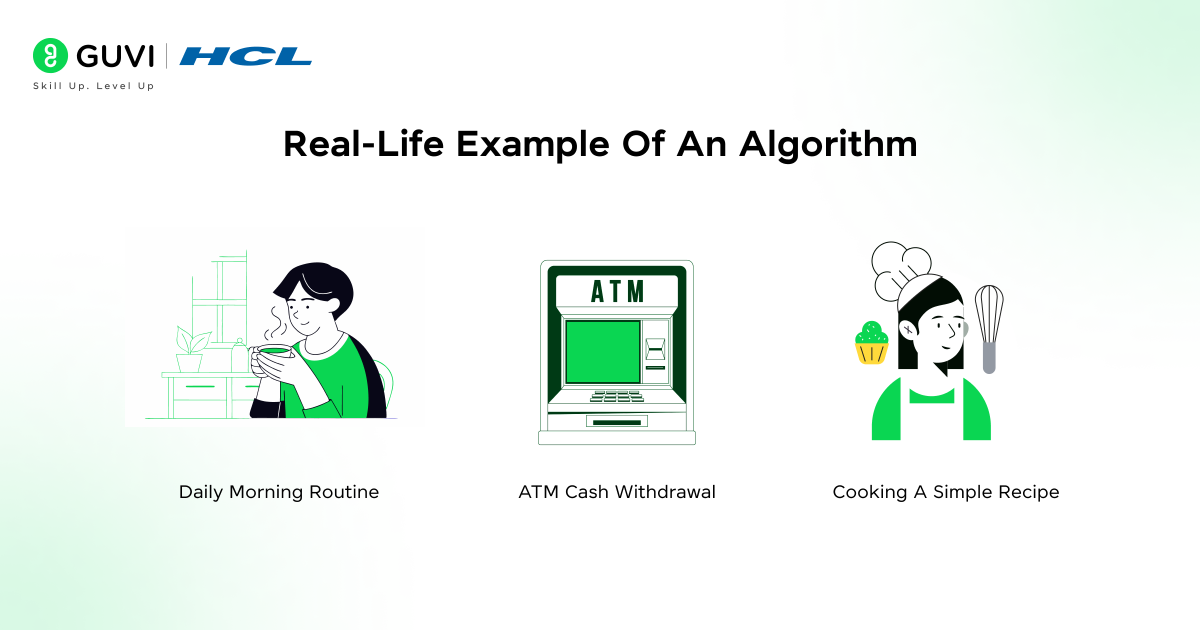
In real life, many activities are completed by following a fixed set of steps in a specific order. These steps help us reach a result without confusion or mistakes. This idea of following ordered instructions is exactly what an algorithm represents. Python uses similar step-by-step logic to solve problems.
1. Daily Morning Routine
When you wake up, you usually brush your teeth, take a bath, and then eat breakfast. Doing these steps in the correct order helps you start the day smoothly. This fixed order of actions is an algorithm.
2. ATM Cash Withdrawal
To withdraw money, you insert your card, enter the PIN, select the amount, and collect the cash. If one step is skipped or done wrongly, the process stops. This shows how algorithms must follow a strict sequence.
3. Cooking A Simple Recipe
While making tea, you boil water, add tea leaves, pour milk, and add sugar. Changing the order affects the result. This step-by-step method is another example of an algorithm.
Simple Algorithm Example Using Python
Algorithms in python become easier to understand when they are applied to simple, real problems. In Python programming, most tasks are solved by first thinking through clear logical steps and then converting them into code. This approach helps beginners understand how problem-solving works in Python. Below are common algorithm examples that show how Python handles basic tasks step by step.
1. Algorithm To Find The Largest Number In A List
Finding the largest number is a common task in Python programs that deal with data. The idea is to compare values one by one instead of checking everything at once. By continuously updating the largest value, Python can arrive at the correct result efficiently. This algorithm in python helps beginners understand comparison and looping logic.
Step 1: Start and take a list of numbers as input.
Step 2: Assume the first number in the list is the largest.
Step 3: Compare the current largest number with the next value in the list.
Step 4: If a larger value is found, update the largest number.
Step 5: Repeat until all numbers are checked.
Step 6: Display the largest number and stop.
2. Algorithm To Check Whether A Number Is Even Or Odd
Checking whether a number is even or odd is a basic decision-making problem in Python. This algorithm in python helps beginners understand how conditions work using simple logic. The decision is made by checking divisibility, which is a common operation in many programs. It is often used in validations and logical checks.
Step 1: Start and take a number as input.
Step 2: Divide the number by 2.
Step 3: Check the remainder after division.
Step 4: If the remainder is zero, display even.
Step 5: Otherwise, display odd.
Step 6: Stop.
3. Algorithm To Calculate The Sum Of First N Numbers
Calculating the sum of numbers is frequently used in counting and mathematical problems. This algorithm shows how repetition works by adding numbers one after another. This algorithm in python helps beginners understand accumulation and looping concepts clearly. Such logic is commonly used in real-world Python programs.
Step 1: Start and take the value of n as input.
Step 2: Initialize a variable sum with value 0.
Step 3: Add numbers from 1 to n to sum.
Step 4: Continue until all numbers are added.
Step 5: Display the final sum.
Step 6: Stop.
If you prefer structured, written explanations to reinforce your understanding of Python and algorithm logic, check out HCL GUVI’s Python eBook. It breaks down Python fundamentals, problem-solving steps, and practical examples in an easy, beginner-friendly format. This eBook is a great companion to deepen your algorithm skills and become more confident in writing Python programs.
Types Of Algorithms In Python
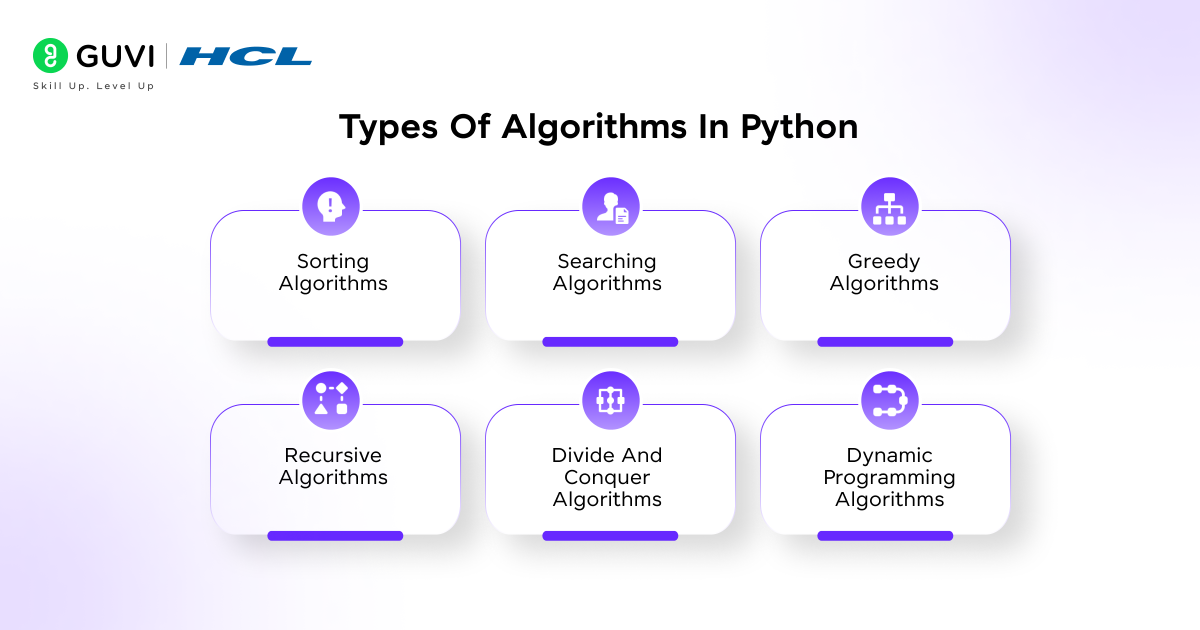
Algorithm in Python are step-by-step procedures used to solve problems logically and efficiently. Different problems require different algorithmic approaches based on data size, structure, and performance needs. Knowing the types of algorithms helps beginners understand how solutions are designed instead of just memorizing code. Below are the major algorithm types explained clearly with working logic, algorithm names, and real-world usage.
1. Sorting Algorithms
Sorting algorithms in Python are used to arrange data in a specific order, such as ascending or descending. They make data easier to analyze, search, and display. Sorting is commonly required before applying other algorithms like searching or statistical analysis. The efficiency of sorting depends on how comparisons and swaps are handled.
How It Works:
The algorithm in python compares elements in the list and checks whether they are in the correct order. If elements are misplaced, it swaps or rearranges them based on the algorithm’s logic. This process repeats multiple times until all elements are arranged properly. Some sorting algorithms divide the list into smaller parts, while others sort by repeated comparisons.
Algorithm Names: Bubble Sort, Selection Sort, Insertion Sort, Merge Sort, Quick Sort
Example Scenario: Sorting product prices from lowest to highest in an e-commerce application.
2. Searching Algorithms
Searching algorithm in python are used to find a specific value within a collection of data. Instead of manually checking each value, these algorithms follow a structured approach to locate the required element. Searching is important when datasets grow large and manual checking becomes inefficient.
How It Works:
The algorithm in python checks elements using a defined pattern to determine whether the target value exists. Some algorithms examine each element one by one, while others reduce the search space by dividing the data. The approach used depends on whether the data is sorted or unsorted. This helps reduce the number of comparisons needed.
Algorithm Names: Linear Search, Binary Search
Example Scenario: Finding a user ID in a database of registered users.
3. Greedy Algorithms
Greedy algorithm in python solve problems by making the best possible decision at each step. They focus on choosing the option that provides immediate benefit rather than considering the full problem. This approach works well when local optimal choices lead to a correct overall solution.
How It Works:
At every step, the algorithm in python selects the choice that seems most beneficial at that moment. Once a decision is made, it is never reconsidered or changed later. The algorithm continues this process until the problem is fully solved. This makes greedy algorithms fast and simple but not suitable for all problems.
Algorithm Names: Activity Selection Algorithm, Coin Change Algorithm
Example Scenario: Selecting the maximum number of tasks that can be completed within limited time slots.

4. Recursive Algorithms
Recursive algorithm in python solve problems by calling the same function repeatedly with smaller inputs. They are useful when a problem can be broken down into similar subproblems. Python supports recursion naturally, making it easy to implement such algorithms.
How It Works:
The function keeps calling itself while reducing the problem size each time. A base condition is defined to stop the recursive calls. Once the base case is reached, the function starts returning values back through each call. This algorithm in python process continues until the original problem is solved.
Algorithm Names: Factorial Calculation, Fibonacci Series
Example Scenario: Calculating factorial values or generating Fibonacci numbers.
5. Divide And Conquer Algorithms
Divide and conquer algorithm in python solve complex problems by splitting them into smaller, manageable parts. Each smaller problem is solved independently, and the results are combined to form the final solution. This approach improves efficiency for large datasets.
How It Works:
The algorithm in python divides the main problem into smaller subproblems repeatedly. Each subproblem is solved individually using the same logic. After solving, the results are merged together in a specific order. This method reduces time complexity and improves performance.
Algorithm Names: Merge Sort, Quick Sort
Example Scenario: Sorting large datasets efficiently in data processing systems.
6. Dynamic Programming Algorithms
Dynamic programming algorithms are used when problems have overlapping subproblems. Instead of recalculating the same results repeatedly, these algorithms store intermediate results. This improves speed and reduces unnecessary computation.
How It Works:
The algorithm in python breaks the problem into smaller subproblems and solves each one only once. The results are stored in memory for future reference. When the same calculation is needed again, the stored result is reused. This significantly improves efficiency for complex problems.
Algorithm Names: Knapsack Algorithm, Longest Common Subsequence
Example Scenario: Finding the most valuable combination of items within a fixed weight limit.
If you want to explore Python fundamentals, examples, and practical guides that support the concepts in this blog, check out HCL GUVI’s Python Hub. It offers curated learning paths and easy-to-follow resources designed to help beginners understand how Python works, including foundational algorithm thinking. This hub can be a useful companion as you continue improving your Python skills.
How To Write An Algorithm In Python
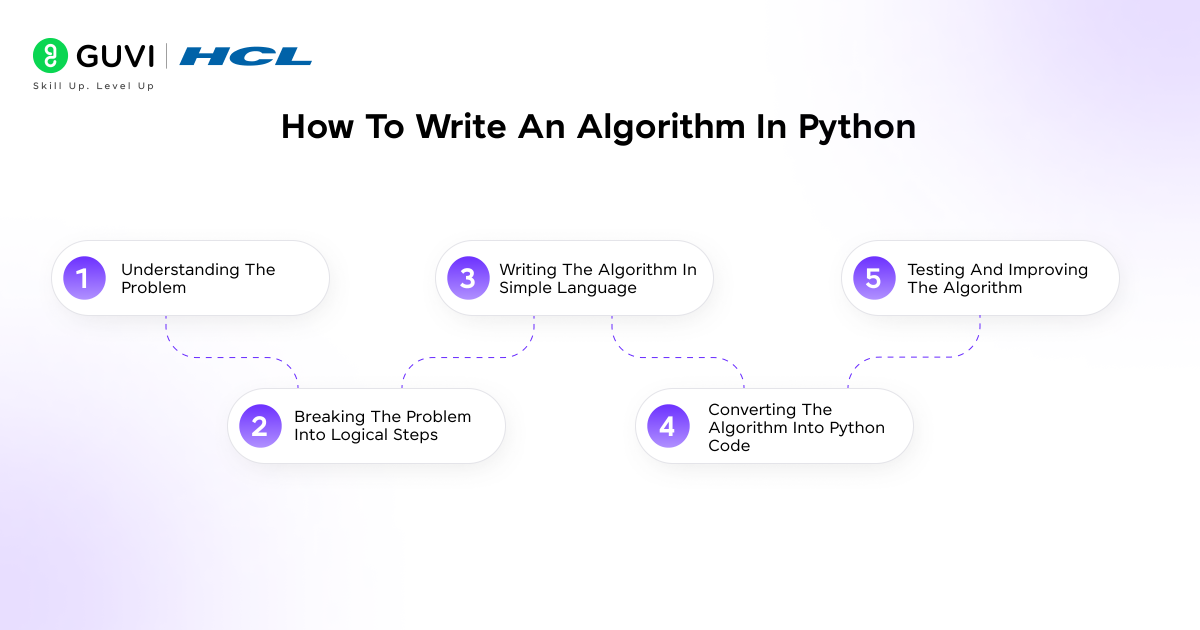
Writing an algorithm in Python is the foundation of solving programming problems logically. An algorithm defines a clear sequence of steps that a Python program follows to transform input into output. For beginners, understanding algorithms in Python improves problem-solving ability and makes coding more structured. This approach helps write correct, readable, and efficient Python programs.
1. Understanding The Problem
The first step in writing an algorithm in Python is clearly understanding what needs to be solved. This involves identifying the input values, expected output, and any conditions involved. Without this clarity, even well-written Python code can produce incorrect results. A clear understanding ensures the algorithm focuses on the correct goal.
Tip: Rewrite the problem in your own words before designing the algorithm.
2. Breaking The Problem Into Logical Steps
Once the problem is understood, it should be divided into smaller, logical steps. Each step should perform a single action and follow a clear sequence. This makes the algorithm easier to write, understand, and convert into Python code. Breaking problems down also helps beginners avoid logical mistakes.
Tip: If a step feels complex, split it into two simpler steps.
3. Writing The Algorithm In Simple Language
An algorithm is written using simple, clear statements instead of Python syntax. This focuses on logic rather than coding rules. Writing steps in plain language allows beginners to verify the correctness of the solution before implementing it in Python. This step builds confidence and clarity.
Tip: Avoid thinking about syntax at this stage and focus only on what should happen.
4. Converting The Algorithm Into Python Code
After the logic is finalized, the algorithm is translated into Python code. Variables, loops, and conditions are added while keeping the logic unchanged. This step turns the algorithm into a working Python program. Proper indentation and syntax are applied at this stage.
Tip: Match each algorithm step to a Python statement while coding.
If you want a hands-on way to practice Python right in your browser while learning algorithms and core logic, try HCL GUVI’s Online Python IDE. It lets you write, run, and test Python code instantly without setup, making it easier to apply what you learn from this blog. This tool is especially useful for beginners who want to experiment with Python algorithms in real time.
5. Testing And Improving The Algorithm
Testing ensures the algorithm works correctly for different inputs and scenarios. Errors or inefficiencies found during testing are corrected by refining the logic. This step improves accuracy and performance. A well-tested algorithm results in a reliable Python program.
Tip: Test your algorithm using both normal and edge-case inputs.
💡 Did You Know?
- Python’s algorithm readability is one of the main reasons it is commonly used in coding interviews in India, as interviewers focus more on logic than syntax.
- Many production systems written in other languages still use Python to prototype and validate algorithms before optimizing them elsewhere.
- Python’s built-in sorting uses Timsort, an algorithm designed specifically for real-world data patterns rather than theoretical cases.
Conclusion
Understanding algorithms in Python is essential for building strong programming fundamentals. Algorithms help you think logically, break problems into clear steps, and write Python code with confidence instead of guessing. For beginners, this approach makes learning Python structured and less confusing.
By learning how algorithms work, when to use them, and how to write them clearly, you build skills that apply beyond Python to any programming language. Strong algorithmic thinking improves problem-solving, interview performance, and real-world coding ability, making it a core skill for every Python developer.
FAQs
1. How do I know which algorithm to use for a real problem in Python?
You decide this by looking at the problem type, such as whether it involves searching, sorting, optimization, or repeated calculations. With practice, you start recognizing patterns and choosing algorithms that fit the problem naturally.
2. Can I write Python programs without knowing algorithms properly?
Yes, but the code may become inefficient, hard to debug, and difficult to scale. Algorithms help you write cleaner logic and avoid trial-and-error coding.
3. How important are algorithms for Python job interviews in India?
Algorithms are extremely important, as most technical interviews test problem-solving ability rather than language syntax. Even simple Python roles expect basic algorithmic thinking.
4. Should beginners focus more on algorithms or Python syntax first?
Beginners should learn basic Python syntax alongside simple algorithms. Learning both together helps understand how logic turns into working code.
5. How long does it take to get comfortable with algorithms in Python?
With regular practice on small problems, beginners usually become comfortable within a few weeks. Consistency matters more than speed.
Success Stories

About the Author
Jebasta
I translate the language of data into stories that anyone can understand. As a writer with a data science background, I simplify analytics, AI, and decision-making so beginners and enthusiasts can confidently explore the world of data.
View all posts by Jebasta
Connect with me @













Did you enjoy this article?