


Python Articles
Excel SQL Python for BPO Professionals Best Guide to Move Into Data Science
Go vs Python for Forward Deployed Engineering Workloads
Python for Forward Deployed Engineers: What You Actually Need to Know
Freelancing as a Python Developer: Getting Your First Client


Get In Touch For Details! Request More Information
Imagine you want to teach a computer to predict house prices or tell whether an email is spam, but you do not want to write complex mathematical formulas from scratch. This is where sklearn in Python comes in, making machine learning feel more like using ready-made tools than solving difficult equations.
This blog is written for beginners who want to clearly understand what sklearn in Python is, why it is widely used, and how it helps build machine learning models easily and efficiently.
Quick Answer
Sklearn in Python is a machine learning library that helps you build models without writing complex algorithms from scratch. It provides ready-to-use tools for tasks like prediction, classification, and data analysis using simple Python code. This makes sklearn ideal for beginners who want to learn machine learning in a practical and easy way.
Table of contents
- What Is Sklearn In Python
- Why Sklearn Is Important In Python
- What Can You Do Using Sklearn In Python
- Classification
- Regression
- Clustering
- Dimensionality Reduction
- Data Preprocessing
- Model Evaluation And Validation
- 💡 Did You Know?
- Conclusion
- FAQs
- What is the difference between sklearn and other machine learning libraries in Python?
- Do I need strong mathematics knowledge to start using sklearn in Python?
- Can sklearn be used for real world industry projects?
- Is sklearn suitable for handling large datasets?
- What should I learn after sklearn in Python?
What Is Sklearn In Python
Sklearn in Python, also known as Scikit-learn, is an open-source machine learning library used to build and evaluate machine learning models easily. It provides simple and efficient tools that help users work with data, apply machine learning algorithms, and measure model performance without writing complex logic from scratch.
In simple terms, sklearn acts like a ready-made machine learning toolkit. Instead of coding algorithms such as linear regression or classification manually, you can use sklearn to apply them with just a few lines of Python code. This makes sklearn in Python especially popular among beginners, students, and professionals who want quick and reliable machine learning solutions.
If you want to explore more Python tutorials, tips, and resources that will strengthen your fundamentals before moving into machine learning with sklearn in Python, do check out HCL GUVI’s Python Hub for structured articles and practical learning.
Why Sklearn Is Important In Python
Sklearn is important in Python because it simplifies the entire machine learning workflow, from data preparation to model evaluation. It allows beginners to start building machine learning models quickly while also giving professionals reliable tools for experimentation and real-world applications.
By providing a consistent structure across algorithms, sklearn in Python helps users focus on understanding data and improving results instead of struggling with complex mathematical implementations.
Key Importance
- Easy To Learn For Beginners – Sklearn uses clean and consistent syntax, making machine learning approachable even for first-time learners.
- Ready-Made Algorithms – It provides built-in implementations of common machine learning algorithms, saving time and effort.
- Consistent Workflow – Almost all models in sklearn follow the same fit, predict, and evaluate pattern, which simplifies learning.
- Strong Data Preprocessing Support – Sklearn includes tools for scaling, encoding, and cleaning data before model training.
- Reliable Model Evaluation – It offers accuracy scores, confusion matrices, and validation techniques to test model performance.
- Fast Experimentation – Developers can quickly test multiple models and compare results using the same dataset.
- Industry Adoption – Sklearn is widely used in real-world data science and machine learning projects.
If you want a comprehensive guide to strengthen your Python fundamentals before jumping into machine learning with sklearn in Python, do check out HCL GUVI’s Python eBook which covers key concepts, examples, and practical exercises.
What Can You Do Using Sklearn In Python
Sklearn in Python is designed to help users perform the most common and practical machine learning tasks with ease. In real-world projects, machine learning is not just about building a model but also about preparing data, choosing the right approach, and evaluating results properly. This section explains the main tasks you can perform using sklearn in Python and how each of them is applied in practical scenarios.
In this section, you will learn about the following tasks using sklearn in Python:
- Classification
- Regression
- Clustering
- Dimensionality Reduction
- Data Preprocessing
- Model Evaluation And Validation
If you want to practice writing and running Python code, including sklearn examples and machine learning experiments, do check out HCL GUVI’s Online Python IDE which lets you code in the browser instantly without any local setup.
1. Classification
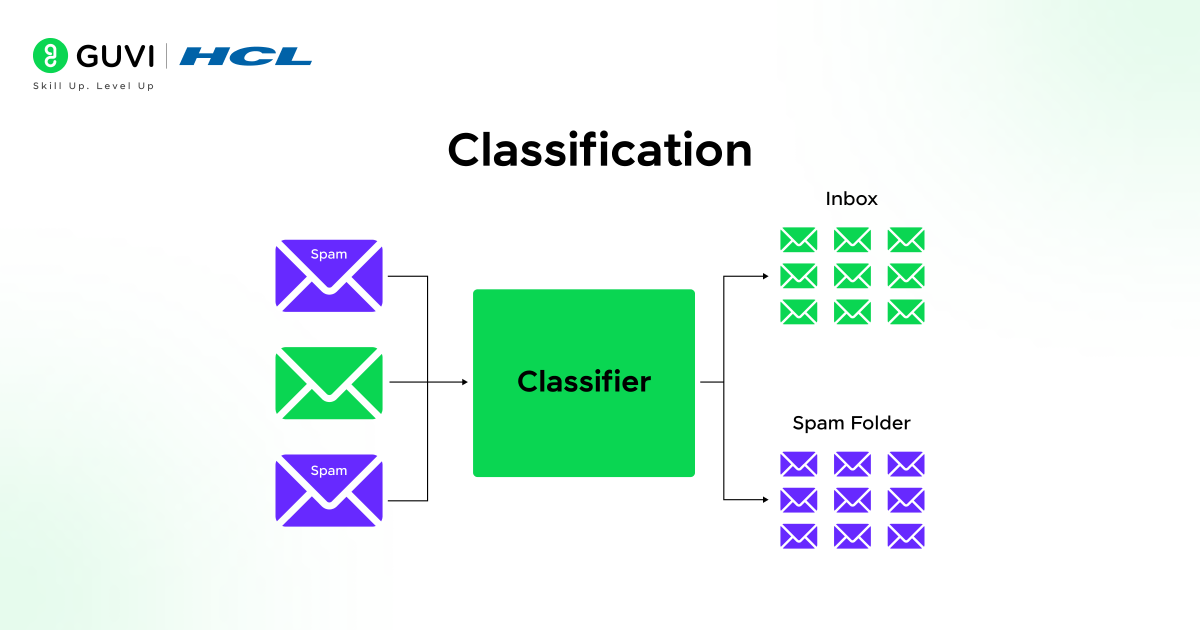
Classification in sklearn in Python is used when the output needs to belong to a specific category or class. The model learns from labeled data and predicts the correct category for new inputs. This technique is widely used in real-world applications where decisions are based on predefined classes, making it one of the most important uses of sklearn.
Classification models help systems automatically make decisions based on patterns learned from historical data. Sklearn provides multiple classification algorithms that work well for both simple and complex datasets.
- Spam Classification – Helps identify whether an email is spam or not.
- Fraud Detection – Used to classify transactions as genuine or fraudulent.
- Sentiment Analysis – Determines whether text data expresses positive, negative, or neutral sentiment.
- Medical Diagnosis – Assists in classifying patients as healthy or at risk based on medical data.
Example Code
from sklearn.linear_model import LogisticRegression

model = LogisticRegression()
model.fit(X_train, y_train)
predictions = model.predict(X_test)
Here, Logistic Regression is used as a classification algorithm. The model learns from training data where the correct class labels are already known. After training, it predicts the class for new input data. This is how sklearn enables systems to automatically categorize information.
2. Regression
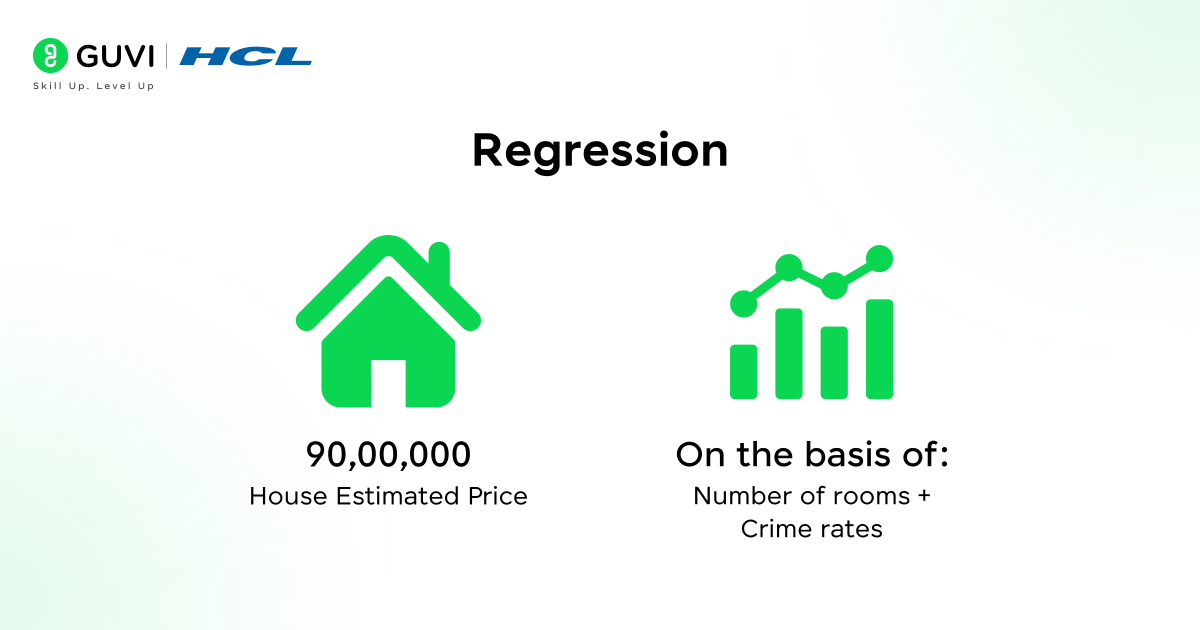
Regression in sklearn in Python is used when the goal is to predict numerical or continuous values instead of categories. The model learns the relationship between input features and output values to make accurate predictions. This approach is commonly used in forecasting and estimation problems.
Regression helps businesses and systems make data-driven predictions by analyzing historical trends. Sklearn offers multiple regression models that are easy to implement and evaluate.
- House Price Prediction – Predicts property prices based on location, size, and other features.
- Sales Forecasting – Estimates future sales using past performance data.
- Demand Prediction – Helps businesses predict product demand over time.
- Performance Scoring – Used to predict scores, ratings, or numerical outcomes.
Example Code
from sklearn.linear_model import LinearRegression

model = LinearRegression()
model.fit(X_train, y_train)
predictions = model.predict(X_test)
This example uses Linear Regression to learn how input values relate to numerical outputs. After training, the model predicts continuous values for new data. This is commonly used in business forecasting and analytics.
3. Clustering
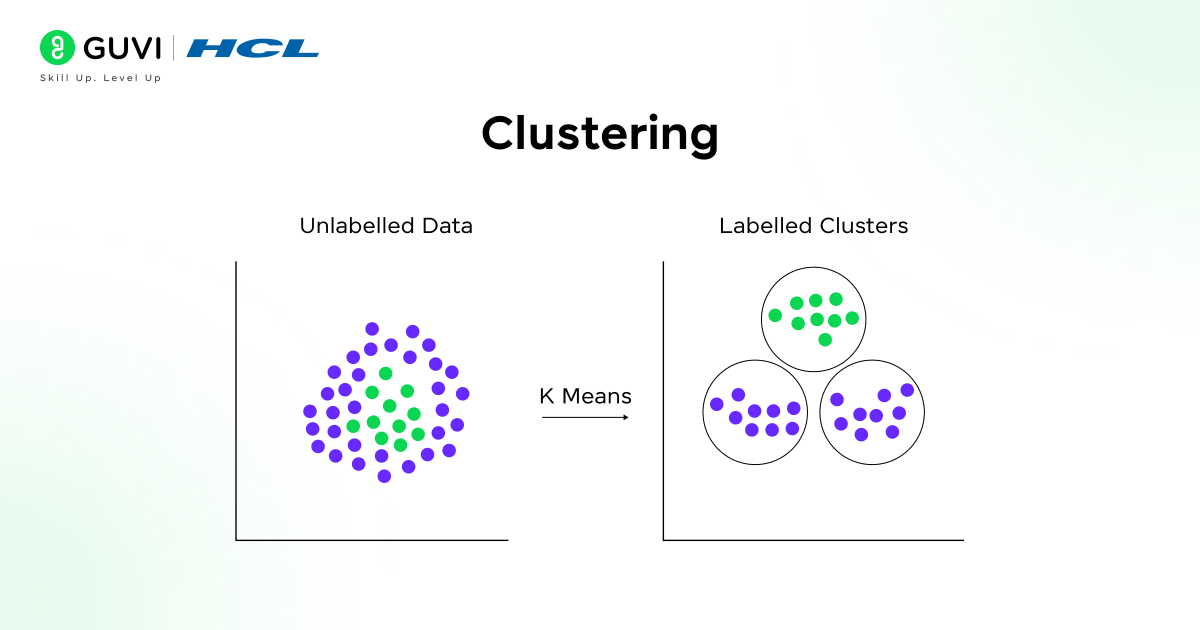
Clustering in sklearn in Python groups similar data points together without using predefined labels. Unlike classification, clustering focuses on discovering hidden patterns and structures within data. It is especially useful when the categories are not known in advance.
This technique helps organizations understand customer behavior and data distribution. Sklearn provides clustering algorithms that efficiently group data based on similarity.

- Customer Segmentation – Groups customers based on purchasing or browsing behavior.
- Market Analysis – Identifies similar products or user groups.
- Pattern Discovery – Finds hidden relationships in large datasets.
- Anomaly Identification – Helps detect unusual data points that differ from normal patterns.
Example Code
from sklearn.cluster import KMeans

model = KMeans(n_clusters=3)
model.fit(X)
labels = model.labels_
This example demonstrates how clustering works in sklearn in Python using the KMeans algorithm. The model groups similar data points together without using predefined labels. It helps uncover hidden patterns and data structure. Clustering is useful when categories are unknown or need to be discovered.
4. Dimensionality Reduction
Dimensionality reduction in sklearn in Python reduces the number of input features while preserving important information. Large datasets often contain unnecessary or redundant features that slow down models and reduce performance.
By reducing dimensions, sklearn helps improve model speed and accuracy. This also makes data easier to visualize and interpret, especially for beginners.
- Feature Simplification – Removes irrelevant or duplicate features from data.
- Improved Model Speed – Reduces computation time during training.
- Better Visualization – Makes high-dimensional data easier to plot and understand.
- Noise Reduction – Helps eliminate unwanted variations in data.
Example Code
from sklearn.decomposition import PCA

pca = PCA(n_components=2)
X_reduced = pca.fit_transform(X)
This example shows how sklearn in Python reduces feature dimensions using PCA. By minimizing unnecessary features, models become faster and more efficient. Dimensionality reduction also improves visualization and reduces noise. It is especially useful when working with large datasets.
5. Data Preprocessing
Data preprocessing in sklearn in Python prepares raw data so it can be effectively used for machine learning. Real-world data is often incomplete, inconsistent, or unstructured, which makes preprocessing a critical step.
Sklearn provides built-in tools to clean, transform, and organize data before model training. Proper preprocessing greatly improves model accuracy and reliability.
- Handling Missing Values – Manages incomplete data without breaking the model.
- Feature Scaling – Ensures all features contribute equally to training.
- Categorical Encoding – Converts text-based data into numerical format.
- Data Normalization – Helps stabilize model learning and performance.
Example Code
from sklearn.preprocessing import StandardScaler

scaler = StandardScaler()
X_scaled = scaler.fit_transform(X)
This example illustrates how sklearn in Python standardizes data before model training. Preprocessing ensures all features are on the same scale. It improves model stability and learning accuracy. Proper preprocessing is essential for reliable machine learning results.
6. Model Evaluation And Validation
Model evaluation in sklearn in Python helps measure how well a model performs on unseen data. This step ensures the model is reliable and does not simply memorize the training data.
Evaluation and validation techniques help compare different models and choose the most effective one. Sklearn makes this process simple and consistent.
- Accuracy Measurement – Checks how correct the model predictions are.
- Cross-validation – Tests model performance on multiple data splits.
- Overfitting Detection – Helps identify when a model performs well only on training data.
- Model Comparison – Allows selecting the best model based on performance metrics.
Example Code
from sklearn.metrics import accuracy_score

accuracy = accuracy_score(y_test, predictions)
print(accuracy)
This example explains how sklearn in Python evaluates model performance. Accuracy score measures how well predictions match actual outcomes. Evaluation helps identify overfitting and model reliability. It ensures the model performs well on unseen data.
Do explore HCL GUVI’s Python Zen Class to strengthen your foundation in Python programming and build the core skills needed to start working with tools like sklearn in Python for machine learning and data analysis.
💡 Did You Know?
- Scikit learn was originally developed as a Google Summer of Code project before becoming one of the most widely used machine learning libraries in Python.
- Sklearn in Python is built on top of NumPy, SciPy, and Matplotlib, which is why it integrates smoothly with the Python data science ecosystem.
- Many popular machine learning concepts like pipelines and cross validation became easier to adopt because sklearn standardized their usage.
Conclusion
Sklearn in Python plays a major role in making machine learning simple, practical, and accessible for beginners as well as professionals. From preparing data and building models to evaluating performance, sklearn in Python provides everything needed to work on real-world machine learning problems without unnecessary complexity.
By learning sklearn in Python, you gain the ability to apply machine learning concepts like classification, regression, clustering, and model evaluation in a structured way. This makes sklearn an essential library for anyone starting their journey in machine learning or aiming to build reliable data-driven applications.
FAQs
1. What is the difference between sklearn and other machine learning libraries in Python?
Sklearn focuses on traditional machine learning algorithms with a simple and consistent API, while libraries like TensorFlow or PyTorch are mainly used for deep learning and neural networks.
2. Do I need strong mathematics knowledge to start using sklearn in Python?
Basic understanding of concepts like averages, graphs, and simple statistics is enough to get started. Deeper math becomes useful as you work on advanced models.
3. Can sklearn be used for real world industry projects?
Yes, sklearn is widely used in real projects for tasks like prediction, classification, clustering, and evaluation, especially when deep learning is not required.
4. Is sklearn suitable for handling large datasets?
Sklearn works well with small to medium sized datasets. For very large datasets, it is often combined with tools like Pandas, NumPy, or distributed frameworks.
5. What should I learn after sklearn in Python?
After sklearn, learners usually move to advanced model tuning, feature engineering, and then explore deep learning libraries depending on their career goals.
Success Stories

About the Author
Jebasta
I translate the language of data into stories that anyone can understand. As a writer with a data science background, I simplify analytics, AI, and decision-making so beginners and enthusiasts can confidently explore the world of data.
View all posts by Jebasta
Connect with me @








Did you enjoy this article?