


Java Articles
How to Run Java in Visual Studio Code?
Java + Spring Boot in 2026: What You Need to Know to Get Hired


Get In Touch For Details! Request More Information
Why Large Enterprises Still Rely on Java: Legacy Systems, Stability & Scale
Feb 24, 2026 5 Min Read 583 Views
(Last Updated)
When a system supports millions of users, processes billions of transactions, and runs without interruption for years, choosing the wrong technology is not an option. Large enterprises operate under constant pressure to stay stable, compliant, and scalable, which is why their technology choices tend to favor reliability over trends.
This is where java for enterprises continues to stand strong. Across banking, healthcare, telecom, and global corporations, Java remains a core part of enterprise infrastructure. This blog explores why java for enterprises is still trusted today, focusing on legacy systems, long term stability, and the ability to scale complex applications with confidence.
Quick Answer
Large enterprises still use Java because it runs core business systems, stays stable for long periods, and handles heavy workloads without issues. It is trusted for critical applications where reliability and scale matter more than trends.
Table of contents
- Large Enterprises That Still Rely On Java
- Core Banking And Financial Systems
- Enterprise Resource Planning (ERP) And CRM Platforms
- Internal Enterprise Applications
- Telecom And Network Systems
- Healthcare Management Applications
- Why Enterprises Continue To Choose Java
- Stability For Mission-Critical Applications
- Scalability For Growing Enterprises
- Security And Compliance
- Long-Term Support And Backward Compatibility
- Availability Of Skilled Developers
- How Java Supports Long-Term Enterprise Growth
- Scalable Architecture
- Robust Performance
- Easy Integration With Modern Technologies
- Long-Term Maintainability
- Strong Ecosystem And Talent Availability
- 💡 Did You Know?
- Conclusion
- FAQs
- Why do large enterprises still rely on Java?
- Can Java handle modern enterprise workloads?
- Is it easy to find skilled Java developers for enterprises?
- How does Java ensure long-term enterprise growth?
- What types of enterprise systems commonly use Java?
Large Enterprises That Still Rely On Java
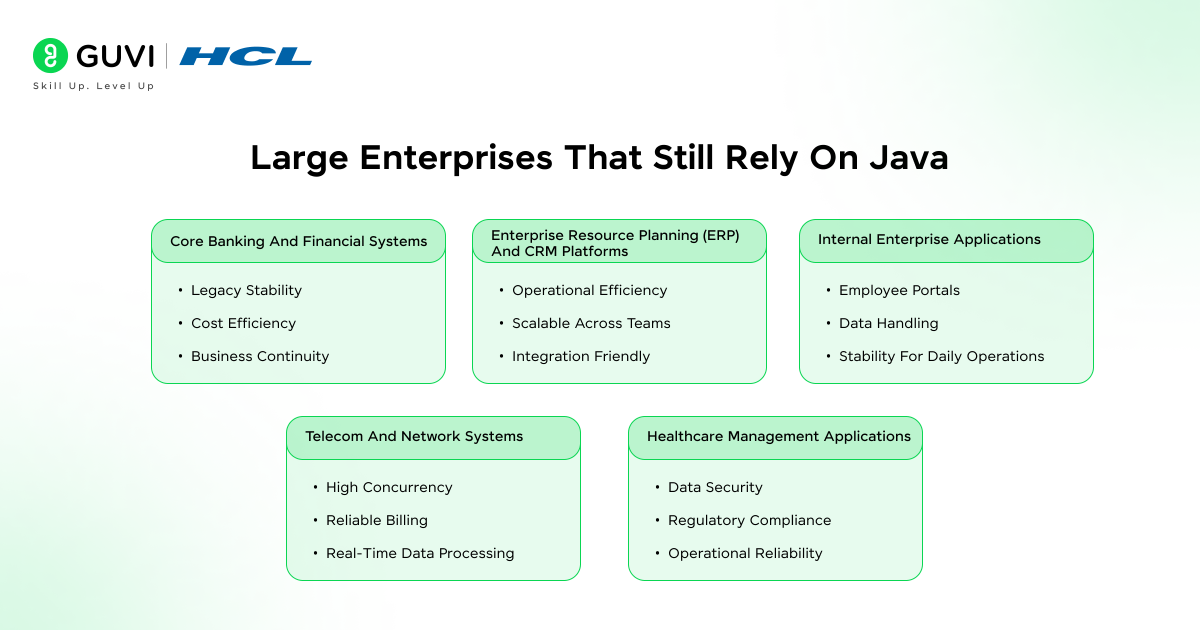
Java for enterprises remains a critical technology for many large organizations because it powers systems that handle high volumes of data, complex workflows, and mission-critical operations. Rewriting these stable systems is costly and risky, so enterprises continue to maintain and enhance their existing Java applications.
In this section, we’ll explore how Java for enterprises supports core banking systems, ERP and CRM platforms, internal enterprise applications, telecom systems, and healthcare management applications.
1. Core Banking And Financial Systems
Many financial institutions rely on Java for enterprises to securely manage transactions, customer data, and regulatory compliance. These systems must operate 24/7, handle millions of daily transactions, and remain reliable even under peak loads, making Java the ideal choice for banking infrastructure.
Key Points
- Legacy Stability: Core banking platforms run on proven Java codebases
- Cost Efficiency: Maintaining Java systems is cheaper than rebuilding from scratch
- Business Continuity: Java ensures uninterrupted financial operations
Example: Major banks and trading platforms use Java to process millions of transactions daily without downtime.
2. Enterprise Resource Planning (ERP) And CRM Platforms
Java for enterprises is widely used to manage operations, inventory, and customer interactions across large organizations. Enterprise systems built with Java can scale efficiently, integrate with multiple tools, and streamline workflows across departments.
Key Points
- Operational Efficiency: Java powers ERP and CRM systems to manage business processes
- Scalable Across Teams: Supports thousands of employees across multiple locations
- Integration Friendly: Connects easily with databases, APIs, and third-party tools
Example: Retail giants use Java ERP systems to manage global warehouses and CRM platforms to maintain consistent customer data across regions.
3. Internal Enterprise Applications
Enterprises rely on java for enterprises to power internal tools such as employee portals, reporting dashboards, and operational analytics platforms. These applications process large volumes of data and must remain highly reliable to support daily business activities.
Key Points
- Employee Portals: Powers HR, intranet, and workflow management systems
- Data Handling: Efficiently processes large volumes of operational data
- Stability for Daily Operations: Reduces the risk of downtime affecting core business tasks
Example: Large corporations use Java-based internal portals for employee reporting, project management, and operational analytics.
4. Telecom And Network Systems
Telecom companies use Java for enterprises to power billing, customer management, and network monitoring systems. These applications must handle millions of concurrent users, process real-time data, and maintain near-zero downtime. Java’s scalability and performance make it a perfect fit for telecom infrastructure.
Key Points
- High Concurrency: Handles millions of simultaneous connections efficiently
- Reliable Billing: Ensures accurate processing of customer invoices
- Real-Time Data Processing: Supports monitoring and analytics without disruption
Example: Telecom giants use Java to power network management platforms and real-time billing systems for millions of subscribers.

5. Healthcare Management Applications
Java for enterprises plays a key role in healthcare management by supporting patient records, hospital operations, and medical data processing applications. These systems must be secure, compliant with regulations, and reliable at all times, making Java a preferred enterprise solution.
Key Points
- Data Security: Protects sensitive patient records with strong encryption
- Regulatory Compliance: Supports HIPAA, GDPR, and other healthcare standards
- Operational Reliability: Ensures hospital management systems run continuously
Example: Large hospitals and healthcare networks use Java to manage electronic health records and scheduling systems for staff and patients.
Do check out the HCL GUVI Java Tutorial Hub – which is a great resource for beginners and professionals looking to strengthen their Java skills. With structured tutorials, practical examples, and step-by-step guidance, you can quickly learn concepts essential for java for enterprises.
Why Enterprises Continue To Choose Java
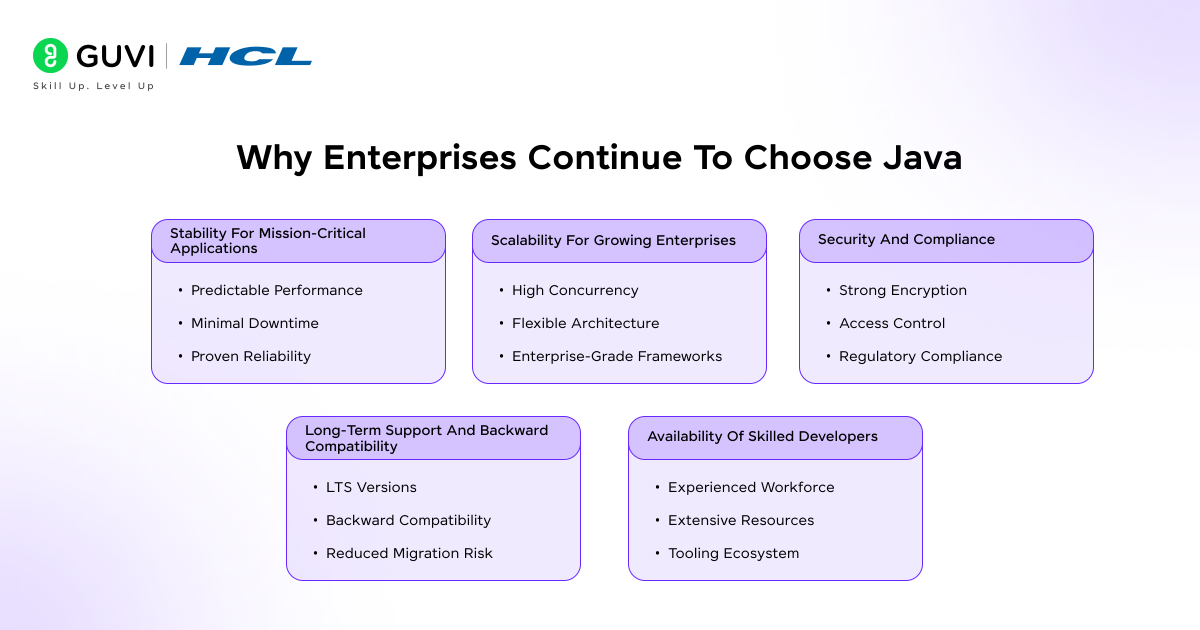
Enterprises continue to choose Java because it provides the reliability, security, and scalability required for large-scale business operations. Java for enterprises allows organizations to maintain mission-critical applications without frequent rewrites.
In this section, we’ll explore why enterprises rely on Java for stability, scalability, security, long-term support, and availability of skilled developers.
1. Stability For Mission-Critical Applications
Large organizations need applications that can run continuously without failures. Java for enterprises is known for its stability and consistent performance, even under heavy workloads or during peak business operations. Its mature ecosystem ensures that mission-critical systems remain reliable over time, reducing the risk of costly downtime.
Key Points
- Predictable Performance: Handles high traffic and long-running processes efficiently
- Minimal Downtime: Reduces risks of system failures in critical applications
- Proven Reliability: Trusted by enterprises for decades
Example: Banks and payment platforms use Java to ensure 24/7 operation of transaction systems, even during peak usage periods.
2. Scalability For Growing Enterprises
As businesses grow, their systems need to manage more users, data, and processes without slowing down. Java for enterprises provides both vertical and horizontal scalability, supporting complex applications that expand alongside the organization. This flexibility allows companies to scale systems without rewriting the entire codebase.
Key Points
- High Concurrency: Efficiently manages multiple threads and large user loads
- Flexible Architecture: Supports both monolithic and microservices systems
- Enterprise-Grade Frameworks: Tools like Spring and Java EE simplify large-scale application development
Example: Telecom companies use Java to scale network management and billing platforms to accommodate millions of subscribers.
3. Security And Compliance
Security is critical for enterprises handling sensitive data. Java for enterprises offers built-in security features and encryption, helping organizations comply with regulatory standards while protecting mission-critical information. Its robust architecture minimizes vulnerabilities and supports secure business operations.
Key Points
- Strong Encryption: Protects financial, personal, and operational data
- Access Control: Manages user permissions securely
- Regulatory Compliance: Supports GDPR, HIPAA, PCI-DSS, and other industry standards
Example: Healthcare networks use Java-based applications to securely manage patient records and ensure compliance with privacy regulations.
4. Long-Term Support And Backward Compatibility
Enterprises require technologies that can evolve without breaking existing systems. Java for enterprises provides long-term support (LTS) versions and backward compatibility, allowing organizations to upgrade systems gradually. This reduces the risk and cost of migration while keeping applications up-to-date with security and performance improvements.
Key Points
- LTS Versions: Receive updates and patches for several years
- Backward Compatibility: Older applications run smoothly on newer Java versions
- Reduced Migration Risk: Systems can evolve without full rewrites
Example: Large corporations continue to modernize ERP systems using new Java versions while maintaining uninterrupted operations.
5. Availability Of Skilled Developers
Maintaining enterprise applications requires a large pool of experienced developers. Java has a global talent base, extensive documentation, and strong community support, making it easier for organizations to hire, train, and retain developers for long-term application maintenance.
Key Points
- Experienced Workforce: Millions of Java developers available worldwide
- Extensive Resources: Tutorials, documentation, and community support
- Tooling Ecosystem: Reliable IDEs, testing tools, and frameworks for enterprise development
Example: Global IT teams rely on Java developers to maintain and scale applications across multiple regions without downtime.
For hands-on practice and building enterprise-grade Java applications, the HCL GUVI IDE is an ideal platform. It provides a fully interactive environment to write, run, and debug Java code directly in the browser, helping you implement concepts learned in real-time. Do check it out to strengthen your practical skills in Java for enterprises.
How Java Supports Long-Term Enterprise Growth
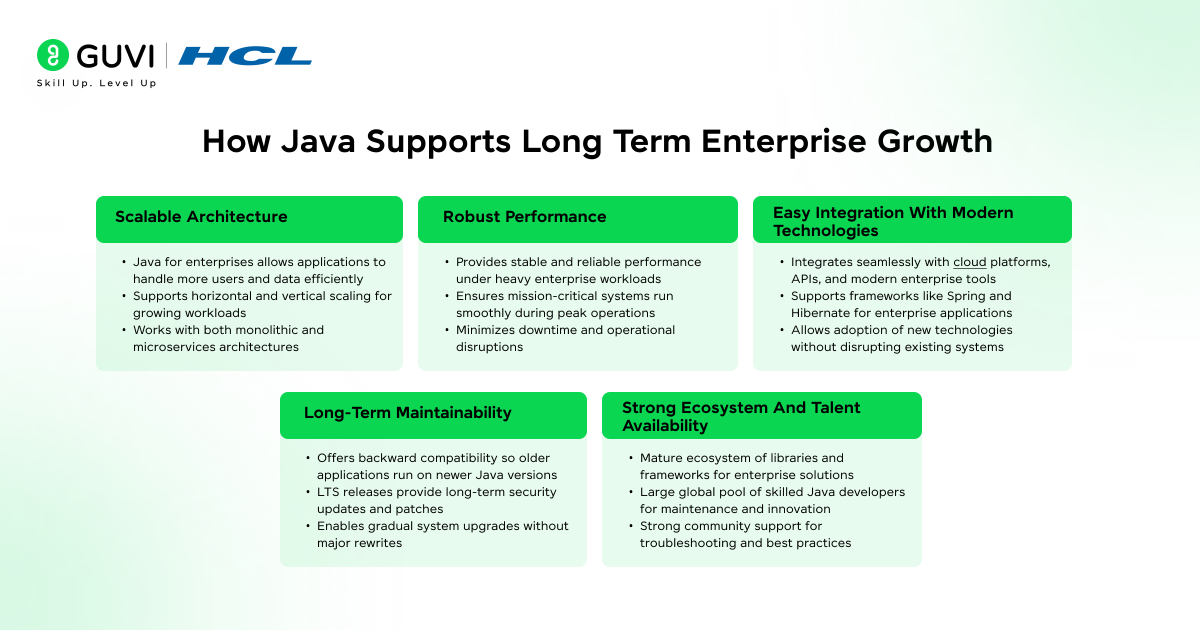
Java for enterprises not only powers current operations but also enables organizations to grow and adapt their systems over time. Let’s discuss how Java supports long-term enterprise growth below.
1. Scalable Architecture
- Java for enterprises allows applications to handle more users and data efficiently
- Supports horizontal and vertical scaling for growing workloads
- Works with both monolithic and microservices architectures
2. Robust Performance
- Provides stable and reliable performance under heavy enterprise workloads
- Ensures mission-critical systems run smoothly during peak operations
- Minimizes downtime and operational disruptions
3. Easy Integration With Modern Technologies
- Integrates seamlessly with cloud platforms, APIs, and modern enterprise tools
- Supports frameworks like Spring and Hibernate for enterprise applications
- Allows adoption of new technologies without disrupting existing systems
4. Long-Term Maintainability
- Offers backward compatibility so older applications run on newer Java versions
- LTS releases provide long-term security updates and patches
- Enables gradual system upgrades without major rewrites
5. Strong Ecosystem And Talent Availability
- Mature ecosystem of libraries and frameworks for enterprise solutions
- Large global pool of skilled Java developers for maintenance and innovation
- Strong community support for troubleshooting and best practices
If you want to start mastering Java and boost your enterprise development skills, the HCL GUVI Master Java Course is the perfect place to begin. This program covers core Java concepts, hands-on projects, and live guidance from industry experts, making it ideal for anyone looking to work on large-scale enterprise applications.
💡 Did You Know?
- Java for enterprises has been powering mission-critical systems in banks, healthcare, and telecom for over 25 years.
- Many large organizations still rely on Java because it ensures stability, scalability, and long-term support.
- The latest Java versions maintain backward compatibility, allowing enterprises to modernize systems without full rewrites.
Conclusion
Java for enterprises remains the technology of choice for large organizations because it combines reliability, scalability, and long-term support. By powering core banking systems, ERP platforms, healthcare applications, and telecom infrastructure, Java ensures enterprises can operate smoothly and efficiently.
Its mature ecosystem and widespread developer availability allow organizations to maintain, enhance, and modernize their applications without disrupting daily operations. For enterprises looking for stability and sustainable growth, Java continues to deliver unmatched value.
FAQs
1. Why do large enterprises still rely on Java?
Large enterprises rely on Java because it offers stability, scalability, security, and long-term support, making it ideal for mission-critical applications.
2. Can Java handle modern enterprise workloads?
Yes. Java for enterprises efficiently manages high volumes of data, integrates with modern tools, and scales to support growing business demands.
3. Is it easy to find skilled Java developers for enterprises?
Yes. Java has a global talent pool and extensive ecosystem, making it easier for enterprises to hire and maintain developers for long-term operations.
4. How does Java ensure long-term enterprise growth?
Java for enterprises provides backward compatibility, long-term support releases, and a scalable architecture, allowing businesses to upgrade and expand systems without disruption.
5. What types of enterprise systems commonly use Java?
Core banking, ERP and CRM platforms, healthcare management, telecom systems, and internal enterprise applications frequently use Java due to its reliability and scalability.
Success Stories

About the Author
Jebasta
I translate the language of data into stories that anyone can understand. As a writer with a data science background, I simplify analytics, AI, and decision-making so beginners and enthusiasts can confidently explore the world of data.
View all posts by Jebasta
Connect with me @











Did you enjoy this article?