


Natural Language Processing Articles
What are NLP Transformers: A Beginner's Guide [2026]
Transfer Learning: Trending and Hottest Topic in NLP
40 Interesting NLP Interview Questions and Answers [Includes All 3 Levels]
12 Interesting Natural Language Processing Project Ideas [With Source Code]


Get In Touch For Details! Request More Information
What is NLP in Artificial Intelligence? A Beginner’s Guide [2025]
Sep 04, 2025 6 Min Read 1720 Views
(Last Updated)
Have you ever wondered how your smartphone understands your voice commands or how chatbots respond to your questions? NLP in artificial intelligence makes this possible by enabling computers to interpret human language.
Natural Language Processing (NLP) refers to an AI method of communicating with intelligent systems using natural languages like English. It’s one of the hottest areas of artificial intelligence thanks to applications like text generators and chatbots that seem almost human.
As a beginner exploring this fascinating field, you’ll discover that NLP stands as a pivotal technology in AI, bridging the gap between human communication and computer understanding. Essentially, NLP is a branch of AI that focuses on developing computer algorithms to understand and process natural language.
Throughout this guide, you’ll learn what NLP in artificial intelligence means, the fundamental techniques behind it, the steps involved in natural language processing, and its wide-ranging applications from automated customer support to real-time language translation.
Table of contents
- What is NLP in Artificial Intelligence?
- How NLP fits into the AI ecosystem
- Examples of NLP in daily life
- How NLP Works: The Basics
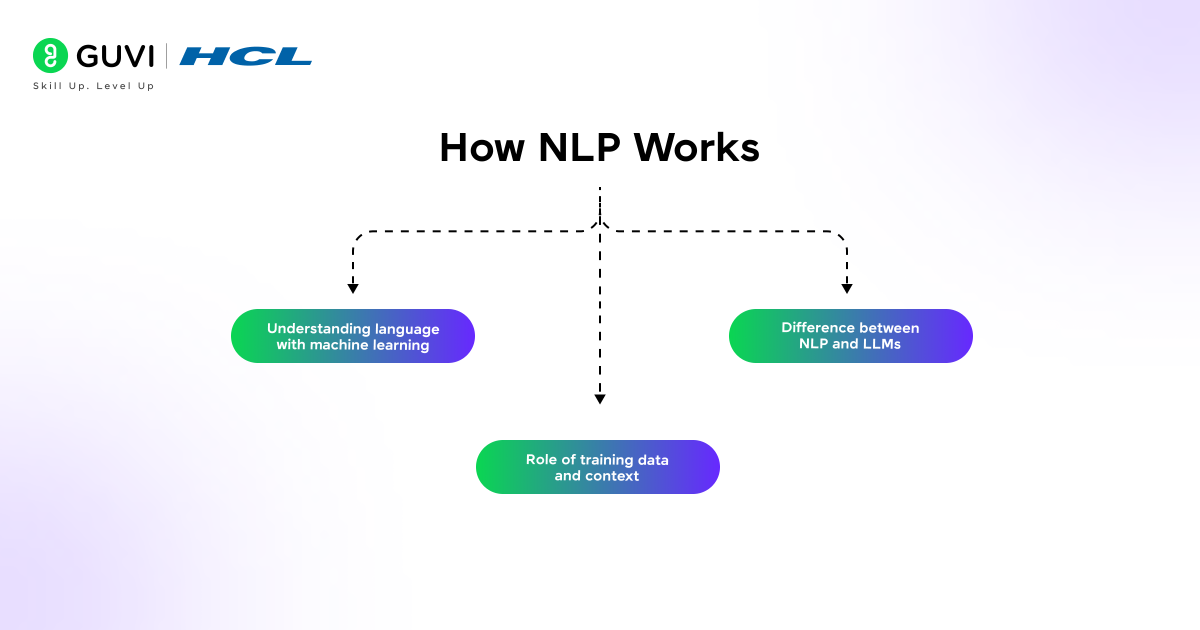
- 1) Understanding language with machine learning
- 2) Role of training data and context
- 3) Difference between NLP and LLMs
- Steps in Natural Language Processing
- Text input and collection
- Preprocessing and cleaning
- Feature extraction
- Model training and evaluation
- Output generation
- Core NLP Techniques and Methods
- NLP Use Case in Real-World Applications
- Concluding Thoughts…
- FAQs
- Q1. What is Natural Language Processing (NLP) in AI and how does it work?
- Q2. How is NLP different from Large Language Models (LLMs)?
- Q3. What are some common applications of NLP in everyday life?
- Q4. What are the main steps involved in Natural Language Processing?
- Q5. How is NLP improving customer service?
What is NLP in Artificial Intelligence?
NLP is a branch of artificial intelligence that helps computers understand, interpret, and manipulate human language. This technology bridges the communication gap between humans and machines, allowing you to interact with devices using the language you speak every day rather than specialized computer commands.
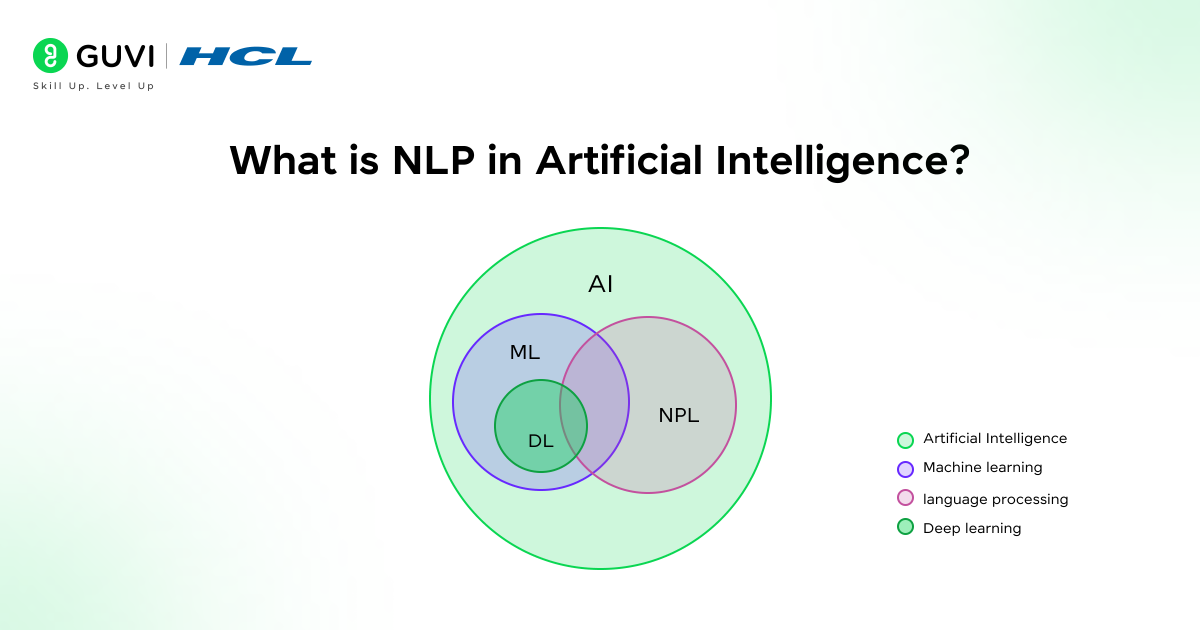
Think of NLP as a translator that sits between you and your digital devices. When you ask a question or give a command, NLP technology breaks down your words, interprets their meaning, and converts them into something the computer can process and respond to.
NLP combines several approaches to process human language:
- Computational linguistics (rule-based modeling of human language)
- Statistical modeling
- Machine learning algorithms
- Deep learning techniques
How NLP fits into the AI ecosystem
NLP doesn’t stand alone in the artificial intelligence landscape. Instead, it’s a specialized subfield within the broader AI framework. While AI encompasses many technologies that enable machines to simulate human intelligence, NLP specifically focuses on language-related tasks.
Within this ecosystem, NLP can be divided into two overlapping subfields:
- Natural Language Understanding (NLU): Focuses on determining the intended meaning of text
- Natural Language Generation (NLG): Concentrates on text generation by machines
Furthermore, NLP is highly interdisciplinary, drawing from multiple fields including computer science, linguistics, philosophy, cognitive science, statistics, and mathematics. This integration of disciplines makes NLP particularly powerful for solving complex language problems.
Examples of NLP in daily life
You might be surprised to discover how frequently you encounter NLP in your everyday activities:
- Email filters that categorize your messages into primary, social, or promotional folders
- Smart assistants like Siri, Alexa, and Cortana that recognize patterns in speech to provide relevant responses
- Search engines that predict what you’re looking for and present relevant results based on your search intent
- Autocorrect and predictive text on your smartphone that correct mistakes and suggest words as you type
- Language translation tools that help you communicate across language barriers
- Customer service chatbots that handle routine inquiries without human intervention
How NLP Works: The Basics
The magic of NLP happens through a series of complex yet fascinating processes. At its foundation, NLP transforms human language into something computers can process and respond to, much like a translator working between two different worlds.

1) Understanding language with machine learning
NLP functions as a translator, analyzing and manipulating human language based on defined rules and structures. This enables machines to comprehend grammar, syntax, and context, allowing them to compute sentiment, extract information, and perform translations.
Initially, NLP relied on rule-based approaches where linguists created specific patterns for computers to follow. However, modern NLP has evolved to incorporate machine learning techniques that allow systems to learn language patterns from data rather than following pre-programmed rules.
The basic NLP workflow generally involves:
- Gathering and preparing unstructured text data
- Preprocessing the text (tokenization, stemming, etc.)
- Training models on processed data
- Deploying the model to analyze new text
2) Role of training data and context
Training data serves as the foundation of any effective NLP system. To function properly, NLP models need data that is:
- Voluminous: More data allows models to learn from numerous scenarios
- Varied: Diversity helps handle different dialects, slang, and contexts
- Accurately annotated: High-quality labels are crucial for teaching the model correctly
Context plays a critical role because language is inherently ambiguous. Words and phrases often have multiple meanings, and their correct interpretation depends on the surrounding text. For example, the word “bank” could refer to a financial institution, a river’s edge, or tilting an airplane.
Modern NLP models use context to assign accurate meanings by analyzing relationships between words. Without context, an NLP system might struggle with tasks like coreference resolution—determining what pronouns like “it” or “they” refer to in a conversation.
3) Difference between NLP and LLMs
| Feature | NLP (Natural Language Processing) | LLMs (Large Language Models) |
| Scope | Broad field of language understanding & processing | Subset of NLP focused on large-scale models |
| Approach | Rule-based or task-specific ML techniques | Trained on massive text corpora to learn language |
| Capabilities | Sentiment analysis, entity extraction, translation, etc. | Text generation, dynamic conversation, context handling |
| Model Size | Typically lightweight and task-specific | Very large, general-purpose models |
| Resource Requirement | Moderate computing power | High computational and data needs |
| Strength | Structured, precision-driven applications | Open-ended, creative, and contextual responses |
| Use Cases | Chatbots, translation, grammar correction | Content creation, coding assistance, creative writing |
Steps in Natural Language Processing
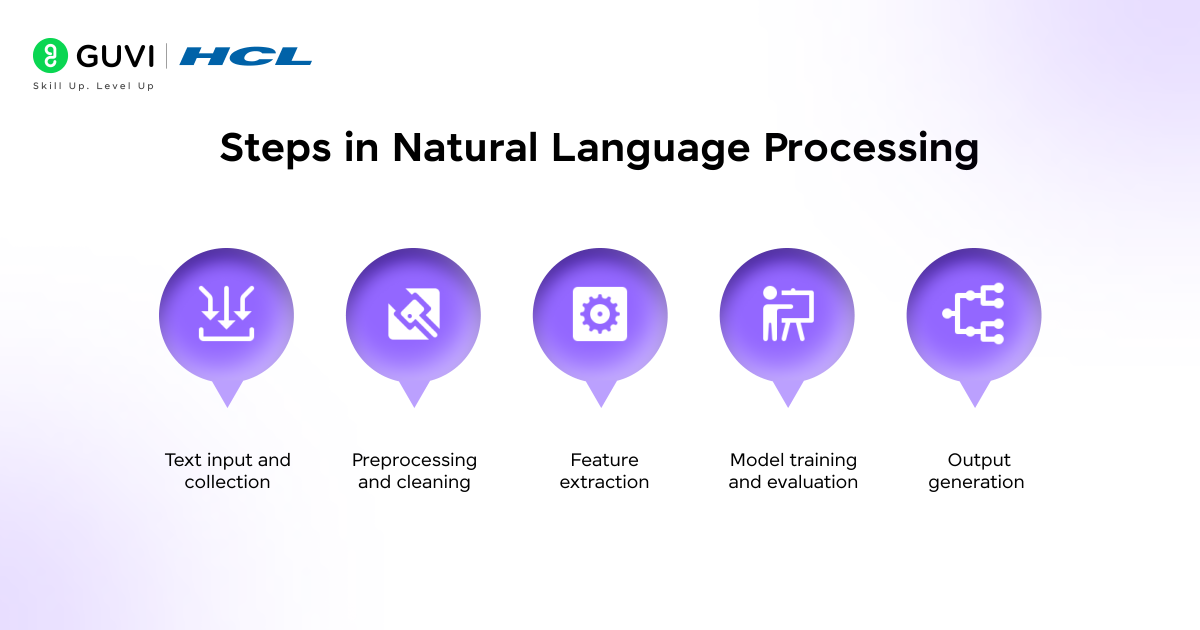
Developing NLP systems in artificial intelligence involves a structured pipeline of steps, each building upon the previous one. From gathering raw text to producing meaningful outputs, this systematic approach ensures that machines can effectively understand and process human language.
1. Text input and collection
The NLP journey begins with gathering unstructured text data from various sources. This fundamental step involves collecting raw language data from:
- Cloud data warehouses
- Internal business applications
- Emails and surveys
- Social media platforms
- Websites and digital documents
During this phase, you need to ensure your data is representative of the language patterns and contexts your NLP system will encounter. The quality and diversity of your collected data significantly impact how well your model will perform on real-world language tasks.
2. Preprocessing and cleaning
Raw text data is typically noisy and unstructured, containing inconsistencies that can hinder analysis. Preprocessing transforms this raw text into a format machines can better understand through several techniques:
- Tokenization: Breaking text into smaller units such as words, sentences, or phrases
- Lowercasing: Converting all text to lowercase to ensure uniformity
- Stop word removal: Filtering out common words like “the,” “is,” or “and” that add little meaning
- Stemming and lemmatization: Reducing words to their root forms (e.g., “running” becomes “run”)
- Text normalization: Standardizing text format, correcting spelling errors, and handling special characters
These preprocessing steps are crucial as they improve data quality and reduce the computational complexity for subsequent analysis.
3. Feature extraction
Since machines can’t directly process human language, this step converts preprocessed text into numerical representations. Feature extraction transforms text into structured data through various methods:
- Bag of Words (BoW): Counts the occurrence of each word in a document, disregarding grammar and word order
- TF-IDF (Term Frequency-Inverse Document Frequency): Weights words by their importance, considering both their frequency in a document and rarity across all documents
- N-grams: Captures sequences of N words to preserve context and word order
- Word Embeddings: Creates dense vector representations where semantically similar words are closer together in vector space
Feature extraction is essentially text vectorization—transforming text into numbers that algorithms can process, making it a critical bridge between human language and machine understanding.
4. Model training and evaluation
With features extracted, the next step involves training NLP models on the processed data. This phase includes:
- Selection: Choosing appropriate algorithms based on your specific task (classification, translation, summarization, etc.)
- Training: Feeding the model with labeled data so it can learn patterns and relationships
- Validation: Testing the model on unseen data to ensure it generalizes well
- Hyperparameter tuning: Adjusting model parameters to improve performance
- Evaluation: Assessing model effectiveness using metrics like accuracy, precision, recall, and F1-score
During evaluation, you might need to revisit previous steps, adjusting preprocessing techniques or feature extraction methods to improve results.
5. Output generation
The final step involves deploying the trained model to produce meaningful outputs for specific NLP tasks:
- For classification tasks, the output might be a category or sentiment
- For translation, it generates text in the target language
- For summarization, it produces condensed versions of longer texts
- For question-answering systems, it provides relevant responses to queries
In transformer-based models like GPT, this step involves a classification layer that predicts the most probable next word in a sequence. The model doesn’t generate text all at once but builds it word by word, estimating the likelihood of each word in the vocabulary being the next one to generate.
Each step in this NLP pipeline is essential for creating systems that can effectively bridge the gap between human communication and machine understanding.
Core NLP Techniques and Methods
Behind every successful NLP application lies a set of powerful techniques and methods that form the backbone of language processing in AI. These fundamental approaches enable computers to break down, understand, and generate human language.
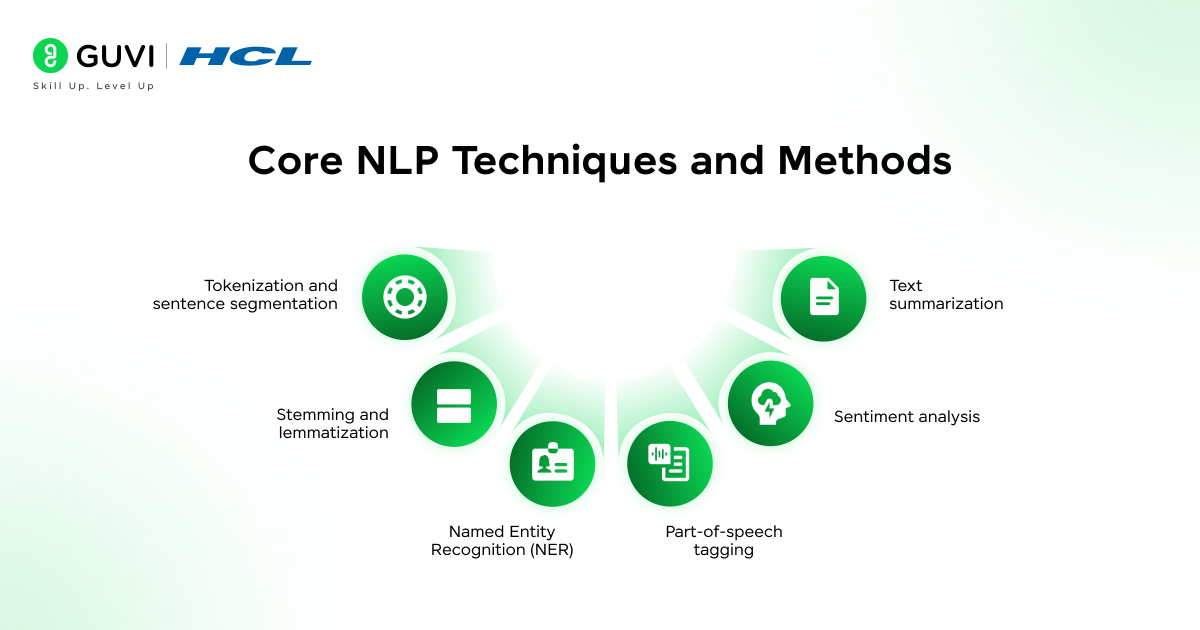
1) Tokenization and sentence segmentation: Tokenization divides text into smaller units called tokens (words, characters, or subwords). This foundational technique converts unstructured text into discrete elements that computers can process. Sentence segmentation, moreover, breaks text into individual sentences, establishing meaningful boundaries for analysis.
2) Stemming and lemmatization: Both techniques reduce words to their base forms, yet differ in approach. Stemming simply chops off word endings using rule-based algorithms (like Porter’s algorithm), creating stems that may not be actual words. Lemmatization, consequently, produces proper dictionary words (lemmas) through more sophisticated morphological analysis. For instance, “running” becomes “run” through both methods, but “better” becomes “good” only through lemmatization.
3) Named Entity Recognition (NER): NER identifies and classifies named entities in text into predefined categories such as person names, organizations, locations, and expressions of time. This technique extracts structured information from unstructured data, making it valuable for information retrieval and text analysis. The process typically involves collecting annotated text, preprocessing, feature extraction, and model training.
4) Part-of-speech tagging: This process marks up words in text as corresponding to particular parts of speech (noun, verb, adjective). POS tagging helps reveal likely neighboring words and syntactic structure, making it a key aspect of parsing language. Modern taggers achieve approximately 97% accuracy through various algorithms including Hidden Markov Models.
5) Sentiment analysis: Sentiment analysis evaluates the emotional tone in text, categorizing content as positive, negative, or neutral. This NLP technique systematically identifies opinions in text data, enabling businesses to understand customer sentiments and make informed decisions. Applications include analyzing customer reviews, social media monitoring, and brand reputation management.
6) Text summarization: This technique condenses text while preserving essential information through two approaches: extractive summarization (selecting key sentences from the original text) and abstractive summarization (generating new content that captures core ideas). Text summarization helps manage information overload by providing concise versions of lengthy documents.
To make things interesting, here are some fascinating facts about Natural Language Processing that you might not know:
The First NLP Program Was Built in 1960: One of the earliest NLP programs, ELIZA, was developed by Joseph Weizenbaum at MIT. It mimicked a psychotherapist by rephrasing user inputs into questions—an early chatbot long before Siri or Alexa existed!
NLP Powers Over 90% of Internet Search Engines: Every time you type into Google, Bing, or any search bar, NLP is at work interpreting your query, predicting your intent, and ranking relevant results. Without NLP, modern search engines wouldn’t exist.
These fun facts show how NLP has quietly shaped the digital tools we use daily—from the first chatbot in the 1960s to the search engines that guide almost everything we do online today!
NLP Use Case in Real-World Applications
From virtual assistants to complex data analysis, NLP applications in artificial intelligence are transforming industries across the globe. These practical implementations demonstrate how NLP bridges the gap between human communication and machine understanding.
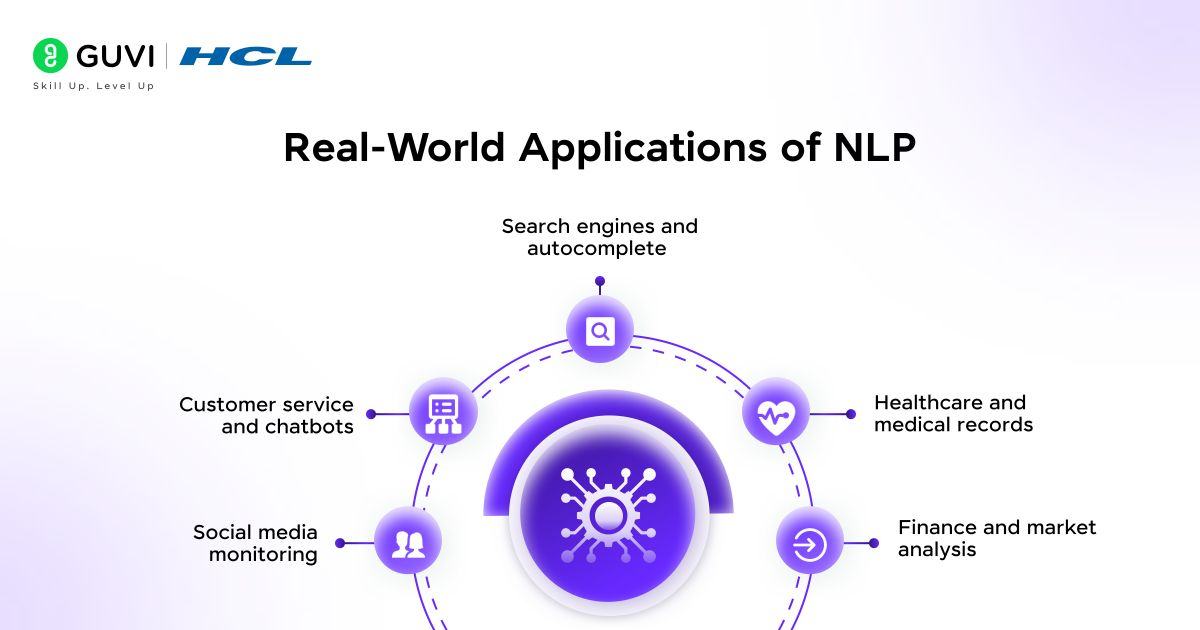
1) Customer service and chatbots: NLP-powered chatbots offer 24/7 support, understand user intent, and handle complex queries. They can resolve up to 80% of customer issues automatically, reducing costs and improving service quality.
2) Search engines and autocomplete: Predictive search, popularized by Google, uses NLP to suggest queries as users type—saving time and improving search accuracy. In ecommerce, it can drive 30–45% of revenue.
3) Healthcare and medical records: NLP processes unstructured EHR data, extracts clinical insights, and improves risk prediction and documentation. Studies show enhanced mortality prediction accuracy from 0.831 to 0.922.
4) Finance and market analysis: Financial firms use NLP to analyze reports, filings, and news at scale—delivering insights much faster and more accurately than humans for quicker decision-making.
5) Social media monitoring: NLP tracks sentiment and trends across platforms. It classifies public opinion and uses keyword analysis to help brands adapt strategies in real time.
To dive deeper into NLP and its real-world applications, check out GUVI’s Intel and IIT-M Certified Artificial Intelligence and Machine Learning Course. Taught by industry experts, this hands-on course covers NLP, ML, Deep Learning, and more—perfect for beginners aiming to build a strong AI foundation.
Concluding Thoughts…
NLP stands as a transformative technology that has fundamentally changed how we interact with machines. Throughout this guide, you’ve discovered that Natural Language Processing bridges the gap between human communication and computer understanding, allowing machines to interpret, process, and respond to our language.
The future of NLP looks promising as algorithms become more sophisticated and training data more abundant. Therefore, understanding the basics of this technology will help you better appreciate the AI-powered tools you use daily and perhaps inspire you to explore how NLP might solve problems in your own field. Good Luck!
FAQs
Q1. What is Natural Language Processing (NLP) in AI and how does it work?
Natural Language Processing is a branch of AI that enables computers to understand, interpret, and generate human language. It works by breaking down language into smaller units, analyzing patterns, and using machine learning algorithms to process and respond to human communication.
Q2. How is NLP different from Large Language Models (LLMs)?
While both are related to language processing, NLP is a broader field focusing on various language tasks using different techniques. LLMs, on the other hand, are a subset of NLP that use massive pre-trained models to generate human-like text and understand complex contexts.
Q3. What are some common applications of NLP in everyday life?
NLP is used in various applications including email filters, smart assistants like Siri and Alexa, search engines, autocorrect features, language translation tools, and customer service chatbots. It’s also utilized in social media monitoring and voice-operated GPS systems.
Q4. What are the main steps involved in Natural Language Processing?
The main steps in NLP include text input and collection, preprocessing and cleaning of data, feature extraction, model training and evaluation, and output generation. Each step is crucial in transforming human language into something computers can process and respond to effectively.
Q5. How is NLP improving customer service?
NLP-powered chatbots and virtual assistants are revolutionizing customer service by providing instant, 24/7 support across multiple channels. These systems can understand user intent, process complex queries, and deliver human-like responses, resolving up to 80% of customer questions automatically while reducing operational costs.
Success Stories

About the Author
Jaishree Tomar
A recent CS Graduate with a quirk for writing and coding, a Data Science and Machine Learning enthusiast trying to pave my own way with tech. I have worked as a freelancer with a UK-based Digital Marketing firm writing various tech blogs, articles, and code snippets. Now, working as a Technical Writer at GUVI writing to my heart’s content!
View all posts by Jaishree Tomar
Connect with me @











Did you enjoy this article?