


Python Articles
How to Install Requirements.txt in Python: A Beginner's Step-by-Step Guide (2026)
How to Check if Python Is Installed on Your Computer


Get In Touch For Details! Request More Information

Have you ever felt that writing Python programs becomes repetitive as your code grows? Instead of creating the same logic again and again, Python provides a simple solution called inheritance that helps you reuse existing code easily.
In this blog, you will clearly understand what inheritance in Python is, how parent and child classes work, different types of inheritance explained in simple terms, and how beginners can use inheritance to write clean, organized, and reusable Python programs.
Quick Answer
Inheritance in Python means a new class can use the code of an existing class. The existing class is called the parent class, and the new one is called the child class. This helps beginners avoid repeating code and makes Python programs easier to understand and manage.
Table of contents
- What Is Inheritance In Python?
- Types Of Inheritance In Python
- Single Inheritance
- Multiple Inheritance
- Multilevel Inheritance
- Hierarchical Inheritance
- Hybrid Inheritance
- 💡 Did You Know?
- Conclusion
- FAQs
- Is Inheritance In Python Mandatory To Use Object-Oriented Programming?
- Can A Child Class Change The Behavior Of A Parent Class In Python?
- Why Is Multiple Inheritance Considered Risky For Beginners?
- Which Type Of Inheritance Is Most Commonly Used In Real Projects?
- Should Beginners Learn All Types Of Inheritance At Once?
What Is Inheritance In Python?
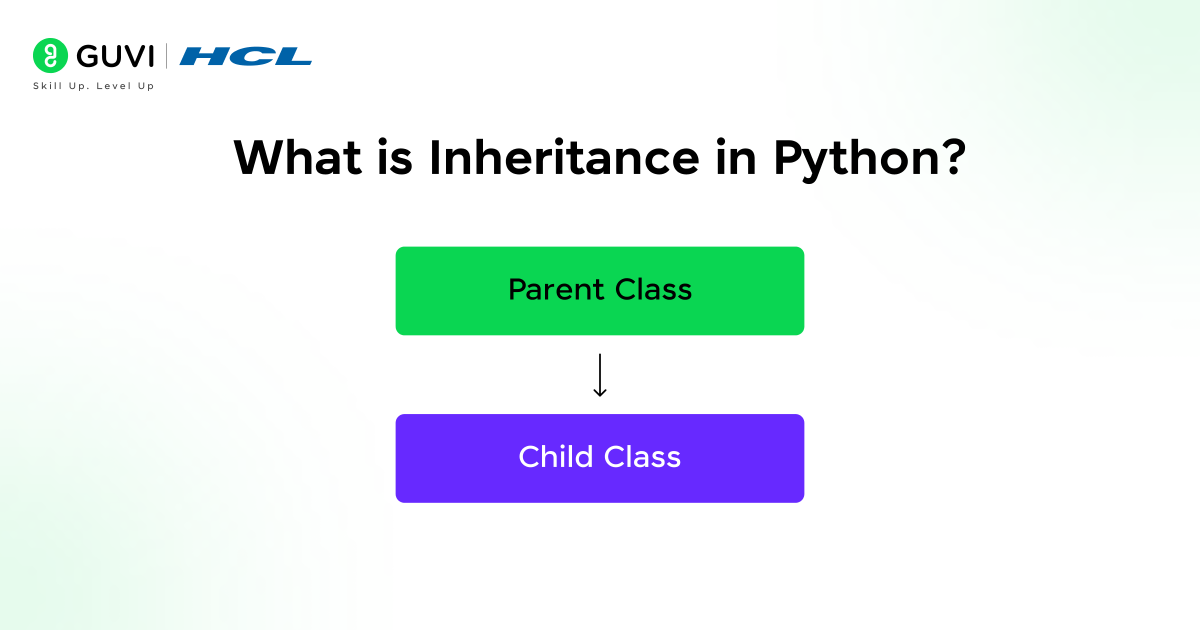
Inheritance in Python is a way to reuse existing code instead of creating everything from scratch. It allows one class to take features from another class, which helps keep programs simple, clean, and easy to maintain as they grow.
Think about a family relationship in real life. A parent has common traits like a family name or habits. A child naturally inherits many of these traits but also develops their own unique qualities. The child does not start from zero, they build on what already exists.
The same idea applies to inheritance in Python. The parent class contains common features, and the child class automatically gets them. The child class can then add new features or change existing ones if needed, making inheritance in Python easy for beginners to understand and use.
Key Points Of Inheritance In Python
- Code Reusability: Common functionality is written once in the parent class and reused by child classes.
- Parent and Child Classes: The parent class provides features, and the child class receives and extends them.
- Better Code Organization: Related classes are grouped logically, making programs easier to read.
- Easy to Maintain: Changes made in the parent class automatically apply to child classes.
- Beginner-Friendly Concept: Inheritance in Python follows real-life relationships, making it simple to learn.
Do check out HCL GUVI’s Python Hub; while this article thoroughly explains inheritance in python, the Python Hub lets you explore more tutorials, examples, and resources to practice concepts, reinforce learning, and build confidence in real-world Python programming.
Types Of Inheritance In Python
Inheritance in Python can be grouped into five types based on how classes are connected. These types help beginners understand different ways in which features can be shared and reused.
Types Of Inheritance In Python
- Single Inheritance
- Multiple Inheritance
- Multilevel Inheritance
- Hierarchical Inheritance
- Hybrid Inheritance
1. Single Inheritance
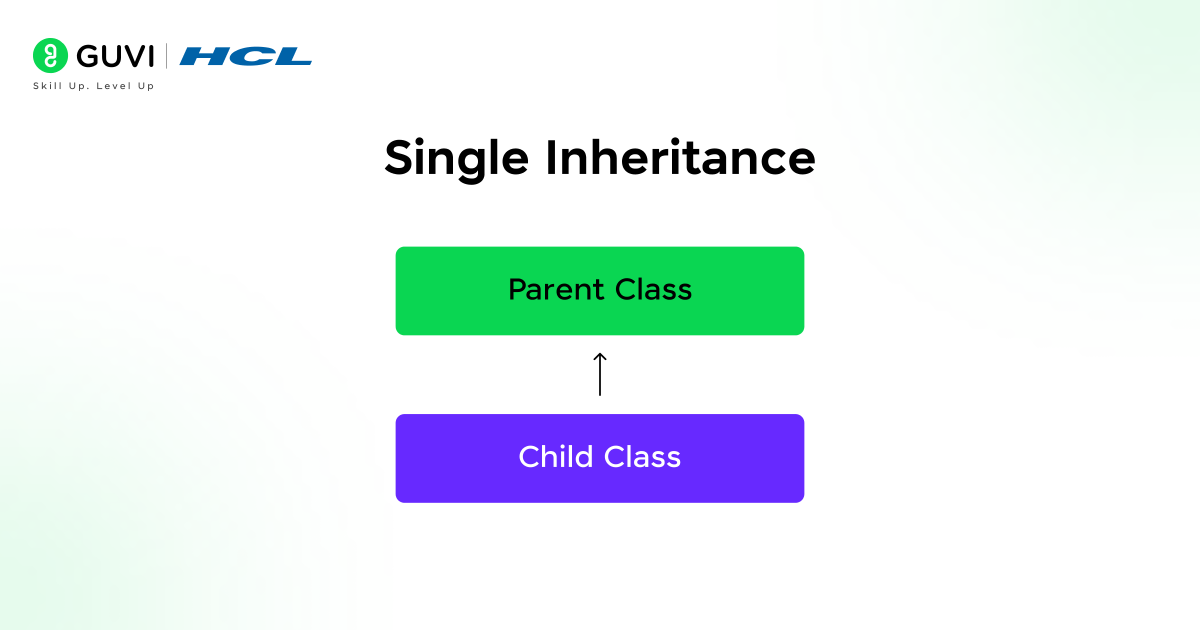
Single inheritance in Python means one child class inherits from one parent class. This is the easiest type for beginners to understand. In this case, the child class uses all common features from the parent class and may add something new without changing the parent.
Key Points
- One Parent One Child: Only one parent class and one child class are involved.
- Easy To Understand: The relationship is simple and clear.
- Best For Beginners: Helps learn inheritance without confusion.
Key Characteristics
- One Parent Class: The child class inherits from only one parent class.
- One Child Class: Only a single derived class is involved.
- Direct Relationship: The inheritance relationship is straight and linear.
- Low Risk Of Conflicts: No ambiguity in inherited features.
- Easy Debugging: Errors are easier to trace and fix.
- High Readability: Code structure remains clear and readable.
Example:
Think of a company where there is a basic Employee role. A Manager is also an employee, so the manager automatically has employee qualities like working hours and salary structure, along with additional responsibilities.
class Employee:
    def __init__(self, salary):
        self.salary = salary
    def show_salary(self):
        print("Salary:", self.salary)
class Manager(Employee):
    def __init__(self, salary, team_size):
        super().__init__(salary)
        self.team_size = team_size
    def show_team(self):
        print("Team Size:", self.team_size
manager = Manager(50000, 10)
manager.show_salary()
manager.show_team()
Here, the Employee is the parent class and Manager is the child class. Since a manager is also an employee, the manager automatically gets the salary feature from the employee class.
The Manager class adds its own detail called team size. This shows single inheritance in Python, where one child class inherits from one parent class in a simple and clear way, making it easy for beginners to understand.

2. Multiple Inheritance
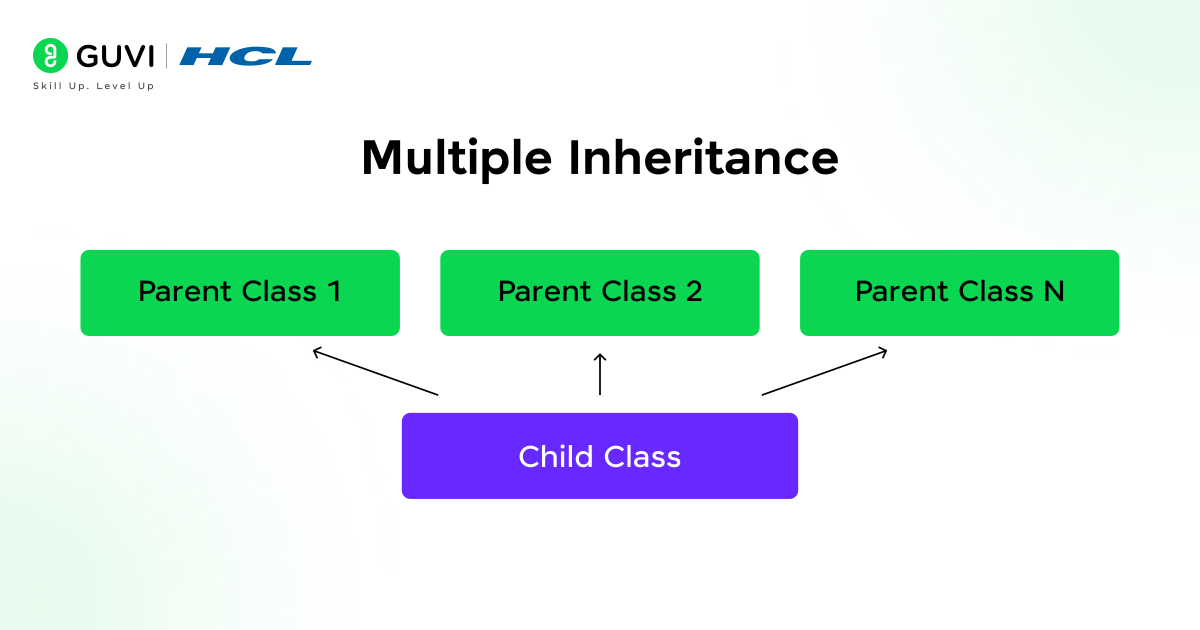
Multiple inheritance in Python happens when one child class inherits features from more than one parent class. This allows a class to combine different abilities, but beginners should use it carefully because it can increase complexity.
Key Points
- More Than One Parent: The child class receives features from multiple classes.
- Combines Behaviors: Useful when a class needs different capabilities.
- Needs Careful Use: Can become confusing if not designed properly.
Key Characteristics
- More Than One Parent Class: The child class depends on multiple parents.
- Feature Combination: Inherits attributes and behaviors from different classes.
- Flexible Design: Allows reuse of unrelated functionalities.
- Method Resolution Order: Python follows a specific order to resolve method conflicts.
- Possibility of Ambiguity: Same method name in parents can confuse.
- Careful Design Required: Poor structure can make code difficult to maintain.
- Powerful Capability: Useful in advanced and large applications.
Example:
A smartphone behaves like a phone and also like a camera. It can make calls and take photos by combining features from both concepts.
class Phone:
    def call(self):
        print("Making a phone call")
class Camera:
    def photo(self):
        print("Taking a photo")
class Smartphone(Phone, Camera):
    pass
my_phone = Smartphone()
my_phone.call()
my_phone.photo()
In this example, Phone and Camera are two parent classes. The Smartphone class inherits from both of them, so it can make calls and take photos.
This shows multiple inheritance in Python, where one child class gets features from more than one parent class. While this is powerful, beginners should use it carefully because combining many classes can make code harder to understand.
3. Multilevel Inheritance
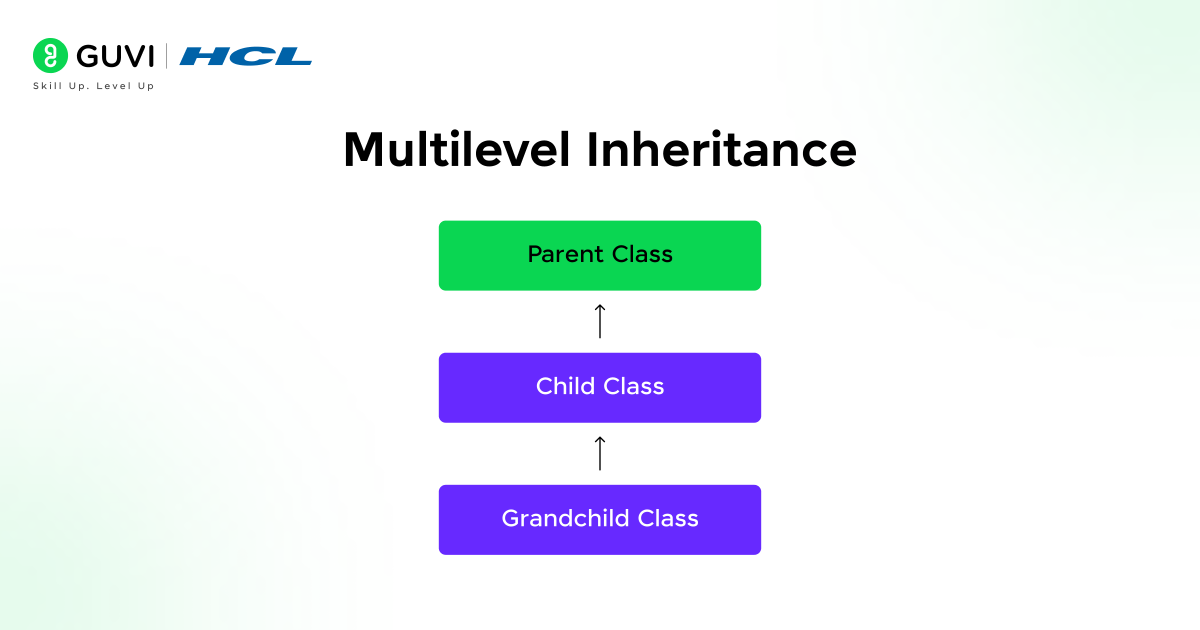
Multilevel inheritance in Python forms a chain of inheritance, where one class inherits from another child class. Each level adds more specific features as you move down the chain.
Key Points
- Inheritance Chain: Classes are connected level by level.
- Features Passed Down: Each level adds more specific behavior.
- Clear Hierarchy: Shows how concepts evolve step by step.
Key Characteristics
- Inheritance Chain: A class inherits from another derived class.
- Multiple Levels: More than two levels of classes are involved.
- Stepwise Feature Inheritance: Features pass down level by level.
- Code Reusability Across Levels: Common features reused throughout the chain.
- Increased Dependency: Changes in higher-level classes affect lower levels.
- Moderate Complexity: Easier than multiple inheritance but deeper than single.
Example:
A living being can be an animal, and an animal can be a dog. Each level builds on the previous one, passing features step by step.
class LivingBeing:
    def breathe(self):
        print("Breathing")
class Animal(LivingBeing):
    def eat(self):
        print("Eating food")
class Dog(Animal):
    def bark(self):
        print("Barking")
my_dog = Dog()
my_dog.breathe()
my_dog.eat()
my_dog.bark()
In this example, LivingBeing is the base class, Animal inherits from it, and Dog inherits from Animal. This creates a clear chain of inheritance.
This demonstrates multilevel inheritance in Python, where features are passed step by step from one level to the next, making it easy for beginners to understand how inheritance works across multiple levels.
4. Hierarchical Inheritance
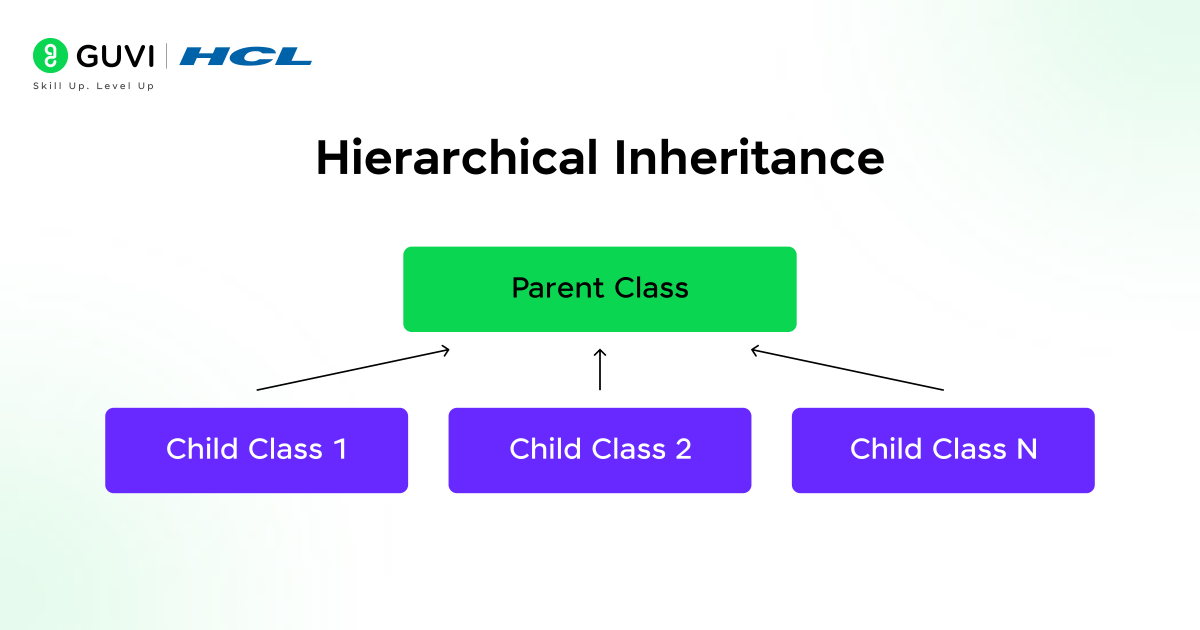
Hierarchical inheritance in Python occurs when multiple child classes inherit from a single parent class. This helps share common features while allowing different behavior for each child.
Key Points
- One Parent Multiple Children: Many child classes share one parent.
- Shared Common Features: Common behavior is reused.
- Different Specializations: Each child adds its own behavior.
Key Characteristics
- Single Parent Class: One base class is shared.
- Multiple Child Classes: More than one derived class exists.
- Independent Children: Child classes do not depend on each other.
- Parallel Structure: All child classes exist at the same inheritance level.
- Efficient Code Reuse: Common logic written once and reused.
- Easy Extension: New child classes can be added easily.
Example:
A vehicle can have different forms such as car, bike, and bus. All of them share common vehicle features but are used differently.
class Vehicle:
    def start(self):
        print("Vehicle starting")
class Car(Vehicle):
    def drive(self):
        print("Driving a car")
class Bike(Vehicle):
    def ride(self):
        print("Riding a bike")
class Bus(Vehicle):
    def travel(self):
        print("Traveling by bus")
car = Car()
bike = Bike()
bus = Bus()
car.start()
bike.start()
bus.start()
In this example, Vehicle is the single parent class, and Car, Bike, and Bus are multiple child classes. All child classes inherit the common feature of starting from the parent class.
This shows hierarchical inheritance in Python, where one parent class shares common behavior with many child classes, while each child still represents a different specialization.
5. Hybrid Inheritance
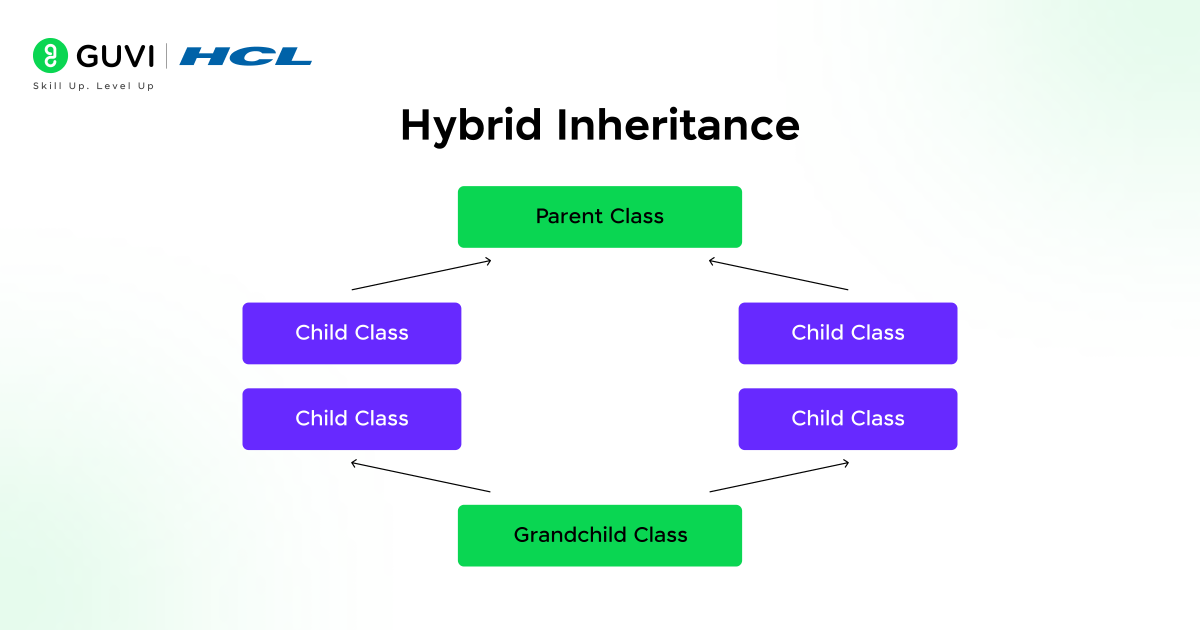
Hybrid inheritance in Python is a combination of two or more inheritance types. It is usually found in larger systems with complex relationships.
Key Points
- Combination of Types: Uses more than one inheritance pattern.
- Used in Complex Systems: Common in large applications.
- Not beginner-focused: Usually learned after basics are clear.
Key Characteristics
- Combination of Structures: Uses multiple inheritance patterns together.
- Complex Relationships: Classes may be connected in different ways.
- High Flexibility: Supports advanced system designs.
- Often Includes Multiple Inheritance: Commonly mixes multiple and hierarchical types.
- Harder to Understand: Not ideal for beginners.
- Requires Strong Design Planning: Poor planning leads to confusion.
- Used in Large Systems: Common in real-world frameworks and applications.
- Higher Maintenance Effort: Changes can affect many linked classes.
Example:
In an education system, a person can be a student or a teacher, and later someone may take on multiple roles, combining different inherited features.
class Person:
    def info(self):
        print("Person information")
class Student(Person):
    def study(self):
        print("Studying")
class Teacher(Person):
    def teach(self):
        print("Teaching")
class TeachingAssistant(Student, Teacher):
    pass
ta = TeachingAssistant()
ta.info()
ta.study()
ta.teach()
In this example, Person is the base class. Student and Teacher both inherit from it, forming hierarchical inheritance. The TeachingAssistant class then inherits from both Student and Teacher, which introduces multiple inheritance.
This combination shows hybrid inheritance in Python, where more than one inheritance type is used together, making it suitable for complex and real-world systems rather than beginner-level programs.
Do check out HCL GUVI’s Python Course if learning inheritance in Python made you curious about how object-oriented concepts work in real projects. This blog explains inheritance in a beginner-friendly way, and a structured course like this helps you go deeper by applying the same ideas through guided lessons, hands-on practice, and real-world scenarios that strengthen your Python fundamentals.
💡 Did You Know?
- Python follows Method Resolution Order (MRO) to decide which parent class method runs first when multiple inheritance is used.
- Every class in Python automatically inherits from the built-in object class, even if it is not written explicitly.
- The super() function helps child classes reuse parent class functionality without rewriting code, making inheritance cleaner and more efficient.
Conclusion
Inheritance in Python helps beginners understand how classes are connected and how code can be reused instead of written again and again. By sharing common features between classes, inheritance in Python makes programs cleaner, easier to manage, and closer to real-life thinking.
Learning the different types of inheritance step by step gives a strong foundation in object-oriented programming. Once beginners understand inheritance in Python clearly, they find it easier to learn advanced concepts and build structured, scalable applications.
FAQs
1. Is Inheritance In Python Mandatory To Use Object-Oriented Programming?
No, inheritance in Python is optional. You can write object-oriented code without using inheritance, but inheritance helps when you want to reuse and organize code efficiently.
2. Can A Child Class Change The Behavior Of A Parent Class In Python?
Yes, a child class can override parent class methods to change or extend behavior while still using the parent structure.
3. Why Is Multiple Inheritance Considered Risky For Beginners?
Multiple inheritance can cause confusion when different parent classes have methods with the same name, making code harder to understand and debug.
4. Which Type Of Inheritance Is Most Commonly Used In Real Projects?
Single and hierarchical inheritance are used most often because they keep code simple, readable, and easy to maintain.
5. Should Beginners Learn All Types Of Inheritance At Once?
No, beginners should start with single inheritance first and then slowly move to other types once the basics are clear.
Success Stories

About the Author
Jebasta
I translate the language of data into stories that anyone can understand. As a writer with a data science background, I simplify analytics, AI, and decision-making so beginners and enthusiasts can confidently explore the world of data.
View all posts by Jebasta
Connect with me @















Did you enjoy this article?