


Interview Articles
My Full Stack Developer Interview Experience: What Nobody Tells You
My Digital Marketing Interview Experience: What They Don't Tell You [2026]
How Long Does Technical Interview Preparation Take? An Expert's Reality Check
Technical QA Interview Questions: What Top Companies Really Ask in 2026


Get In Touch For Details! Request More Information
The Ultimate Guide: 9 Things to Research Before an Interview
Feb 05, 2026 5 Min Read 1615 Views
(Last Updated)
Imagine walking into the interview room confidently. You mention the company’s growth opportunities and explain how your skills align with their needs. You also point out the problems the company is facing. Or, you ask questions that seem to read the interviewer’s mind.
This is the power of interview preparation research. It can turn you from an average applicant into someone who really stands out. The hiring manager is impressed and is already picturing you as part of the team.
Knowing the things to research before interview isn’t a difficult task, but it is your competitive advantage in today’s job market.
You might be wondering what you should research before an interview.
Quick Answer:
The most important things to research before an interview include the company’s mission, values, products, recent news, the job description, the team you’ll work with, and the company’s culture.
This blog explains everything from learning about the company to helpful insider tips, so you can impress every interviewer with confidence and clear answers.
Table of contents
- Things to Research Before an Interview
- Start By Knowing the Company
- Research the Company’s Core Details
- Company Current Progress and Future Plans
- Know the Company’s Culture
- Research the Company’s Latest News and Achievements
- Job Description Analysis (Read It Like a Detective)
- What Employees Say
- Role-specific research (Understand Your Future Job)
- Know Your Interviewers: The Hiring Manager and Interview Team
- Bonus Tips
- Creating a Job Interview Research Checklist Document
- Wrapping Up
- FAQs
- What should I research before an interview?
- Which of the following should you research before an interview?
- What is a red flag in a job interview?
- What are 5 common interview mistakes?
- Why should we hire you?
Things to Research Before an Interview
Walking into an interview without proper research is like playing a game without knowing the rules. Interviewers can quickly tell who has done their homework and who hasn’t.
In a recent study, almost half of all recruiters (47%) said they would probably not hire someone who doesn’t know much about the company they are applying to.
Today, employers want candidates who are truly interested in the job, care about the company’s goals, and have taken the time to learn about what the organization does and stands for. Showing that you are curious and prepared to make an impact.
1. Start By Knowing the Company
Researching the company is the first and most important step. It’s the base that everything else stands on. When you really understand how the company works, you show that you care. And help you make smarter choices about your career. Interviewers easily tell who has taken time to learn about their company and who is just applying everywhere.
2. Research the Company’s Core Details
The way to figure out is to ask: What does this company actually do?
Mission and Vision
Learn about the mission, vision, and values, what problems it solves, what it aims to achieve, and what principles guide its decisions. Study the company’s products or services, target audience, and business model.
Next, look into size and structure. Is it a small startup or a global corporation? This will help you understand the work environment and your potential role.
Finally, research the leadership and ownership, who the CEO is, what their background is, and what leadership style they follow. A company’s leadership philosophy often reflects its culture and priorities.
Dig Deeper Into
What problem does the company solve?
How big is the company and how is it organized?
Who is the CEO?
What’s their background and leadership philosophy?
3. Company Current Progress and Future Plans
Look into the company’s recent performance and future direction.
Is the company growing, stable, or facing challenges? If it’s public, review financial reports and analyst summaries. If private, search for funding announcements, new product launches, or expansion news.
Recent achievements, awards, or partnerships tell you what the company values most right now. Mentioning these in your interview shows you’re informed and forward-thinking.
Dig Deeper Into
Is this company moving forward?
Are they expanding, launching new ideas, or trying to fix problems?
4. Know the Company’s Culture
What’s it really like to work there?
Company culture reflects its identity and values. Read how the company presents itself on its website, social media. And marketing materials. Check employee testimonials or Glassdoor reviews to understand the internal environment.
Learn about the company’s history and milestones, and its founding story often reveals the purpose and resilience.
Dig Deeper Into
How is the company perceived in the market?
What is their brand voice and personality?
What major milestones have they hit?

5. Research the Company’s Latest News and Achievements
Stay informed about what’s happening right now. Has the company launched new products, raised funding, expanded to new markets, or won industry awards?
Use sources like the company’s blog, LinkedIn page, Google News, and industry sites.
Mention something recent,
For example, I noticed your company just launched a new app for teachers. I think that’s awesome because education is something I’m passionate about.
This sounds so much better than: ‘I want to work here.’
Why This Matters for Your Interview
When you mention something recent about the company, the interviewer knows you’ve done your homework. It shows you actually care about working there.
6. Job Description Analysis (Read It Like a Detective)
Find: What does the job description really want?
The job description is your treasure map. It tells you exactly what the company needs you to do. Read it several times and look for clues about what the job is really like. Each time you read it, you’ll notice something new.
Look for patterns; if words like teamwork or attention to detail appear often, those are key traits they’re seeking.
Understand the top three to five responsibilities you’ll handle daily, and note who you’ll work with. Reading between the lines helps you tailor your answers and highlight relevant strengths.
Always: Read Between the Lines
| Example Job Description | The Main Responsibilities Are |
| Write code for web applications (50% of time), fix bugs and debug problems (25% of time), review and improve code quality (15% of time), communicate with product and team (10% of time) | Write code for web applications (50% of time), fix bugs and debug problems (25% of time), review and improve code quality (15% of time), communicate with product and team (10% of time) |
Sometimes the real message is hidden. Companies use certain words repeatedly because those qualities matter most.
Read for Patterns
If they say ‘multitasking’ or ‘juggling priorities’: → They want someone organized who can handle chaos → You should prepare to talk about times you managed multiple projects
If they say, ‘teamwork’ or ‘collaboration’: → They want someone who plays nice with others and communicates well → You should prepare stories about working in teams
If they say ‘fast-paced’ or ‘quick thinking’: → Things move fast here; decisions happen quickly → You should be ready for a rapid environment
If they say ‘attention to detail’ many times: → Mistakes are not acceptable; quality matters → You should emphasize the times you caught errors or improved quality
Explore HCL GUVI’s Professional Collaboration Course to learn the fundamentals of teamwork and understand its impact on success.
7. What Employees Say
Find: What Do People Actually Say About Working There?
Online reviews reveal what it’s really like to work at a company. Use platforms like Glassdoor, Indeed, and LinkedIn to gather honest employee feedback.
Red Flags to Watch For
Many people leave quickly if lots of people quit after 6 months, something’s wrong.
Complaints about the same thing if everyone mentions a problem, it’s probably real.
8. Role-specific research (Understand Your Future Job)
Now let’s go deeper. The job description gave you the basics. Now decode detailed research into what their day-to-day works look like and how success is measured.
Look up current employees in similar roles on LinkedIn, check company team pages, and talk to people in your network for real insights. This helps you understand whether the role fits your skills and career goals, and it gives you smart questions to ask in the interview.
Dig Deeper Into
Search for people with this exact job title at this company
Read their profiles to see what they’ve done
Contact them and ask for a 15-minute chat
Company Website
Look at team pages that might describe departments
Similar jobs at other companies
If you can’t find much about this company’s role, look at similar jobs elsewhere
This gives you a general idea of what the job involves
Ask People You Know
Do you know anyone who works there? Ask them questions.
Do you know someone in this field? Ask them about the role.
9. Know Your Interviewers: The Hiring Manager and Interview Team
Find out who’s interviewing you and do a quick employer research beforehand. Search for their LinkedIn profiles, recent posts, and professional background. See if you can learn about their career journey and values. Getting to know them a little helps you build a connection.
When you refer to something specific, like a project they lead or an article they shared, it builds instant rapport and shows your interest.
To learn in such effective ways, explore HCL GUVI’s complete interview preparation courses.
Bonus Tips
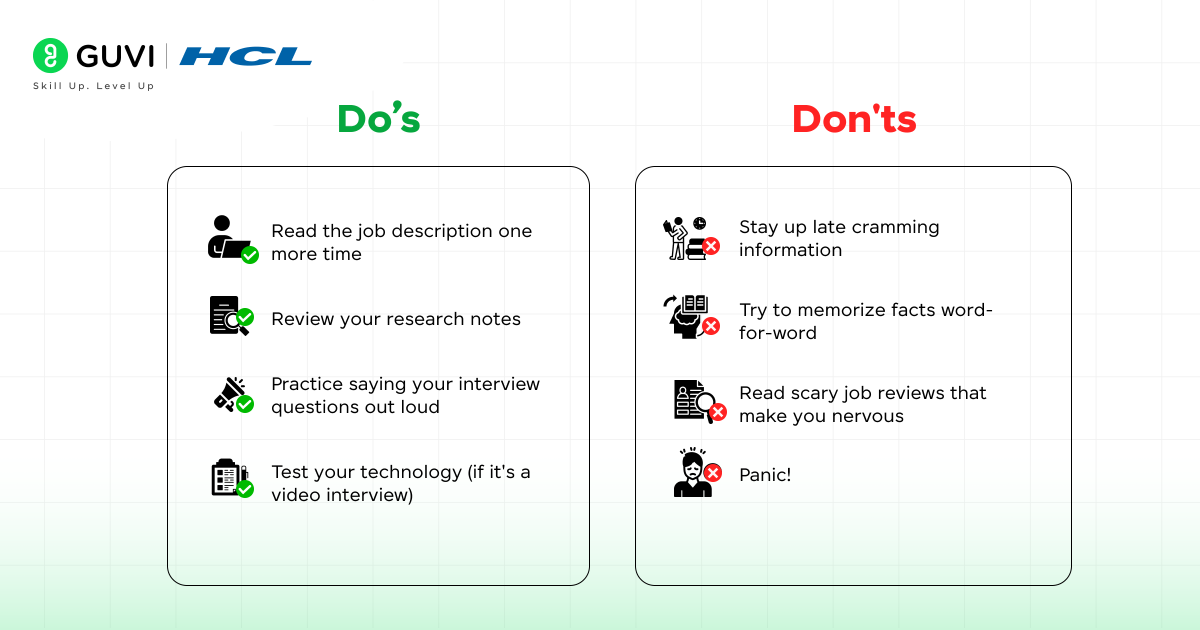
Creating a Job Interview Research Checklist Document
Create a simple company research document that includes:
Company at Glance: year founded, milestones, size, industry.
Mission, Vision, and Values
Recent Financial or Growth Updates
Latest News and Achievements
Leadership Team
Why does this company appeal to you?
Having a one-page summary will make it easy to review on the day before your interview.
Wrapping Up
Here’s the truth: interview preparation research is your secret advantage. It turns you from just another applicant into someone who clearly did their homework.
Things to research before the interview include the company’s story, their wins, their challenges, the role, the team, and the industry.
When you walk into that interview room or join the Zoom call knowing all this, you’ll stand out. You’ll ask smart questions that get their attention and have real conversations instead of robotic question-and-answer sessions.
The companies hiring right now aren’t choosing people at random. They’re choosing those who care enough to prepare.
FAQs
1. What should I research before an interview?
Before any interview, it’s important to do solid interview preparation research. Start by learning about the company’s history, mission, and recent achievements. Read the job description carefully so you know exactly what skills and experiences they’re looking for. You should also research the team or department you’d be joining to get a sense of their goals and work culture.
2. Which of the following should you research before an interview?
When thinking about the main things to research before interview day, focus on the company, the role, and the people. Learn about the company’s story, its leadership, and its values. The more you know, the easier it will be to have meaningful conversations during the interview instead of giving surface-level answers.
3. What is a red flag in a job interview?
A red flag in a job interview is a sign that something might not be right about the company or the position. For example, if the interviewer avoids answering your questions or seems unclear about the role, that could be a warning sign. If you spot several red flags, it’s wise to think carefully before accepting an offer.
4. What are 5 common interview mistakes?
One of the biggest is not doing enough interview preparation research before the meeting. Others include talking too much or too little, failing to ask questions, speaking negatively about former employers, and forgetting to follow up after the interview.
5. Why should we hire you?
This is your chance to connect your skills and experience with what the company needs.
Use your research to show that you understand their goals and challenges. You might say something like, “From my research, I understand your company values innovation and teamwork. My background in project management and my experience leading creative teams make me confident that I can help the company grow.
Success Stories

About the Author
Salini Balasubramaniam
A curious, information-savvy writer loves to turn deep insights into authentic and engaging content that connects. With experience in writing for brands and driving audience engagement, I believe that words can make a powerful difference.
View all posts by Salini Balasubramaniam
Connect with me @











Did you enjoy this article?