


DevOps Articles
My DevOps Interview Experience at MAANG: From Rejection to Success [2026]
What is Ansible in DevOps? A Complete Practical Guide
Azure DevOps Lifecycle: 7 Stages from Planning to Deployment


Get In Touch For Details! Request More Information

The Future & Scope of DevOps: A Comprehensive Outlook
Oct 27, 2025 6 Min Read 5133 Views
(Last Updated)
What does the future of software development look like when speed and collaboration all move in the same direction? DevOps has grown from a practice into a necessity that bridges development and operations, helping businesses deliver software faster with fewer failures. Organizations in every industry now view DevOps as a core strategy for innovation, and its influence is expanding with cloud adoption, artificial intelligence, and stronger security practices. Professionals aiming to build a long-term career in technology are finding that DevOps provides a path filled with opportunity, growth, and relevance.
Read the full blog to explore the future and scope of DevOps in detail.
- Around 80% of global organizations now use DevOps in some capacity, making it a mainstream practice rather than a niche methodology.
- Only 9% of organizations have fully integrated AI into their DevOps pipelines, showing massive room for innovation.
- DevOps adoption jumped from 33% in 2017 to nearly 80% in 2024, reflecting a dramatic cultural and technological shift across industries.
Table of contents
- Part 1) My Background and First Setbacks
- 1) Getting Laid Off And Starting Over
- 2) Freelancing To Build Real-World Skills
- Part 2) How I Prepared for the DevOps Interview
- 1) Learning Tools Like Terraform, GitLab CI, And Kubernetes
- 2) Practicing With Mock Interviews And Real Scenarios
- 3) Improving My Resume And LinkedIn Profile
- Part 3) Breakdown Of My MAANG DevOps Interview Rounds
- 1) Technical Round: YAML, Cloud, And Scripting
- 2) System Design Round: Solving Real-World Problems
- 3) Behavioral Round: Communication And Ownership
- 4) Final Round: Culture Fit And Team Alignment
- Part 4) Key Takeaways From My DevOps Interview Experience
- 1) Why Mindset And Adaptability Matter
- 2) How To Stand Out Without Knowing Every Tool
- 3) The Importance Of Showing Real Impact
- Concluding Thoughts…
- FAQs
- Q1. What are the key components of a successful DevOps interview preparation?
- Q2. How important is practical experience in DevOps interviews?
- Q3. What types of questions can I expect in a MAANG DevOps interview?
- Q4. How can I stand out in a DevOps interview without knowing every tool?
- Q5. What's the importance of quantifying achievements in DevOps interviews?
What is DevOps?

DevOps is a set of practices that connects software development with IT operations to improve the way applications are built, tested, and released. It concentrates on collaboration between developers and operations teams so that software can move from idea to deployment faster and with fewer errors. The approach brings automation into processes like code integration and deployment, which reduces manual work and improves consistency.
Organizations that adopt DevOps often see shorter development cycles and more reliable software delivery. It is both a culture and a methodology that reshapes how teams work together in modern technology environments.
Current State of DevOps in the Industry
DevOps has reached a stage where adoption is visible across enterprises, startups, and SMBs. Large companies view it as a way to maintain faster release cycles and reduce downtime. Startups use it to stay competitive and scale without creating operational bottlenecks. SMBs implement DevOps to achieve efficiency and lower costs while keeping pace with growing customer demands.
The global DevOps market is valued at around USD 16.13 billion in 2025 and is projected to reach USD 43.17 billion by 2030, with a CAGR of 21.76 %. DevOps automation tools alone are expected to grow from USD 14.44 billion in 2025 to USD 72.81 billion by 2032, at a CAGR of 26 %. Adoption is also reflected in practices, as more than 80 % of organizations use CI/CD pipelines to deliver software faster with fewer errors. Industries such as finance, healthcare, and e-commerce rely on DevOps for both innovation and resilience.
The Future of DevOps: Emerging Trends
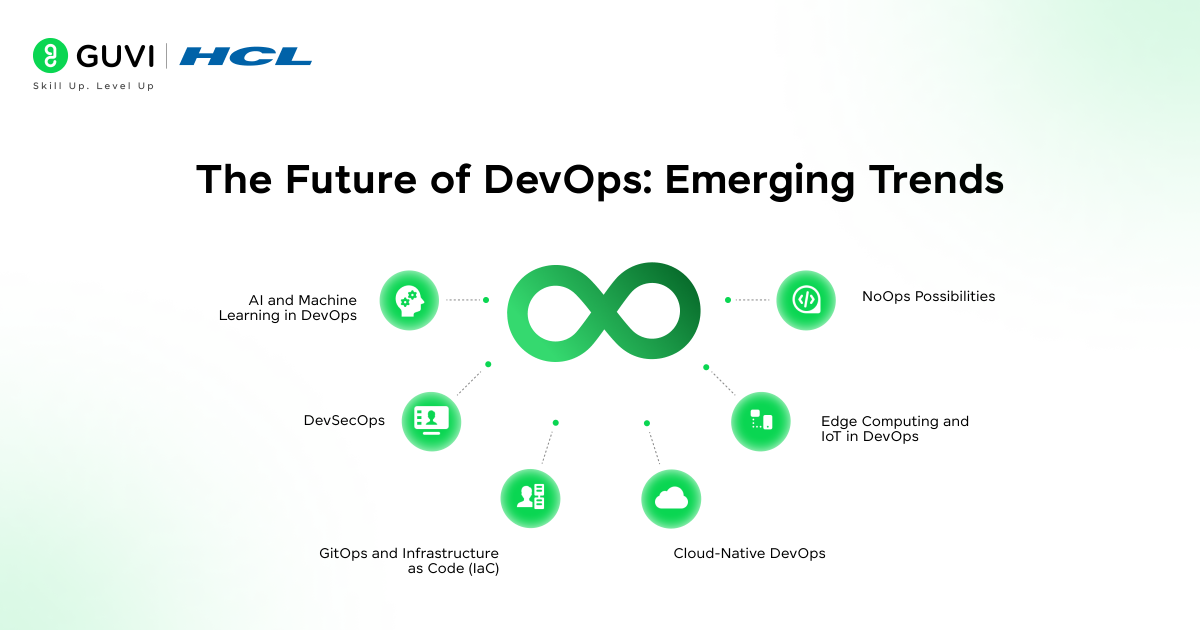
1. AI and Machine Learning in DevOps
Artificial intelligence and machine learning are already shaping how DevOps teams manage pipelines, identify anomalies, and optimize performance without human intervention. These systems assess logs, flag irregularities, and reduce noise in alerts to help engineers focus on real issues.
To illustrate, here are some focus areas where AI is active today:
- Predictive Insights: Models forecast resource exhaustion or error cascades based on historical data.
- Intelligent Automation: Systems trigger fixes for recurring faults automatically, such as restarting failed services.
- Data-Driven Decisions: Tools analyze past deployments to recommend safer deployment windows and rollback thresholds.
In the future, AI will advance toward fully autonomous pipelines that self-optimize and repair with minimal human oversight. Self-healing systems will become the norm, and AI will drive continuous improvement in delivery velocity and reliability.

2. DevSecOps
Security is already woven into modern DevOps pipelines through automated scanning and early detection of vulnerabilities. These practices help reduce last-minute surprises and shift security checks into early phases of development.
Key practices in use now include:
- Continuous Scanning: Every build undergoes automatic vulnerability and dependency checks.
- Policy as Code: Security and compliance rules are codified and applied consistently in CI/CD workflows.
- Adaptive Threat Detection: Tools monitor runtime behavior to flag suspicious patterns for further inspection.
Going forward, DevSecOps will incorporate more AI-based threat detection, risk forecasting, and dynamic policy enforcement. Security systems will adapt in real time to emerging threats, and “security as code” will evolve into “security as intelligence” embedded deeply in pipelines.
3. GitOps and Infrastructure as Code (IaC)
GitOps and Infrastructure as Code are already shaping infrastructure workflows by applying version control and reproducibility to operational changes. Teams rely on these approaches to manage environment consistency, change audits, and rollback discipline.
Current strengths include:
- Auditable Changes: Every infrastructure change is recorded in Git, making traceability and accountability possible.
- Rollback Capabilities: Failed deployments are undone by reverting to previous repository states.
- Standardization: IaC enforces the same configuration across development, staging, and production environments.
In coming years, GitOps will evolve to support more dynamic, self-adjusting infrastructure. Infrastructure will manage itself in response to demand, policy shifts, or system health. The concept of “environment drift” will become obsolete as IaC systems continuously reconcile desired and actual states.
4. Cloud-Native DevOps
Cloud-native practices are already shaping how teams design, deploy, and manage applications with serverless patterns and cloud portability. Teams use Kubernetes to orchestrate microservices and serverless functions to simplify operations.
Relevant trends in practice today include:
- Container Orchestration: Kubernetes coordinates container lifecycle and scaling across clusters.
- Serverless Functions: Code executes on demand without manual infrastructure management.
- Multi-Cloud Strategies: Applications span providers to improve resilience and control costs.
Looking ahead, cloud-native DevOps will shift toward universal abstractions over infrastructure so teams rarely need to think about underlying platforms. Workloads will migrate freely across clouds, environments will auto-provision, and serverless will become the default for many services.
5. Edge Computing and IoT in DevOps
Edge computing and IoT infrastructure are already shaping DevOps strategies beyond centralized clouds. Teams design for intermittent connectivity, limited compute, and remote updates, pushing software closer to users.
Active patterns include:
- Incremental Updates: Devices receive small delta patches rather than full upgrades.
- Latency Optimization: Logic is pushed to the edge so that reactive systems respond without cloud round trips.
- Remote Monitoring: Lightweight agents track device health even under constrained networks.
In the future, edge environments will self-organize, sync, and repair autonomously. DevOps pipelines will orchestrate tens of millions of devices seamlessly. Updates and rollback logic will flow dynamically, and edge clusters will integrate with cloud systems as a unified fabric.
6. NoOps Possibilities
Automation is already shaping parts of operations so that many routine tasks no longer require direct human control. Platforms today offer auto-scaling and resource optimization with minimal intervention.
Some examples in the field now:
- Self-Healing Systems: Platforms detect common faults and remediate them automatically.
- Automated Scaling: Resources expand or shrink in real time according to usage.
- Strategic Oversight: Teams monitor system health and intervene only on exceptions.
Moving forward, NoOps will expand so that operations become entirely reactive. Systems will foresee failures, schedule maintenance, and optimize themselves. Human roles will evolve into architects and overseers managing exceptions, policy, and strategic direction.
The future of DevOps is brighter than ever, and companies worldwide are looking for skilled engineers who can streamline development and operations. Our DevOps Course equips you with CI/CD pipelines, Docker, Kubernetes, cloud platforms, monitoring, and automation through real-world projects and expert mentorship. With global certification, lifetime access, and placement support, you’ll gain the skills to thrive in this high-demand field. Enroll today and build a future-ready DevOps career!
The Scope of DevOps Careers
1. Growing Demand for DevOps Roles
DevOps careers are already shaping the IT job market with strong demand across enterprises and startups. Organizations need engineers who can manage CI/CD, cloud deployments, and automation at scale. The rise of digital transformation projects has made DevOps one of the most requested skill sets.
Some of the current opportunities appear in these areas:
- DevOps Engineers: Professionals skilled in CI/CD pipelines and automation are central to almost every software team.
- Site Reliability Engineers (SREs): These roles focus on building systems that are reliable and scalable.
- Cloud Specialists: Engineers with AWS, Azure, or Google Cloud expertise manage hybrid and multi-cloud setups.
In the future, demand for DevOps professionals will rise further as organizations automate workflows and expand into edge and AI-driven environments. Roles will become more specialized, with expertise in AIOps, DevSecOps, and platform engineering shaping career paths.
2. Essential Skills in DevOps Careers
Current DevOps roles require a mix of coding ability, infrastructure management, and problem-solving. Employers value knowledge of scripting languages, cloud platforms, and tools for automation and monitoring. Teams also seek strong collaboration and communication skills since DevOps depends on cross-functional work.
Key skills shaping careers today include:
- CI/CD Mastery: Building and maintaining pipelines with Jenkins, GitHub Actions, or GitLab.
- Containerization: Using Docker and Kubernetes for scalable application deployment.
- Monitoring and Observability: Applying tools like Prometheus and Grafana to maintain performance.
In the years ahead, DevOps careers will demand fluency in AI-integrated platforms, security automation, and infrastructure self-management. Professionals who adapt to these areas will find themselves in leadership roles guiding the next stage of DevOps evolution.
3. Certifications and Learning Pathways
DevOps certifications are already shaping career development by providing structured proof of skills. Programs from AWS, Azure, Google Cloud, and Kubernetes give professionals credibility in competitive markets. These certifications often lead to higher salaries and quicker career growth.
Some popular certifications today include:
- AWS Certified DevOps Engineer: Focused on cloud automation and monitoring.
- Certified Kubernetes Administrator (CKA): Demonstrates deep knowledge of container orchestration.
- Microsoft Azure DevOps Solutions: Emphasizes CI/CD, monitoring, and compliance in Microsoft’s ecosystem.
Looking ahead, certifications will expand into areas such as AI-driven DevOps, DevSecOps, and edge automation. Professionals who pursue these future-focused learning paths will stay relevant in a job market that rewards adaptability.
4. Career Outlook and Salaries
The career outlook for DevOps professionals is already strong, with salaries ranking among the highest in IT. Employers compete for experienced engineers, which drives compensation upward. Many companies now consider DevOps a leadership track due to its impact on business results.
Key factors influencing careers today are:
- High Salaries: In India, DevOps engineers earn on average ₹9,50,000 per year, with ranges between ₹5,97,724 and ₹13,91,750 per Glassdoor. In deeper roles, DevOps Engineer II positions report base pay between ₹11,00,000 and ₹26,00,000 per year.
- Global Demand: DevOps skills are sought after across North America, Europe, and Asia. Remote roles allow engineers in India to tap global salary bands and leverage currency arbitrage.
- Career Mobility: Experience in DevOps opens paths into cloud architecture, product engineering, and top-tier IT leadership because the role spans methodology, infrastructure, and delivery.
Challenges and Limitations in DevOps Adoption
DevOps adoption is already shaping organizations across industries, but it does not come without challenges. The most common challenges appear in these areas:
- Cultural Resistance: Development and operations teams often work in silos, and shifting toward shared ownership requires a new mindset.
- Skill Gaps: Tools evolve quickly, yet teams may lack knowledge of automation, cloud platforms, or monitoring systems.
- Security and Compliance: Faster releases sometimes expose weaknesses in security practices and create audit pressure.
- Complexity at Scale: Large organizations with distributed systems face difficulty aligning pipelines, tools, and workflows.
Future Outlook: Where is DevOps Headed?
DevOps is already shaping digital transformation efforts in enterprises, pushing teams toward collaborative and automated practices. The Key directions for the next 5–10 years include:
- Predictions for Growth: The DevOps market is projected to more than double by 2030 as adoption spreads across sectors.
- Role in Digital Transformation: DevOps accelerates innovation by aligning development with business agility.
- Convergence of Technologies: AI, security automation, and cloud-native tools will merge into DevOps workflows.
- Impact on IT and Business: DevOps practices extend beyond IT, influencing customer experience, compliance, and strategy.
Conclusion
DevOps has already reshaped the way software is delivered by aligning development and operations for faster and more reliable outcomes. It introduces cultural change and measurable business benefits, which makes it one of the most influential approaches in modern IT.
Today it serves as the backbone of efficiency, collaboration, and shorter release cycles, while also creating rewarding career paths that offer high salaries and global demand. Businesses adopting DevOps experience greater agility and stronger customer satisfaction, and the methodology continues to evolve as the foundation for cloud-native and secure delivery models. In the future, DevOps will remain vital to how enterprises compete and innovate, guiding both technological progress and business strategy.
FAQs
1. Why is DevOps important for business growth?
DevOps shortens the time between idea and delivery, which helps businesses respond faster to market changes. Faster releases improve customer satisfaction and create room for continuous innovation.
2. How does DevOps improve software quality?
DevOps integrates automated testing, monitoring, and feedback into every stage of development. This reduces defects, improves stability, and helps teams deliver reliable applications.
3. What tools are commonly used in DevOps pipelines?
Popular tools include Jenkins for CI/CD, Docker and Kubernetes for containerization, Terraform for Infrastructure as Code, and Prometheus for monitoring. Each tool supports faster delivery and better collaboration.
4. Is DevOps only for large enterprises?
DevOps benefits startups, SMBs, and enterprises alike. Small teams use it to scale quickly without extra costs, while large organizations rely on it to manage complexity and maintain agility.
5. How does DevOps relate to cloud computing?
Cloud platforms give DevOps teams flexibility to deploy and monitor applications more effectively. With multi-cloud and serverless adoption, DevOps practices become essential for managing distributed workloads.

Success Stories

About the Author
Tushar Vinocha
A seasoned content writer with over four years of experience in crafting both technical and non-technical blogs. My passion for writing is fuelled by a relentless curiosity and a love for following-down the rabbit hole, recently leading me to explore the fascinating fields of Natural Language Processing (NLP), Human psychology and Philosophy. Here, you’ll find a blend of genuine insights, innovative ideas, and refusal to settle for the mundane.
View all posts by Tushar Vinocha
Connect with me @
















Did you enjoy this article?