


Python Articles
How to Install Requirements.txt in Python: A Beginner's Step-by-Step Guide (2026)
How to Check if Python Is Installed on Your Computer


Get In Touch For Details! Request More Information
List Comprehension in Python: A Practical Guide
Mar 12, 2026 6 Min Read 1051 Views
(Last Updated)
Are you still writing long for loops to build lists when Python offers a cleaner and more expressive alternative? Many Python programs become harder to read and maintain because simple transformations are written in verbose ways. List comprehension provides a concise syntax that combines looping, filtering, and transformation into a single, readable expression, which makes Python code more efficient and easier to understand.
Follow this guide to understand what list comprehension in Python is, how it works under the hood, and how to use it correctly in real-world programming scenarios.
Quick Answer: List comprehension in Python is a concise, readable way to create lists by combining iteration, optional filtering, and transformation in a single expression. It executes efficiently at the interpreter level, avoids repeated append operations, and produces deterministic results. List comprehensions improve code clarity and performance for common data processing, filtering, and transformation tasks.
Table of contents
- What Is List Comprehension in Python?
- Basic Syntax of List Comprehension
- Nested List Comprehensions
- Using Conditions in List Comprehension
- Performance Characteristics of List Comprehension in Python
- List Comprehension vs Traditional For Loops
- List Comprehension vs Generator Expression
- Real-World Examples List Comprehension in Python
- Common Mistakes With List Comprehension
- Best Practices for List Comprehension in Python
- Conclusion
- FAQs
- Can list comprehensions replace map and filter functions?
- Are list comprehensions suitable for large datasets?
- Can list comprehensions contain function calls?
What Is List Comprehension in Python?
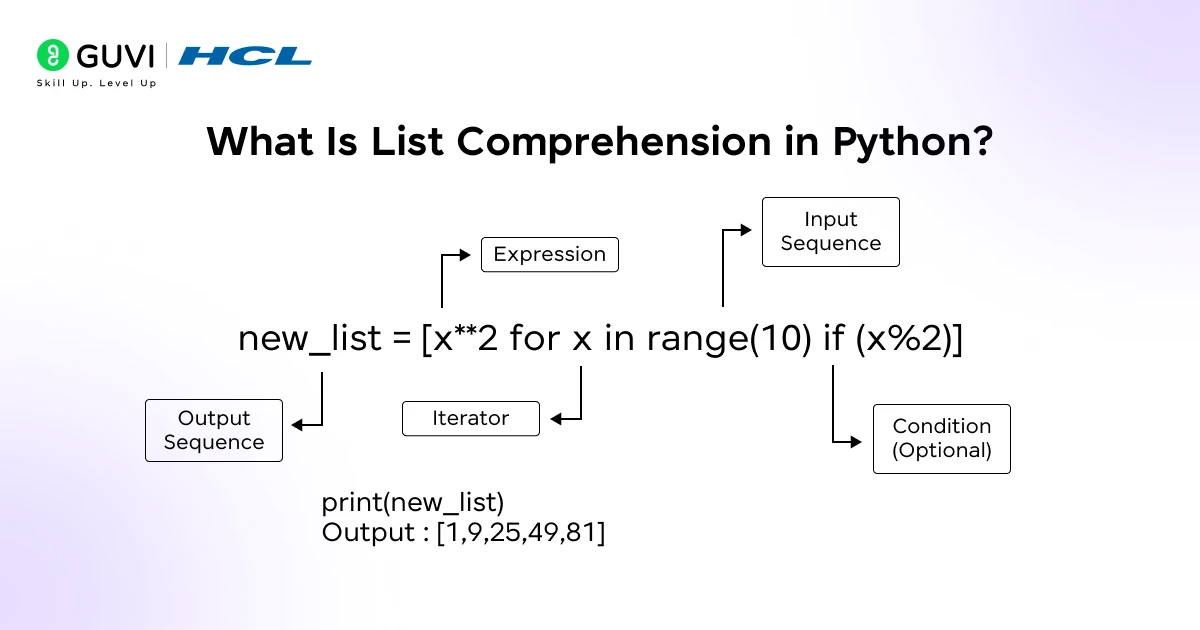
List comprehension in Python is a concise syntax for creating new lists by applying an expression to each element in an iterable, with optional filtering logic included in the same construct. It combines iteration, condition checking, and transformation into a single, readable statement that executes efficiently at the interpreter level. List comprehensions evaluate elements in order, create the resulting list in memory immediately, and avoid the overhead of repeated list appends seen in traditional loops.
Basic Syntax of List Comprehension
List comprehension provides a compact and expressive way to generate lists by combining iteration and transformation into a single construct. It replaces multi-line loop logic with a declarative expression that clearly describes how each element of the result is produced.
Core Structure: Expression, Loop, and Iterable
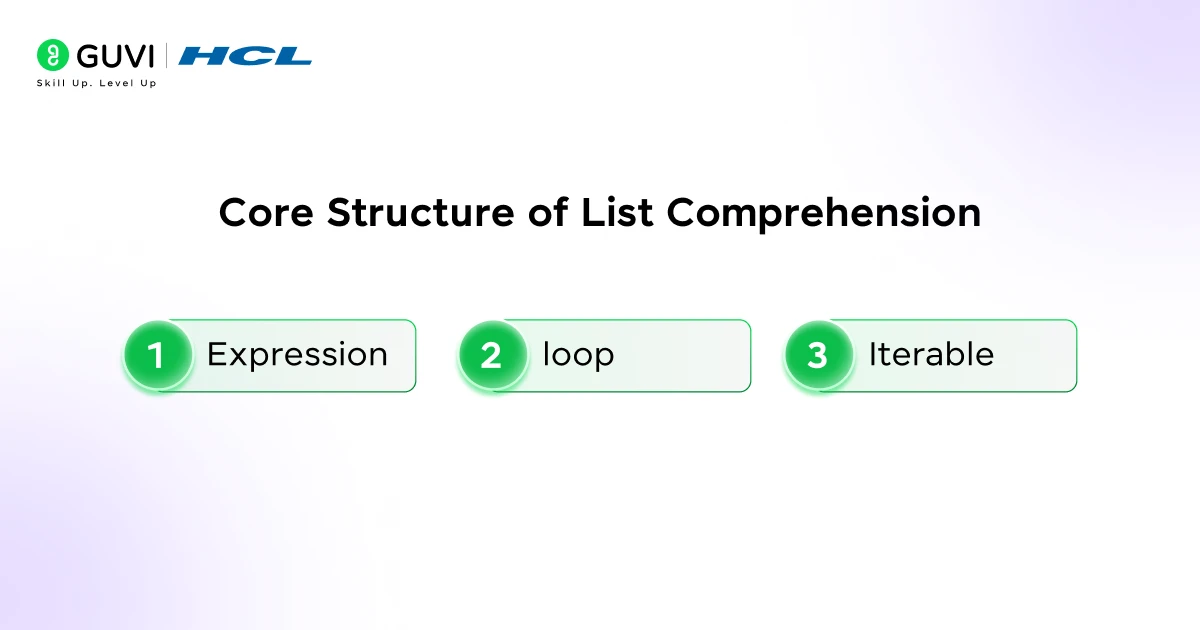
- Expression determines the value that is added to the resulting list for each iteration. It can include arithmetic operations, method calls, or conditional expressions.
- Loop defines the iteration variable and controls how elements are retrieved from the iterable.
- Iterable supplies the source sequence, which can be any object that supports iteration, such as Python lists, tuples, ranges, strings, or generators.
[expression for item in iterable]
Understanding Evaluation Order
Python evaluates the iterable first and then processes each element sequentially. For every item produced by the iterable, the expression is evaluated and the resulting value is immediately appended to the output list. The comprehension completes only after all elements have been processed, at which point the full list exists in memory.
Simple List Comprehension Example
The example below generates a list of squared numbers using a range iterable:
squares = [x * x for x in range(5)]
Here, the loop iterates over integers from 0 to 4, the expression x * x transforms each value, and Python constructs a new list containing the computed results. This process avoids explicit list initialization and repeated append operations, which improves readability and reduces boilerplate code.
Nested List Comprehensions
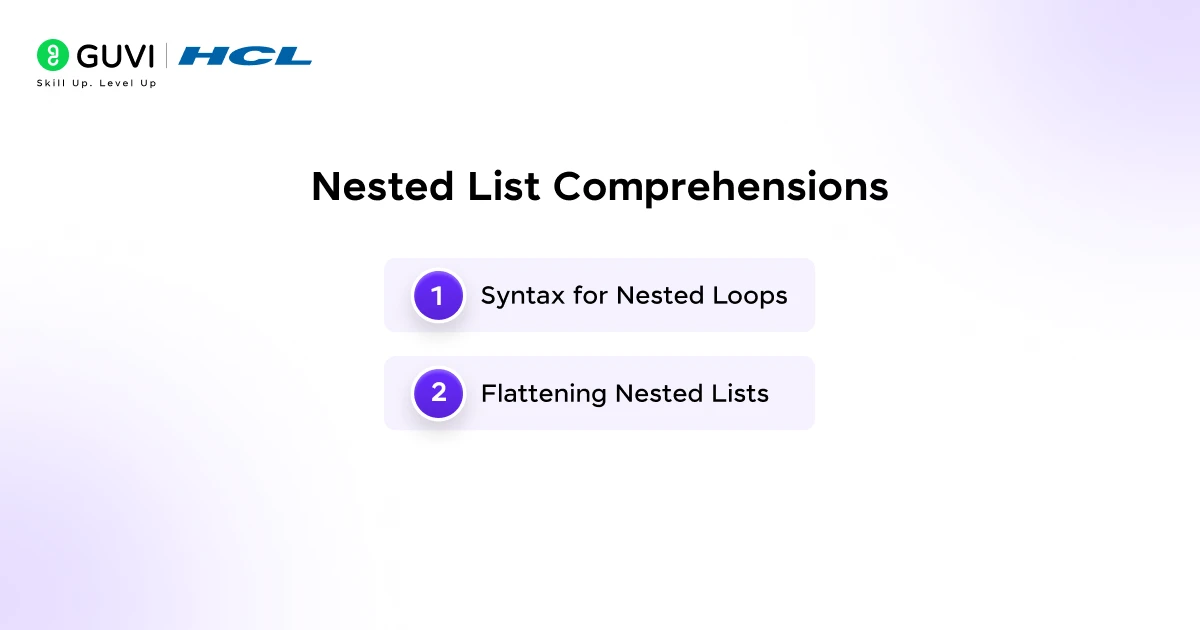
- Syntax for Nested Loops
Nested list comprehensions allow multiple for clauses, which correspond to nested loops in traditional syntax. The order of loops follows the same left-to-right evaluation as standard nested for loops.
[(x, y) for x in range(3) for y in range(2)]
This expression is equivalent to two nested loops where y iterates fully for each value of x.
- Flattening Nested Lists
A common use case for nested list comprehensions is flattening a list of lists into a single list. This approach avoids explicit loop nesting and intermediate list creation.
matrix = [[1, 2], [3, 4], [5, 6]]
flat = [item for sublist in matrix for item in sublist]
The comprehension iterates over each sublist first, then over each element within that sublist.
- Readability Concerns With Nesting
Nested list comprehensions can become difficult to read and maintain when too many loops or conditions are combined. Deep nesting reduces clarity and increases the likelihood of logical errors. In such cases, traditional loops or helper functions provide better readability and debuggability.

Using Conditions in List Comprehension
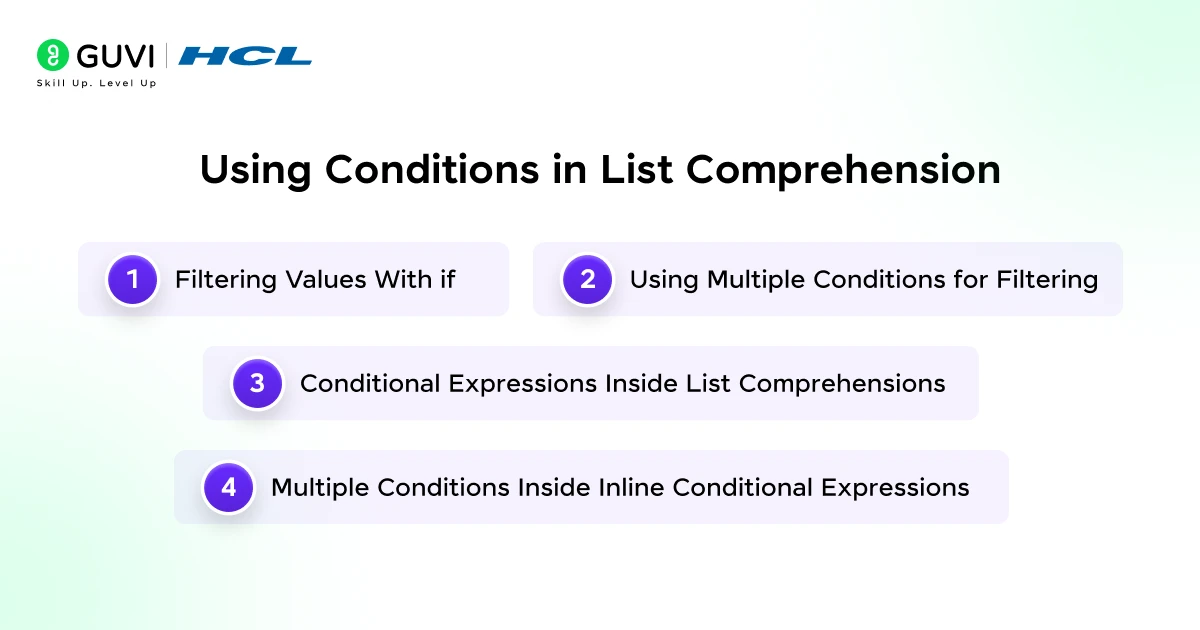
List comprehensions support conditional logic directly within their syntax, which allows filtering and transformation to occur in a single pass over the data. Python provides multiple conditional patterns in list comprehensions, and understanding each pattern is critical for writing correct, readable, and efficient code.
- Filtering Values With if
A filtering condition is placed after the iterable and determines whether an element is included in the resulting list. Elements that do not satisfy the condition are skipped entirely and never evaluated further.
For example:
[x for x in range(10) if x % 2 == 0]
In this example, the iterable generates values from 0 to 9. The condition x % 2 == 0 filters the sequence so that only even numbers are added to the result list. Odd values are excluded completely.
Common use cases include removing invalid records, selecting values within defined limits, filtering data based on rules, and preprocessing datasets before further analysis.
- Using Multiple Conditions for Filtering
Multiple filtering conditions can be combined using logical operators such as and, or, and not. All conditions must evaluate to True for an element to be included.
[x for x in range(20) if x % 2 == 0 and x > 10]
This example includes only values that are both even and greater than 10. Combining conditions allows precise control over which elements appear in the output list.
- Conditional Expressions Inside List Comprehensions
Inline conditional expressions are placed inside the expression part of the comprehension. This pattern applies logic to every element and determines what value is added to the list, rather than whether the element is included.
[“even” if x % 2 == 0 else “odd” for x in range(5)]
Each value from the iterable is processed, and the condition determines whether “even” or “odd” is added to the output list. No elements are removed, and the length of the output list matches the length of the iterable.
This approach is commonly used for classification, labeling, value substitution, and data normalization tasks.
- Multiple Conditions Inside Inline Conditional Expressions
Inline conditional expressions can also include multiple conditions, which are evaluated in sequence.
[“high” if x > 10 else “low” if x > 5 else “very low” for x in range(15)]
This structure assigns different labels based on value ranges and preserves positional consistency across the output list.
- Difference Between Filtering and Inline Conditions
Filtering with if controls which elements are included in the output list and can reduce the number of elements produced. Inline conditional expressions control how each element is transformed and always preserve the number of elements generated by the iterable. Choosing the correct pattern depends on whether the goal is to eliminate values or to transform them while maintaining positional consistency.
Performance Characteristics of List Comprehension in Python
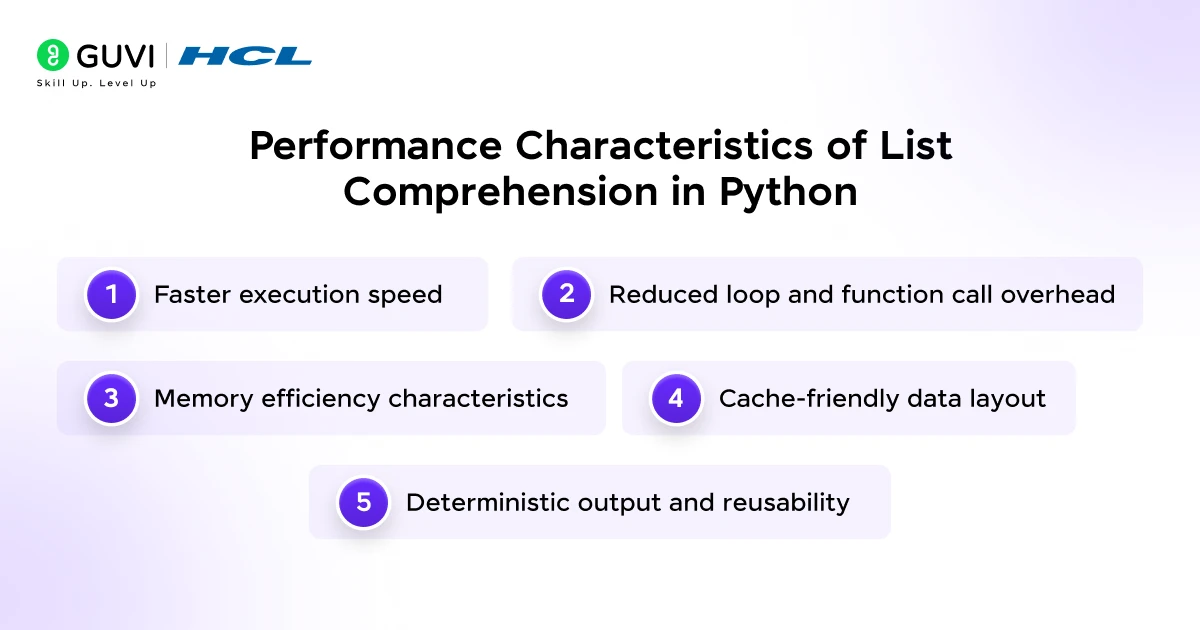
- Faster Execution Speed: List comprehensions execute faster than traditional for loops because they are optimized at the interpreter level. They avoid repeated attribute lookups and method calls such as list.append, which reduces per-iteration overhead and improves overall execution time for simple transformations.
- Reduced Loop and Function Call Overhead: The looping logic in a list comprehension is handled internally by Python’s execution engine. This minimizes bytecode instructions and eliminates explicit loop control statements, which results in more efficient iteration compared to manually written loops.
- Memory Efficiency Characteristics: List comprehensions allocate memory for the entire result list upfront and populate it during evaluation. This makes element access fast and predictable but increases memory usage. They are best suited for small to medium datasets where immediate access to all elements is required, while generator expressions are more appropriate for large or streaming data.
- Cache-Friendly Data Layout: List comprehensions create a contiguous list in memory, which improves cache locality. This layout allows faster iteration and access compared to dynamically growing lists built with repeated appends.
- Deterministic Output and Reusability: The fully materialized list produced by a list comprehension can be reused, indexed, sliced, and iterated multiple times without recomputation. This makes them suitable for workflows that require repeated access to the same computed results.
Once you understand how list comprehensions simplify loops and data transformations, the next step is mastering Python end to end with real-world practice. Enroll in HCL GUVI’s Python course to earn an industry recognised certification at an affordable fee, learn through 100 percent online and self-paced modules, and get full lifetime access to all content.
List Comprehension vs Traditional For Loops
List comprehension and traditional for loops achieve similar results, but they differ significantly in clarity, execution model, and intent. List comprehension expresses data transformation declaratively by stating what the resulting list should contain, rather than how to build it step by step. This reduces boilerplate code such as list initialization and repeated append calls, which improves readability and lowers the risk of logical errors.
Internally, list comprehensions are optimized at the interpreter level, which often makes them slightly faster than equivalent loops for simple transformations. Traditional for loops remain preferable when the logic involves multiple statements, complex branching, side effects, or early termination, whereas list comprehension is best suited for straightforward, single-purpose list construction.
Here is a concise table that compares list comprehension with traditional for loops across key aspects:
| Factor | List Comprehension | Traditional for Loop |
| Code length | Concise, single expression | Verbose, multi-line |
| Readability | High for simple transformations | Clear for complex logic |
| Intent | Declarative, describes result | Imperative, describes steps |
| Performance | Slightly faster for simple cases | Slightly slower due to overhead |
| Memory behavior | Creates list immediately | Creates list incrementally |
| Use of append | Not required | Required for list building |
| Complexity handling | Limited to simple logic | Supports complex workflows |
| Side effects | Discouraged | Common and explicit |
Want to deepen your Python skills beyond list comprehensions? Explore HCL GUVI’s Python Hub to strengthen core Python concepts, improve coding efficiency, and apply clean, readable patterns across real-world programming scenarios.
List Comprehension vs Generator Expression
List comprehension and generator expressions serve similar purposes in Python but differ in evaluation strategy and memory usage. From a Python developer’s perspective, a list comprehension evaluates all elements immediately and stores the results in memory, making it suitable when the full dataset is required for repeated access or indexing.
A generator expression evaluates values lazily, producing one item at a time only when requested, which reduces memory consumption and improves efficiency for large or streaming datasets. The choice depends on whether immediate materialization or memory-efficient iteration is required.
Here is a concise table that highlights the key differences between list comprehension and generator expressions.
| Factor | List Comprehension | Generator Expression |
| Evaluation | Eager, computes all values immediately | Lazy, computes values on demand |
| Memory usage | Stores entire list in memory | Minimal memory footprint |
| Result type | List | Generator object |
| Reusability | Can be reused and indexed | Can be iterated only once |
| Access pattern | Supports indexing and slicing | Sequential access only |
| Performance | Faster for small to medium datasets | Better for large or streaming data |
| Syntax | Uses square brackets [] | Uses parentheses () |
| Use case | When full dataset is needed | When memory efficiency matters |
Real-World Examples List Comprehension in Python
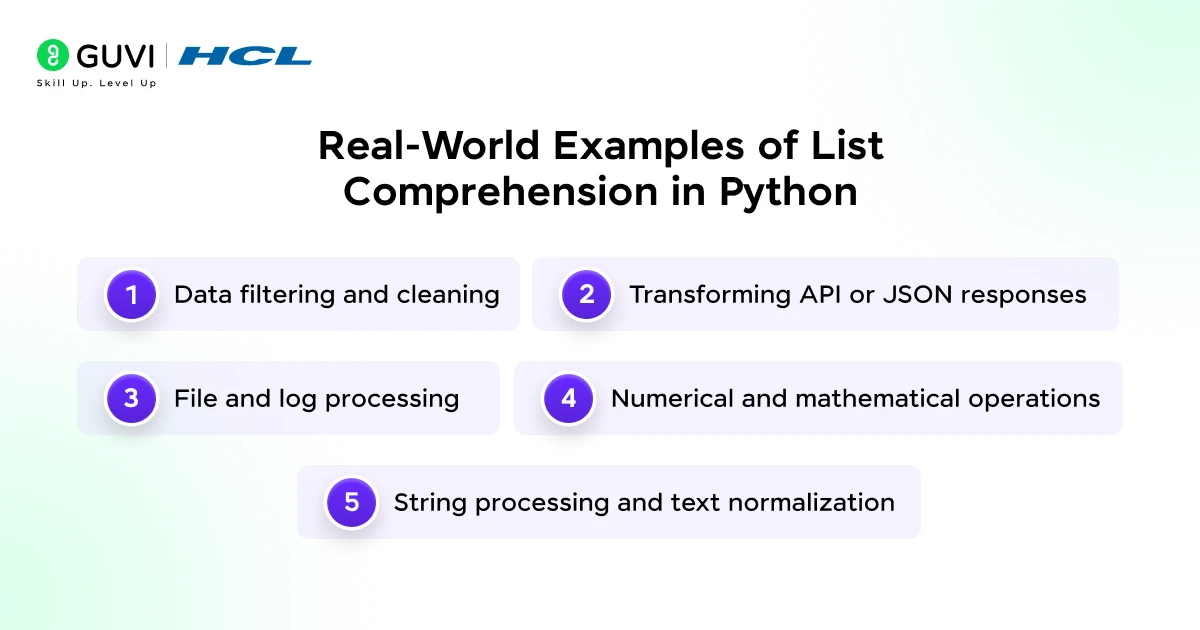
- Data Filtering and Cleaning
List comprehension is widely used to filter datasets by applying conditional logic during iteration. It helps remove invalid entries, normalize values, and prepare clean lists for further processing without modifying the original data structure.
- Transforming API or JSON Responses
List comprehension efficiently extracts and transforms specific fields from API responses or parsed JSON objects. It allows developers to reshape nested data into flat, usable lists required for business logic or reporting.
- File and Log Processing
List comprehension simplifies reading text files and logs by filtering lines based on keywords, trimming whitespace, and converting raw strings into structured values. This approach reduces boilerplate code while maintaining clarity.
- Numerical and Mathematical Operations
List comprehension is commonly applied to generate derived numerical datasets, such as squared values, normalized metrics, or calculated fields. It enables vector-style operations over sequences with minimal syntax.
- String Processing and Text Normalization
List comprehension, as part of Python basics, supports bulk string manipulation tasks such as converting cases, removing unwanted characters, and applying formatting rules across collections of text values, making it especially useful for input validation and data preprocessing pipelines.
Common Mistakes With List Comprehension
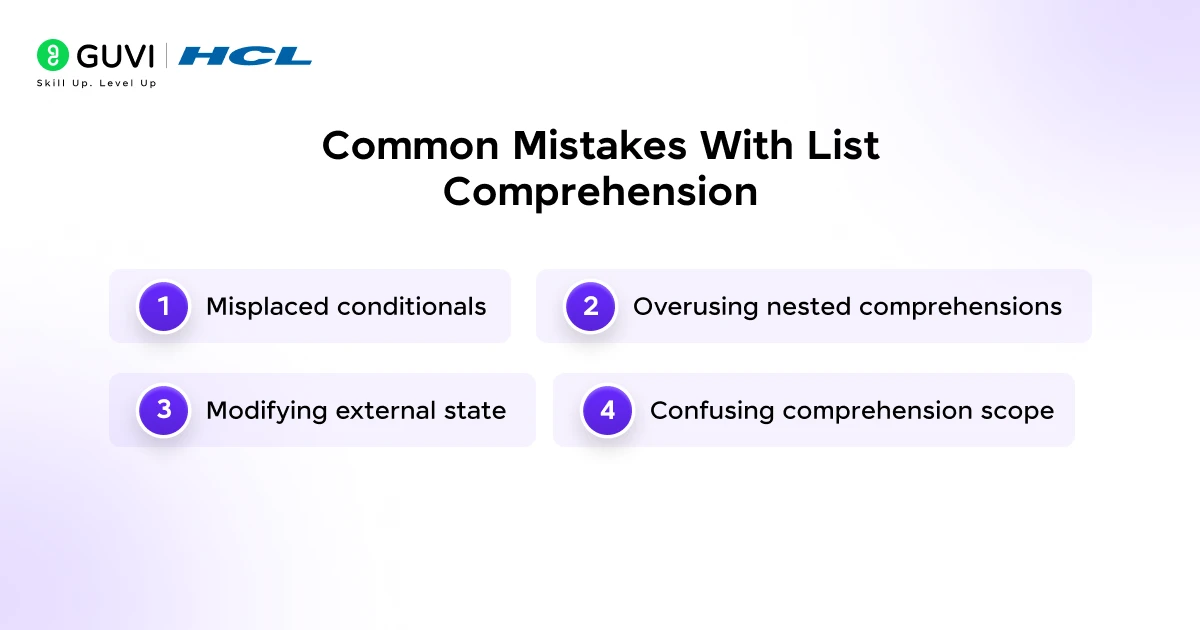
- Misplaced Conditionals: Placing if conditions in the wrong position can change the logic from filtering elements to transforming values, which leads to unexpected results.
- Overusing Nested Comprehensions: Deeply nested list comprehensions reduce readability and make debugging difficult. Complex logic is better expressed using traditional loops or helper functions.
- Modifying External State: Using list comprehensions to update external variables or cause side effects breaks their declarative intent and can introduce subtle bugs.
- Confusing Comprehension Scope: Variables inside a list comprehension have their own scope. Assuming they affect or persist outside the comprehension can lead to logical errors.
Best Practices for List Comprehension in Python
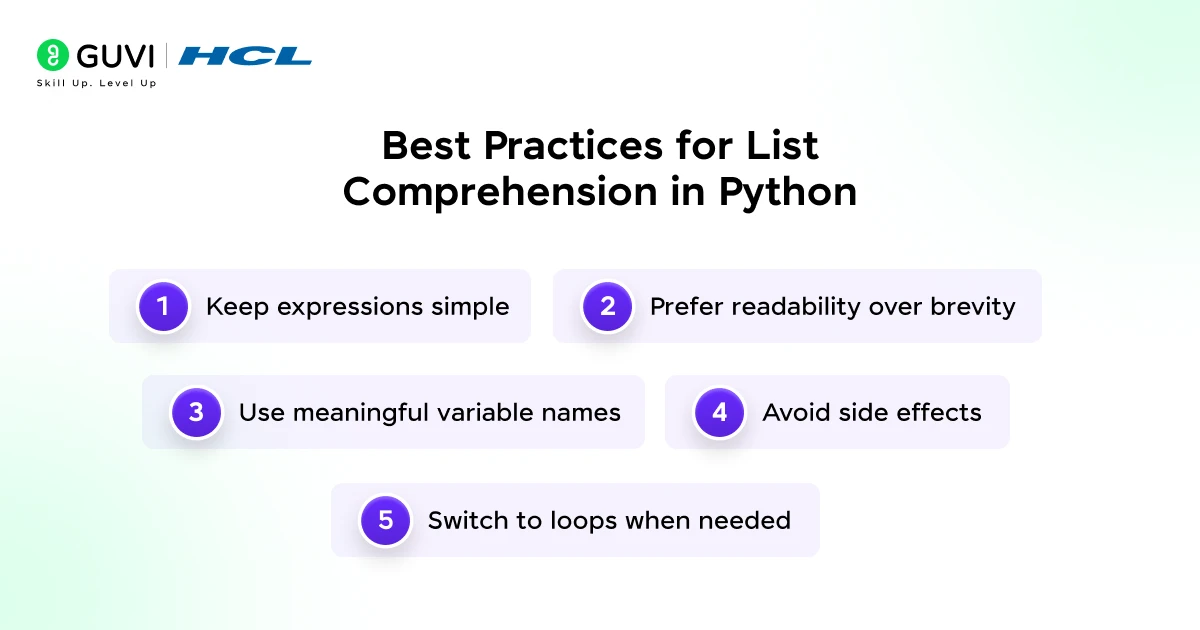
- Keep Expressions Simple: Use list comprehensions for straightforward transformations or filtering. Complex logic reduces clarity and maintainability.
- Prefer Readability Over Brevity: Shorter code is not always better. Choose list comprehensions only when the intent is immediately clear.
- Use Meaningful Variable Names: Clear iteration variable names improve understanding and reduce mental overhead.
- Avoid Side Effects: Ensure list comprehensions are used to produce values, not to perform actions or modify external state.
- Switch to Loops When Needed: Use traditional loops when logic includes multiple steps, early exits, or complex branching.
Conclusion
List comprehension is a powerful Python feature that simplifies list creation by combining iteration, filtering, and transformation into a clear and efficient syntax. When used appropriately, it improves readability, reduces boilerplate code, and delivers strong performance. Understanding its structure, limitations, and best practices helps developers write cleaner, more maintainable Python code while choosing the right construct for each real-world scenario.
FAQs
Can list comprehensions replace map and filter functions?
Yes, list comprehensions can replace most uses of map() and filter() by combining transformation and filtering logic into a single, more readable expression.
Are list comprehensions suitable for large datasets?
They work well for small to medium datasets. For very large or streaming data, generator expressions are more memory-efficient.
Can list comprehensions contain function calls?
Yes, the expression part can include function calls, as long as the logic remains simple and does not introduce side effects.
Success Stories

About the Author
Vaishali
I'm a seasoned writer with four years of experience across technical, non-technical, and just about every genre or niche you can imagine. Adaptable and curious, I enjoy exploring new topics and making information engaging and easy to understand. Fueled by a steady stream of tea, I approach each project with creativity, reliability, and genuine enthusiasm for storytelling.
View all posts by Vaishali
Connect with me @













Did you enjoy this article?