


Full Stack Development Articles
My Full Stack Developer Interview Experience: What Nobody Tells You
What Is CRUD? A Complete Guide to Create, Read, Update, Delete in Modern Applications
How to Build Your First ML Powered Web App (Even If You're Not a Data Scientist)
How to Stay Valuable as a Web Developer in The Era of AI [2026]

Get In Touch For Details! Request More Information
Is Full-Stack Dead? Navigating the “Saturated” Developer Market
Jan 23, 2026 3 Min Read 1162 Views
(Last Updated)
Is full-stack dead? A question that keeps coming up as developers face tougher competition, hiring slowdowns, and changing expectations from companies. With so many opinions online claiming the role is outdated, it is natural to wonder about the future of full stack development and whether it still offers long-term career value.
This blog breaks down why the market feels saturated, what companies actually expect today, and how the future of full stack development is evolving. It is useful for students, early-career developers, working professionals, and anyone trying to understand whether full stack skills are still worth investing in.
Quick Answer
The short answer is no, full stack is not dead. However, the future of full stack development favors developers with strong fundamentals, real-world experience, and depth in at least one area. Generic profiles with shallow knowledge are struggling, which is why the market feels saturated.
Table of contents
- Why Full-Stack Feels Saturated Today
- What Companies Expect In The Future Of Full Stack Development
- The Shift From Generalist To T-Shaped Full-Stack Developers
- Are Specialized Roles Replacing Full-Stack Developers
- Is Full-Stack Dead Or Just Evolving
- 💡 Did You Know?
- Conclusion
- FAQs
- Is full stack dead in 2026?
- What skills matter most for the future of full stack development?
- How can developers stand out in a saturated full stack market?
Why Full-Stack Feels Saturated Today
The idea that full stack is dead mainly comes from how crowded and competitive the entry-level developer market has become in recent years. With learning resources available everywhere, many developers acquire similar front-end and back-end skills in a short time. This creates a situation where resumes, portfolios, and project ideas look almost identical to recruiters. The saturation is not due to a lack of demand for developers, but because too many profiles offer the same surface-level capabilities.
- Rapid Growth Of Entry-Level Developers: A high volume of developers learn the same popular stacks every year, increasing competition.
- Repetitive Portfolio Projects: Similar CRUD-based applications fail to differentiate candidates.
- Low Barrier To Claiming Full-Stack Skills: Basic knowledge is often misrepresented as full stack expertise.
- Lack Of Production Exposure: Limited real-world experience reduces hiring confidence.
- Depth-Focused Hiring: Interviews prioritize system thinking over tool familiarity.
Tip: Focus on fewer, more complex projects that reflect real-world problems.
What Companies Expect In The Future Of Full Stack Development
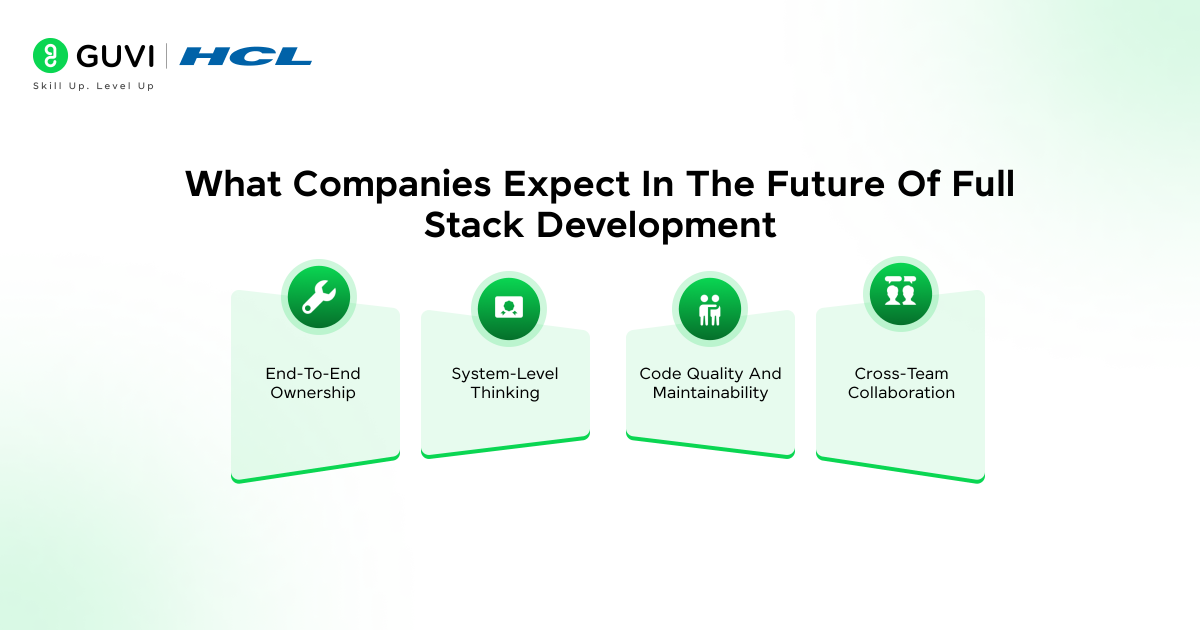
The future of full stack development is driven by how well developers understand complete systems rather than isolated tools. Companies expect full-stack developers to think beyond writing code and consider performance, scalability, and long-term maintenance. Hiring decisions now reflect a preference for developers who can take ownership of features from concept to production. This shift explains why generic profiles struggle while experienced developers continue to find opportunities.
- End-To-End Ownership: Responsibility for designing, building, deploying, and maintaining features.
- System-Level Thinking: Awareness of how decisions impact the entire application.
- Code Quality And Maintainability: Emphasis on readable, scalable, and reliable code.
- Cross-Team Collaboration: Ability to work with designers, product managers, and specialists.
Tip: Practice explaining architectural decisions clearly during interviews.
The Shift From Generalist To T-Shaped Full-Stack Developers
When people ask if full stack is dead, they often overlook how the role has evolved. The modern full-stack developer is no longer expected to know everything at a shallow level. Instead, the future of full stack development favors T-shaped developers who balance breadth with meaningful depth. This approach allows developers to contribute across the stack while offering strong value in one focused area.
- Broad Stack Awareness: Working knowledge of front-end, back-end, databases, and deployment.
- Deep Focus Area: Strong expertise in one domain such as back-end systems or front-end performance.
- Higher Problem-Solving Ability: Depth enables better handling of complex challenges.
Tip: Choose one specialization while maintaining full stack fundamentals.

Are Specialized Roles Replacing Full-Stack Developers
The rise of specialized roles has led many to believe that full stack is dead, but this is a misunderstanding of hiring trends. Different company sizes and product stages require different skill distributions. Large organizations often rely on specialists, while startups still depend heavily on adaptable full-stack developers. In many cases, both roles exist within the same organization, serving different needs.
- Large Enterprises: Favor specialists for scale, security, and performance.
- Startups And Lean Teams: Depend on full-stack developers for speed and flexibility.
- Hybrid Teams: Use full-stack developers for integration and feature ownership.
Is Full-Stack Dead Or Just Evolving
The question is full stack dead usually reflects outdated expectations rather than reality. Full stack development has shifted toward greater responsibility, stronger decision-making, and deeper technical understanding. Developers who evolve with these expectations continue to build long-term careers. Those who rely only on basic frameworks often struggle in a competitive market.
- Outdated Expectations: Framework familiarity alone is no longer sufficient.
- Modern Expectations: Ownership, impact, and system understanding matter most.
- Career Longevity: Adaptable developers remain relevant despite market changes.
Do check out the IITM Pravartak Certified MERN Full Stack Developer Course with AI Integration – it focuses on building strong MERN fundamentals with industry relevance. It combines full stack development with practical AI concepts used in modern applications. The program emphasizes hands-on projects, system thinking, and scalable development. It is suitable for learners preparing for the future of full stack development.
💡 Did You Know?
- Searches for is full stack dead increase during hiring slowdowns rather than permanent market shifts.
- The future of full stack development increasingly overlaps with system design and DevOps.
- Developers with production debugging experience are shortlisted faster.
Conclusion
Full stack development is not dead, but it has clearly evolved beyond basic framework knowledge and tutorial-based skills. The perception that full stack is dead comes mainly from increased competition and higher expectations, not from a lack of demand. Developers who understand systems, take ownership, and think beyond code continue to stay relevant in the market.
To take this knowledge to the next level, focus on building real-world projects, gaining production experience, and developing depth in one strong area while keeping full stack fundamentals intact. Actively analyze job descriptions, improve system design thinking, and refine problem-solving skills through practical challenges. This approach aligns directly with the future of full stack development and long-term career growth.
FAQs
1. Is full stack dead in 2026?
No. Full stack roles still exist, but expectations are higher than before.
2. What skills matter most for the future of full stack development?
System design, production experience, and depth in one focus area.
3. How can developers stand out in a saturated full stack market?
By building real-world projects, specializing strategically, and demonstrating end-to-end ownership.
Success Stories

About the Author
Jebasta
I translate the language of data into stories that anyone can understand. As a writer with a data science background, I simplify analytics, AI, and decision-making so beginners and enthusiasts can confidently explore the world of data.
View all posts by Jebasta
Connect with me @



















Did you enjoy this article?