


Career Articles
How I Switched from Web Developer to ML Engineer (A Web Developer's Real Story)
PHP Developer Resume: Writing Guide & Key to Landing Your Dream Job
My Frontend Developer Interview at Google: What Really Happens Behind Closed Doors
Future of Electric Vehicle Course: Fast-Track Your EV Career


Get In Touch For Details! Request More Information

High-Paying and Stable Career Options Beyond MBBS, Engineering, IT, and Law
Feb 25, 2026 7 Min Read 1858 Views
(Last Updated)
For decades, Indian parents have echoed the same advice: “Become a doctor, engineer, lawyer, or go into IT.”
These professions promised stability, respect, and a comfortable income. But the career landscape in 2026 looks vastly different from what it was even a decade ago.
High competition, long education timelines, and market saturation have made conventional careers harder to crack.
At the same time, non-traditional high paying careers and alternative careers in India are offering faster growth, high income, and long-term stability.
This shift has opened doors to non-traditional, high-paying careers, stable career options beyond engineering, and well-paying careers without an MBBS or law.
Success is now possible through skills, outcomes, and adaptability rather than degrees alone.
The traditional “Big Four” are no longer the only pathways to financial security and professional fulfilment.
High competition, lengthy education requirements, and market saturation have made these fields increasingly challenging.
Meanwhile, a new generation of careers has emerged. These careers offer comparable (and often superior) income potential, faster growth, and genuine job satisfaction.
This guide is for:
- Students exploring career options beyond conventional paths
- Graduates feeling trapped in unfulfilling traditional roles
- Career switchers seeking stable, high-paying alternatives
- Parents looking to understand modern career possibilities
Quick Answer
High-paying careers go beyond MBBS, engineering, IT, and law. Non-traditional high-paying careers like product management, UX design, digital marketing, and financial planning offer ₹8–30 lakhs+ with strong job stability.
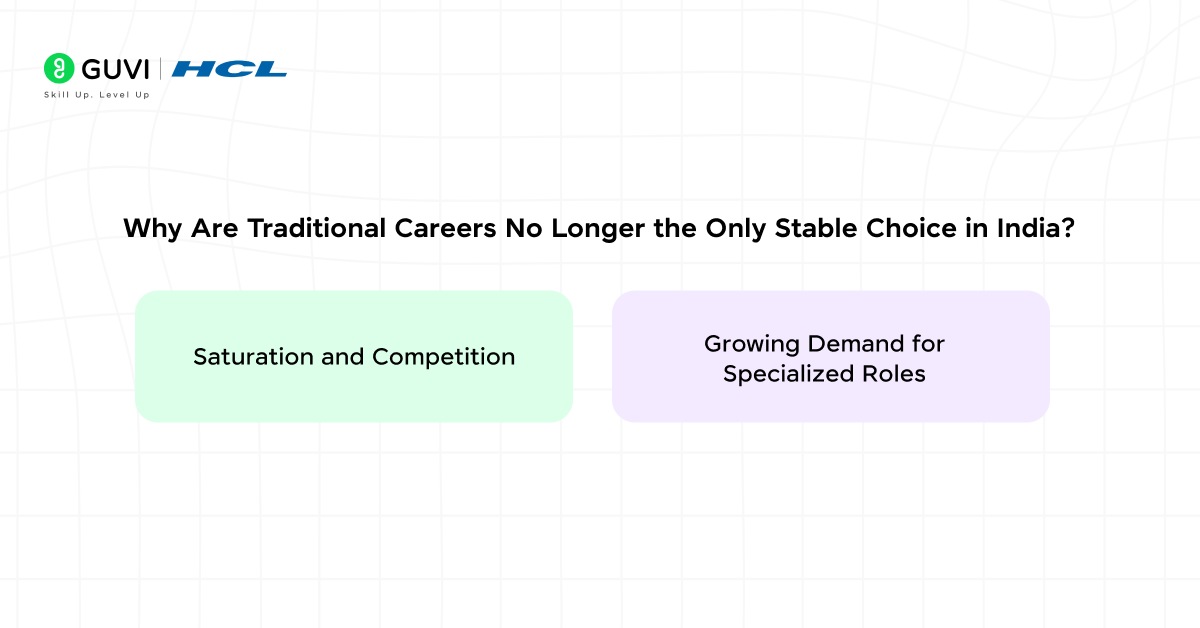
Table of contents
- Why Are Traditional Careers No Longer the Only Stable Choice in India?
- Growing Demand for Specialised Roles
- What Makes an Alternative Career High-Paying and Stable?
- Demand vs Supply Dynamics
- Industry Resilience and Future Relevance
- 12 High-Paying and Stable Career Options
- Product Management
- UX/UI Design
- Data Analytics (Non-Coding Track)
- Digital Marketing & Growth Strategy
- Management Consulting
- Supply Chain & Logistics Management
- Financial Planning & Wealth Management
- Corporate Training & Learning Design
- Cybersecurity
- Content Strategy & Content Marketing
- Entrepreneurship & Solopreneur Careers
- Traditional vs Alternative Career Options
- How to Choose the Right Alternative Career for You
- Skills vs Interests vs Market Demand
- Education vs Certification vs Experience
- Risk Tolerance and Income Expectations
- Skills You Need to Succeed in Non-Traditional Careers
- Communication and Problem-Solving
- Business Thinking and Adaptability
- Continuous Learning Mindset
- Conclusion
- Frequently Asked Questions
- What are the most stable career options beyond engineering in India?
- Can I earn a high salary without MBBS or law degrees?
- Are non-traditional careers safe for long-term job security?
- How can I switch to an alternative career without a technical degree?
Why Are Traditional Careers No Longer the Only Stable Choice in India?
Saturation and competition: India produces around 15 lakh engineering graduates every year, but recent analyses suggest only a small fraction secure good roles, with one 2024 report indicating that barely 10% are expected to get jobs in that year and only about 45% meet industry readiness standards. Medical seats remain scarce, with extremely low acceptance rates in top colleges, and law graduates in many cities face oversupply and long timelines to build a profitable practice.
Traditional careers demand 4 to 7 years of education before you earn your first rupee; engineering usually takes 4 years, MBBS 5.5 years plus internship, and integrated law 5 years, not counting entrance coaching time and opportunity cost.
A 2025 recruiter survey reported that about 73% of hiring managers now prioritise talent and skills over premier college tags, showing that portfolios, certifications, and demonstrated abilities matter more than pedigree alone.
You can consider enrolling in HCL GUVI’s Data Science Course, where you gain hands-on experience by working on real-world projects. The program covers essential tools and concepts such as Python, statistics, data analysis, machine learning, and data visualization to make you industry-ready.
This reality is pushing more students and professionals toward non-traditional, high-paying careers that value practical skills over long academic timelines.
Saturation and Competition: Over 15 lakh engineering graduates enter the job market annually in India, but only 20% to 25% are considered employable by industry standards.
Medical seats remain scarce, with acceptance rates below 2% for top colleges. Law graduates face an oversupplied market where establishing a practice takes years.
Traditional careers demand 4 to 7 years of education before you earn your first rupee. Engineering takes 4 years. MBBS requires 5.5 years plus internship. Law needs 5 years minimum.
Add preparation time for entrance exams, and you’re looking at a significant opportunity cost.
Modern employers increasingly care about what you can do, not what degree you hold. Skill-based hiring has transformed recruitment. Companies now hire based on portfolios, certifications, and demonstrated abilities rather than pedigree alone.

Growing Demand for Specialised Roles
The Indian economy is evolving. E-commerce, fintech, SaaS companies, and digital-first businesses are creating thousands of roles that didn’t exist a decade ago.
These positions offer stable career options beyond engineering and career stability without technical degrees. They reward specialised expertise over generalist education.
What Makes an Alternative Career High-Paying and Stable?
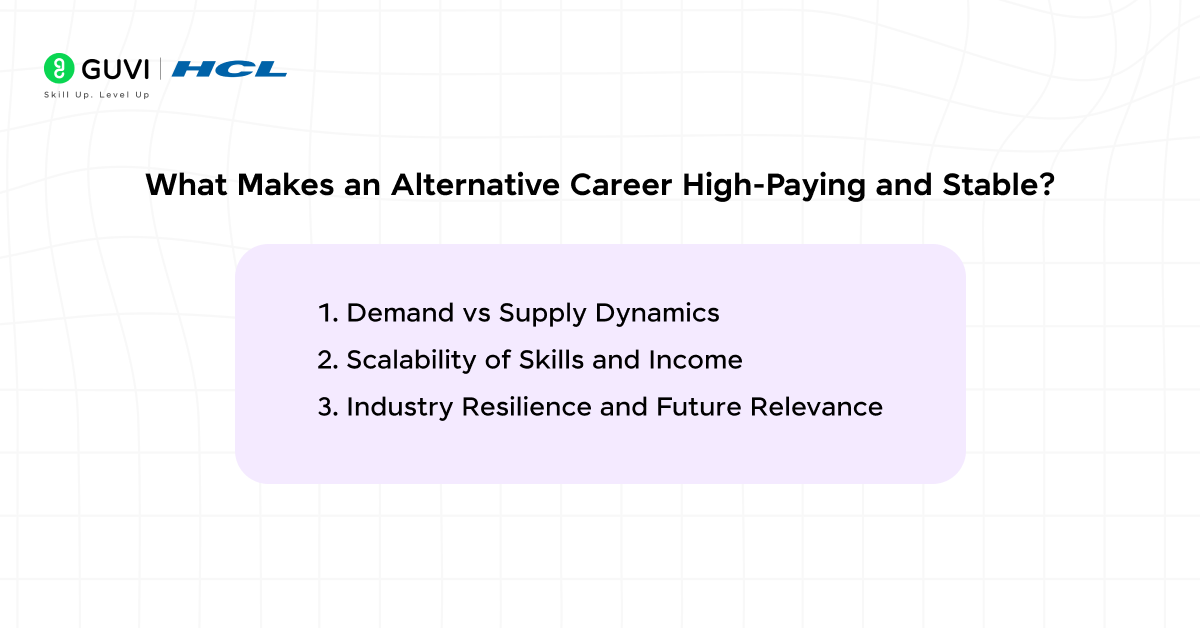
1. Demand vs Supply Dynamics
Careers become lucrative when demand exceeds supply, which is exactly why many non-traditional high-paying careers outperform conventional paths today.
The best alternative careers allow you to scale your income as you gain expertise. Unlike fixed-salary government jobs, these roles offer performance-based growth, equity participation, and the ability to work with multiple clients or employers simultaneously.
3. Industry Resilience and Future Relevance
Stable careers aren’t immune to change. They’re adaptable to it. The professions listed here address fundamental business needs that persist across economic cycles: understanding customers, managing operations, building brands, and making data-driven decisions.
These skills remain valuable regardless of technological disruptions.
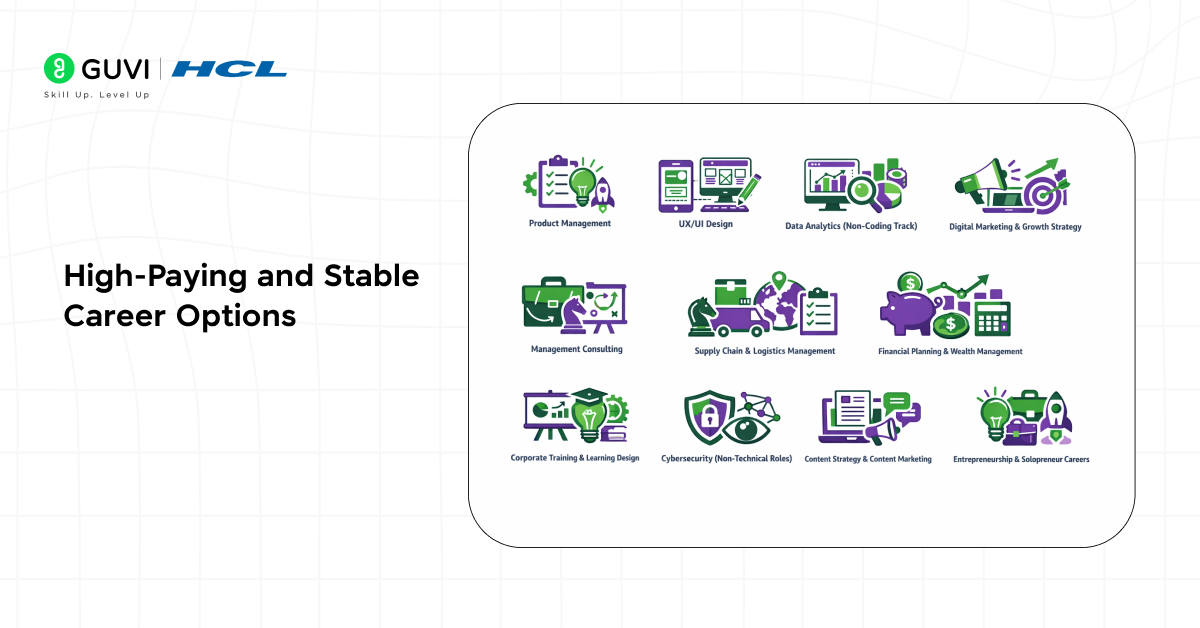
12 High-Paying and Stable Career Options
Below are some of the most in-demand non-traditional high-paying careers in India that offer high income, growth, and long-term stability.
1. Product Management
Product managers bridge business, technology, and user experience. They decide what products get built and how, making them central to company success. According to reports, product management hiring in India has grown by 42%.
No Coding Required: While technical understanding helps, many product managers come from non-engineering backgrounds, including commerce, management, and liberal arts.
Salary Range: Entry-level product managers earn ₹8 to 15 lakhs annually.
With 5+ years of experience, salaries range from ₹20.3 Lakhs to 22.5 lakhs at major companies. Senior product leaders can command ₹35 Lakhs to 38.7 Lakh.
Entry Path: Learn product fundamentals, build case studies through side projects or internships, gain cross-functional experience, and apply for Associate Product Manager roles at startups and product companies.
Growth Path: Associate Product Manager → Product Manager → Senior PM → Group Product Manager → VP of Product
2. UX/UI Design
The Creative Meets Business Career: User experience and interface design combine aesthetic sensibility with business thinking. Designers create digital experiences that millions use daily, from apps to websites to software platforms.
Why It’s Stable: Every company building digital products needs designers. The role has evolved from “making things look nice” to a strategic business function impacting revenue and customer satisfaction.
Salary Range: Freshers with strong portfolios earn ₹4 to 4.4 lakhs. Mid-level designers earn ₹8 to 10 lakhs. Senior and Lead designers earn around 20 lakhs. Design directors at top firms earn ₹50 lakhs+.
Growth Path: UI/UX Designer → Senior UI/UX Designer → Lead Designer → Design Manager → Head of Design
Entry Path: Learn design tools (Figma, Adobe XD), build a portfolio through freelance projects or redesign concepts, and apply directly to startups and product companies.
3. Data Analytics (Non-Coding Track)
Business Analytics Without Programming: While data science requires heavy coding, business analytics focuses on interpreting data, creating reports, and driving decisions. It’s perfect for those comfortable with Excel, SQL, and business intelligence tools.
Analysts help companies understand customer behavior, optimize operations, and identify growth opportunities. Every business decision today is data-informed.
Growth Path (Data Analytics):
Data Analyst → Senior Data Analyst → Lead Analyst → Analytics Manager → Head of Analytics / Chief Data Officer
Entry Path:
Learn analytics tools (Excel, SQL, Python, Power BI/Tableau), work on real-world datasets and projects, build a strong portfolio, and apply for junior data analyst roles at startups and data-driven companies.
Salary Range: Entry-level analysts earn ₹5.9 Lakh to 7 lakhs. Experienced analysts earn ₹12 to 22 lakhs. Senior business analysts and Analytics managers earn ₹29 to 35 lakhs.
4. Digital Marketing & Growth Strategy
Digital marketing encompasses SEO, content marketing, performance marketing, email campaigns, and growth hacking. It’s measurable, results-driven, and directly tied to revenue.
These roles highlight how non-traditional high paying careers reward performance, specialization, and real-world outcomes over formal degrees.
Companies allocate massive budgets to digital channels. Marketers who can demonstrate ROI (turning ₹1 spent into ₹5 earned) become invaluable assets.
Salary Range: Digital marketing executives earn ₹3 to 6 lakhs. Performance marketing managers earn ₹8 to 18 lakhs. Growth leads and Marketing heads earn an average of 21.3 Lakhs. Freelance and agency owners earn ₹30 lakhs to ₹1 crore+.
Skills to Develop: Google Ads, Facebook Ads, SEO, email marketing, analytics tools, copywriting, and conversion optimization.
Growth Path:
Digital Marketing Executive → Senior Digital Marketer → Marketing Manager → Head of Digital Marketing → Chief Marketing Officer (CMO)
Entry Path:
Learn core digital skills (SEO, SEM, social media, content marketing, analytics tools), run campaigns through internships or freelance projects, build measurable case studies, and apply for entry-level roles at startups, agencies, or product companies.
5. Management Consulting
Consultants solve complex business problems for clients. This includes market entry strategies, operational efficiency, and digital transformation.
While top consulting firms prefer MBA graduates, many mid-size and boutique consultancies hire talented undergraduates and train them. Industry expertise matters more than degrees.
Salary Range: Analysts earn ₹8 to 15 lakhs. Consultants earn ₹15 to 25 lakhs. Senior consultants and Managers earn ₹39.5 lakhs to 41.7 lakhs.
Growth Path:
Business Analyst → Consultant → Senior Consultant → Manager / Engagement Manager → Partner / Principal
Entry Path:
Build strong problem-solving and analytical skills, learn business fundamentals (strategy, finance, operations), gain experience through internships or case competitions, and apply to analyst roles at mid-size or boutique consulting firms where industry expertise matters more than an MBA.
6. Supply Chain & Logistics Management
Every product you buy (from groceries to electronics) reaches you through supply chain professionals. E-commerce growth has made this field more critical than ever.
Salary Range: Supply chain executives earn ₹4 to 8 lakhs. Supply chain managers earn ₹10 to 20 lakhs. Senior managers and Directors earn ₹25 to 45 lakhs.
Growth Path (Supply Chain & Logistics Management):
Supply Chain Executive → Supply Chain Analyst → Supply Chain Manager → Senior Manager → Director / Head of Supply Chain
Entry Path:
Learn supply chain fundamentals (procurement, inventory, logistics, demand planning), pursue certifications like CSCP or CPIM, gain experience through operations or warehouse roles, and apply to entry-level positions in e-commerce, logistics, manufacturing, or FMCG companies.
7. Financial Planning & Wealth Management
Financial planners help individuals and families manage investments, plan for retirement, minimise taxes, and build wealth. You don’t need a CA or a law degree.
Growing Market: India’s expanding middle class and increasing financial literacy are creating massive demand for qualified advisors.
Salary Range: Entry-level planners earn ₹3 to 6 lakhs base plus commissions. Experienced advisors earn ₹10 to 25 lakhs. Independent wealth managers earn ₹30 lakhs
Growth Path (Financial Planning & Wealth Management):
Junior Financial Planner → Financial Planner → Senior Wealth Manager → Portfolio Manager → Head of Wealth Management / Chief Investment Officer (CIO)
Entry Path:
Learn financial planning basics (investments, insurance, taxation, retirement planning), clear certifications like CFP or NISM, build client experience through internships or advisory firms, and start in junior planner or relationship manager roles at banks, wealth firms, or fintech companies.
8. Corporate Training & Learning Design
Companies invest heavily in employee development. Corporate trainers design and deliver programs on leadership, technical skills, communication, and professional development.
Why It’s Stable: Continuous learning isn’t optional anymore. It’s business-critical. Organizations need skilled facilitators and instructional designers.
Salary Range: Training executives earn ₹4 to 8 lakhs. Learning managers earn ₹10 to 18 lakhs. L&D heads earn ₹20 to 35 lakhs.
Strong communicators, subject matter experts in any field, and those passionate about teaching.
Growth Path (Corporate Training & Learning Design):
Training Executive → Instructional Designer → Learning & Development (L&D) Manager → Head of L&D → Chief Learning Officer (CLO)
Entry Path: Start with corporate training programs, get certified (ATD, training certifications), or transition from domain expertise into training roles.
9. Cybersecurity
While penetration testing requires coding, cybersecurity includes governance, risk management, compliance, and audit. These roles focus on policies, frameworks, and organizational security.
With increasing data breaches and regulatory requirements (GDPR, data protection laws), companies need security professionals urgently.
Salary Range: Security analysts earn ₹6 to 12 lakhs. GRC (Governance, Risk, Compliance) managers earn ₹15 to 28 lakhs.
Entry Path:
Learn cybersecurity fundamentals, risk management, and compliance standards (ISO 27001, GDPR, SOC 2), earn certifications like CISA, CRISC, or ISO 27001 Lead Implementer, gain experience through audit, compliance.
Certifications: CISA, CISM, CRISC, ISO 27001 Lead Auditor. None require hardcore programming.
Suitable For: Those interested in risk assessment, policy frameworks, and strategic security thinking rather than technical exploitation.
10. Content Strategy & Content Marketing
Content strategists don’t just create content. They develop comprehensive plans for how brands communicate, attract audiences, and convert readers into customers.
Strategic Business Function: Modern content strategy encompasses SEO, brand voice, demand generation, customer education, and thought leadership.
Salary Range: Content writers earn ₹3 to 6 lakhs.
Content strategists earn ₹8 to 16 lakhs. Content marketing managers earn ₹15 to 28 lakhs. Content heads and Directors earn ₹30 to 50 lakhs.
Many content professionals freelance or run agencies, earning ₹50 lakhs to 8 figures by serving multiple clients.
Skills Required: Excellent writing, SEO knowledge, content management systems, analytics, and strategic thinking.
Growth Path (Content Strategy & Content Marketing):
Content Writer → Content Strategist → Senior Content Strategist → Content Marketing Manager → Head of Content / Director of Content Marketing
Entry Path:
Build strong writing and research skills, learn SEO and content analytics, create blogs or case studies showing measurable results, and start in content writer or junior content marketer roles at startups, agencies, or product companies.
11. Entrepreneurship & Solopreneur Careers
Entrepreneurship isn’t limited to tech startups requiring crores in funding. Solopreneurs and small business owners create stable income through freelancing, agencies, coaching, online courses, or niche services.
Income Stability Through Diversification: Smart entrepreneurs build multiple income streams including client services, digital products, affiliate income, consulting, and teaching.
Realistic Expectations: Most solopreneurs earn ₹10 to 30 lakhs annually after 2 to 3 years of building. Top performers in coaching, consulting, and specialized services can exceed ₹50 lakhs to crore.
Freelance marketing consultants, design agencies, accounting services, career coaches, content agencies, specialized training providers.
Pick a niche, become excellent, and build reputation through consistent delivery and marketing.
Traditional vs Alternative Career Options
The table below clearly shows why non-traditional high paying careers are becoming a preferred choice over traditional professions in India.
| Factor | Traditional Careers (MBBS/Engineering/Law) | Alternative Career Option |
| Study Duration | 4 to 7 years of formal education | 3 to 18 months of focused learning/certification |
| Entry Cost | ₹5 to 50 lakhs (education + coaching) | ₹20,000 to ₹5 lakhs (courses + certifications) |
| Time to First Income | 4 to 7 years | 6 months to 2 years |
| Salary Growth Timeline | Gradual, seniority-based | Faster, skill and performance-based |
| Competition Level | Extremely high (15+ lakh engineers/year) | Moderate to high (but growing demand) |
| Stress Levels | High (entrance exams, long hours) | Moderate (work-life balance improving) |
| Geographic Flexibility | Often location-dependent | Remote work options common |
How to Choose the Right Alternative Career for You

Skills vs Interests vs Market Demand
The ideal career sits at the intersection of three factors:
- What you’re good at (or can become good at with effort)
- What you enjoy doing (or at least don’t mind doing daily)
- What the market values (pays well for)
Don’t choose based on just one factor. A career you’re passionate about but has no market demand leads to struggle. A high-paying career you hate leads to burnout.
Education vs Certification vs Experience
Education: Traditional degrees still matter for some roles. Consulting firms prefer MBAs. Policy requires relevant backgrounds.
Certification: Many alternative careers value certifications over degrees. CFP for financial planning. Google Ads certification for digital marketing. CISA for cybersecurity.
Experience: Portfolio and demonstrated skills often trump both. UX designers get hired based on portfolios. Product managers get hired based on past outcomes. Content strategists get hired based on published work.
The Modern Approach: Combine short-form education (bootcamps, online courses) with hands-on projects to build credibility quickly.
Risk Tolerance and Income Expectations
Be honest about your situation. If you have financial responsibilities and zero savings, jumping into entrepreneurship might be risky. Starting with a stable alternative career (product management, analytics) might be smarter.
Consider:
- Financial runway: How long can you afford to learn or transition?
- Family support: Will your family support non-traditional choices?
- Geographic constraints: Can you relocate if needed?
- Income expectations: What’s your minimum acceptable salary?
Skills You Need to Succeed in Non-Traditional Careers
Regardless of which alternative career you choose, certain meta-skills determine success
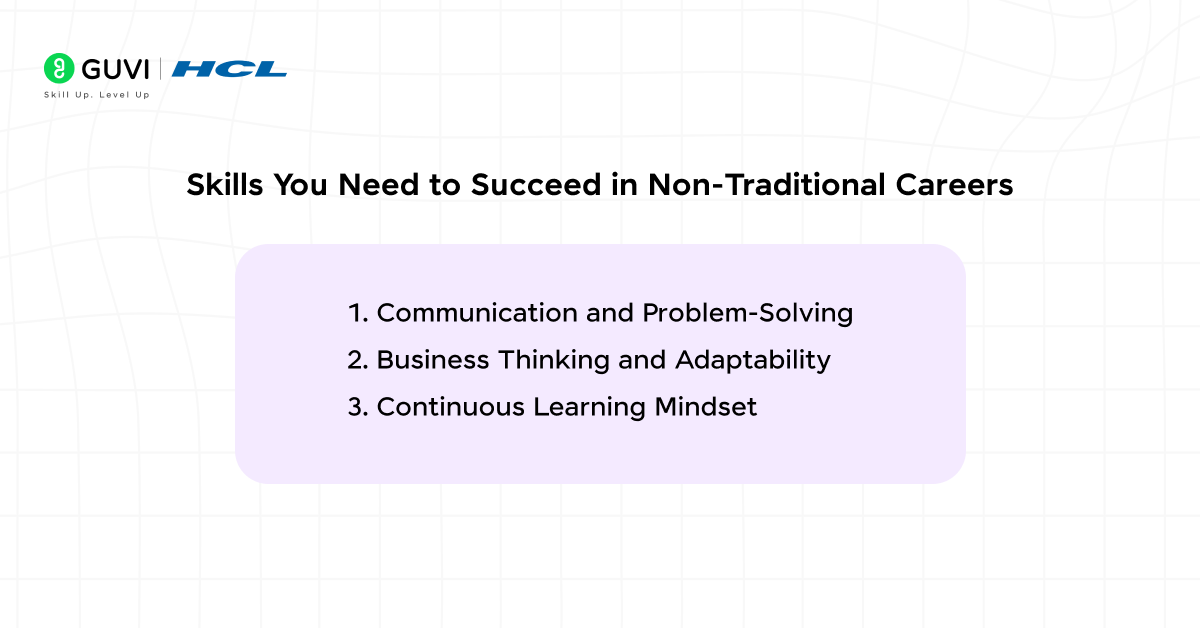
1. Communication and Problem-Solving
Every high-paying role involves solving problems for others, whether customers, businesses, or society. Your ability to understand problems, think critically, and communicate solutions clearly matters more than technical knowledge.
How to Develop: Practice writing clearly, presenting ideas, active listening, and asking good questions.
2. Business Thinking and Adaptability
Understanding how businesses work (revenue, costs, customers, competition) makes you valuable in any career. Commercial awareness separates average performers from high earners.
How to Develop: Read business news, study company strategies, understand P&L statements, and think about how decisions impact business outcomes.
3. Continuous Learning Mindset
Alternative careers evolve rapidly. Digital marketing tools change every year. Design trends shift. New frameworks emerge in product management. Your willingness to keep learning determines long-term success.
How to Develop: Set aside time weekly for learning, follow industry thought leaders, take courses regularly, and experiment with new tools and approaches.
Conclusion
The days of choosing between only four career paths are over. Non-traditional high paying careers now offer real, proven alternatives with strong income, flexibility, and long-term job security.
These alternative careers aren’t experimental or risky. They’re real professions at leading companies worldwide.
Frequently Asked Questions
1. What are the most stable career options beyond engineering in India?
Product management, supply chain management, financial planning, corporate training, and data analytics offer strong stability in India. These careers also offer clear growth paths and transferable skills that work across different sectors.
2. Can I earn a high salary without MBBS or law degrees?
Yes, absolutely. Many alternative careers match or exceed traditional professional salaries. Product managers with 5 to 8 years of experience regularly earn ₹20 to 50 lakhs annually
3. Are non-traditional careers safe for long-term job security?
Yes, when you focus on developing valuable, adaptable skills. Job security today comes from having in-demand abilities, not just traditional degrees. A skilled product manager or digital marketer often has more job security than an average engineer struggling to find relevant work.
5. How can I switch to an alternative career without a technical degree?
Start by identifying skills from your current background that transfer to your target career. Then pursue focused learning through online courses, bootcamps, or certifications relevant to that field. Build a portfolio by taking on small freelance projects, doing volunteer work, or creating practice projects.
Success Stories

About the Author
Salini Balasubramaniam
A curious, information-savvy writer loves to turn deep insights into authentic and engaging content that connects. With experience in writing for brands and driving audience engagement, I believe that words can make a powerful difference.
View all posts by Salini Balasubramaniam
Connect with me @













Did you enjoy this article?