


Artificial Intelligence and Machine Learning Articles
How to Audit LLM Models for Backdoors: Tools & Frameworks for Developers
AI Governance & Compliance in Web Apps: Why You Can’t Ignore Data Risk When Using LLMs
How to Evaluate LLMs for Production: Beyond Benchmarks (A Developer’s Guide)


Get In Touch For Details! Request More Information
Difference Between Strong AI and Weak AI: A Comparison Guide
Sep 15, 2025 5 Min Read 2862 Views
(Last Updated)
What exactly separates the AI we use today from the futuristic AI we often see in movies? The answer lies in the difference between weak AI and strong AI.
While weak AI is all around you – from voice assistants to recommendation systems – strong AI is the ambitious idea of machines that can truly think and reason like humans. Understanding this distinction is the first step to grasping where AI stands today and where it could take us in the future.
In this article, we’ll explore what each term means, how they differ, and why the distinction matters. Sp, without further ado, let us get started!
Table of contents
- Understanding Weak AI (Narrow AI)
- Understanding Strong AI (General AI)
- Key Differences Between Weak AI and Strong AI
- Conclusion
- FAQs
Understanding Weak AI (Narrow AI)
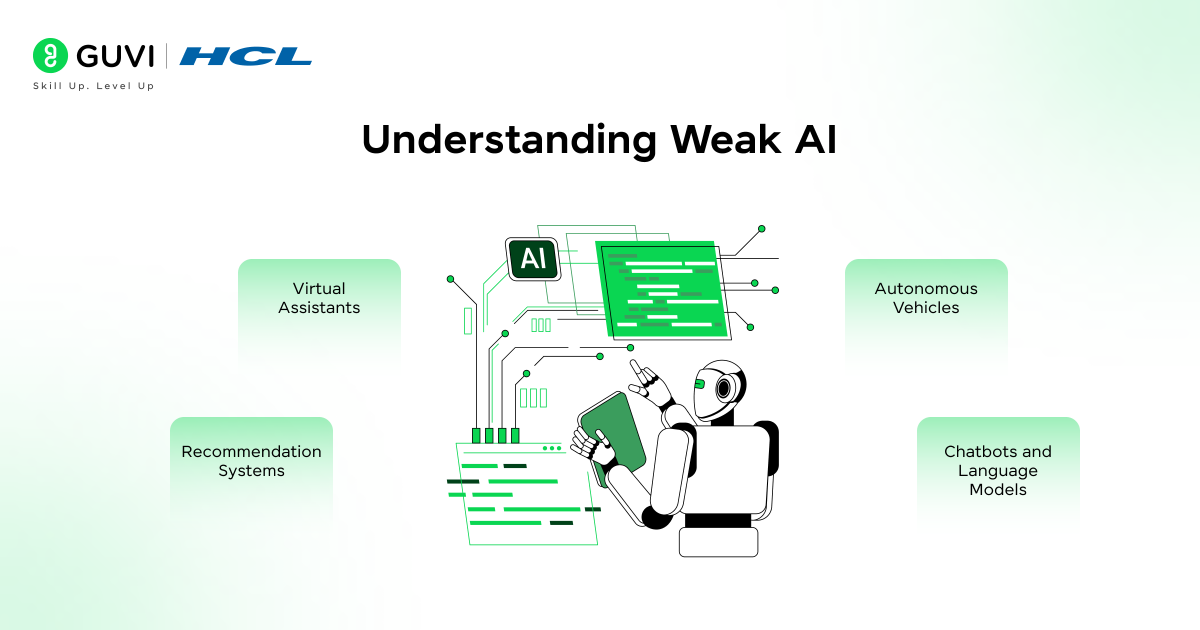
Weak AI, often called narrow AI, refers to artificial intelligence that is designed to perform a limited, specific task or a set of related tasks. These systems do not possess genuine understanding or consciousness; they operate within pre-defined parameters and simulate intelligent behavior without true cognition.
This is actually the AI we interact with every day, and despite the name “weak,” these systems can be incredibly powerful and useful in their domain.
Some key characteristics of weak AI include:
- Single-Task Focus: The system is highly specialized. It can perform one type of task extremely well, but it cannot generalize its knowledge to different tasks.
- No True Understanding or Consciousness: These systems simulate thought but do not truly understand the meaning behind their actions or outputs. They follow algorithms and training data.
- Dependency on Human Input: Weak AI typically requires human-defined parameters and training. Its intelligence is confined to what it has been taught or programmed to do. It relies on humans to provide data and goals, and it can’t learn entirely new tasks on its own beyond its narrow scope.
- Prevalence Today: Virtually all AI in use today falls under weak AI. This includes everything from your smartphone’s virtual assistant to advanced machine learning models.
Examples of Weak AI Today
You don’t have to look far to find examples of weak AI – they are everywhere in modern technology. Here are a few common examples of weak (narrow) AI systems:
- Virtual Assistants: Voice-activated assistants like Siri, Alexa, or Google Assistant are classic weak AI examples.
- Recommendation Systems: When Netflix suggests a movie or Amazon recommends a product you might like, that’s a weak AI at work. These systems use algorithms to analyze your past behavior and predict preferences.
- Autonomous Vehicles: Self-driving car AI is another form of narrow AI. It processes sensor data and makes driving decisions. However, it is limited to driving tasks – it can’t suddenly use its driving intelligence to, say, translate a document or cook a meal.
- Chatbots and Language Models: Even advanced language models like ChatGPT are considered weak AI. They can generate impressively human-like text and answer questions across many topics, but they are still specialized in one domain: language. They don’t possess general intelligence or self-awareness.
It’s worth noting that calling these systems “weak” isn’t a knock on their capabilities. The term simply means their intelligence is narrowly focused. A weak AI can outperform humans in its specialty, but it cannot go beyond that domain.
Understanding Strong AI (General AI)

Now let’s talk about strong AI. Strong AI – also known as Artificial General Intelligence (AGI) – refers to a hypothetical AI system that possesses intelligence comparable to a human being across the board.
A strong AI would not be limited to one task; it would be able to understand, learn, and apply knowledge to any problem in any domain, much like a person can. In addition, strong AI implies a level of sentience or consciousness; the machine wouldn’t just simulate understanding, it would genuinely understand and be self-aware.
Key features that would define a strong AI include:
- General Problem-Solving Ability: A strong AI could tackle any intellectual task. It would have the ability to generalize knowledge and skills from one context to another.
- Learning and Adaptation: Strong AI would learn from experience just as humans do. It could learn new skills or information without explicit programming for each new task. It would also adapt to changes in its environment or goals, showing reasoning and common sense across different situations.
- Autonomy and Self-Improvement: Unlike weak AI, which heavily relies on human-provided training data and objectives, a strong AI might set its own goals or at least continue learning and improving autonomously. It would not require constant human intervention once it’s up and running.
- Consciousness and Understanding: This is a debated aspect, but strong AI in the purest sense implies that the AI has a mind of its own, it experiences awareness, understands context, and has intentionality. In other words, it wouldn’t just output responses based on patterns; it would actually comprehend meanings and possibly even have emotions or creativity akin to a human.
It’s important to clarify that strong AI does not exist as of today – at least not yet. All the impressive AI systems we see till now are still narrow AI. Strong AI remains theoretical.

Key Differences Between Weak AI and Strong AI

Now that we’ve defined weak vs strong AI, let’s summarize the major differences between them. This comparison will highlight why strong AI is such a big leap from what we have today:
| Aspect | Weak AI (Narrow AI) | Strong AI (General AI) |
| Scope of Intelligence | Weak AI is confined to a specific task or a narrow domain. For instance, a recommendation engine can suggest movies but cannot switch to diagnosing diseases. | Strong AI would be able to handle any intellectual task across domains, much like humans. It wouldn’t just perform well in one niche; it could transfer learning from one area to another.. |
| Existence Today | All the AI we interact with today falls under weak AI. From Siri and Alexa to fraud detection systems and self-driving car algorithms, every working AI system in 2025 is an example of weak AI. | Strong AI is still hypothetical. It hasn’t been achieved yet. It exists only as a concept in research labs and as characters in science fiction. No machine currently demonstrates the full generality and awareness of human intelligence. |
| Learning and Adaptability | Weak AI typically requires large amounts of training data and can only operate within the boundaries of that training. It struggles with unfamiliar problems because it cannot generalize knowledge across tasks. | Strong AI would be able to learn new skills independently, adapt to unexpected challenges, and apply reasoning in unfamiliar contexts. Much like humans, it could approach problems creatively and improve continuously without needing task-specific programming. |
| Consciousness and Understanding | Weak AI does not truly “understand” what it processes. It relies on algorithms, pattern recognition, and statistical models to generate outputs. | Strong AI would possess something closer to true understanding or consciousness. It wouldn’t just manipulate symbols or patterns; it would actually grasp meaning, context, and possibly even emotions. This is why philosophers often associate strong AI with the idea of machines having a “mind.” |
| Autonomy | Weak AI often outperforms humans in its narrow domain (a chess AI can beat world champions), but the trade-off is rigidity. The moment you take it outside its comfort zone, it fails. | Strong AI would have a degree of autonomy, potentially setting its own goals or at least reasoning about the best way to achieve a task. |
| Performance vs. Flexibility | Weak AI often outperforms humans in its narrow domain (a chess AI can beat world champions), but the trade-off is rigidity. The moment you take it outside its comfort zone, it fails completely. | Strong AI would prioritize flexibility over narrow perfection. Even if it doesn’t always outperform humans in every niche, its ability to shift across domains and contexts would make it far more versatile. |
| Terminology | Weak AI is also called narrow AI or Artificial Narrow Intelligence (ANI). Despite the term “weak,” it is the foundation of almost all AI applications today. | Strong AI is often called general AI or Artificial General Intelligence (AGI). It’s the next big step researchers are aiming for, though still largely speculative. Beyond this lies Artificial Superintelligence (ASI), which would surpass human cognition entirely. |
In summary, weak AI is like a set of highly skilled specialists, each expert at one thing, whereas strong AI would be like a Renaissance person (or a whole team of experts in one mind) that can do all the things and truly understand them.
Did you know that the terms “strong AI” and “weak AI” originate from a thought experiment in the 1980s? The distinction was popularized by philosopher John Searle in 1980 as part of his Chinese Room argument. Searle defined strong AI as the claim that an appropriately programmed computer literally has a mind and understands, while weak AI is merely the claim that computers can simulate thought without real understanding. This philosophical perspective highlighted the question of whether a machine that behaves intelligently truly has a mind, or if it’s just manipulating symbols. So when we use the terms today, we are not only talking about technical capabilities but also touching on this deeper question of genuine understanding vs. simulation!
If you’re serious about mastering artificial intelligence and want to apply it in real-world scenarios, don’t miss the chance to enroll in HCL GUVI’s Intel & IITM Pravartak Certified Artificial Intelligence & Machine Learning course. Endorsed with Intel certification, this course adds a globally recognized credential to your resume, a powerful edge that sets you apart in the competitive AI job market.
Conclusion
In conclusion, the difference between strong AI and weak AI boils down to the breadth of capability and true understanding. Weak AI (narrow AI) is all around us – it powers our apps, our gadgets, and many systems we rely on. It is “weak” only in a limited sense, because it can’t go beyond its specialized programming.
Strong AI (general AI), on the other hand, remains the ultimate vision: a machine that could think and learn as freely as a human being, applying intelligence to any problem and perhaps even experiencing consciousness.
As technology advances, the journey from narrow intelligence to general intelligence will shape not only the future of AI but also the future of humanity.
FAQs
1. What is the main difference between strong AI and weak AI?
The main difference is that weak AI (narrow AI) is designed to perform specific tasks very well but cannot go beyond them, while strong AI (general AI) refers to a hypothetical system that can understand, learn, and apply intelligence across any domain, similar to human beings.
2. Does strong AI exist today?
No, strong AI does not exist yet. All the AI systems we currently use—such as voice assistants, chatbots, and recommendation engines—are examples of weak AI. Strong AI is still a concept under research and remains mostly theoretical.
3. Why is weak AI called “weak” if it’s so powerful?
The term “weak” doesn’t mean ineffective. It simply means that the AI’s abilities are narrow and limited to specific tasks. For example, a chess-playing AI can beat world champions but cannot perform unrelated tasks like driving or writing essays.
4. What are some real-world examples of weak AI?
Everyday examples of weak AI include Siri, Alexa, Google Assistant, Netflix recommendations, fraud detection systems, and self-driving car software. These systems are highly effective in their domains but lack general intelligence.
5. What are the challenges in creating strong AI?
The challenges include replicating human-like cognition, enabling machines to generalize knowledge across domains, achieving true understanding or consciousness, and overcoming massive computational and ethical hurdles. These are the reasons strong AI remains out of reach today.
Success Stories

About the Author
Lukesh S
A professional content writer who has experience in freelancing and now working as a Technical Content Writer at GUVI. Google Certified Digital Marketer. Have a sound knowledge of SQL, Data Structures and Cloud Computing.
View all posts by Lukesh S
Connect with me @








Did you enjoy this article?