


Interview Articles
How Long Does Technical Interview Preparation Take? An Expert's Reality Check
Technical QA Interview Questions: What Top Companies Really Ask in 2026
My DevOps Interview Experience at MAANG: From Rejection to Success [2026]
Data Engineer Interview Experience: What MAANG Companies Really Want


Get In Touch For Details! Request More Information
Difference Between Passing an Interview and Getting Selected
Dec 26, 2025 6 Min Read 608 Views
(Last Updated)
Have you ever walked out of an interview feeling like you did almost everything right, only to find out later that you didn’t get the job? It’s a frustrating moment, especially for fresh graduates entering tech hiring for the first time. You solve the problems, communicate clearly, stay confident, and still wonder: What exactly went wrong?
Here’s the thing: there is a lot of difference between passing an interview and getting selected. One shows that you’re capable. The other shows that you’re the right fit. When you understand the distinction, the entire interview experience becomes clearer and far less mysterious.
This article breaks down the difference between passing an interview and getting selected in a straightforward, practical way so you can move from simply clearing rounds to confidently landing the role. So, without further ado, let us get started!
Quick Answer:
Passing an interview means you met the basic technical expectations, while getting selected means the company sees you as the best overall fit among everyone who passed, based on your communication, mindset, potential, and alignment with the team’s needs.
Table of contents
- What Passing an Interview Actually Means
- You met the technical expectations
- You stayed composed under pressure
- You demonstrated a clear thought process
- There were no red flags
- What this really means
- What Getting Selected Actually Means
- You match what the team actually needs
- Your communication made collaboration feel natural
- You showed potential beyond today’s skills
- You demonstrated the right attitude
- You stood out in a competitive pool
- What this really means
- Difference Between Passing an Interview and Getting Selected
- Why Fresh Graduates Often Pass but Don’t Get the Job
- You demonstrated skill, but not distinction
- You didn’t show enough enthusiasm for the role
- Your project explanations were surface-level
- You hesitated during behavioral questions
- You didn’t stand out in comparison discussions
- How You Can Move From Passing to Getting Selected?
- Tell a clear story about who you are
- Go beyond describing projects, analyze them
- Ask questions that reflect curiosity
- Bring strong behavioral stories
- Conclusion
- FAQs
- What’s the difference between passing an interview and getting selected?
- Why do candidates pass all rounds but still not get the job?
- How can I increase my chances of getting selected after passing?
- Does cultural fit really matter in technical hiring?
- What mistakes should I avoid during the final selection stage?
What Passing an Interview Actually Means
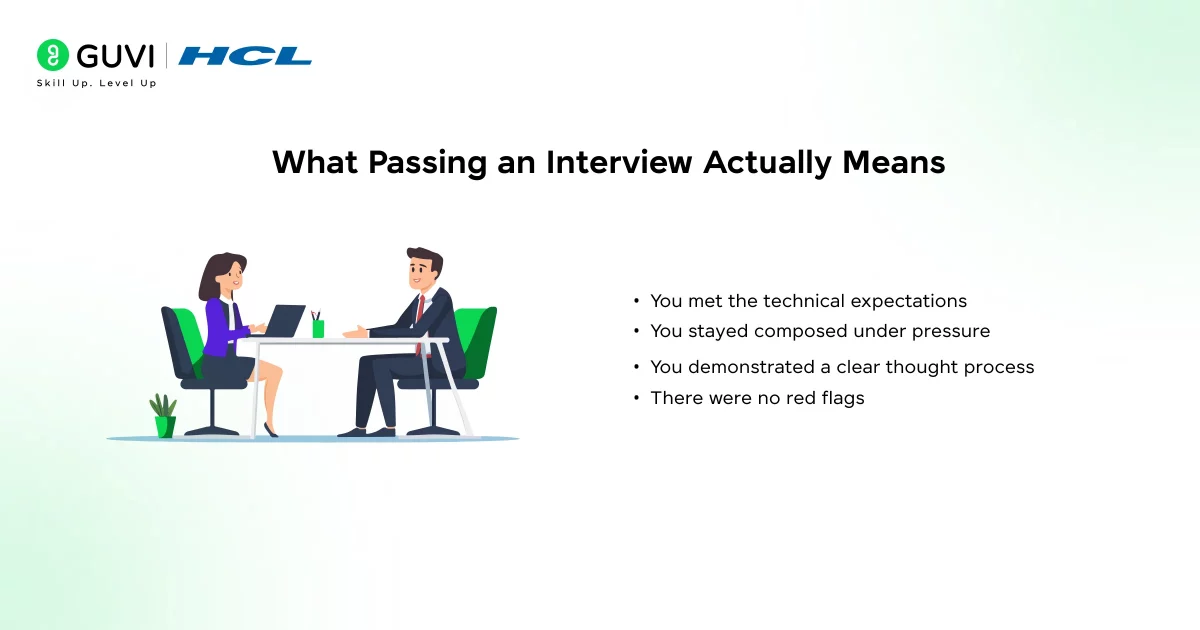
When you pass an interview, think of it as crossing a threshold rather than reaching the finish line. Companies design interviews to test whether you can handle the core responsibilities of the role. If you pass, it simply means you’ve proven that you have enough foundational skills to be considered a potential hire.
Here’s what that usually covers for tech roles:
1. You met the technical expectations
Companies want to confirm that you understand the fundamentals: data structures, algorithms, clean coding habits, debugging approaches, and the ability to explain your reasoning. Passing indicates that, for the most part, your answers made sense and your logic held up.
2. You stayed composed under pressure
Interviewers pay attention to how you react when the problem gets tricky. Passing means you didn’t freeze, panic, or give up. You showed that you can handle a real engineering environment where unexpected challenges often come up.
3. You demonstrated a clear thought process
The interviewer isn’t just checking whether you can reach the correct answer. They care about how you get there. Passing means your approach was structured enough for them to follow, and you communicated your steps in a way that showed you understand what you’re doing.
4. There were no red flags
Sometimes, passing simply means you didn’t do anything that raised concerns. You didn’t argue with the interviewer, you didn’t bluff your way through technical topics, and you didn’t show signs of poor teamwork or attitude.
What this really means
Passing puts you in the pool of qualified candidates. It tells the company: “Yes, this person can do the job.” But it doesn’t tell them whether they should choose you over the others who also passed. And that’s where selection comes in.
If you want to read more about DSA and want to quickly brush the topics, consider reading HCL GUVI’s Free Ebook: The Complete Data Structures and Algorithms Handbook, which covers the key concepts of Data Structures and Algorithms, including essential concepts, problem-solving techniques, and real MNC questions
What Getting Selected Actually Means
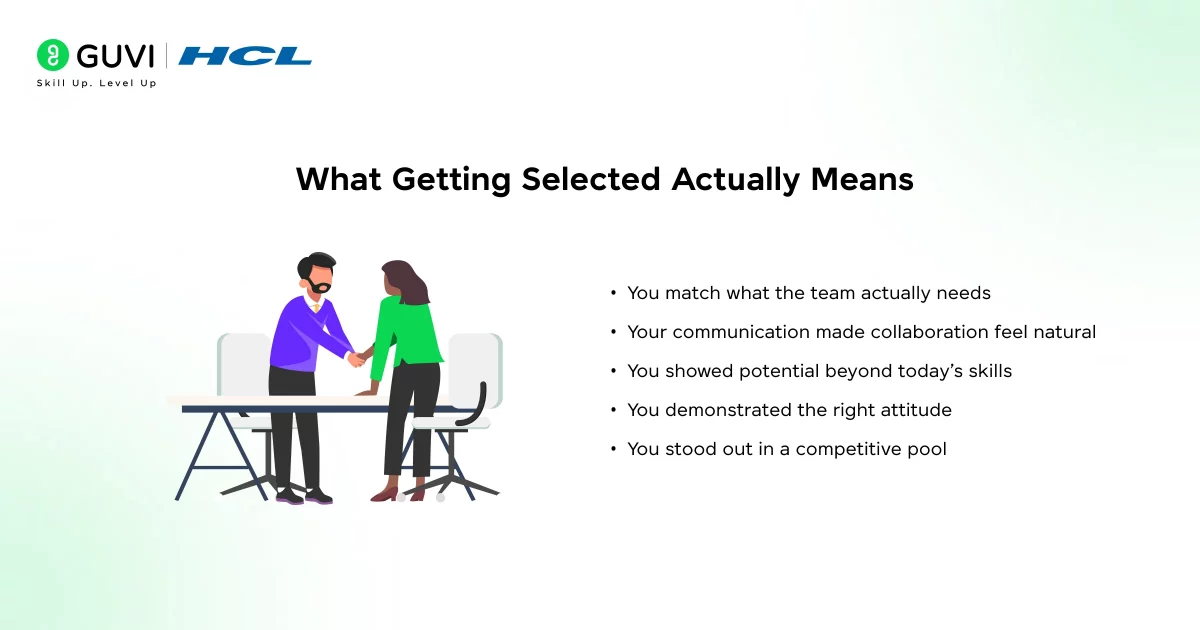
Getting selected is the company saying, “Out of everyone who passed, you’re one of the people we want to hire.” At this stage, the expectations go beyond solving coding challenges or knowing theory. Selection focuses more on who you are as a potential team member, not just a problem solver.
Let’s break it down.

1. You match what the team actually needs
Sometimes two people pass with the same technical score, but the company chooses the one whose strengths align better with the team’s current challenges. Maybe your project experience matches their tech stack. Maybe your problem-solving style fits their workflow. This alignment often tips the scales.
2. Your communication made collaboration feel natural
Selection heavily depends on how easy it would be to work with you. If you explain ideas clearly, listen actively, ask thoughtful questions, and show curiosity, you automatically feel like someone who would contribute well in a real engineering environment.
3. You showed potential beyond today’s skills
Companies want someone they can train, coach, and grow. Selection reflects your long-term promise, not just your performance in a one-hour interview. If you show a learning mindset, self-awareness, and genuine enthusiasm for the role, you stand out. This is why soft skills are as important as technical skills!
4. You demonstrated the right attitude
Hiring managers care about reliability, humility, confidence, and ownership. A candidate who admits what they don’t know and tries to learn is often favored over someone who is technically strong but rigid or dismissive.
5. You stood out in a competitive pool
Here’s the tough truth: many people pass interviews, especially in campus hiring. But companies rarely have enough seats for everyone. Selection becomes a comparative decision: who showed more consistency, who handled feedback better, whose thinking felt sharper or more adaptable.
What this really means
Getting selected means the company is convinced that you’ll be a positive addition to the team: technically, culturally, and professionally. It’s not about being perfect. It’s about being the right fit at the right moment.
If you want to learn the nuances of cracking an interview, then this blog is for you – How to Prepare for a Job Interview and Ace it? Top 8 Steps
Difference Between Passing an Interview and Getting Selected
Below is a table that lets you clearly understand the difference between passing an interview and getting selected.
| Aspect | Passing an Interview | Getting Selected |
| What it represents | Passing tells the company that you’ve cleared the bar they set. You demonstrated the essential skills, handled the questions reasonably well, and showed that you’re capable of performing the core tasks. It’s proof that you understand the basics and can apply them. | Getting selected means the company didn’t just see you as capable, they saw you as the person they want on their team. It reflects confidence in your long-term fit, your mindset, and your potential to grow within the company. |
| How interviewers view it | Interviewers see passing as a signal that you’re technically sound and can be considered further. You checked the right boxes and didn’t raise concerns. You’re qualified, but you’re still one among many who performed well. | Interviewers view selection as a commitment. They’ve compared you with others, discussed your strengths, and decided you bring something valuable that stands out. |
| What it means for your hiring journey | Passing moves you into the “eligible” category. It means you can progress to the next round or be part of the final shortlist. But it doesn’t guarantee anything because multiple candidates may reach the same point. | Selection closes the journey. It means you’re getting the offer. The panel is confident about your fit, and you’ve left a strong enough impression to be chosen over other candidates who may have performed equally well. |
| What influences it the most | Your technical knowledge, coding ability, clarity of thought, and problem-solving approach largely decide whether you pass. It’s mostly about what you know and how you apply it under timed conditions. | Selection is influenced by broader factors: your communication, personality, curiosity, adaptability, cultural fit, potential, and alignment with the team’s immediate needs. It’s about how you think, how you behave, and what kind of teammate you’d be. |
| The easiest way to understand it | Passing is like crossing the qualifying line in a marathon. You’ve shown you’re skilled enough to be in the race, and your performance makes you a worthy contender. | Getting selected is like finishing among the top runners who actually get a medal or recognition. Everyone who qualified is good, but only a few make it to the final list, the ones who showed something extra. |
If you are on the journey of cracking a tech interview, go through this pool of interview blogs of various domains that will help boost your confidence – Interview – HCL GUVI Blogs
Why Fresh Graduates Often Pass but Don’t Get the Job
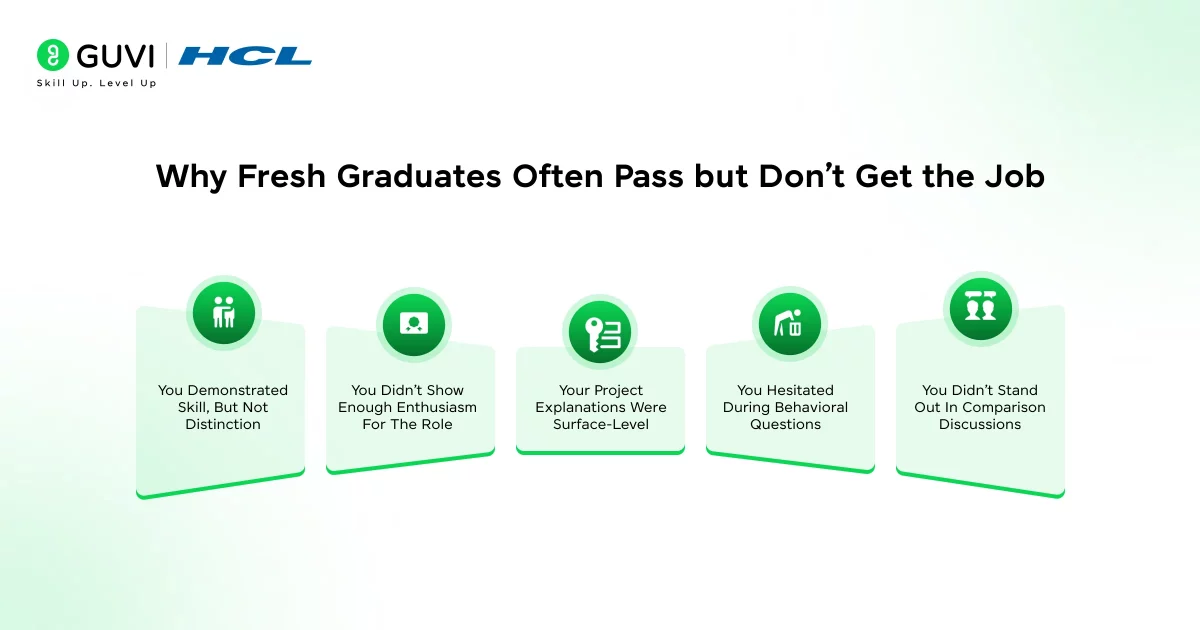
Many graduates walk out of an interview feeling confident. They solved the coding questions, communicated decently, and didn’t make any obvious mistakes. Yet the result email arrives, and it’s a polite rejection. It feels unfair, but there’s usually a clear reason behind it.
Let’s understand what typically happens.
1. You demonstrated skill, but not distinction
In most tech hiring drives, especially campus or early-career roles, the number of people who pass is surprisingly high. Many students study from the same resources, practice the same coding patterns, and deliver similar answers.
Companies don’t want to be identical. They want to be memorable. That doesn’t mean flashy or dramatic; it simply means you brought something unique, whether it’s clarity, maturity, curiosity, or a stronger sense of purpose.
2. You didn’t show enough enthusiasm for the role
Fresh graduates sometimes treat interviews like exams: answer the questions, smile politely, and leave. But companies are looking for hints that you genuinely want the role.
When your answers feel rehearsed, uninterested, or too neutral, interviewers may wonder whether you’re motivated enough to thrive in real-world challenges.
3. Your project explanations were surface-level
This is one of the biggest deal-breakers for freshers. You may have built great projects, but if your explanation sounds like: “It was a team project. We used React and Node. My task was the login page.”… Then interviewers lose confidence.
Companies aren’t evaluating your tools; they’re evaluating your thinking. They want insight into your decisions, your problem-solving process, and your awareness of trade-offs.
4. You hesitated during behavioral questions
Many candidates are strong with code but weak with people-oriented questions. When interviewers ask about conflict, teamwork, deadlines, or failures, vague or simplistic answers can ruin your chances.
Behavioral rounds tell companies what kind of teammate you’ll be. If your responses lack depth, they assume you haven’t reflected enough or haven’t developed the interpersonal maturity required in collaborative environments.
Quickly prepare for behavioral questions with this blog – Top 25 HR Interview Questions and Answers
5. You didn’t stand out in comparison discussions
After interviews, hiring panels gather and compare notes. Imagine a table with 10 names, all passed. Only 3 seats are available. This final conversation is where selection is truly decided.
If you didn’t give them enough to remember you by, a thoughtful question, a well-structured approach, a clear explanation, you blend into the background. And when everyone seems “good”, companies only select the ones who showed something extra.
How You Can Move From Passing to Getting Selected?
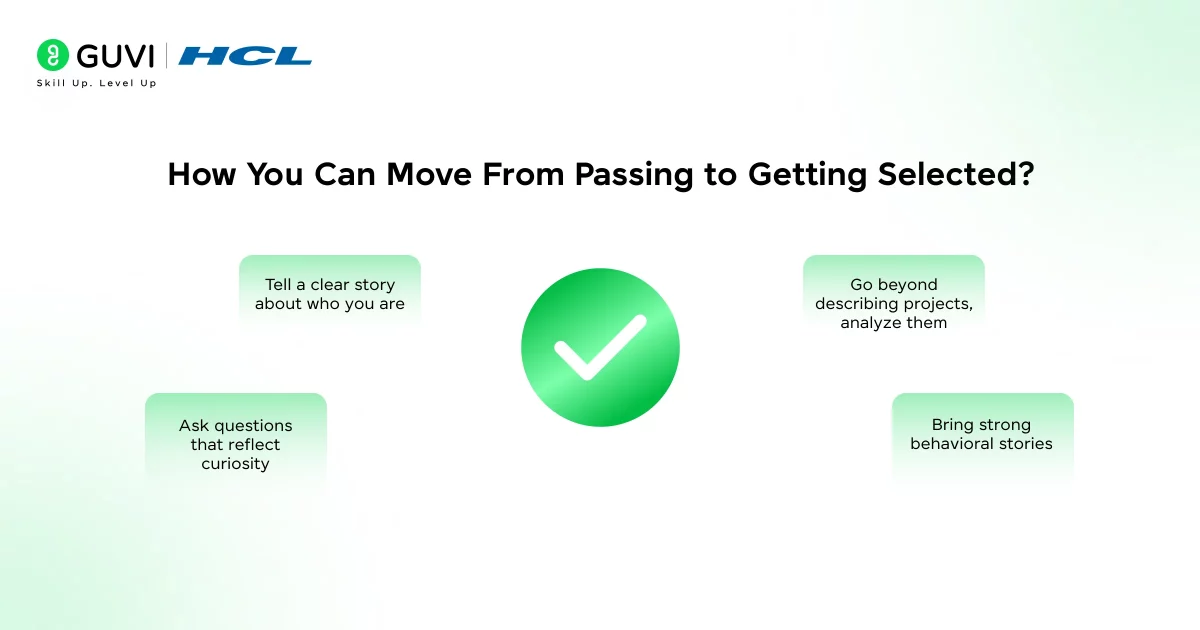
The good news? Selection isn’t about being a genius. It’s about being intentional. When you understand what companies value, you can shape your preparation accordingly.
Let’s walk through practical steps that help you bridge the gap.
1. Tell a clear story about who you are
Interviewers meet dozens of freshers. Most talk about their skills, but very few talk about their journey.
Share things like:
- Why did you choose tech
- How did you discover your interest in coding
- What problem or experience shaped your learning
- What kind of engineer do you hope to become
A clear narrative immediately makes you more relatable and memorable.
2. Go beyond describing projects, analyze them
Treat every project like a mini case study. Break it down the way real engineers do:
- What problem were you solving?
- What challenges came up during development?
- Why did you choose one approach over another?
- What would you do differently if you rebuilt it today?
These details show depth, ownership, and engineering thinking, the qualities that elevate you above others who merely followed tutorials.
3. Ask questions that reflect curiosity
You don’t need to ask something philosophical. Practical, grounded questions work best, like:
- How does the engineering team collaborate?
- What version control practices do you follow?
- Does the team emphasize testing or pair programming?
- What does a typical sprint look like?
These questions make you sound like someone who already thinks in an engineering mindset.
4. Bring strong behavioral stories
Prepare stories related to:
- Dealing with setbacks
- Taking initiative
- Managing time
- Resolving misunderstandings
- Learning something quickly
Use real events, not rehearsed templates. Companies care more about authenticity than perfection.
When you relate your answers to their environment, you immediately feel like a better fit.
Conclusion
In conclusion, the difference between passing an interview and getting selected isn’t about luck or hidden criteria. It’s about clarity, intention, and how well you present who you are beyond your technical answers. Companies already know that fresh graduates are still learning, so they’re not expecting perfection. What they do look for is someone who thinks clearly, communicates well, stays curious, and brings a sense of ownership to their work.
Once you understand this mindset, you stop treating interviews like high-stress exams and start approaching them as conversations about potential. That shift alone is powerful. It helps you stand out, stay authentic, and show interviewers that you’re ready to grow with their team.
FAQs
1. What’s the difference between passing an interview and getting selected?
Passing means you met the basic requirements for the role. Getting selected means the company chose you over others who also passed. It’s about fit, potential, and how well you stood out.
2. Why do candidates pass all rounds but still not get the job?
Because selection depends on more than correct answers. Companies evaluate communication, mindset, cultural fit, and team needs. Even strong performers may not align with what the team is looking for.
3. How can I increase my chances of getting selected after passing?
Show clear reasoning, ask thoughtful questions, and communicate confidently. Share strong project stories and demonstrate curiosity. Small signals of maturity and coachability make a big difference.
4. Does cultural fit really matter in technical hiring?
Yes, especially for fresh graduates. Teams want people who collaborate well and adapt quickly. Technical skills get you in; cultural fit helps you stay.
5. What mistakes should I avoid during the final selection stage?
Don’t give generic answers or rely on memorized responses. Avoid shallow project descriptions and ignoring hints. Lack of curiosity or preparation can easily hurt your chances.
Success Stories

About the Author
Lukesh S
A professional content writer who has experience in freelancing and now working as a Technical Content Writer at GUVI. Google Certified Digital Marketer. Have a sound knowledge of SQL, Data Structures and Cloud Computing.
View all posts by Lukesh S
Connect with me @














Did you enjoy this article?