


Artificial Intelligence and Machine Learning Articles
Building Visual RAG Pipelines with Llama 3.2 Vision and Ollama: A Beginners Guide 2026
Creating a Sentiment Analysis App with Hugging Face and Streamlit
Agentic AI vs Generative AI: Key Differences, Use Cases, and Enterprise Impact in 2026
Build an AI Travel Assistant With Google Agent Development Kit (ADK)


Get In Touch For Details! Request More Information

Challenges of Machine Learning: The Other Side Of The Coin
Sep 01, 2025 6 Min Read 1812 Views
(Last Updated)
Machine learning (ML) has become a cornerstone of modern technology, powering everything from recommendation engines to medical diagnosis tools. Yet, the challenges of machine learning can often catch newcomers (and even experienced practitioners) by surprise.
If you understand the basics of ML, you might be asking: Why do so many ML projects stumble, and what hurdles should you watch out for?
In this article, we’ll dive into the major challenges of machine learning. By the end, you’ll not only recognize these challenges but also have a sense of how to address them. Let’s explore these obstacles together.
Table of contents
- What is Machine Learning?
- Challenges of Machine Learning
- Data Quality and Quantity: The Fuel and the Friction
- Bias and Fairness in Data
- Overfitting and Underfitting
- Complexity and Interpretability: The Black Box Problem
- Computational Resource Demands and Costs
- Security and Adversarial Challenges
- Skill Gaps and Evolving Expertise
- Concept Drift: Models Losing Touch With Reality
- Data Leakage: The Silent Accuracy Killer
- Deployment Pitfalls: From Lab to Real World
- Conclusion
- FAQs
- What are the biggest challenges of machine learning?
- How does data quality affect machine learning models?
- Why is interpretability such a challenge in machine learning?
- How can machine learning models be protected from adversarial attacks?
- Is overfitting the most common challenge in machine learning?
What is Machine Learning?
Machine Learning (ML) is a branch of artificial intelligence that enables computers to learn patterns from data and make decisions or predictions without being explicitly programmed for every possible scenario. Instead of writing rules manually, you feed the machine large amounts of data, and it figures out the rules on its own by recognizing patterns and correlations.
Here’s how it works, in simpler terms:
- You provide input data (like images, text, or numbers).
- The machine learns a pattern from this data through a process called training.
- Once trained, it can make predictions or decisions on new, unseen data.
Think of it like teaching a kid to recognize fruits. Instead of giving them a list of rules to identify an apple, you show them enough apples until they start recognizing one by themselves. In the same way, a machine learning model learns from examples, and the more quality data you give it, the better it gets.
Challenges of Machine Learning
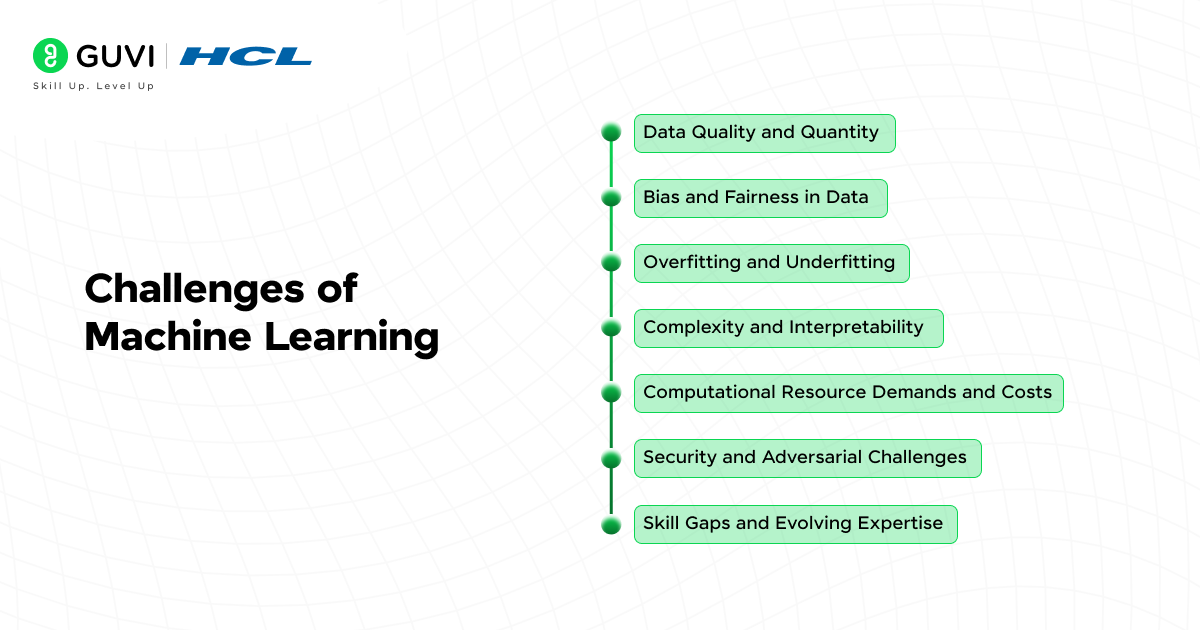
Below are some common challenges of machine learning that you should know to be aware of and familiarize yourself with:
1. Data Quality and Quantity: The Fuel and the Friction

Data is the lifeblood of machine learning, and ensuring its quality and sufficiency is one of the fundamental challenges of machine learning projects.
You’ve probably heard the phrase “garbage in, garbage out.” It holds very true in ML – if you feed a model poor data, you’ll get poor results. Machine learning systems rely heavily on large volumes of high-quality data to learn patterns and make accurate predictions.
- Insufficient or Noisy Data: If the dataset is too small or contains errors (missing values, outliers, typos, etc.), the model may learn incorrect patterns or not learn effectively at all.
- Data Collection Difficulties: In some domains, gathering enough data is easier said than done. Proprietary information, privacy regulations, or simply rare events can limit what data you have.
Addressing data challenges involves investing in data preprocessing and governance (clean your data, handle those missing values) and sometimes getting creative. Always remember: the better your data, the better your model.

2. Bias and Fairness in Data
It’s not just quantity – the content of the data can be problematic. Bias in machine learning datasets is a well-known hurdle that directly impacts fairness. If the data reflects historical biases or an unbalanced representation of groups, the model will likely learn those biases, leading to unfair or even discriminatory outcomes.
Bias can creep in through many channels (biased sampling, societal biases present in historical data, etc.), and it’s challenging to eliminate. Tackling this challenge requires vigilance: use bias detection tools, deliberately include diverse data during training, and set up ethical AI guidelines for your project.
3. Overfitting and Underfitting
Once you have data in hand, the next challenge of machine learning is training a model that generalizes well. If you’ve trained a model before, you might have seen cases where the model performs too well on training data but poorly on new data, or conversely, it struggles to even learn the training set. These issues are known as overfitting and underfitting, respectively.
- Overfitting happens when a model learns the training data too closely and captures noise or random fluctuations as if they were important patterns. Such a model will have high accuracy on the training set but will fail on unseen data because it didn’t learn the true generalizable patterns. It’s like memorizing answers to specific questions instead of understanding the underlying material – great for the practice test, disastrous for the real exam.
- Underfitting is the opposite – the model is too simple or too constrained and fails to capture the underlying trend in the data. Underfit models perform poorly even on training data; imagine using a straight line to fit curved data points. The model just isn’t powerful enough to model the relationship.
Finding the right balance between overfitting and underfitting is a core challenge. You often have to experiment with model complexity, do careful hyperparameter tuning, and employ techniques like cross-validation to check how well your model generalizes to data it hasn’t seen.
4. Complexity and Interpretability: The Black Box Problem
Have you ever looked at a complex ML model’s output and wondered, “How on earth did it come up with that?” You’re not alone.
Many powerful machine learning models, especially deep learning neural networks, operate as “black boxes.” They can have millions of parameters interacting in non-intuitive ways, so understanding their inner reasoning is a major challenge.
Addressing the interpretability challenge usually means incorporating Explainable AI (XAI) techniques or choosing inherently interpretable models when possible. Some approaches include:
- Using simpler, transparent models (like decision trees or linear models) for problems where high-stakes decisions are made, so you can easily explain outcomes.
- Applying post-hoc explainability tools (for complex models) such as LIME or SHAP, which attempt to highlight what factors influenced a particular prediction.
- Designing visualizations or summaries that help humans follow the model’s logic.
These steps can improve transparency without drastically compromising performance. Remember, the most accurate model isn’t always the best model if no one trusts or understands it.
5. Computational Resource Demands and Costs

You might have noticed that cutting-edge ML (especially deep learning) often requires serious computing power. Training large models on huge datasets can take hours, days, or even weeks on specialized hardware.
So, what can you do? Here are a few strategies to mitigate this challenge:
- Optimize your models and code: Efficient algorithms and techniques (like using minibatches, mixed-precision training, etc.) can shorten training time. Also, profile your code to avoid wasteful computations.
- Leverage transfer learning: Instead of training from scratch, you can start from a pre-trained model and fine-tune it for your task. This often requires far less data and computing.
- Use cloud resources wisely: Take advantage of cloud services with GPU/TPU instances when needed, but remember to shut them down when not in use! Some cloud providers also offer spot instances or credits for researchers, which can cut costs.
- Scale gradually: Before you throw a 10-million-image dataset into a huge model, try a prototype on a smaller scale. It’s amazing how often a simpler approach gets you close to your goal with a fraction of the compute.
In short, be mindful of the resource challenge. Plan for the hardware you need, and be prepared to justify the cost (or find clever ways around it).
6. Security and Adversarial Challenges

When machine learning models move out of the lab and into the real world, they face a variety of security threats.
How can you address these security challenges? A few approaches include:
- Adversarial Training: Intentionally training your model on some adversarial examples (inputs altered in ways an attacker might) can make the model more robust to such tricks.
- Rigorous Testing: Just like software is penetration-tested for vulnerabilities, ML models can be tested with adversarial scenarios to see how they cope.
- Encryption and Access Control: Protect sensitive data through encryption and strict access controls. Only those who truly need access to the data (or model) should have it. This reduces the risk of unauthorized exposure.
- Monitoring and Alerts: When your model is in production, monitor its inputs and outputs for unusual patterns. If a sudden odd input yields a confident yet weird prediction, it could be an adversarial attempt – better to catch it early.
Security is often an overlooked challenge in machine learning projects because everyone is focused on accuracy and performance.
One famous example of an adversarial attack involved simple stickers on a road sign. Researchers found that by adding a few carefully designed stickers to a STOP sign, a self-driving car’s vision system was fooled into thinking the sign was actually a 45 mph speed-limit sign. In that case, the car didn’t even attempt to stop – a potentially dangerous consequence of an ML system being too easily misled.
7. Skill Gaps and Evolving Expertise
Here’s a challenge that’s less about the tech and more about the people: Do you have the right skills (or team) to implement machine learning successfully? There’s a well-known shortage of skilled ML and data science professionals, and this skill gap can significantly slow down or derail ML adoption.
What can be done about the skill gap? A few strategies are emerging:
- Invest in Training: If you’re an individual, keep learning (courses, certifications, projects). If you’re an organization, consider upskilling your current staff – many companies run internal ML training programs to grow talent from within.
- Leverage Community and Collaboration: There are many open-source resources, forums, and communities where practitioners share knowledge. Engaging with these can help you overcome specific technical challenges faster.
The key is to recognize the human factor in machine learning projects. Successful ML is not just about algorithms and data – it’s also about people: those who design the system and those who use it.
8. Concept Drift: Models Losing Touch With Reality
Machine learning models are not “train once and done.” Over time, the patterns in real-world data can shift – this is known as concept drift.
- This means that the relationship between input features and output labels changes as time goes on.
- Example: A credit scoring model trained on customer behavior before a recession may underperform once the economy shifts, because people’s spending and repayment patterns evolve.
- Solution: Continuous monitoring, retraining on fresh data, and setting up alerts when model performance degrades.
Concept drift reminds us that ML is not static. A good model today might fail tomorrow if you don’t keep it updated.
9. Data Leakage: The Silent Accuracy Killer
One of the trickiest challenges of machine learning is data leakage, because it often goes unnoticed until the model fails in production.
- This means that the information from outside the training process sneaks into the training data, giving the model an unrealistic “peek” into the future.
- Example: In a medical model, if the training data includes test results that wouldn’t be available at prediction time, the model will look perfect in training but useless in the real world.
- Solution: Keep strict separation of training, validation, and test sets. Review your data pipeline carefully to make sure no future or outcome-related information leaks in.
Think of data leakage as a hidden trap – your model might look brilliant on paper, but turn disastrous when deployed.
10. Deployment Pitfalls: From Lab to Real World
Getting a model from your laptop into the real world is often more difficult than building it. Many ML projects never make it past the deployment stage.
- Integration issues: Models need to work with existing systems, APIs, and infrastructure.
- Scalability challenges: A model trained on a small dataset may not perform well when exposed to millions of real-time inputs.
- Monitoring needs: Once deployed, models must be tracked for accuracy, latency, and failures.
- Maintenance: Models may require retraining, updates, and version control – otherwise they quickly lose relevance.
Deployment is where theory meets reality. Success isn’t just about accuracy in the lab but reliability in production.
If you’re serious about mastering machine learning and want to apply it in real-world scenarios, don’t miss the chance to enroll in HCL GUVI’s Intel & IITM Pravartak Certified Artificial Intelligence & Machine Learning course. Endorsed with Intel certification, this course adds a globally recognized credential to your resume, a powerful edge that sets you apart in the competitive AI job market.
Conclusion
In conclusion, in the ever-evolving landscape of AIML, new challenges will continue to emerge. The key is to stay informed and adaptable. Keep asking questions like the one we started with, and keep seeking answers through research and experimentation.
Ultimately, the challenges of machine learning are worth tackling because of the tremendous value ML can provide. With careful planning and a bit of creativity, you can navigate these challenges.
FAQs
1. What are the biggest challenges of machine learning?
Some of the most significant challenges include poor data quality, biased datasets, overfitting/underfitting, lack of interpretability, high computational costs, security vulnerabilities, and a shortage of skilled professionals. These can affect both the performance and trustworthiness of ML models.
2. How does data quality affect machine learning models?
Data is the foundation of machine learning. If your data is noisy, incomplete, or biased, the model will likely make inaccurate or unfair predictions. High-quality, representative data is essential for building robust and reliable ML systems.
3. Why is interpretability such a challenge in machine learning?
Many advanced ML models, especially deep learning networks, are often “black boxes” that make it hard to understand how they reach a decision. This lack of transparency can hinder trust, compliance with regulations, and the ability to debug or improve the system.
4. How can machine learning models be protected from adversarial attacks?
Models can be protected through adversarial training (training with manipulated inputs), rigorous testing, secure data handling, and continuous monitoring. Without such measures, even minor input manipulations can cause dangerous misclassifications.
5. Is overfitting the most common challenge in machine learning?
Yes, overfitting is one of the most common issues, especially for beginners. It happens when a model learns the training data too well, including its noise, and fails to generalize to new, unseen data. Techniques like cross-validation, regularization, and pruning help mitigate it.
Success Stories

About the Author
Lukesh S
A professional content writer who has experience in freelancing and now working as a Technical Content Writer at GUVI. Google Certified Digital Marketer. Have a sound knowledge of SQL, Data Structures and Cloud Computing.
View all posts by Lukesh S
Connect with me @













Did you enjoy this article?