


Artificial Intelligence and Machine Learning Articles
How to Differentiate Lesson Content with ChatGPT?
How to Create and Use an OpenAI ChatGPT API Key (2026)


Get In Touch For Details! Request More Information

Balancing College, ML Learning & Social Life: How to do it?
Dec 26, 2025 6 Min Read 1116 Views
(Last Updated)
Have you ever felt like you’re constantly choosing between college work, ML learning, and having an actual social life? You’re not alone.
Many early-career learners struggle to strike a balance between academic responsibilities, technical skill development, and personal well-being. The good news is that balance isn’t a myth; it’s a skill you can build intentionally.
This article walks you through practical strategies to grow your ML skills, keep up with your coursework, and still make space for friendships, rest, and joy. So, without further ado, let us get started!
Quick Answer:
You can balance college, ML learning, and your social life by prioritizing your weekly goals, using structured time blocks, and keeping your routines consistent so you make steady progress without sacrificing well-being. This works best when you adjust your schedule based on workload and energy levels.
Table of contents
- Why Balancing College, ML Learning & Social Life Matters
- Setting Realistic Priorities
- Academic Commitments
- ML Learning Goals
- Social Life and Well-Being
- Time Management Techniques That Work
- Time Blocking in Action
- Task Batching
- The 2-Day Rule
- Smart Study Habits for ML Learners
- Learn by Doing
- Reflection After Each Session
- Peer Learning
- Avoiding Burnout While Doing All These
- Micro-Rest Rituals
- Emotional Bandwidth Matters
- The Art of Saying No
- Planning Long-Term Growth
- Real-World Habits That Scale
- Conclusion
- FAQs
- How can I balance college work with learning machine learning?
- How many hours should I spend learning ML as a student?
- Can I build ML projects while studying full-time?
- How do I avoid burnout while learning ML in college?
- Is it okay to prioritize social life sometimes over ML or academics?
Why Balancing College, ML Learning & Social Life Matters

Let’s be honest: trying to do everything at once is exhausting. Cutting out social time makes you feel isolated. Focusing only on college leaves you underprepared for the real world. And diving too deeply into Machine learning without structure can derail your academics.
Balance doesn’t mean splitting time evenly. It means creating a rhythm that supports:
- Clear learning progress
- Healthy relationships
- Strong academic performance
- Personal well-being and mental clarity
Once you see these areas as connected rather than competing, the entire process becomes easier to manage.
Students who intentionally schedule small, focused blocks of work for ML learning alongside their academic sessions often report higher retention and lower burnout. It’s not the number of hours that creates impact, it’s the consistency and clarity behind them.
Setting Realistic Priorities
Setting priorities sounds simple until you’re staring at a pile of assignments, an ML project that excites you, and friends planning a meetup. This is where intentional prioritization becomes a game-changer.
Realistic priorities start with understanding that not all tasks carry the same weight. Some moves you closer to your future. Some sustain your well-being. Others can wait. Instead of reacting to whatever appears urgent, you begin to weigh tasks through the lens of impact.
Here’s how to think about it:
- Academic commitments give structure to your week and often come with fixed deadlines.
- ML learning goals are flexible but essential if you’re aiming for a tech career.
- Social commitments keep you emotionally grounded and motivated.
Your job isn’t to treat these as competing forces. It’s to identify which one deserves attention today, and which one can shift to tomorrow without harming your progress.
A simple weekly reset helps. Look ahead at deadlines, your energy levels, and any upcoming personal plans. A quick 10-minute review at the start or end of each week is enough to assign weight to your commitments. Over time, this habit builds clarity and gives you a stable sense of control over your schedule.
1. Academic Commitments
Your coursework forms the backbone of your schedule. Instead of letting assignments and exams catch you off guard, map them out early. Look for patterns in your workload; some weeks will be heavy on reading, others on labs or presentations. Plan your ML practice and social activities around these peaks to avoid unnecessary stress.

2. ML Learning Goals
Machine learning rewards consistency more than intensity. When you build your priorities around ML learning, think in terms of:
- Practical skills
- Conceptual understanding
- Portfolio-building
You don’t need five-hour sessions. Even one focused hour each day creates compounding growth. Align your ML goals with what you’re currently learning in college when possible—it reduces cognitive load and creates natural reinforcement.
3. Social Life and Well-Being
Your social connections support your learning. When you spend time with people who energize you, your productivity actually improves. Schedule at least one meaningful interaction each week, something that feels rejuvenating rather than draining. This keeps you grounded and prevents isolation, which is a major contributor to burnout.
Time Management Techniques That Work
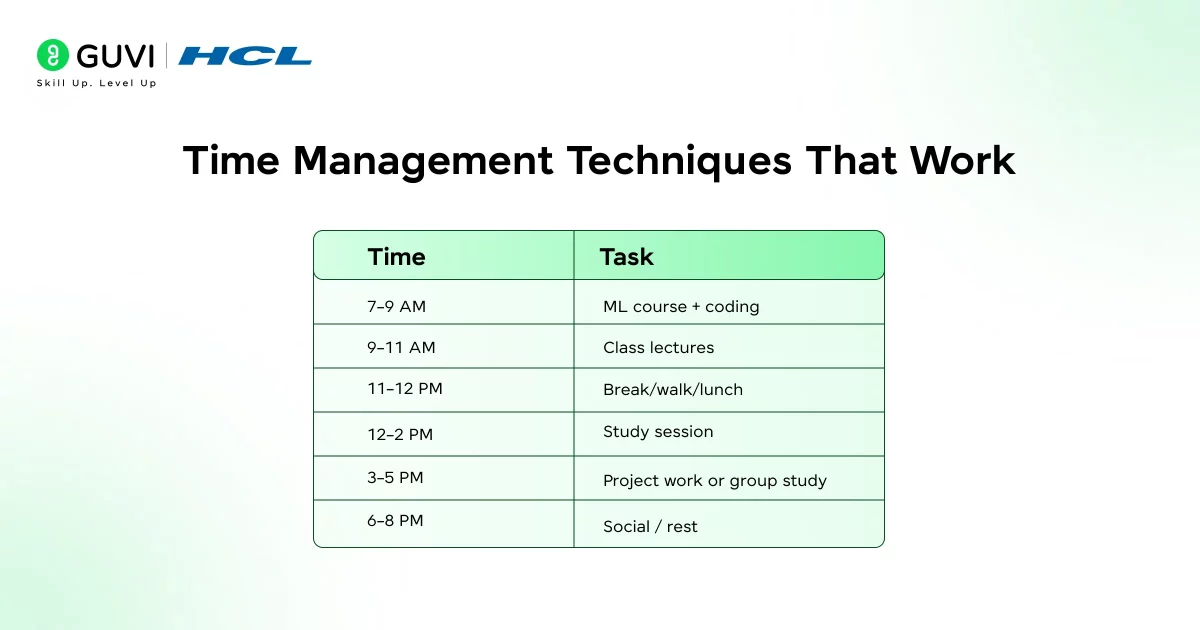
Time management isn’t about squeezing more into your day; it’s about reducing decision fatigue so your energy goes toward actual work, not planning.
The most effective technique for early-career learners is time blocking. Instead of deciding what to do every hour, you divide your day into preset segments: studying, ML practice, classes, rest, and social time. Once the block begins, the decision is made. There’s no debate, no guilt, no scrambling.
This approach trains your brain to expect certain types of work at certain times. Over weeks, it becomes second nature.
Time Blocking in Action
A simple daily block might look like this:
- Morning: ML practice (your brain is fresh)
- Midday: Classes and coursework
- Afternoon: Project or review sessions
- Evening: Relaxation and social time
This structure reduces the friction you feel when switching tasks throughout the day. It also builds predictable routines that eliminate procrastination triggers.
Example:
| Time | Task |
| 7–9 AM | ML course + coding |
| 9–11 AM | Class lectures |
| 11–12 PM | Break/walk/lunch |
| 12–2 PM | Study session |
| 3–5 PM | Project work or group study |
| 6–8 PM | Social / rest |
Task Batching
Batch similar tasks together, reading research papers, debugging code, reviewing notes, or cleaning up datasets. When your brain stays in the same mode, you work faster and with fewer mental resets.
The 2-Day Rule
If you miss a day of ML study or a planned session, make sure you never miss two in a row. This keeps your momentum alive even on busy or low-energy days. It also prevents the guilt spiral that often follows skipped sessions.
Smart Study Habits for ML Learners
ML isn’t something you memorize; it’s something you internalize. That means your study habits need to support long-term understanding rather than short bursts of cramming.
One of the strongest habits you can build is studying in layers. You won’t fully grasp linear regression, backpropagation, or regularization the first time. But each pass deepens your understanding. Permit yourself to revisit concepts without judging yourself for not mastering them instantly.
1. Learn by Doing
If you learn a new technique or model, apply it immediately, even if the example is tiny. Your brain retains concepts better when they’re tied to action. Try running experiments, tweaking parameters, exploring errors, and writing summaries of what you learned. These mini-interactions with the idea add texture to your understanding.
2. Reflection After Each Session
Take two or three minutes after a study session to ask:
- What clicked today?
- Where did I get stuck?
- What’s the next logical step?
This reflection loop builds self-awareness about your learning process. Over weeks, you’ll notice patterns in how you learn best.
3. Peer Learning
Explaining a concept to another person is one of the fastest ways to strengthen your understanding. Join a study group, engage in forums, or find a friend who’s learning with you. Discussing ideas introduces you to perspectives you wouldn’t find alone and adds a social boost to your technical journey.
Avoiding Burnout While Doing All These
Burnout rarely arrives loudly. It creeps in through exhaustion, loss of motivation, and the sense that everything is suddenly harder than it used to be. When you’re balancing college and ML, which both demand cognitive depth, it’s easy to push past your limits without noticing.
Start by recognizing the early signals:
- You’re tired even after sleeping
- You dread tasks you once enjoyed
- You feel mentally foggy or slower
These aren’t signs of weakness. They’re data points. And you need to respond to them the same way you’d respond to model drift, by recalibrating.
1. Micro-Rest Rituals
Short, regular pauses keep your brain from overheating. Think:
- A 10-minute walk
- Stretching
- Deep breathing
- Looking away from screens
- Music breaks
These aren’t distractions, they’re maintenance. The more consistent you are with them, the clearer your thinking becomes.
2. Emotional Bandwidth Matters
Burnout isn’t just mental; it’s emotional. If you constantly feel like you’re behind, you create pressure that drains your enthusiasm. Make space every week for things that have no measurable outcome. It might be a hobby, a casual meetup, or downtime with no screens. These are essential, not optional.
3. The Art of Saying No
Early learners often overload themselves because everything looks like an opportunity. But saying yes to everything dilutes your focus. Learn to decline commitments that don’t align with your goals or capacity. Every “no” is actually a “yes” to your well-being and long-term growth.
Planning Long-Term Growth
Long-term growth isn’t a sprint; it’s a steady climb shaped by deliberate choices. Especially in ML, where the field evolves quickly, having a long-term plan helps you avoid feeling lost or scattered. You’re building skills that will matter years from now, so the way you structure your growth today has compounding effects.
The first step is to turn your aspirations into milestones. Instead of vague goals like “learn ML,” break them into concrete phases:
- Complete foundational courses
- Build small but meaningful projects
- Deepen knowledge in one specialization
- Participate in competitions or research
- Contribute to open source or internships
Each milestone gives you direction without overwhelming you.
- Reflection is another essential part of long-term growth. Every few weeks, step back and ask what you’ve learned and what you want to explore next. Your interests will change over time, and that’s a sign of growth. Stay flexible so your plans can evolve with you.
- Remember to engage with communities, mentors, and peers. Networking isn’t transactional; it’s informational. Listening to others’ experiences helps you refine your own path and stay aware of new opportunities.
- Most importantly, accept that progress will have quiet seasons and fast seasons. The key is to move with intention, not speed. Over the years, that steady pace builds expertise that lasts.
Real-World Habits That Scale
Some habits grow with you, no matter how your life changes. These are worth developing early because they make you more resilient, adaptable, and effective in everything you pursue.
- One of these habits is consistent learning. Not intense sprints, not all-nighters, just steady, thoughtful engagement with your craft. This builds endurance and makes ML understanding feel natural instead of forced.
- Another habit is documenting your work. Whether it’s through notes, GitHub repos, or project logs, documentation improves your clarity and helps you track your evolution as a learner. It also becomes a valuable asset when you need to showcase your experience later.
- Seeking feedback is another habit that scales tremendously. Feedback accelerates growth by exposing blind spots you didn’t know you had. Over time, learning to welcome critique becomes one of the most powerful professional skills you can develop.
- Clear communication also matters everywhere, in projects, internships, presentations, and job interviews. Being able to explain your reasoning clearly signals confidence and competence.
- And finally, learn to protect your time. When you set boundaries around your work and energy, you give yourself room to grow without burning out. This discipline will serve you throughout your career.
If you’re serious about mastering machine learning and want to apply it in real-world scenarios, don’t miss the chance to enroll in HCL GUVI’s Intel & IITM Pravartak Certified Artificial Intelligence & Machine Learning course. Endorsed with Intel certification, this course adds a globally recognized credential to your resume, a powerful edge that sets you apart in the competitive AI job market.
Conclusion
In conclusion, balancing college, ML learning, and your social life isn’t about finding a perfect formula; it’s about understanding what you need in each season of your growth. When you plan intentionally, prioritize realistically, and build habits that support your well-being, the entire journey becomes more sustainable and more rewarding.
You don’t have to sacrifice joy for progress or progress for rest. With the right rhythm, you can build the skills you want, nurture the relationships that matter, and stay grounded while pursuing your early career goals.
FAQs
1. How can I balance college work with learning machine learning?
Break your week into fixed study blocks and assign specific times for ML practice. Small, consistent sessions work better than long, irregular ones. Keep your workload aligned with your academic schedule to avoid overload.
2. How many hours should I spend learning ML as a student?
Aim for 1–2 focused hours a day or 7–10 hours a week. It’s the consistency that builds skill, not long, occasional grind sessions. Adjust based on your academic load.
3. Can I build ML projects while studying full-time?
Yes, start with small, manageable projects and scale them as your confidence grows. Choose topics connected to your coursework to reduce cognitive load. Mini-projects still make strong portfolio pieces.
4. How do I avoid burnout while learning ML in college?
Use micro-breaks, manage your workload realistically, and keep at least one weekly activity for relaxation or social connection. Burnout usually comes from ignoring rest, not from learning itself.
5. Is it okay to prioritize social life sometimes over ML or academics?
Absolutely. A healthy social life supports mental clarity, motivation, and long-term productivity. Balance is about shifting priorities based on your current needs, not sticking to a rigid formula.
Success Stories

About the Author
Lukesh S
A professional content writer who has experience in freelancing and now working as a Technical Content Writer at HCL GUVI having sound knowledge in Blog Writing and Creative Writing!
View all posts by Lukesh S
Connect with me @














Did you enjoy this article?