


Python Articles
Go vs Python for Forward Deployed Engineering Workloads
Python for Forward Deployed Engineers: What You Actually Need to Know
Freelancing as a Python Developer: Getting Your First Client


Get In Touch For Details! Request More Information
What Is a Dictionary in Python: An In-Depth Guide
Mar 31, 2026 6 Min Read 1660 Views
(Last Updated)
How does Python retrieve a value instantly, even when a program manages thousands of data points under constant change? That capability comes from a data structure designed around direct access, predictable behavior, and semantic clarity rather than positional rules. Python dictionaries sit at the center of this design, providing a reliable way to store, access, and manage structured information where meaning matters more than order.
Understanding how dictionaries work, how they behave internally, and how they are used across real systems is essential for writing correct, scalable, and maintainable Python code. Let’s learn more:
Quick Answer: A Python dictionary is a built-in key-value data structure that uses hashing for fast, direct data access. It enforces unique, immutable keys, supports constant-time average operations, preserves insertion order, and allows any value type. Dictionaries are central to Python for configurations, mappings, aggregations, state management, and scalable real-world applications.
Table of contents
- What Is a Dictionary in Python?
- Key Characteristics of Python Dictionaries
- Common Dictionary Methods in Python
- Real-World Use Cases of Python Dictionaries
- Core Dictionary Operations and Usage Patterns in Python
- Dictionary Syntax in Python
- Accessing Values in a Python Dictionary
- Adding and Updating Dictionary Elements
- Removing Elements from a Dictionary
- Looping Through a Dictionary
- Best Practices for Dictionary Loops
- Nested Dictionaries in Python
- Dictionary Comprehension in Python
- Performance and Time Complexity of Dictionaries
- Python Dictionary vs Other Data Structures
- Common Mistakes When Using Python Dictionaries
- Dictionary Best Practices in Python
- Conclusion
- FAQs
- Are dictionaries ordered in Python?
- Can dictionary keys be lists?
- Can dictionaries contain other dictionaries?
- When should dictionaries not be used?
What Is a Dictionary in Python?
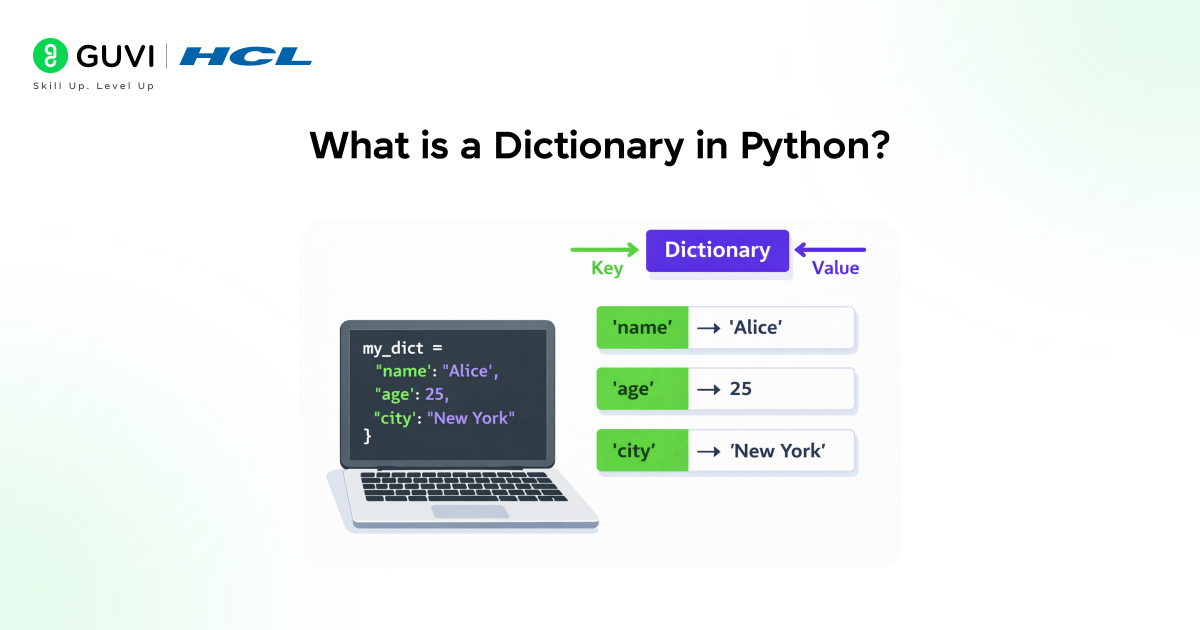
A dictionary in Python is a built-in data structure that stores data as key and value pairs, where each key maps to a specific value through a hashing mechanism. This structure supports rapid data retrieval because keys are resolved directly to memory locations. It allows lookups, updates, and deletions to occur in constant time under normal conditions. Modern Python versions preserve insertion order, which allows predictable iteration behavior across keys and values. This data structure is widely used to represent structured information such as configurations, mappings, and aggregated results, where clarity and direct access matter.
Key Characteristics of Python Dictionaries
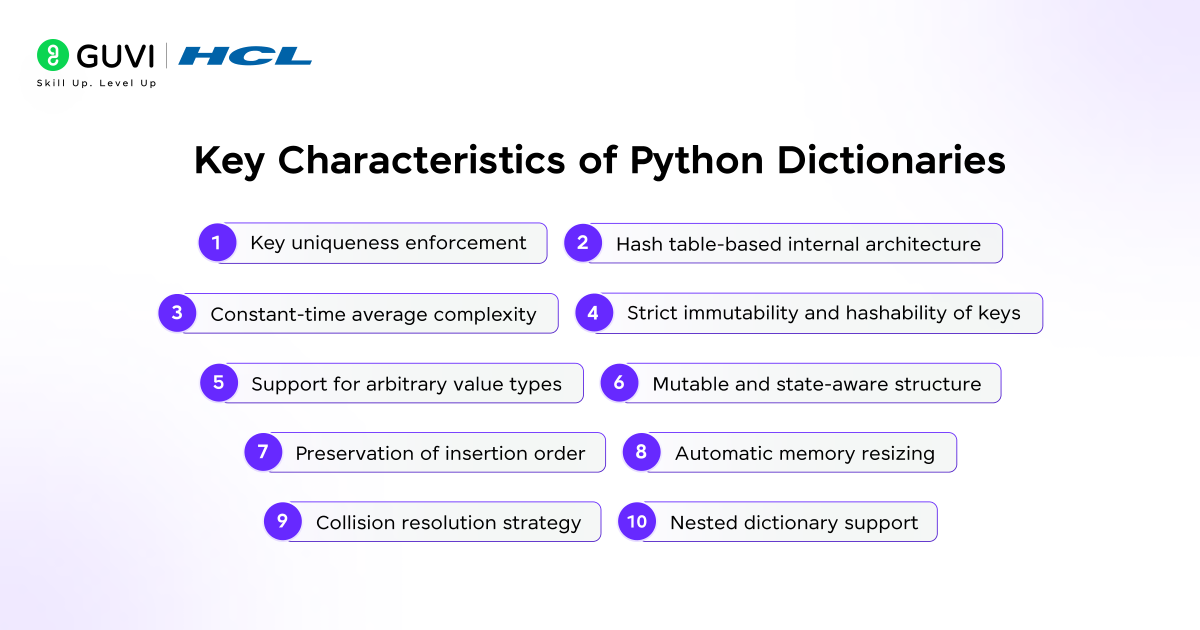
- Key-Value Pair Storage Model
Python dictionaries organize data as explicit key and value associations, where each key represents a logical identifier mapped to a corresponding value. This model aligns data access with meaning rather than position, which improves clarity in domain-driven logic.
- Key Uniqueness Enforcement
Each key must be unique within a dictionary. Reassigning a value to an existing key replaces the previous value atomically, which prevents ambiguity and duplicate identifiers in the data structure.
- Hash Table-Based Internal Architecture
Dictionaries are implemented using hash tables, where keys are converted into hash values that determine their placement in memory. This architecture underpins the efficiency and scalability of dictionary operations.
- Constant-Time Average Complexity
Read, write, update, and delete operations execute in constant time on average due to direct hash-based addressing. Performance remains stable as long as the hash distribution remains uniform.
- Strict Immutability and Hashability of Keys
Keys must be immutable and hashable to maintain consistent hash values across the dictionary’s lifetime. Mutable objects are excluded because changes would invalidate stored hash references and corrupt lookup integrity.
- Support for Arbitrary Value Types
Values accept any Python object, including user-defined classes, dictionary functions, and generators. This allows dictionaries to model complex application state and object relationships.
- Mutable and State-Aware Structure
Dictionary contents can change during runtime through the insertion, modification, or removal of entries. This property supports evolving application state without recreating data containers.
- Preservation of Insertion Order
Keys retain the order in which they are added, and iteration respects this sequence. Predictable ordering supports deterministic output, debugging, and consistent data serialization.
- Automatic Memory Resizing
The dictionary adjusts its internal capacity as entries grow or shrink. This resizing balances memory usage with lookup efficiency while avoiding manual capacity management.
- Collision Resolution Strategy
Hash collisions are resolved internally using probing techniques that preserve access correctness. These strategies maintain performance even under non-ideal hash distributions.
- Built-In Views for Keys, Values, and Items
Dictionary views provide dynamic representations of keys, values, and key-value pairs. These views reflect real-time changes to the dictionary and support efficient iteration without copying data.
- Deterministic Equality and Membership Semantics
Key membership checks rely on hash equality followed by value comparison. It guarantees deterministic behavior during lookups, comparisons, and set-like operations.
- Deep Integration with Python Language Features
Dictionaries integrate with JSON serialization, unpacking syntax, keyword arguments, counters, and caching mechanisms. This integration makes dictionaries a core construct across Python’s standard library and application design patterns.
Common Dictionary Methods in Python
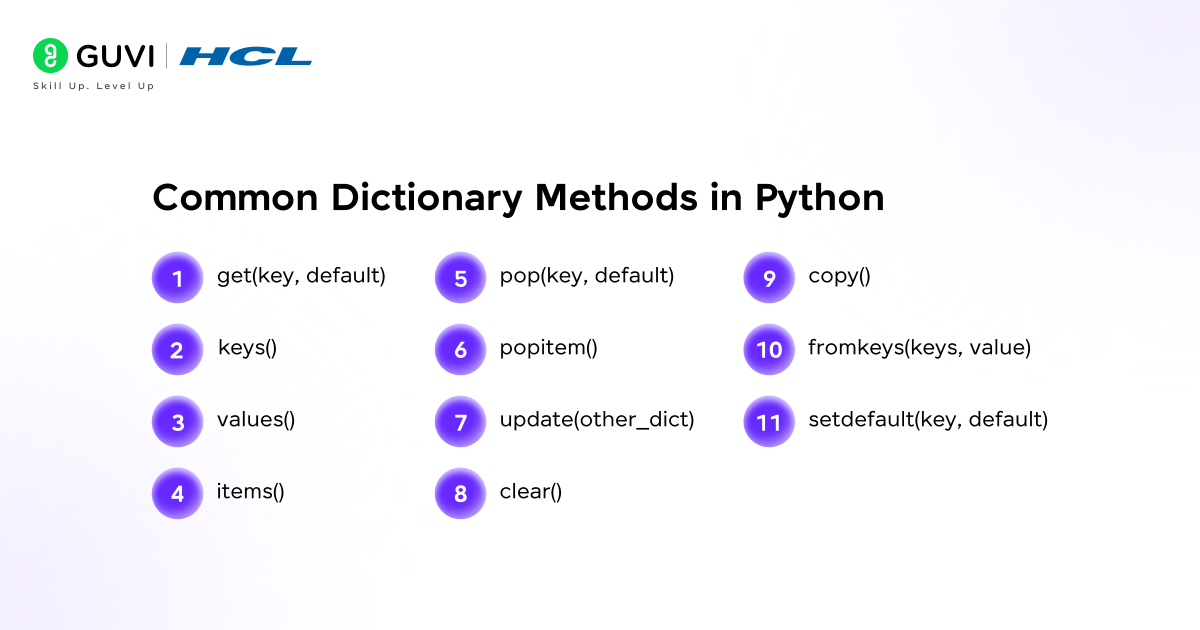
- get(key, default)
The get method retrieves the value associated with a given key using a non-exception-based access path. Key lookup is performed through hashing, and a default return value is used when the key is absent, which supports defensive programming and predictable control flow.
- keys()
The keys method returns a dynamic view object that exposes all keys stored in the dictionary. This view is iterable, supports membership tests, and reflects structural changes to the dictionary in real time without allocating additional memory.
- values()
The values method provides a live view of all values maintained by the dictionary. This view does not guarantee uniqueness and updates automatically as entries are added, updated, or removed, which supports efficient read-only traversal.
- items()
The items method exposes key and value pairs as tuple-based view objects. These tuples are generated on demand during iteration, which supports efficient unpacking patterns in loops and comprehensions.
- pop(key, default)
The pop method performs a lookup and deletion as a single atomic operation. A default return value can be supplied to handle missing keys, which avoids exception handling overhead in controlled removal scenarios.
- popitem()
The popitem method removes and returns the most recently inserted key and value pair following insertion order rules. This behavior supports deterministic removal patterns and stack-style workflows in dictionary-based state management.
- update(other_dict)
The update method applies bulk insertion and overwrite operations from another mapping or iterable of key-value pairs. Existing keys are reassigned, while new keys are appended in insertion order, preserving structural consistency.
- clear()
The clear method removes all key and value references from the dictionary while keeping the object identity intact. It authorizes the reuse of the same dictionary reference across different execution phases.
- copy()
The copy method produces a shallow copy of the dictionary, where top-level keys and values are duplicated as references. Nested mutable objects remain shared, which has implications for state mutation and data isolation.
- fromkeys(keys, value)
The fromkeys class method generates a new dictionary using an iterable of keys associated with a single shared value reference. Care is required when assigning mutable values, as changes affect all mapped keys.
- setdefault(key, default)
The setdefault method retrieves the value for a given key and inserts the key with a default value when it does not exist. This operation combines lookup and insertion, which simplifies incremental data population patterns.
Real-World Use Cases of Python Dictionaries
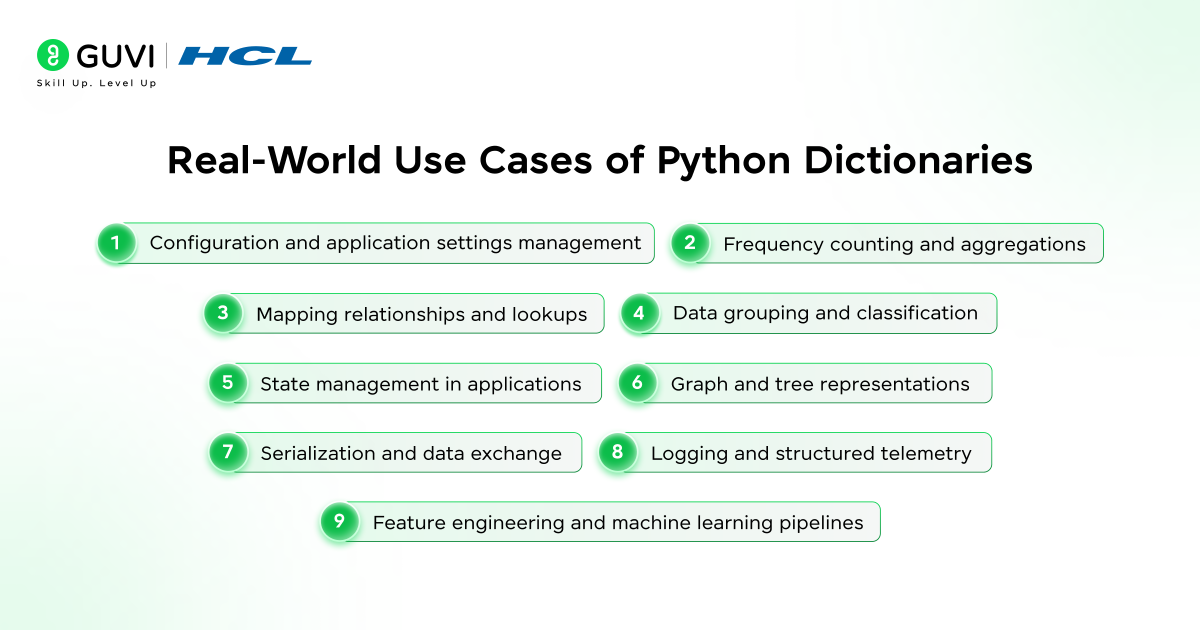
- Configuration and Application Settings Management
Python dictionaries are widely used to store application configuration parameters such as environment variables, feature flags, thresholds, and runtime options. Key-based access allows deterministic retrieval of settings by name, which supports maintainable configuration loading and override patterns across environments.
- Frequency Counting and Aggregations
Dictionaries are commonly used to count occurrences of items such as words, events, or status codes. Keys represent unique elements, and values track counts, which supports efficient aggregation logic in data processing and analytics workflows.
- Mapping Relationships and Lookups
Dictionaries are effective for mapping identifiers to objects, such as user IDs to profiles or product codes to metadata. This structure supports direct access without scanning collections, which improves efficiency in business logic and data pipelines.
- State Management in Applications
Dictionaries store mutable application state such as session data, request context, or workflow progress. Key-based updates allow precise control over state transitions without positional dependencies.
- Graph and Tree Representations
Dictionaries model adjacency lists in graph structures, where keys represent nodes and values store connected nodes. This approach supports efficient traversal, search algorithms, and dependency resolution logic.
- Serialization and Data Exchange
Dictionaries integrate directly with serialization formats such as JSON and YAML. Structured key-value data simplifies persistence, transport, and reconstruction of application state across systems.
- Logging and Structured Telemetry
Dictionaries capture structured log entries where keys represent attributes like timestamp, severity, and context. This structure supports downstream indexing, filtering, and analysis in monitoring systems.
- Feature Engineering and Machine Learning Pipelines
Dictionaries store feature names mapped to values during preprocessing and model inference. This representation supports flexible feature sets and aligns with vectorization and encoding stages.
Want to go beyond understanding Python dictionaries and start writing fast, scalable, real-world Python code with confidence? Enroll in HCL GUVI’s Python Course to master core Python concepts through 100 percent online, self-paced learning, earn a globally recognised certification, get full lifetime access to all content, clear doubts through dedicated forum support, and strengthen your skills using four gamified practice platforms designed for real-world application development.

Core Dictionary Operations and Usage Patterns in Python
1. Dictionary Syntax in Python
- Basic Dictionary Declaration
A dictionary is created by binding a variable name to a mapping object that maintains internal hash slots for key resolution. The declaration establishes an empty or pre-populated container that supports direct key-based access rather than sequential traversal.
- Creating Dictionaries Using {}
The literal syntax initializes dictionaries at compile time, which allows Python to allocate internal storage efficiently. This form is preferred when keys and values are known upfront and remain stable during initialization.
- Creating Dictionaries Using the dict() Constructor
The constructor enables dictionary creation from keyword arguments, iterable pairs, or existing mappings. This approach supports dynamic key generation, controlled data normalization, and transformation from external data sources.
2. Accessing Values in a Python Dictionary
- Accessing Values Using Keys
Key-based access performs a hash lookup followed by equality comparison to resolve the correct value. This operation assumes key existence and is suited for controlled data paths where schema integrity is guaranteed.
- Using the get() Method Safely
The get() method introduces a non-failing retrieval path by returning a fallback value. This pattern is commonly used in loosely structured data pipelines where key presence varies across records.
- Handling Missing Keys
Missing keys are addressed through default values, pre-initialization, or conditional membership checks. These strategies prevent runtime disruption and support robust data ingestion workflows.
3. Adding and Updating Dictionary Elements
- Adding New Key-Value Pairs
Insertion assigns a hash slot to the new key and stores a reference to the value. The dictionary may trigger internal resizing if capacity thresholds are exceeded.
- Updating Existing Values
Updating a value rebinds the reference stored against an existing key. The operation does not alter dictionary size or key ordering.
- Overwriting Values and Key Behavior
Reusing a key guarantees replacement rather than duplication. This enforces one-to-one key ownership and ensures deterministic state transitions.
4. Removing Elements from a Dictionary
- Using the del Keyword
The del statement removes the key reference and frees the associated slot for reuse. This operation directly mutates the dictionary structure.
- Using pop() and popitem()
The pop() method combines lookup and removal, which simplifies controlled eviction logic. The popitem() method removes the most recently inserted entry, which supports predictable teardown sequences.
- Clearing an Entire Dictionary
The clear() method removes all key references while retaining allocated memory structures, which improves performance during reuse cycles.
5. Looping Through a Dictionary
- Iterating Through Keys
Key iteration traverses the internal order preserved by insertion. This pattern supports selective access and conditional processing.
- Iterating Through Values
Value iteration operates on stored references without resolving keys repeatedly. It reduces lookup overhead during aggregation tasks.
- Iterating Through Key-Value Pairs
Pair iteration exposes complete mapping context. This is commonly used in transformation, validation, and export logic.
Best Practices for Dictionary Loops
Iteration should avoid redundant lookups and nested access patterns. Using view-based iteration maintains clarity and minimizes overhead.
1. Nested Dictionaries in Python
- What is a Nested Dictionary: A nested dictionary stores mapping objects as values, forming multi-level key hierarchies. This structure supports representation of complex domain models.
- Accessing Nested Dictionary Values: Nested access resolves keys level by level. Safe traversal requires validation at each level to avoid runtime failures.
- Real-World Examples of Nested Dictionaries: Nested dictionaries are used in configuration hierarchies, API responses, structured logs, and metadata-driven applications.
2. Dictionary Comprehension in Python
- What is Dictionary Comprehension: Dictionary comprehension constructs mappings using expression-based logic executed in a single pass. This reduces intermediate object creation.
- Syntax and Examples: Comprehensions define key expressions, value expressions, and iteration sources, with optional filtering conditions applied inline.
- Use Cases for Cleaner and Faster Code: Comprehensions improve readability for transformation-heavy logic and perform efficiently due to localized execution scope.
3. Performance and Time Complexity of Dictionaries
- Average Lookup Time: Most dictionary operations execute in constant time due to direct hash indexing and controlled collision resolution.
- Why Dictionaries Are Fast: Optimized hashing, cache-friendly storage, and probing strategies reduce memory access and comparison steps.
- Hashing and Internal Implementation Overview: Keys are hashed to determine storage slots, and collisions are resolved through probing. Automatic resizing maintains low load factors to preserve performance consistency.
Python Dictionary vs Other Data Structures
| Key Factor | Dictionary | List | Tuple | Set |
| Data Structure Type | Key-value mapping | Ordered collection | Ordered collection | Unordered unique collection |
| Access Method | Key-based lookup | Index-based access | Index-based access | Membership-based |
| Lookup Performance | Constant time average | Linear search | Linear search | Constant time average |
| Ordering | Preserves insertion order | Preserves insertion order | Preserves insertion order | No guaranteed order |
| Mutability | Mutable | Mutable | Immutable | Mutable |
| Duplicate Handling | Keys must be unique | Allows duplicates | Allows duplicates | Does not allow duplicates |
| Data Association | Explicit relationship between key and value | Positional relationship only | Positional relationship only | No direct association |
| Use of Hashing | Yes | No | No | Yes |
| Nested Structure Support | Strong support | Supported | Supported | Limited |
| Memory Overhead | Higher due to hashing | Lower | Lower | Moderate |
| Readability for Mappings | High | Low | Low | Low |
| Suitable for Structured Data | Yes | No | No | No |
Common Mistakes When Using Python Dictionaries
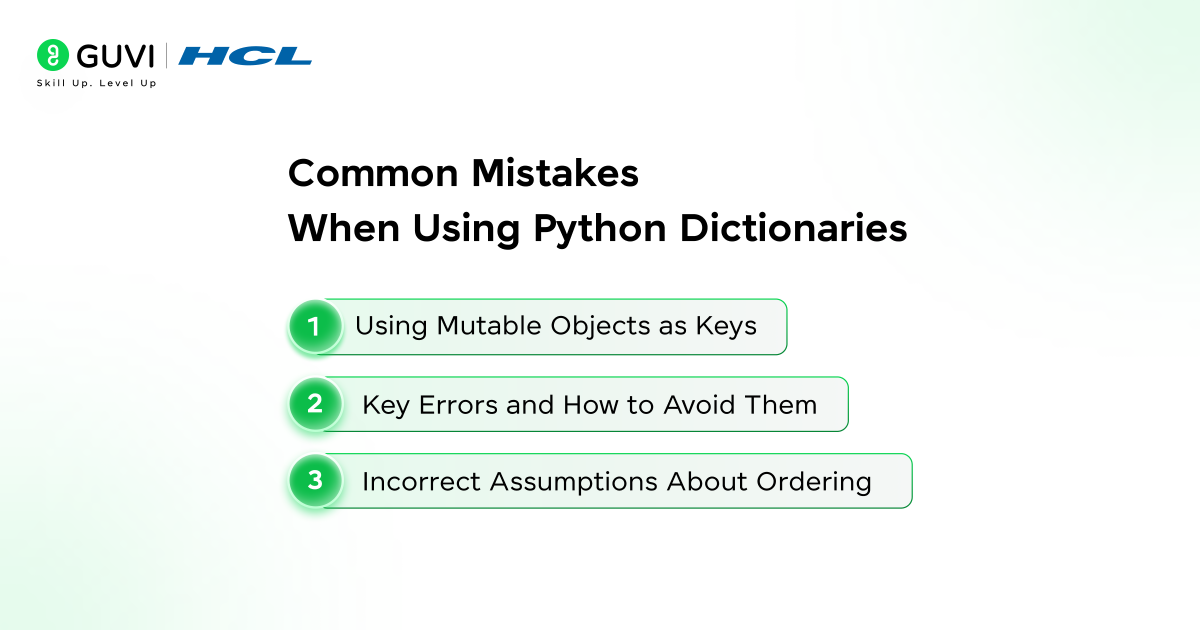
- Using Mutable Objects as Keys: Dictionary keys must be immutable and hashable. Mutable objects such as lists or sets can change their internal state, which breaks hash consistency and leads to unreliable lookups.
- Key Errors and How to Avoid Them: Direct access to missing keys raises a KeyError. Safe access patterns rely on the get method, setdefault, or explicit membership checks to maintain predictable control flow.
- Incorrect Assumptions About Ordering: Dictionaries preserve insertion order in modern Python versions, but relying on ordering for algorithmic correctness creates fragile logic. Dictionaries should represent mappings, not ordered sequences.
Dictionary Best Practices in Python
- Choosing Meaningful Keys: Keys should reflect clear domain meaning and remain stable over time. Well-chosen keys improve readability, reduce misuse, and align dictionary structure with business logic.
- Using .get() Instead of Direct Access: The get method provides controlled access with default handling, which avoids runtime errors and supports defensive programming patterns in production code.
- When to Use defaultdict or Counter: defaultdict simplifies scenarios that require automatic initialization of values, while Counter is suited for frequency-based aggregations. These specialized structures reduce boilerplate and improve clarity when standard dictionaries become verbose.
Conclusion
Python dictionaries provide a reliable foundation for managing structured data through direct key-based access, predictable behavior, and strong performance guarantees. Their internal design supports scalability, clarity, and flexibility across application logic, data processing, and system-level features. Mastering dictionary operations, usage patterns, and best practices helps Python developers write code that remains correct, efficient, and maintainable as complexity and data volume increase.
FAQs
Are dictionaries ordered in Python?
Yes, dictionaries preserve insertion order in Python versions 3.7 and later, which means keys are returned in the sequence they were added.
Can dictionary keys be lists?
No, dictionary keys cannot be lists because keys must be immutable and lists can change their contents after creation.
Can dictionaries contain other dictionaries?
Yes, dictionaries can store other dictionaries as values, which allows hierarchical and structured data representations.
When should dictionaries not be used?
Dictionaries should be avoided when data relies on positional access or ordered indexing because lists and tuples handle those patterns more clearly.
Success Stories

About the Author
Vaishali
I'm a seasoned writer with four years of experience across technical, non-technical, and just about every genre or niche you can imagine. Adaptable and curious, I enjoy exploring new topics and making information engaging and easy to understand. Fueled by a steady stream of tea, I approach each project with creativity, reliability, and genuine enthusiasm for storytelling.
View all posts by Vaishali
Connect with me @













Did you enjoy this article?