


Interview Articles
Capgemini Exceller Interview Questions 2026: Coding, Technical, HR, and AI Prep - Best Guide
Wipro Elite NTH Interview Experience 2026: What Candidates Say
Wipro HR Interview Questions for Elite NTH 2026: How to Answer Them - Best Guide
Wipro Technical Interview Questions 2026: Most Asked Questions and Answers


Get In Touch For Details! Request More Information
Technical Interview Questions Commonly Asked in Startups
Jul 21, 2026 6 Min Read 2822 Views
(Last Updated)
If you’ve ever stepped into a startup interview, you know it feels different. The conversation moves faster, the expectations feel a bit broader, and the questions often dig deeper than the usual textbook definitions. Startups want engineers who can build, debug, collaborate, and adapt from day one.
So let’s break down what actually gets asked, why it gets asked, and how you can prepare without feeling overwhelmed.
This article walks you through the most common types of technical interview questions asked in startups, along with examples, insights, and preparation tips you can put to use right away.
Quick Answer:
Startup technical interviews usually focus on practical coding tasks, core algorithms, debugging, and small-scale system design, giving interviewers a clear view of how you think, communicate, and solve real engineering problems in fast-moving environments.
Table of contents
- Why Startup Interviews Feel Different
- The Main Categories of Technical Interview Questions in Startups
- Algorithms and Data Structures
- What to Expect
- Common Topics
- Sample Questions
- How to Stand Out
- Coding Implementation Questions
- What to Expect
- Examples
- What Interviewers Watch For
- Debugging and Code Reading Questions
- What to Expect
- Sample Tasks
- What This Tests
- System Design Interviews
- What to Expect
- How to Approach These
- What Interviewers Want to See
- API Design Questions
- What You Might Be Asked
- What to Cover
- Practical Problem-Solving Questions
- Examples
- Why These Matter
- Behavioral Questions You’ll Still Encounter
- Examples
- What Interviewers Listen For
- A Closer Look at Real Startup-Style Questions
- Problem 1: Build a basic rate limiter
- Problem 2: Design a notification system
- Problem 3: Given logs of API requests, find the most frequent users
- Problem 4: Fix this broken snippet
- Problem 5: Build a search function for a product list
- Tips to Handle Startup Technical Interviews with Confidence
- Before the Interview
- During the Interview
- After the Interview
- Conclusion
- FAQs
- What technical questions do startups usually ask?
- Are startup interviews harder than big tech interviews?
- How should I prepare for coding interviews at startups?
- Do startups ask system design questions for junior roles?
- How important is communication in a startup interview?
Why Startup Interviews Feel Different
Here’s the thing: unlike larger companies that rely on fixed hiring structures, startups shape interviews around practical needs. If they need someone to ship features quickly, expect questions around debugging and code clarity. If they’re scaling, they’ll lean toward design and architecture problems.
You’re not just being evaluated for coding skills. You’re being evaluated for how you think, how you learn, and how you handle ambiguity.
A few traits startups tend to look for:
- Comfort with full-stack or cross-functional work
- Ability to write clean, understandable code
- Curiosity and problem-solving instincts
- Ownership mindset
- Communication clarity
- A willingness to dive into unfamiliar territory
Now let’s get into the question types you’ll most likely see.
The Main Categories of Technical Interview Questions in Startups
Most startups structure their technical interviews around a mix of these core categories:
- Algorithms and data structures
- Coding implementation
- Debugging and code reading
- System design
- API design questions
- Practical problem-solving
- Cultural/technical alignment
Let’s understand each of these with examples.
1. Algorithms and Data Structures
Startups may not grill you with the same depth as big tech, but algorithmic thinking still matters. They want to know you can reason about efficiency, break problems down, and avoid brute-force approaches when possible. That’s why data structures and algorithms are crucial for technical interview questions in startups!
You’ll usually encounter at least one problem involving fundamental algorithms or data structures. They need engineers who can write code that works efficiently because inefficiency becomes expensive when the team is small and the product is growing fast.
What to Expect
- Problems are usually practical rather than abstract
- Interviewers often allow pseudocode
- They’ll ask you to explain your trade-offs clearly
- They care more about clarity than obscure optimizations
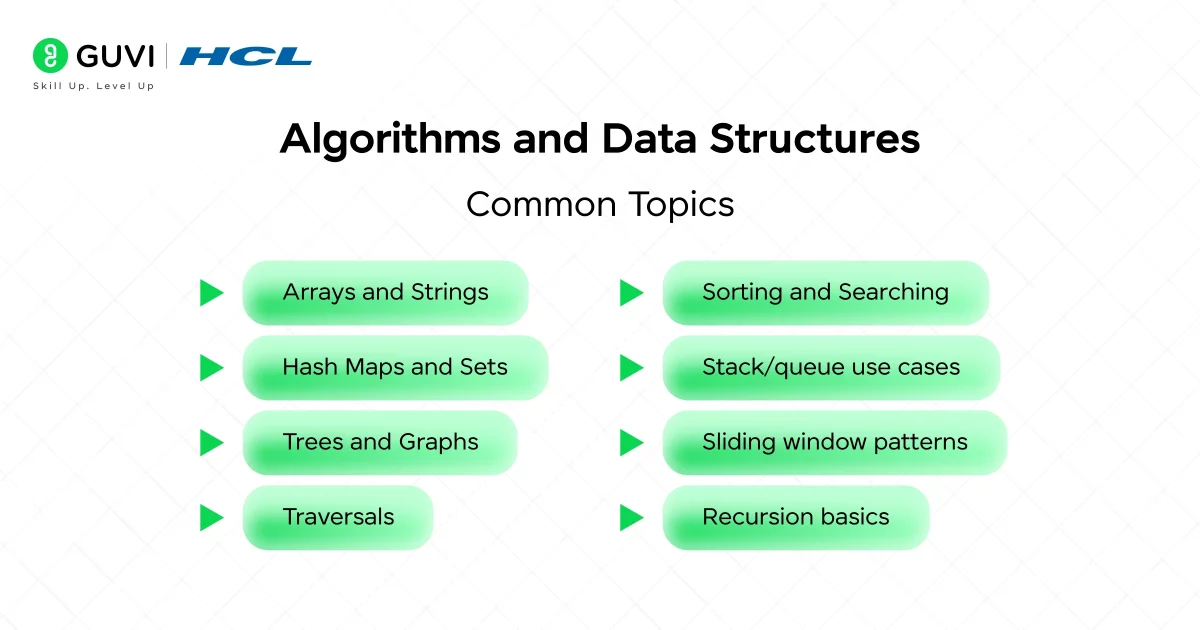
Common Topics
- Arrays and strings
- Hash maps and sets
- Trees and graphs
- Traversals
- Sorting and searching
- Stack/queue use cases
- Sliding window patterns
- Recursion basics
Sample Questions
- Given a list of tasks, return the order in which they’d execute based on dependencies.
- Check if two strings are permutations of each other.
- Merge overlapping intervals.
- Find the shortest path in a simple graph.
How to Stand Out
- Explain your reasoning before typing.
- Mention edge cases early (empty arrays, duplicates, null values).
- Think out loud when refining your solution.
If you want to read more about DSA and want to quickly brush the topics, consider reading HCL GUVI’s Free Ebook: The Complete Data Structures and Algorithms Handbook, which covers the key concepts of Data Structures and Algorithms, including essential concepts, problem-solving techniques, and real MNC questions
Explore: Key Questions to Ask Before a Technical Interview
2. Coding Implementation Questions
These questions reflect the kind of work you’d actually be doing if you joined the team. Instead of abstract challenges, you’ll often receive a prompt that mimics a real feature request or bug report.
You might be asked to implement a login flow, validate user input, parse a data stream, build a small API-like interface, or stitch together a few functions to complete a workflow. Startups care about practicality, and they want to see if you can turn requirements into code without getting lost in unnecessary complexity.
What to Expect
- Code written directly in an IDE-like environment, shared doc, or platform
- Emphasis on clean, maintainable code
- Possible use of language features, libraries, or built-in functions
- Expect at least one multi-step problem
Examples
- Implement a simplified authentication flow.
- Build a rate limiter.
- Create a function to parse and validate data inputs.
- Simulate a search feature with filtering and sorting.
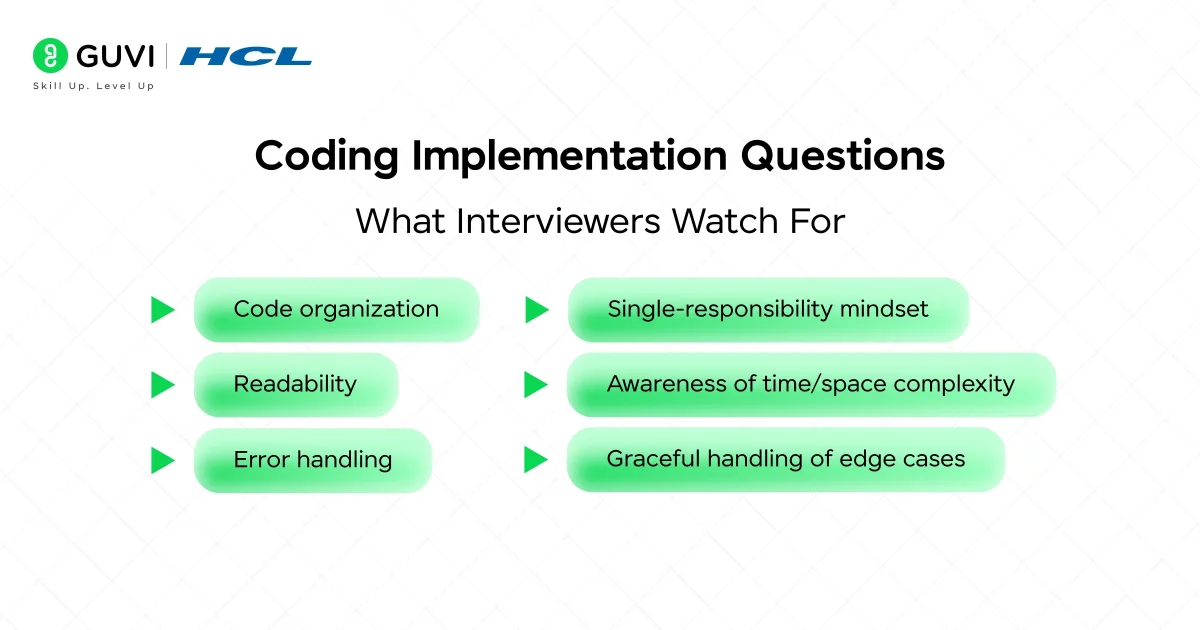
What Interviewers Watch For
- Code organization
- Readability
- Single-responsibility mindset
- Error handling
- Awareness of time/space complexity
- Graceful handling of edge cases
A simple trick: once you finish coding, narrate a brief walkthrough. It shows confidence and helps the interviewer catch your intent.
Also Read: The Ultimate Coding Interview Preparation Guide to Crack Any Interview
3. Debugging and Code Reading Questions
Debugging interviews reveal a different side of your skill set. They show whether you can deal with messy, imperfect, or inherited code, the kind that every engineer encounters sooner or later. Startups rely heavily on engineers who can diagnose issues quickly without getting flustered, because a blocking bug can delay releases, upset users, or interrupt revenue flow.
You may receive a snippet that looks mostly correct but fails on certain inputs. Or you may be asked to find a performance bottleneck and rewrite a function using a more appropriate data structure. Sometimes the interviewer hides subtle traps, an off-by-one error, a misused reference, or an overlooked null case. Your job is to trace the code thoughtfully, speak your assumptions aloud, and treat the exercise like you’re genuinely debugging a production issue.
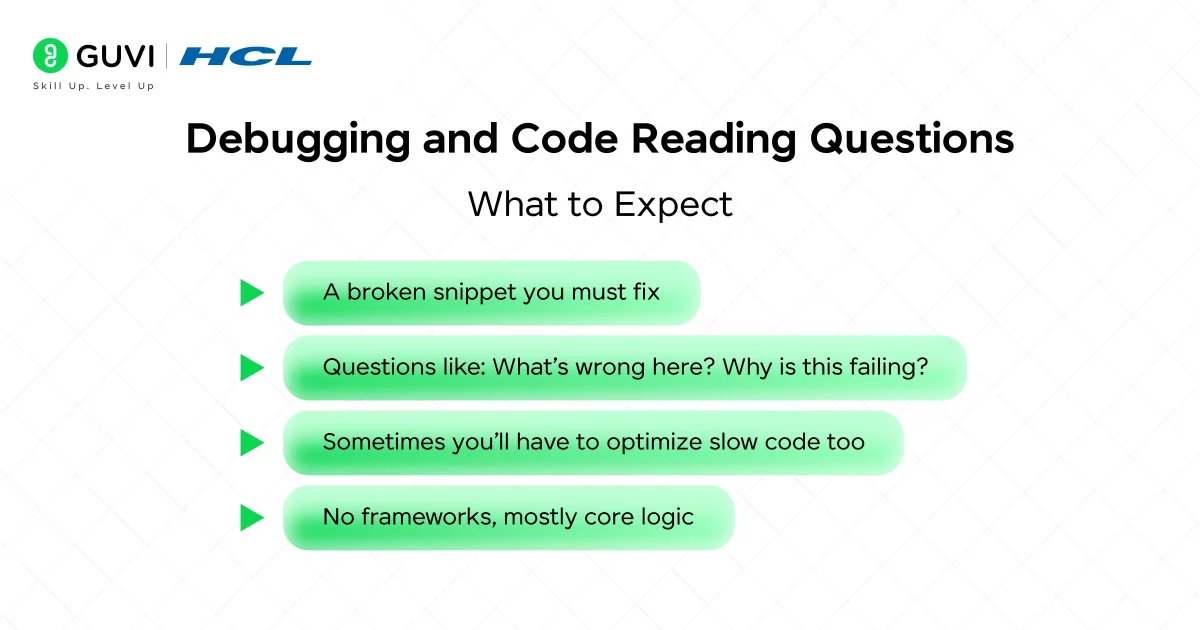
What to Expect
- A broken snippet you must fix
- Questions like: What’s wrong here? Why is this failing?
- Sometimes you’ll have to optimize slow code too
- No frameworks, mostly core logic
Sample Tasks
- Identify why a function returns incorrect results.
- Spot infinite loops or off-by-one errors.
- Rewrite inefficient code using better data structures.
What This Tests
- Your ability to read unfamiliar code
- Pattern recognition
- Understanding of core language features
- Practical engineering mindset
Think of this round as demonstrating your “engineer instincts,” not just your academic skills.
4. System Design Interviews
Startup system design interviews are usually lighter than what you’d face at huge tech companies, but they still reveal how you think about architecture. You won’t be asked to design the next hyper-distributed global service, but you might be asked to design a messaging system, a simple e-commerce workflow, a notification pipeline, or a URL shortener with basic scaling needs.
The interviewer pays close attention to how you structure your explanation. They want you to identify the key components, discuss how they interact, think about data storage, and highlight early trade-offs between simplicity and performance. If you mention improvement paths like caching, batching, or indexing, you’ll show that you’re thinking ahead without overcomplicating the design.
What to Expect
Instead of designing a global distributed system, you might get tasks like:
- Design a simple messaging feature.
- Create a URL shortener.
- Build a notification system.
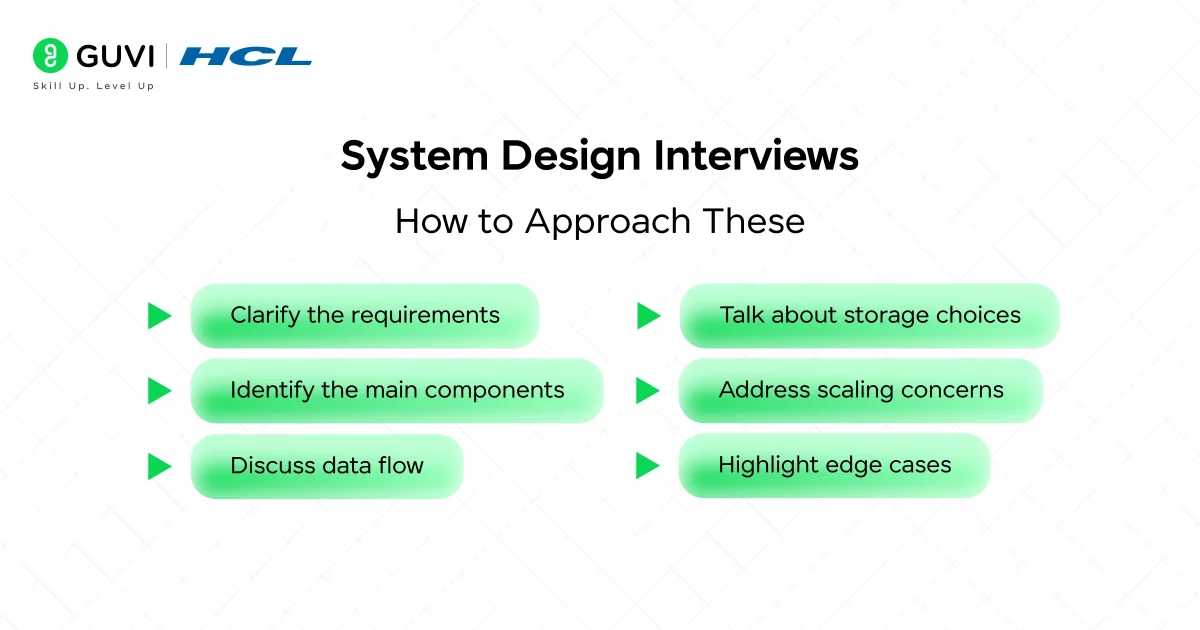
How to Approach These
Break your explanation into clear steps:
- Clarify the requirements
- Identify the main components
- Discuss data flow
- Talk about storage choices
- Address scaling concerns
- Highlight edge cases
What Interviewers Want to See
- Clear reasoning
- Trade-off understanding
- Familiarity with APIs and data modeling
- Practical, not perfect, solutions
Remember, startups value simplicity. Overengineering can be a red flag.
5. API Design Questions
Some startups like to explore your understanding of API design, especially if the product interacts with other services or third-party systems. These questions measure whether you can structure endpoints in a way that’s intuitive, consistent, and easy to consume.

You might need to design a small REST API for managing users, tasks, or items, including how requests and responses should look, how errors should be handled, and how future versions could be supported.
Interviewers want to see whether you can think from the perspective of both the developer building the API and the developer consuming it. Clean routes, clear payload formats, sensible conventions, and predictable behavior matter a lot.
What You Might Be Asked
- Design a REST API for managing users or tasks.
- Create endpoints for paginated search.
- Explain how rate limiting should work.
- Describe how you’d handle authentication and authorization.
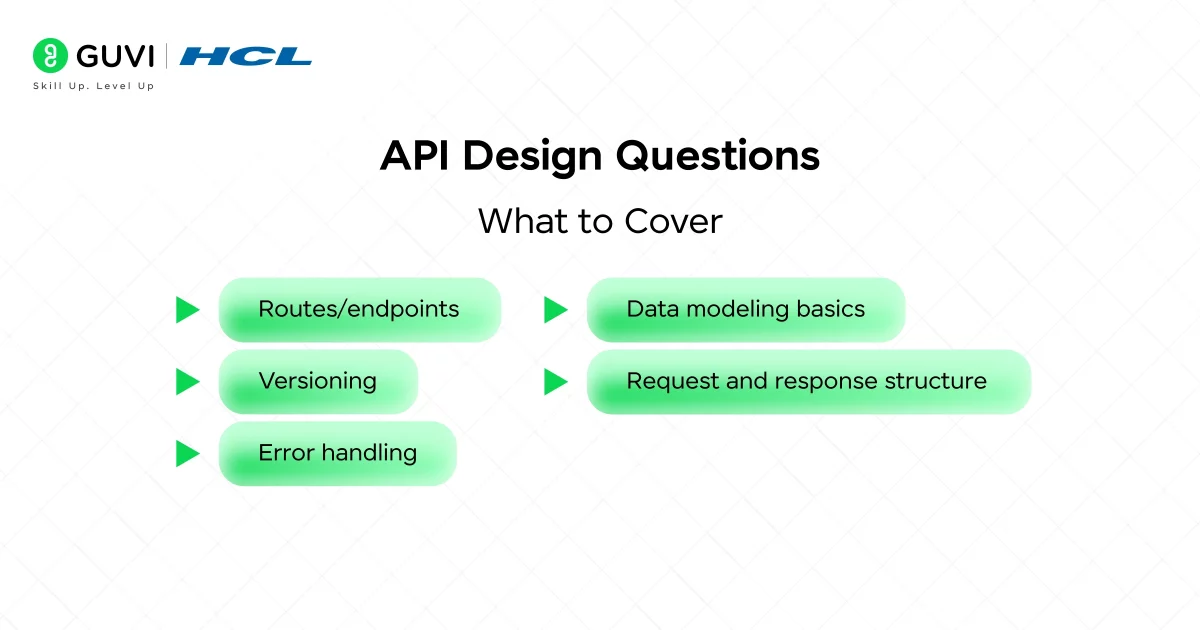
What to Cover
- Routes/endpoints
- Request and response structure
- Error handling
- Versioning
- Data modeling basics
If you can explain your API design as if you’re talking to another engineer on your team, that’s a strong signal.
6. Practical Problem-Solving Questions
These questions reflect the actual challenges startups face daily.
Examples
- You’re assigned a bug with minimal context. How do you start?
- A new feature request conflicts with the existing architecture. What’s your approach?
- You need to refactor a critical module without introducing downtime. How do you plan it?
Why These Matter
Startups need engineers who can think holistically, combining communication, creativity, and technical grounding.
7. Behavioral Questions You’ll Still Encounter
Even though startups focus heavily on technical depth, behavioral questions play a surprisingly important role. They help interviewers understand what it’s like to work with you day to day, how you handle ambiguity, and how you respond to challenges.
Startups rely on small teams, which means one person’s mindset, habits, or communication style can affect the entire group. Behavioral questions offer a window into how you collaborate and how you grow.
Examples
- Tell us about a time you improved a system or process.
- Describe a technical challenge that pushed you to learn something new.
- Share an example where you collaborated with a product or design to solve a problem.
- When you’re stuck on a complex bug, what’s your method for unblocking yourself?
What Interviewers Listen For
- Ownership
- Team mindset
- Communication clarity
- Curiosity
- Humility
These aren’t just soft questions; they help interviewers understand how you’ll fit into a small, fast-moving team.
Quickly prepare for Behavioral questions and HR Interviews with this blog – Top 25 HR Interview Questions and Answers
A Closer Look at Real Startup-Style Questions
To make your prep more concrete, here are some realistic examples:
Problem 1: Build a basic rate limiter
What they’re testing: Understanding of time windows, caching, and resource control.
Problem 2: Design a notification system
What they’re testing: Data flow, queues, reliability, and user experience.
Problem 3: Given logs of API requests, find the most frequent users
What they’re testing: Hash maps, iteration, sorting.
Problem 4: Fix this broken snippet
What they’re testing: Debugging instinct and language familiarity.
Problem 5: Build a search function for a product list
What they’re testing: Filtering logic, sorting, and optional pagination.
You don’t need perfect answers. You need clarity.
Tips to Handle Startup Technical Interviews with Confidence
Startups care about how you think, not how fast you solve a LeetCode problem. Here’s how to stay grounded and confident.
Before the Interview
- Brush up on fundamentals
- Practice communication with mock interviews
- Review a few common design patterns
- Work on basic system design and data modeling
- Read code written by others, not just your own
During the Interview
- Ask clarifying questions
- Talk through trade-offs
- Keep your code modular
- Review your solution before you say you’re done
- If you get stuck, verbalize your thought process
After the Interview
- Reflect on any questions that caught you off guard
- Note areas where your explanations felt unclear
- Don’t over-prepare for niche algorithms—focus on real-world scenarios
If you focus on these skills, you’ll walk into your next interview with a lot more confidence and a lot less anxiety.
If you want to stand out in your interview, even if you are a fresher, then read the blog – 17 Tips to Stand Out in Entry-Level Tech Interviews
If you’re serious about mastering software developer interviews along with AI and want to apply it in real-world scenarios, don’t miss the chance to enroll in HCL GUVI’s IITM Pravartak and MongoDB Certified Online AI Software Development Course. Endorsed with NSDC certification, this course adds a globally recognized credential to your resume, a powerful edge that sets you apart in the competitive job market.
Conclusion
In conclusion, preparing for startup technical interviews becomes a lot less intimidating once you understand what’s actually being tested. You’re not walking into a marathon of trick questions or obscure theory. You’re stepping into a conversation where the interviewer wants to see how you think, how you communicate, and how you turn real-world problems into clean, intentional solutions.
When you focus on fundamentals, stay curious, and approach each question with a calm, structured mindset, you’ll start to notice that these interviews feel more like collaborative problem-solving sessions than high-pressure exams. And once you build that confidence, you’ll be ready to walk into any startup interview knowing you can handle whatever they throw your way.
FAQs
1. What technical questions do startups usually ask?
Startups focus on practical coding tasks, debugging exercises, system design basics, and real-world problem-solving. They often mix algorithm questions with feature-building prompts to gauge how you think and communicate.
2. Are startup interviews harder than big tech interviews?
They aren’t necessarily harder, but they’re less predictable. Startups prioritize versatility, clarity, and problem-solving over rigid algorithm depth, so you may face more practical, product-focused questions.
3. How should I prepare for coding interviews at startups?
Strengthen your fundamentals, practice writing clean code, review common patterns, and do a few mock sessions to refine your communication. Focus on real-world scenarios, not just competitive programming.
4. Do startups ask system design questions for junior roles?
Yes, but they keep them lightweight. Expect small-scale designs like messaging features, notification flows, or simple APIs that test your structural thinking rather than your architectural expertise.
5. How important is communication in a startup interview?
Extremely important. Interviewers pay close attention to how clearly you explain your ideas, walk through your reasoning, and adjust based on feedback, since teams are small and collaboration is constant.
Success Stories

About the Author
Lukesh S
A professional content writer who has experience in freelancing and now working as a Technical Content Writer at HCL GUVI having sound knowledge in Blog Writing and Creative Writing!
View all posts by Lukesh S
Connect with me @










Did you enjoy this article?