


Interview Articles
InfyTQ Interview Experience 2026: Process, Questions, Preparation & Tips
Deloitte NLA Interview Experience 2026: Rounds, Questions and Preparation - Best Guide
Capgemini Exceller Interview Questions 2026: Coding, Technical, HR, and AI Prep - Best Guide
Wipro Elite NTH Interview Experience 2026: What Candidates Say


Get In Touch For Details! Request More Information
Technical Writer Interview Questions: What Recruiters Really Ask in 2026
Feb 23, 2026 8 Min Read 1507 Views
(Last Updated)
What do recruiters really want from technical writers in 2026? The answer goes far beyond grammar and formatting. Modern recruiters evaluate how well you think, collaborate, and communicate across tools, technologies, and teams.
Whether you are getting ready for your first documentation interview or updating your approach for a senior role, understanding what recruiters will ask gives you more than just prepared answers. It helps you speak with confidence, show precision in your thinking, and present your skills in a way that feels real and relevant.
Keep reading to explore this complete 2026 recruiter guide and learn what questions to prepare for in your next technical writer interview.
Quick Answer: Technical writer interviews in 2026 focus on clarity, collaboration, and adaptability. Recruiters assess how you explain complex ideas, use AI responsibly, and align writing with business goals. Mastering documentation tools, understanding user needs, and communicating effectively across teams are key to standing out and advancing your technical writing career.
- Despite moderate growth, technical writing sees around 4,500 new job openings every year. It shows how stable and recurring the demand for skilled documentation professionals remains.
- The average salary for technical writers in the U.S. is around $86,000 per year.
- In India, entry-level technical writers often earn between ₹4–6 lakh/year, mid-level around ₹7–10 lakh/year, and experienced writers can earn ₹12 lakh or more annually depending on company and role.
Table of contents
- Who Is a Technical Writer?
- Core Technical Writing and Communication Questions
- Technical Tools, Platforms, and Domain Knowledge
- Key Technical Tools to Review Before a Technical Writer Interview (2026)
- Collaboration and Workflow Questions
- Behavioral and Scenario-Based Questions
- Domain-Specific and AI-Driven Documentation Questions
- Domain Relevance and Audience Adaptation
- Collaboration Between Writers and AI
- Writing for AI, Data, and Complex Systems
- Evaluating and Improving AI-Driven Documentation
- Adapting to Industry Shifts and Emerging Tools
- Career Growth and Future-Focused Questions
- Professional Growth and Learning Mindset
- Long-Term Career Vision
- Conclusion
- FAQs
- Will AI replace technical writers?
- What skills do recruiters expect from technical writers in 2026?
- How do recruiters evaluate a technical writer’s collaboration skills?
- How can you prepare for AI-related technical writing questions?
Who Is a Technical Writer?
A technical writer is a professional who translates complex technical concepts into clear and user-friendly documentation. They bridge the gap between engineers, developers, and end users by turning technical knowledge into accessible formats. Technical writing is a rewarding career that combines technology and creativity. It offers opportunities to work in diverse industries like software development, AI, healthcare, and fintech.
Top Skills Every Technical Writer Needs
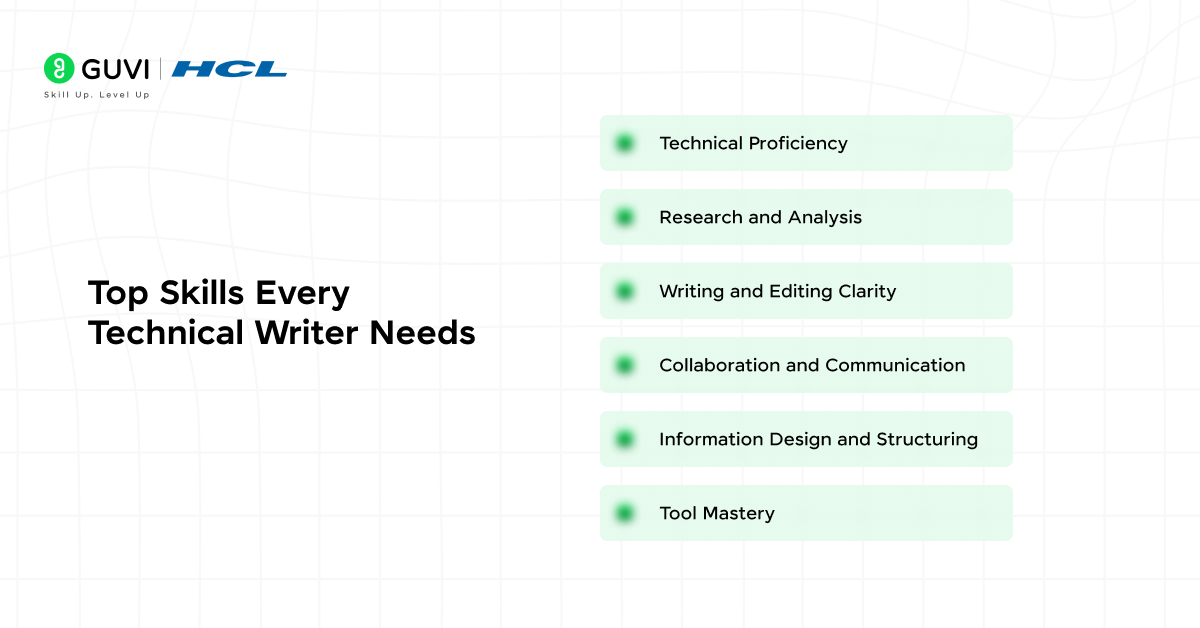
- Technical Proficiency: Understanding programming basics, APIs, and software tools helps writers communicate technical information accurately and confidently.
- Research and Analysis: The ability to extract details from complex systems and translate them into structured content ensures accuracy and completeness in documentation.
- Writing and Editing Clarity: Strong command over language, grammar, and structure helps convey ideas with precision and flow, reducing ambiguity for readers.
- Collaboration and Communication: Working closely with developers, designers, and product teams requires active listening and adaptability.
- Information Design and Structuring: Organizing content logically through headings, visuals, and consistent formatting enhances readability and user engagement.
- Tool Mastery: Familiarity with documentation tools such as Markdown, Git, Confluence, and MadCap Flare enables efficiency and collaboration in modern workflows.
Core Technical Writing and Communication Questions
Recruiters in 2026 focus on how you think through information rather than how many documents you have written. Before your interview, review how you structure your explanations, collaborate with engineers, and edit your own work. Here are examples of what recruiters now ask in this area:
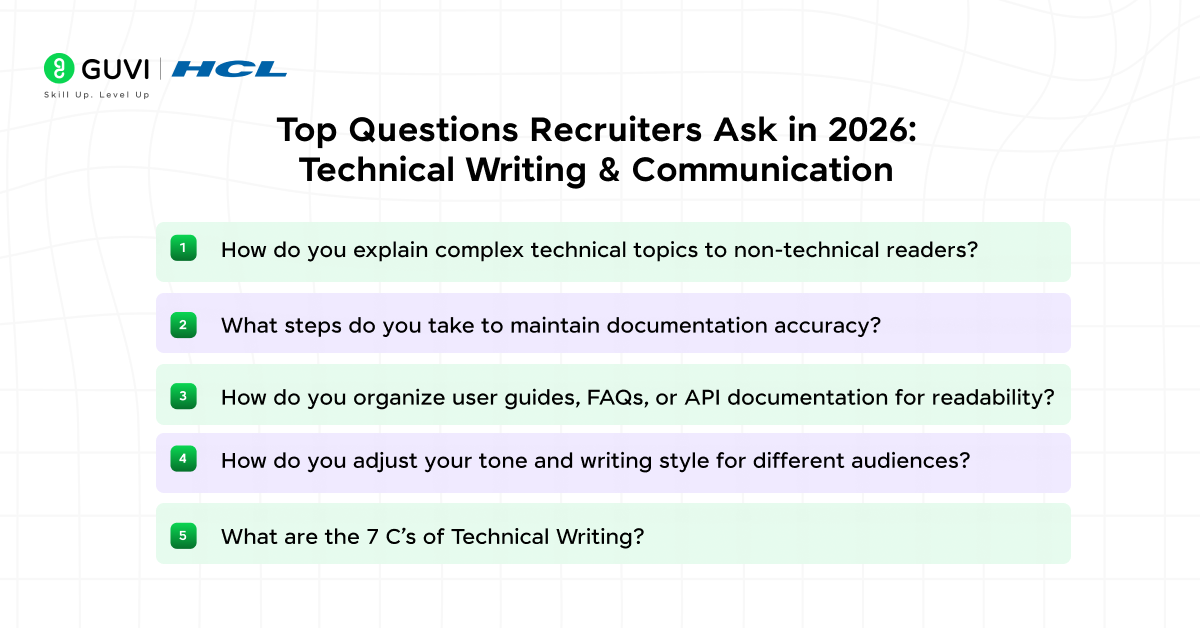
1. How do you explain complex technical topics to non-technical readers?
This question helps recruiters understand how you approach clarity and structure. They also assess essential soft skills for tech professionals, such as communication and empathy. Recruiters listen for examples that show how you break large ideas into smaller and understandable parts without losing accuracy or confidence in delivery.
2. What steps do you take to maintain documentation accuracy?
Recruiters assess whether you verify facts with subject matter experts, manage updates consistently, and keep tone and terminology uniform across projects. They also check whether you use tools such as version control or content management systems to track revisions.
3. How do you organize user guides, FAQs, or API documentation for readability?
This question explores your understanding of hierarchy, flow, and accessibility. Recruiters usually want to know how you decide what information comes first and how you guide users through it without confusion.
4. How do you adjust your tone and writing style for different audiences?
This question checks whether you can shift between developer documentation, user-facing content, or internal process guides. Recruiters value adaptability that keeps information consistent across diverse user groups.
5. What are the 7 C’s of Technical Writing?
Recruiters also use the 7 C’s of technical writing as a quick way to evaluate how clearly and professionally a candidate communicates. These principles help ensure that documentation is accurate, easy to follow, and valuable for both technical and non-technical audiences.
The 7 C’s include:
- Clarity: Every sentence must convey a single, precise idea without ambiguity.
- Concise: Use only the words needed to express the message directly.
- Completeness: Include all necessary details so the reader can act without confusion.
- Consistency: Maintain uniform terminology, structure, and tone across documents.
- Correctness: Ensure technical accuracy, grammar, and data reliability.
- Courtesy: Write respectfully and helpfully, keeping the reader’s perspective in mind.
- Concreteness: Support explanations with specific facts, examples, or visuals.
Technical Tools, Platforms, and Domain Knowledge
In 2026, recruiters evaluate how well technical writers use modern tools, how AI works, and workflows that support real-time collaboration. The profession now requires comfort with automation and developer environments.
Here are common recruiter questions for this area:
1. Which documentation tools have you used and why?
You may mention Markdown, Confluence, Git, or MadCap Flare. Recruiters expect you to describe how each tool fits into your workflow and how it improves collaboration or content management.
2. Do you have experience writing API documentation or developer guides?
Recruiters often test your proficiency to deal with developer-focused writing. They look for familiarity with tools such as Swagger, Postman, or Redocly and want to see how you balance accuracy with readability.
3. How do you stay updated on new technologies relevant to documentation?
This question reveals curiosity and initiative. Recruiters value writers who stay informed about topics like AI-driven documentation tools, DevOps processes, and data-driven content systems. Candidates who follow tech blogs, communities, or certification programs show readiness for growth.
4. Can you explain a technical concept as if you were teaching a new user?
Recruiters often ask this to see how well you simplify without oversimplifying. You may be asked to explain topics such as API authentication or API Response structure best practices, cloud deployment, or version control in plain terms. The answer shows how clearly you think and how well you adapt language to user needs.
5. How do you measure the success of your documentation projects?
Recruiters expect writers to think beyond content delivery. They want candidates who mention metrics such as user satisfaction scores, support ticket reduction, or content reuse efficiency. A data-backed explanation shows you understand documentation as part of business value creation.
Key Technical Tools to Review Before a Technical Writer Interview (2026)
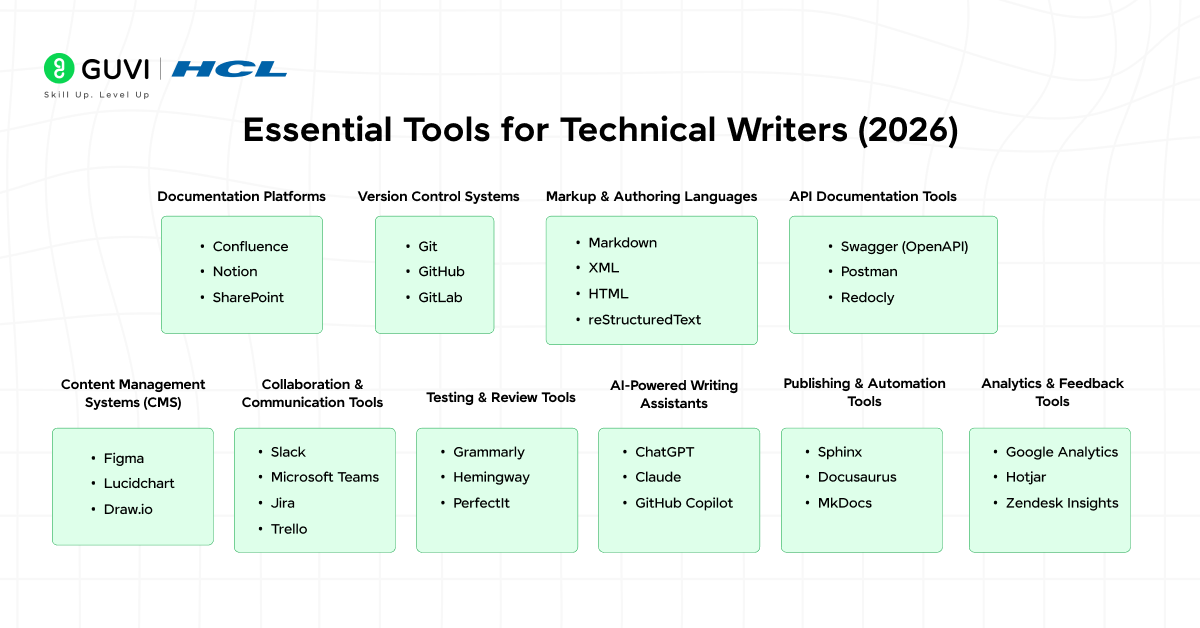
Also, here is a quick reference table that will help you revise essential technical tools before your interview. Reviewing these ensures that you can answer confidently when recruiters ask about your tool proficiency and practical workflow experience:
| Tool Category | Examples to Review | Purpose in Technical Writing | What Recruiters Look For |
| Documentation Platforms | Confluence, Notion, SharePoint | Organize, collaborate, and publish internal or external docs | Familiarity with structured documentation workflows |
| Version Control Systems | Git, GitHub, GitLab | Manage versions, track edits, and collaborate with developers | Understanding of branching, commits, and pull requests |
| Markup and Authoring Languages | Markdown, XML, HTML, reStructuredText | Create readable, reusable, and exportable technical documents | Ability to write clean, consistent, and validated code |
| API Documentation Tools | Swagger (OpenAPI), Postman, Redocly | Document RESTful APIs and integrate with developer workflows | Skill in structuring endpoints, parameters, and examples |
| Content Management Systems (CMS) | MadCap Flare, Paligo, Adobe FrameMaker | Manage modular documentation and multi-format publishing | Experience with topic-based authoring and single sourcing |
| Design and Visualization Tools | Figma, Lucidchart, Draw.io | Create diagrams, visuals, and flow representations | Ability to convert complex processes into simple visuals |
| Collaboration & Communication Tools | Slack, Microsoft Teams, Jira, Trello | Coordinate documentation tasks with cross-functional teams | Clear understanding of agile documentation processes |
| Testing & Review Tools | Grammarly, Hemingway, PerfectIt | Review grammar, readability, and tone | Consistency in language and attention to linguistic detail |
| AI-Powered Writing Assistants | ChatGPT, Claude, GitHub Copilot | Accelerate drafting and maintain style consistency | Balanced use of AI tools with human editing judgment |
| Publishing & Automation Tools | Sphinx, Docusaurus, MkDocs | Automate builds and deploy documentation websites | Experience with static site generation and versioning |
| Analytics & Feedback Tools | Google Analytics, Hotjar, Zendesk Insights | Measure documentation usage and user engagement | Ability to interpret data and improve content strategy |
Collaboration and Workflow Questions
Technical writing has become a collaborative profession where teamwork defines success. Recruiters in 2026 evaluate how well you work with developers, data engineers, designers, and product teams to produce accurate and timely documentation. Below are the questions recruiters commonly ask in this area:
1. How do you collaborate with developers and subject matter experts?
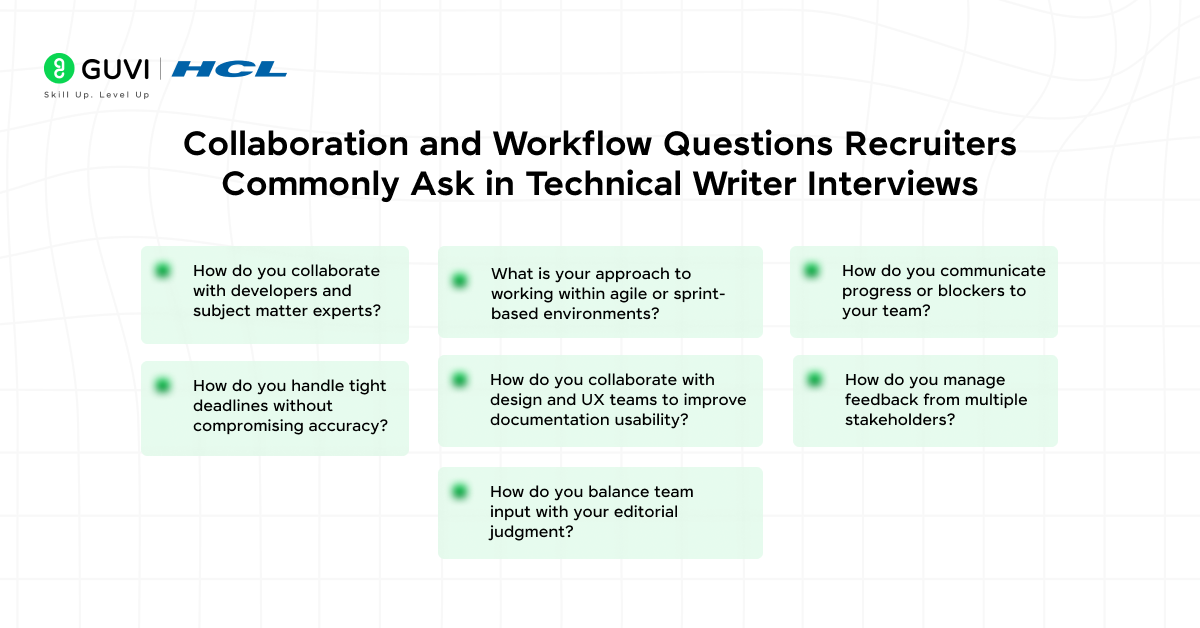
Recruiters ask this to understand how you gather information. They listen for examples where you build strong relationships with technical experts, ask focused questions, and verify content before publishing. They also observe whether you value active listening, which improves accuracy and mutual trust.
2. How do you manage feedback from multiple stakeholders?
Documentation involves input from several reviewers, each with a different focus. Recruiters want to know if you have a structured system for tracking feedback, such as using version control or comment threads within documentation tools. They value candidates who stay calm, organized, and objective even when feedback conflicts.
3. What is your approach to working within agile or sprint-based environments?
Recruiters assess your familiarity with iterative workflows. They often ask how you align documentation tasks with product releases or sprint goals. They prefer writers who attend stand-up meetings, track progress with tools like Jira or Asana, and communicate blockers early.
4. How do you handle tight deadlines without compromising accuracy?
This question evaluates how you balance speed and precision. Recruiters want to see practical examples of prioritizing sections, using templates, and coordinating early reviews. Candidates who describe calm decision-making and clear communication under time pressure stand out.
5. How do you collaborate with design and UX teams to improve documentation usability?
Modern documentation is visual as much as textual. Recruiters ask this to check whether you understand layout, readability, and accessibility. They value candidates who coordinate visuals, screenshots, and user interface terminology to make content intuitive.
6. How do you communicate progress or blockers to your team?
Clear status updates are essential in cross-functional teams. Recruiters listen for structure in your approach. They prefer candidates who summarize issues, propose next steps, and notify teams before a delay escalates. Consistent communication demonstrates reliability.
7. How do you balance team input with your editorial judgment?
Recruiters explore how you maintain authority without being rigid. They often ask how you handle situations where technical teams suggest edits that weaken readability. Explaining how you present rationale for clarity decisions shows professionalism and leadership maturity.
Behavioral and Scenario-Based Questions
Recruiters in 2026 view behavioral questions as the most reliable way to understand a candidate’s mindset and working habits. Behavioral and scenario-based questions reveal how you think, react, and make decisions.
The most effective responses use the STAR framework: Situation, Task, Action, and Result. This structure allows you to present a clear narrative without drifting into vague explanations. Recruiters in 2026 usually expect you to apply STAR naturally to describe how you handled technical, interpersonal, or process-related challenges.
Here are the types of behavioral and situational questions that recruiters frequently ask:

1. Can you describe a time when you managed multiple documentation deadlines?
This question helps recruiters understand your ability to prioritize. They listen for examples where you assessed urgency, set milestones, and communicated realistic timelines to stakeholders. Writers who describe proactive coordination between teams demonstrate reliability and self-management.
2. How did you handle a disagreement with a developer or reviewer about content accuracy?
Recruiters explore how you balance confidence with diplomacy. They want to know whether you verified the concern, supported your position with data or testing, and maintained professionalism throughout. A strong response shows respect for technical expertise while preserving clarity and user focus.
3. Describe a situation where you had to learn a new technology quickly to complete a project.
Adaptability defines success in modern documentation. Recruiters want to see that you can research, experiment, and produce content within a limited time. Explaining how you structured your learning and validated information demonstrates independence and curiosity.
4. How did you respond when your documentation received critical feedback from a manager or client?
This question measures emotional maturity. Recruiters assess whether you reacted defensively or constructively. They look for candidates who treat feedback as guidance, not rejection, and who adjust content thoughtfully while maintaining their professional tone.
5. Tell me about a project where you identified and fixed a recurring documentation issue.
This question reveals problem-solving ability. Recruiters value candidates who analyze the root cause rather than treat surface symptoms. Explaining how you standardized formats, improved workflows, or introduced checklists demonstrates initiative and attention to process efficiency.
6. How did you handle a situation where a project scope changed suddenly?
Recruiters test your ability to stay composed under uncertainty. They want to know whether you reviewed priorities, clarified deliverables, and adjusted expectations early. Effective answers show calm reasoning and practical flexibility.
Domain-Specific and AI-Driven Documentation Questions
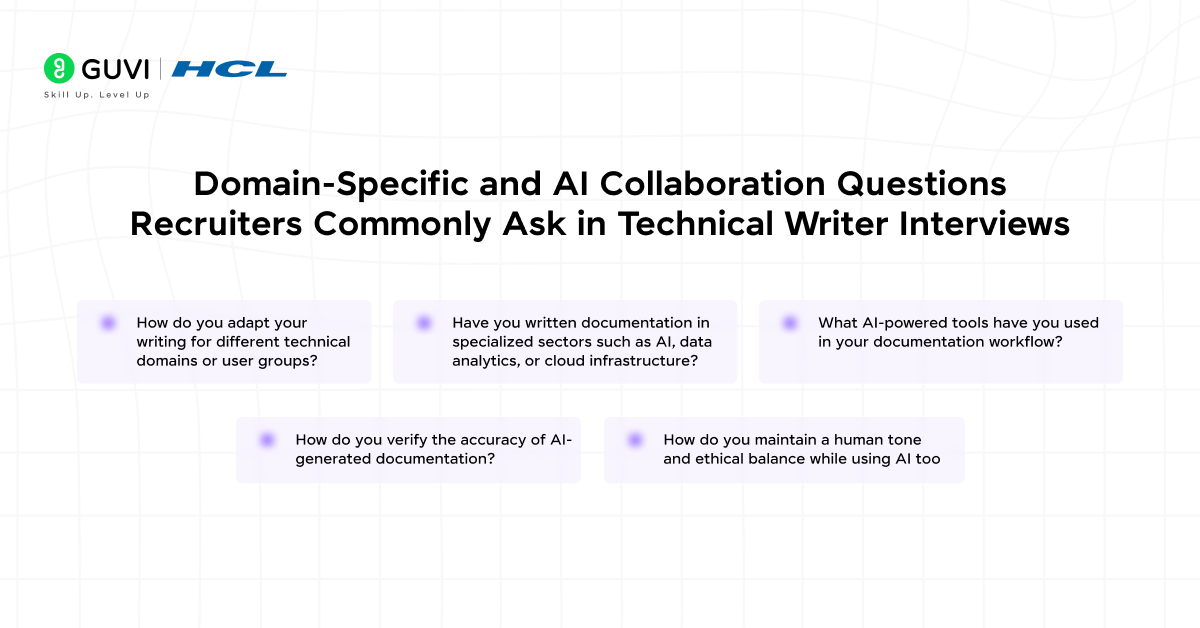
Recruiters in 2026 evaluate technical writers through two lenses: domain understanding and AI adaptability. Recruiters value candidates who can speak the language of developers and business users with equal confidence. This skill is particularly relevant in industries such as cloud computing, cybersecurity, fintech, healthcare, and AI research, where accuracy and compliance determine content credibility.
In 2026, technical writing roles are also deeply influenced by AI-assisted documentation pipelines. Companies rely on generative AI to produce drafts and predict information gaps. Recruiters now test how writers use these tools responsibly: verifying AI-generated text, managing metadata, and maintaining documentation integrity.
Here are the key areas and questions recruiters focus on in 2026 interviews:
1. Domain Relevance and Audience Adaptation
- How do you adapt your writing for different technical domains or user groups?
Recruiters assess your awareness of varied reader levels. They look for candidates who explain how they simplify code-heavy topics for non-developers or add precision for engineering audiences. Writers who mention tailoring vocabulary, structure, and tone for each audience demonstrate mature content strategy skills.
- Have you written documentation in specialized sectors such as AI, data analytics, or cloud infrastructure?
Recruiters value writers who can handle domain-specific challenges, such as describing APIs, compliance workflows, or algorithm logic. Mentioning familiarity with cloud platforms like AWS or Azure or data tools such as TensorFlow and Spark signals readiness for complex documentation projects.
2. Collaboration Between Writers and AI
- What AI-powered tools have you used in your documentation workflow?
Recruiters look for familiarity with emerging tools like ChatGPT Enterprise, GitHub Copilot, or Writer.com that support writing and review processes. They want to hear how you integrate them into documentation cycles while maintaining critical review at every stage.
- How do you verify the accuracy of AI-generated documentation?
This question tests your editorial control. Recruiters expect you to explain how you cross-check code snippets, validate parameters, and align auto-generated text with developer input. They look for writers who can detect factual drift or stylistic inconsistency caused by automation.
- How do you maintain a human tone and ethical balance while using AI tools?
Recruiters in 2026 care deeply about responsible AI tools and their usage. They expect writers to understand the risks of bias, over-reliance, and misinformation. Explaining that you maintain an editorial checklist for inclusivity and tone alignment reflects accountability.
3. Writing for AI, Data, and Complex Systems
- Can you explain how you would document an AI-based system or data pipeline?
Recruiters use this question to assess conceptual understanding. They look for writers who can describe training data, model architecture, and deployment processes in structured, accessible language. Clarity and logical sequencing of ideas demonstrate both domain comprehension and communication skill.
- How do you write for products that continuously evolve, such as ML models or cloud APIs?
Recruiters value consistency and proactive management. They expect you to mention techniques such as maintaining release notes, changelogs, and auto-generated references tied to product updates. The ability to handle fast iteration cycles reflects adaptability.
4. Evaluating and Improving AI-Driven Documentation
- How do you measure the performance of AI-assisted documentation?
Recruiters now assess data-driven thinking. Writers are expected to track metrics such as content reuse rates or user interaction analytics. Those who use AI dashboards or A/B testing for documentation improvements show high analytical maturity.
- What challenges have you faced when integrating AI into documentation workflows?
This question explores critical awareness. Recruiters listen for responses mentioning hallucination issues, loss of contextual depth, or version mismatches. Candidates who propose practical solutions such as human-in-the-loop review pipelines or metadata tagging demonstrate technical leadership.
5. Adapting to Industry Shifts and Emerging Tools
- How do you stay updated with documentation technology trends?
Recruiters look for continuous learners. They value writers who read engineering blogs, participate in documentation forums, and test tools like Docs-as-Code frameworks or OpenAPI. Mentioning that you adapt workflows as tools evolve shows professional resilience.
Career Growth and Future-Focused Questions
During interviews, recruiters focus on how candidates plan their professional development. They look for curiosity, adaptability, and initiative. These are the fine qualities that show you will stay updated in transforming the digital environment.
Here are the key areas recruiters now explore when discussing career development and future readiness:
1. Professional Growth and Learning Mindset
- How do you plan to keep your technical writing skills relevant over the next few years?
Recruiters expect specific learning strategies rather than general statements. They look for candidates who mention continuous education through online courses or documentation communities. Writers who show a plan for adapting to new tools or formats signal long-term reliability.
- Which new skills are you currently building that support your technical writing career?
This question helps recruiters identify your initiative and technical skills. They want to know whether you are learning automation or AI-assisted authoring. Candidates who mention experimenting with documentation APIs, structured data, or prompt writing demonstrate forward-thinking technical skills
2. Long-Term Career Vision
- What kind of technical writing projects or roles do you want to grow into?
Recruiters want to understand whether your goals align with the company’s direction. They listen for clear, realistic aspirations such as transitioning into documentation strategy, information architecture, or content design leadership. Candidates who express focused ambition stand out as committed professionals.
- Where do you see the future of technical writing heading?
This question checks your industry awareness. Recruiters expect answers that mention Artificial Intelligence integration, modular content reuse, and documentation analytics. They appreciate candidates who explain how these shifts will redefine writing as a data-informed and collaborative discipline.
Ready to stand out in your Technical Writer interview? Learn how to answer with precision and confidence through HCL GUVI’s Interview Preparation Course, crafted to help you master both technical and communication skills recruiters expect in 2026. Get mock interview practice, expert feedback, and guidance to present your writing, collaboration, and tool proficiency like a pro. Build your confidence, refine your delivery, and ace every question that comes your way.
Conclusion
Preparing for a technical writer interview in 2026 means blending writing skills with technological awareness. Recruiters now concentrate on how well you communicate across AI tools and collaborate in agile environments. Each question is an opportunity to show clarity, structure, and adaptability. When you study tools, review your writing samples, and understand how documentation adds business value, you demonstrate the mindset recruiters value most: thoughtful, informed, and ready to grow in a rapidly growing technical domain.
FAQs
1. Will AI replace technical writers?
AI will not replace technical writers but will transform how they work. Tools like ChatGPT and GitHub Copilot can assist with drafting, formatting, and summarizing, but they lack the human judgment and contextual reasoning needed for accurate documentation. Technical writing depends on clarity and adaptability across complex systems. These are the qualities that remain uniquely human. Basically, the future favors writers who combine AI efficiency with critical thinking and curation.
2. What skills do recruiters expect from technical writers in 2026?
Recruiters in 2026 expect candidates to demonstrate both writing precision and technical fluency. They value writers who can document APIs, automate publishing workflows, and use analytics to improve content strategy. Proficiency in Git-based collaboration, Markdown authoring, and AI-assisted documentation tools is also considered essential.
3. How do recruiters evaluate a technical writer’s collaboration skills?
Recruiters assess collaboration through examples of how you work with developers, UX designers, and product teams. They look for structured communication, calm handling of feedback, and active participation in agile processes.
4. How can you prepare for AI-related technical writing questions?
Preparation should include understanding AI-assisted documentation tools such as ChatGPT Enterprise, GitHub Copilot, and Writer.com. Review how AI supports version control, metadata tagging, and content suggestions. Recruiters expect you to explain how you verify AI-generated content, prevent bias, and maintain editorial integrity throughout documentation workflows.
Success Stories

About the Author
Vaishali
I'm a seasoned writer with four years of experience across technical, non-technical, and just about every genre or niche you can imagine. Adaptable and curious, I enjoy exploring new topics and making information engaging and easy to understand. Fueled by a steady stream of tea, I approach each project with creativity, reliability, and genuine enthusiasm for storytelling.
View all posts by Vaishali
Connect with me @












Did you enjoy this article?