


Data Science Articles
Accountant to Data Analyst: Skills, Roadmap and Career Path (2026)
SQL for customer support executives: What to Learn and How to Practice
Accounting Team Lead to Data Analytics Skills and Roadmap
Can an Insurance Professional Become a Data Analyst Early in Their Career?


Get In Touch For Details! Request More Information

Data Strategist Salary in India 2026: A Detailed Breakdown
Nov 11, 2026 6 Min Read 2396 Views
(Last Updated)
Table of contents
- TL;DR
- Who Is a Data Strategist, and What Do They Do?
- Key Responsibilities of a Data Strategist
- Why the rising demand?
- Data Strategist Salary Breakdown by Experience – What You Might Expect
- Data Strategist vs Data Analyst vs Data Scientist: Salary and Role Comparison
- What Factors Affect a Data Strategist's Salary in India?
- Professional Experience
- Technical Skills
- Business and Domain Knowledge
- Stakeholder Management
- Company Size and Data Maturity
- Leadership Responsibilities
- Demonstrated Business Impact
- Skills to Improve Your Data Strategist Salary Potential
- Business and strategic understanding
- Communication and storytelling
- Technical fluency
- What’s Next?
- AI is becoming central to strategy
- Salaries are rising steadily
- From dashboards to decisions
- Remote and hybrid opportunities
- Data governance is the next big thing
- Which Industries Offer Higher-Paying Opportunities?
- What to Ask Yourself (and Your Employer) in a Salary Conversation
- Want to Build the Skills for a Data Strategy Career?
- Conclusion
- FAQs
- What is the average salary for a Data Strategist in India?
- How much can a senior-level Data Strategist earn in India?
- Can a Data Strategist earn more than ₹30 LPA?
- What skills help increase the salary potential of a Data Strategist?
- Can a fresher or someone with little experience enter as a Data Strategist and earn a high salary?
- Which industries hire Data Strategists?
TL;DR
- Data Strategist Salary in India: Indicative annual compensation ranges from ₹10–15 LPA for early-career professionals to ₹28–35 LPA or more for experienced leaders.
- Experience Matters: Professionals with strong strategic ownership, stakeholder management, and measurable business impact may qualify for higher-paying positions.
- Top Hiring Locations: Bengaluru, Mumbai, Delhi-NCR, Hyderabad, Pune, and Chennai offer opportunities across technology, consulting, finance, and analytics.
- High-Value Skills: SQL, Python, Power BI, Tableau, data governance, business strategy, stakeholder management, and AI fundamentals.
- Career Growth: Data Analyst → Senior Data Analyst → Analytics Lead → Data Strategist → Head of Data Strategy.
- Industry Influence: Compensation varies across technology, fintech, consulting, e-commerce, healthcare, and manufacturing.
- Salary Negotiation: Evaluate base salary, variable pay, benefits, role responsibilities, and growth opportunities before accepting an offer.
- Career Outlook: AI adoption, data governance, and business-focused analytics are influencing the responsibilities of Data Strategy professionals.
What if your next career move could take you from analysing data to influencing million-rupee business decisions? That’s the opportunity a Data Strategist role can offer.
While Data Analysts focus on interpreting information and Data Scientists build predictive models, Data Strategists take a broader view. They connect data initiatives with business priorities, help organizations make informed decisions, and identify opportunities where analytics can deliver measurable value. But with greater responsibility comes an important question: How much does a Data Strategist earn in India in 2026?
Can someone with a few years of analytics experience earn ₹15 LPA? What does it take to reach ₹25–30 LPA? And which skills, industries, and locations offer stronger salary opportunities? The answers depend on more than your years of experience. Your technical knowledge, industry expertise, ability to influence business decisions, and scope of responsibility can all affect your compensation.
In this guide, we’ll explore the Data Strategist salary in India, experience-wise salary ranges, city and industry considerations, essential skills, career progression, and practical strategies to improve your earning potential.
Who Is a Data Strategist, and What Do They Do?
A Data Strategist is a professional who helps organizations use data to achieve business objectives, improve decision-making, and develop long-term analytical capabilities.
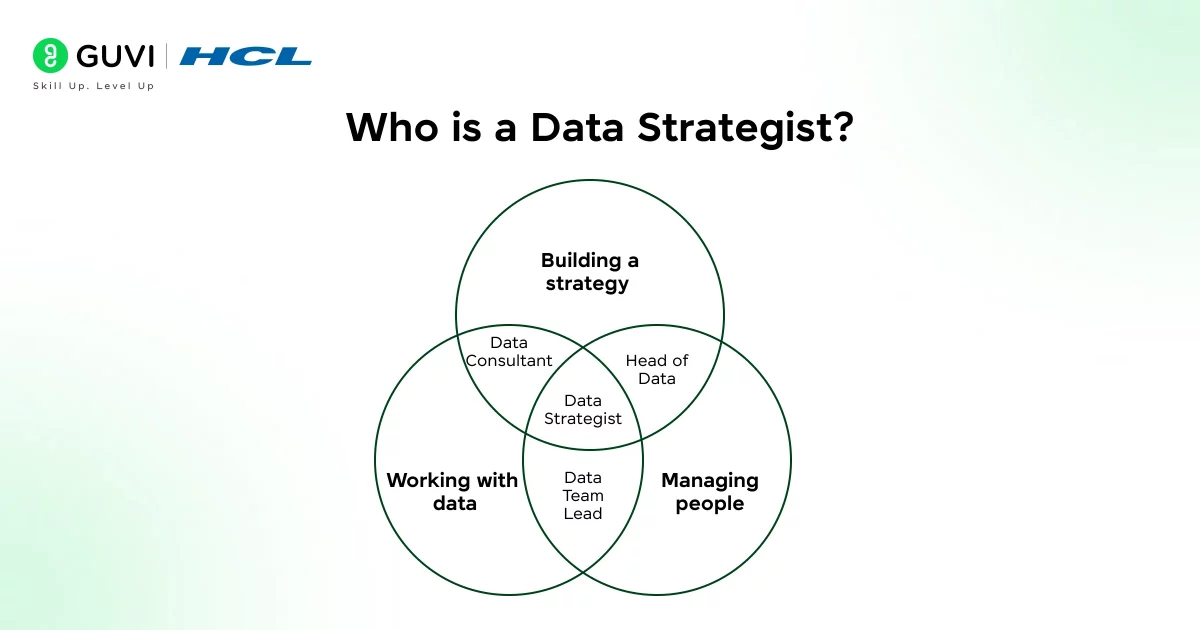
The role combines business understanding, analytical knowledge, strategic planning, and stakeholder collaboration. For example, imagine an e-commerce company struggling with customer retention.
- A Data Analyst might create a dashboard showing customer churn trends.
- A Data Scientist might build a model predicting which customers are likely to leave.
A Data Strategist would help identify which customer problems matter most, determine how analytics should support retention decisions, prioritize initiatives, and establish how success will be measured.
Key Responsibilities of a Data Strategist
| Responsibility | What It Involves |
|---|---|
| Data Strategy Development | Aligning data initiatives with business goals |
| Business Analysis | Identifying opportunities for data-driven improvements |
| Stakeholder Management | Collaborating with leadership and functional teams |
| Data Governance | Supporting data quality, ownership, and responsible usage |
| Analytics Planning | Prioritizing dashboards, reporting, and analytical initiatives |
| KPI Development | Defining metrics to measure business performance |
| Strategic Communication | Presenting findings and recommendations |
| AI and Analytics Adoption | Evaluating opportunities to use advanced analytics and AI |
A Data Strategist doesn’t necessarily need to build every model or dashboard personally. However, they need enough technical understanding to evaluate analytical solutions and recommend appropriate approaches.
Why the rising demand?
- Organizations increasingly realize that data is not just a by-product but a strategic asset.
- As more companies adopt analytics, AI, and ML, the question shifts from “can we do analytics?” to “how can we embed analytics into our strategy?”
- In India, with the growing adoption of data-driven decision-making in sectors such as fintech, e-commerce, healthcare, and manufacturing, a role like Data Strategist is increasingly valued.
If you want to know how to become a successful data strategist, consider reading – How to Become a Data Strategist
Data Strategist Salary Breakdown by Experience – What You Might Expect
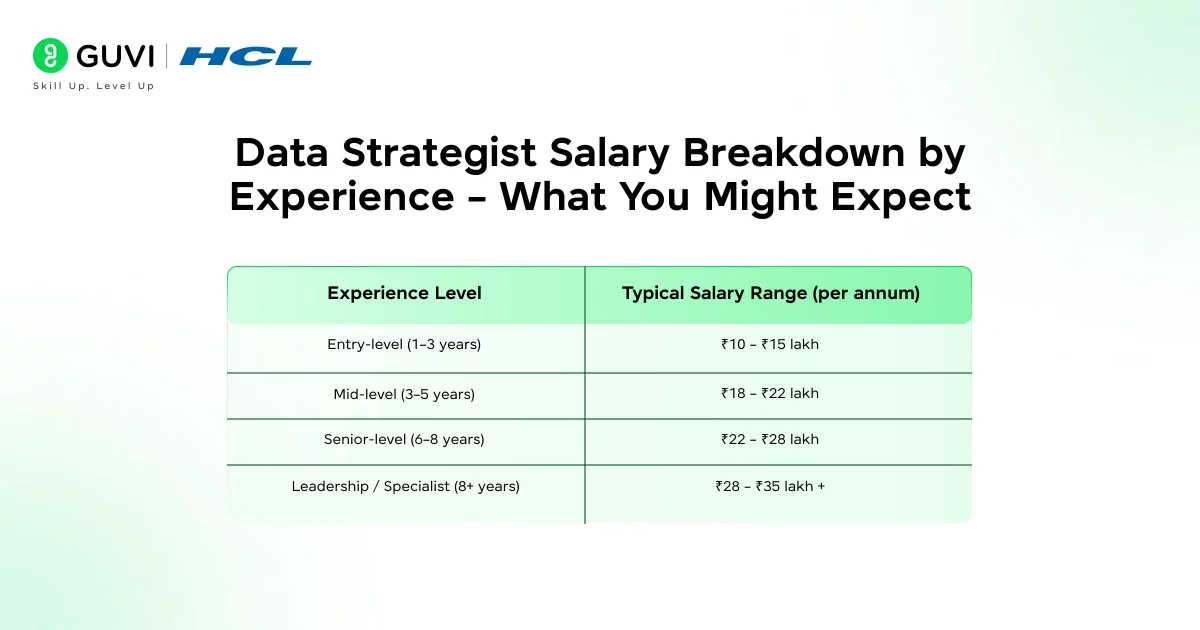
- For entry-level/early career (1-3 years): You may be in the range of ₹10-₹15 lakh per annum. At this stage, you are still building strategic exposure, may be working under a senior strategist, and your impact on business outcomes is just beginning.
- For mid-level experience (3-5 years): Your pay might move into the ₹18-₹22 lakh per annum bracket. You’re expected to handle more autonomous tasks, influence data strategy, liaise with business stakeholders, and demonstrate measurable contributions.
- For experienced / senior level (6-8 years or more): Salaries commonly sit in the ₹22-₹28 lakh per annum range; in favorable circumstances (large company, high impact role, leadership remit) you could cross ₹30 lakh+.
- It’s important to view these as guidelines, not hard caps; the actual number will depend heavily on your company, location, domain, and the strategic scope of your role.
| Experience Level | Typical Salary Range (per annum) | What This Level Involves |
| Entry-level (1–3 years) | ₹10 – ₹15 lakh | You’re building foundational experience, supporting senior strategists, and learning how data aligns with business goals. Involves hands-on analytics, basic reporting, and exposure to data strategy frameworks. |
| Mid-level (3–5 years) | ₹18 – ₹22 lakh | You start taking ownership of specific data initiatives, work directly with stakeholders, and begin shaping how insights guide business decisions. Expect more autonomy and measurable impact. |
| Senior-level (6–8 years) | ₹22 – ₹28 lakh | You handle end-to-end strategy design, oversee implementation, and coordinate cross-functional data projects. Leadership and business alignment become key expectations. |
| Leadership / Specialist (8+ years) | ₹28 – ₹35 lakh + | You lead teams, define long-term data strategies, and directly influence company-wide decisions. Salaries can exceed this range in global firms or highly data-driven industries. |
(Source: Glassdoor)
If you want to read more about how important the role of Data Strategist is in the field of Data Science, consider reading HCL GUVI’s Free Ebook: Master the Art of Data Science – A Complete Guide, which covers the key concepts of Data Science, including foundational concepts like statistics, probability, and linear algebra, along with essential tools.
Data Strategist vs Data Analyst vs Data Scientist: Salary and Role Comparison
Before comparing salaries, understand how these roles differ.
| Factor | Data Analyst | Data Scientist | Data Strategist |
|---|---|---|---|
| Primary Focus | Data analysis and reporting | Statistical and predictive modelling | Data-driven business strategy |
| Key Responsibilities | Dashboards, SQL queries, reporting | ML models, experimentation, analysis | Strategic planning, prioritization, governance |
| Technical Skills | Excel, SQL, Power BI | Python, SQL, statistics, ML | SQL, BI tools, data architecture awareness |
| Business Involvement | Operational and analytical | Analytical and product-focused | Strategic and cross-functional |
| Stakeholder Interaction | Team and departmental | Technical and business teams | Business leaders and cross-functional teams |
| Career Progression | Senior Analyst, Analytics Lead | Senior Data Scientist, ML Lead | Data Strategy Lead, Head of Data Strategy |
What Factors Affect a Data Strategist’s Salary in India?
Several factors determine how employers evaluate compensation.
1. Professional Experience
Experience matters because senior roles generally involve greater decision-making responsibility.
However, years of experience alone don’t determine salary.
Employers also consider the complexity and impact of your previous work.
2. Technical Skills
Knowledge of SQL, Python, data visualization, and analytical systems can help you evaluate technical solutions.
Technical fluency becomes especially useful when collaborating with Data Engineers, analysts, and Data Scientists.
3. Business and Domain Knowledge
Understanding industry-specific problems can make your recommendations more relevant.
For example, a Data Strategist working in banking may need to understand risk metrics, customer behaviour, and regulatory requirements.
4. Stakeholder Management
Professionals who can communicate with senior stakeholders and influence decisions may qualify for broader strategic responsibilities.
5. Company Size and Data Maturity
Organizations with established analytics functions may offer specialized strategy positions.
Smaller companies may combine Data Strategy with hands-on analytics, product, or operations responsibilities.
6. Leadership Responsibilities
Managing teams, coordinating initiatives, and overseeing budgets can increase the scope of a role.
7. Demonstrated Business Impact
Employers may value evidence that your recommendations contributed to measurable outcomes.
Examples include reduced reporting time, improved customer retention, better forecasting processes, or more reliable business metrics.

Skills to Improve Your Data Strategist Salary Potential
Your skills play a huge role in determining how much you can earn as a Data Strategist. It’s not just about knowing tools; it’s about how well you connect data with business strategy.
1. Business and strategic understanding
Companies pay more to professionals who understand the “why” behind the numbers. If you can see how data influences business outcomes, like boosting revenue or improving customer experience, you instantly become more valuable.
2. Communication and storytelling
Data alone doesn’t convince anyone; the story behind it does. The ability to present insights in a way that decision-makers understand and act on is a major salary booster. Being the person who can bridge the gap between analysts and leadership will always put you ahead.
3. Technical fluency
You don’t have to be a full-fledged data scientist, but knowing your way around SQL, Power BI, Tableau, or Python helps. It allows you to ask better questions, evaluate data quality, and guide your team effectively. A strategist who can speak both “business” and “data” is rare and well-paid.
What’s Next?
The landscape for Data Strategists in India is shifting fast, and the years ahead look promising. Here’s what’s shaping the next phase of this career.
1. AI is becoming central to strategy
More companies are integrating artificial intelligence into decision-making. That means strategists who understand how to align AI insights with business goals will see a clear salary advantage.
2. Salaries are rising steadily
Industry reports suggest that pay for data-related roles is expected to grow by 8–9% in 2026, with Data Strategists leading the pack. The more companies rely on insights for high-stakes decisions, the more they’re willing to invest in people who can deliver them.
3. From dashboards to decisions
The role is evolving from “report creator” to “business influencer.” Instead of just presenting trends, strategists are expected to recommend concrete actions and track their impact, an evolution that comes with higher responsibility and higher pay.
4. Remote and hybrid opportunities
Flexible work setups are expanding the job market. You can now work for a top firm in Bengaluru while living in Jaipur or Kochi, which means location will matter less over time, but competition will increase.
5. Data governance is the next big thing
With new privacy regulations and data protection laws in place, strategists who understand compliance and ethical data use will become even more sought-after. It’s a skill set that will define leadership roles in data for the next decade.
Which Industries Offer Higher-Paying Opportunities?
Technology, consulting, and financial services can offer specialized and strategically important data roles.
However, salary comparisons must account for company size, seniority, technical requirements, and compensation structure.
A senior strategist in manufacturing may earn more than a junior strategist in a technology company.
The role’s responsibilities matter more than the industry label alone.
What to Ask Yourself (and Your Employer) in a Salary Conversation
When it’s time to talk numbers, the smartest thing you can do is walk in prepared. Salary isn’t just about how long you’ve worked; it’s about the impact you can prove. Here are some questions that you can ask whenever you are sitting in an interview:
1. What’s the real scope of this role?
Titles can be misleading. Some companies use “Data Strategist” for roles that are more like analysts, while others expect full-scale strategy leadership.
2. How directly does my work affect business outcomes?
The closer your work is to driving measurable results, like higher sales, lower costs, or stronger customer engagement, the stronger your negotiation position will be.
3. Who will I collaborate with most?
Roles that interact directly with leadership or cross-functional teams often carry more weight and better pay. Being close to decision-making circles increases both visibility and value.
4. What does growth look like here?
Ask if there’s room to move into leadership or advisory roles. A clear path for advancement can justify accepting a slightly lower initial package if it comes with long-term upside.
5. Are there bonuses or stock options?
Sometimes, total compensation tells a different story than the base salary alone. Understanding the full package, bonuses, profit sharing, and flexible perks gives you a complete picture.
Want to Build the Skills for a Data Strategy Career?
A career in Data Strategy typically begins with strong foundations in Data Analytics, programming, and business problem-solving. If you’re planning to enter the data field or strengthen your technical capabilities, structured learning can help you develop relevant skills.
HCL GUVI’s Data Science Program offers a learning pathway covering foundational Data Science concepts and practical applications. Building skills in SQL, Python, statistics, data analysis, and visualization can support your progression toward more advanced analytics responsibilities.
Conclusion
The Data Strategist salary in India depends on more than experience alone. Your earning potential is influenced by technical expertise, business understanding, strategic responsibilities, industry specialization, and demonstrated outcomes.
Indicative salary ranges extend from ₹10–15 LPA for early-career professionals to ₹28–35 LPA or more for experienced leaders, but actual compensation varies widely.
If you’re currently working in analytics, focus on developing the skills that connect data with business decisions. Strengthen SQL and visualization, learn data governance, improve stakeholder communication, and seek opportunities to take ownership of analytical initiatives.
FAQs
1. What is the average salary for a Data Strategist in India?
The typical base salary sits around ~ ₹12 lakh per annum, with a wide variation depending on experience and company.
2. How much can a senior-level Data Strategist earn in India?
At senior levels (8+ years, strong impact), salaries often reach ₹25–30 lakh per year or more, especially in mature organizations and major cities.
3. Can a Data Strategist earn more than ₹30 LPA?
Yes, some senior leadership and specialist roles may offer compensation above ₹30 LPA. However, such packages depend on organizational scope, experience, and employer.
4. What skills help increase the salary potential of a Data Strategist?
Skills beyond analytics, such as business communication, stakeholder management, data governance, domain expertise, plus proficiency in tools like SQL, Python, or visualization, increase your earning power.
5. Can a fresher or someone with little experience enter as a Data Strategist and earn a high salary?
Entry-level roles do exist, but they typically carry lower pay. As you build experience, deliver business value, and gain strategy exposure, your salary potential rises significantly.
6. Which industries hire Data Strategists?
Relevant opportunities may exist in technology, consulting, financial services, e-commerce, healthcare, manufacturing, and telecommunications.
Success Stories

About the Author
Lukesh S
A professional content writer who has experience in freelancing and now working as a Technical Content Writer at HCL GUVI having sound knowledge in Blog Writing and Creative Writing!
View all posts by Lukesh S
Connect with me @














Did you enjoy this article?