


Full Stack Development Articles
Claude for Architecture and Engineering Documentation
Freelancing as a Python Developer: Getting Your First Client


Get In Touch For Details! Request More Information
Ruby on Rails (ROR) for Backend Development
Jun 15, 2026 8 Min Read 3430 Views
(Last Updated)
Ruby on Rails (ROR) has emerged as a leading framework for backend development, renowned for its speed, efficiency, and versatility. In this blog, we will explore ROR, its standout features, and why it remains a top choice for developers in 2025. Learning Ruby on Rails promises new possibilities in your web development journey.
Let’s understand the power of ROR and its impact on modern backend development.
Table of contents
- What is Ruby on Rails (ROR)?
- Examples of Ruby on Rails Core Elements
- Object-Oriented Programming
- MVC Pattern
- ActiveRecord
- Unit Testing with RSpec
- APIs and JSON
- REST and HTTP Protocol
- 5 Reasons Why Backend Developers Love Ruby on Rails
- Rapid Application Development (RAD)
- Open Source Libraries
- Model View Controller (MVC)
- Great Testing Environment
- Code Modification and Migration
- Applications of Ruby on Rails
- Fintech Platforms
- Social Networking Applications
- E-commerce Development
- Step-by-Step Integration Guide for Ruby on Rails
- 1) Prepare the environment
- 2) Create the application structure
- 3) Establish conventions
- 4) Manage database changes carefully
- 5) Build a testing culture
- 6) Plan for performance early
- 7) Integrate background processing
- 8) Strengthen security practices
- 9) Add caching and optimization layers
- 10) Monitor and refine continuously
- Ruby on Rails vs Other Backend Frameworks
- Best Practices in Ruby on Rails
- Organize Code With Care
- Plan Database Migrations
- Maintain a Reliable Test Suite
- Follow Established Conventions
- Monitor Performance Regularly
- Strengthen Security Practices
- Why Should You Learn Ruby on Rails in 2025?
- A) Demand for Rails Developers is Higher Than Ever
- B) Earn Top Salaries as a Ruby on Rails Developer
- C) Career Advancement Through Diverse Rails Functionality
- D) Ruby on Rails Skills are Versatile for Businesses
- E) Engaged Rails Open-source Community Makes Upskilling a Breeze
- Conclusion
- FAQs
- What makes Ruby on Rails a suitable choice for backend development?
- Is Ruby on Rails still relevant in today's rapidly evolving tech landscape?
- What career opportunities are available for developers proficient in Ruby on Rails?
What is Ruby on Rails (ROR)?
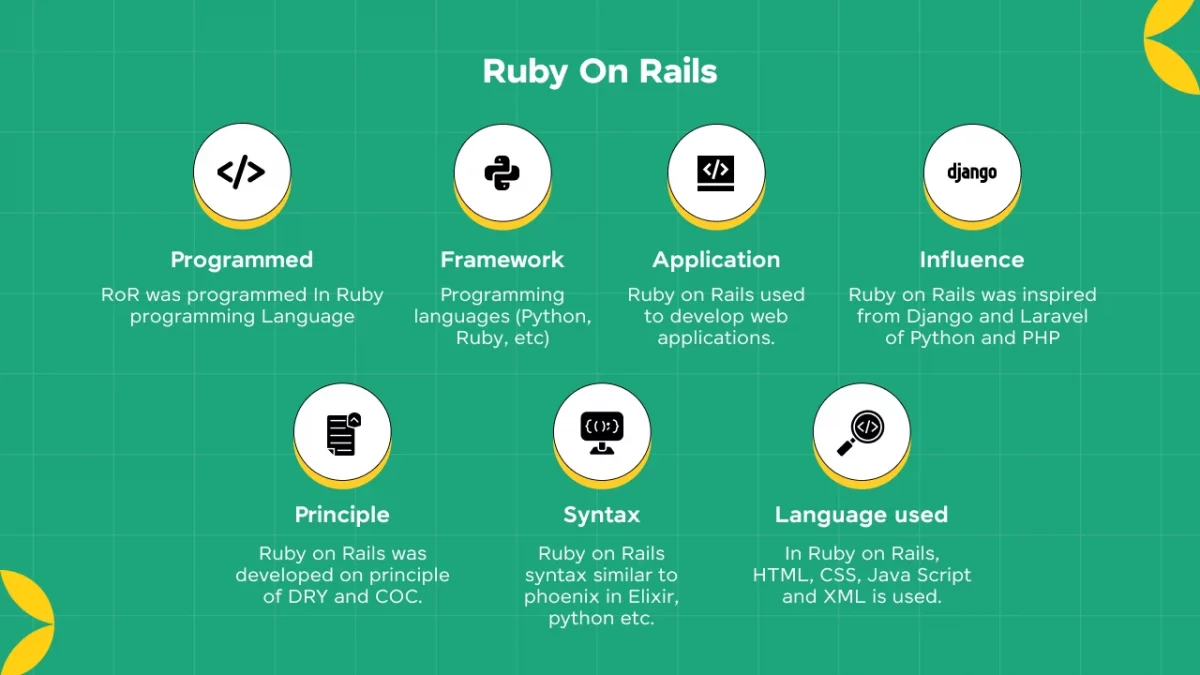
Ruby on Rails (often simply referred to as Rails or ROR) is a popular open-source web application framework written in Ruby, a dynamic programming language. It follows the Model-View-Controller (MVC) architectural pattern, which separates the application’s data, logic, and presentation layers.
Rails is designed to make web development easier and more productive by emphasizing convention over configuration, which means it provides default structures and patterns for developers to follow, reducing the need for repetitive coding tasks.
Also Read: The Easiest Programming Languages to Learn in 2025
Key features of Ruby on Rails include:
- Convention over Configuration: Rails comes with a set of conventions that developers can follow to minimize the amount of code they need to write. By adhering to these conventions, developers can focus more on building the unique aspects of their applications rather than configuring every detail.
- Don’t Repeat Yourself (DRY): Rails encourages the principle of DRY, which means that developers should avoid duplicating code. Instead, common functionalities should be encapsulated in reusable components.
- RESTful Routing: Rails encourages the use of RESTful routes for defining the application’s URL structure. This promotes a standardized and intuitive approach to handling HTTP requests.
- Active Record: Rails includes an object-relational mapping (ORM) library called Active Record, which simplifies database interactions by abstracting database tables into Ruby objects. This allows developers to work with database records using familiar Ruby syntax.
- Scaffolding: Rails provides a feature called scaffolding, which generates a basic implementation of MVC components (models, views, and controllers) based on a data model. While scaffolding can be useful for prototyping, it’s typically not used in production code.
- Gems: Rails uses the RubyGems package manager to allow developers to easily add functionality to their applications through the use of third-party libraries called gems.
Ruby on Rails is widely used for developing web applications due to its developer-friendly features, robust ecosystem, and strong community support. It powers numerous websites and web services, ranging from small startups to large-scale enterprises.
Also Read: Top 6 Backend Frameworks That You Should Know in 2025
Examples of Ruby on Rails Core Elements
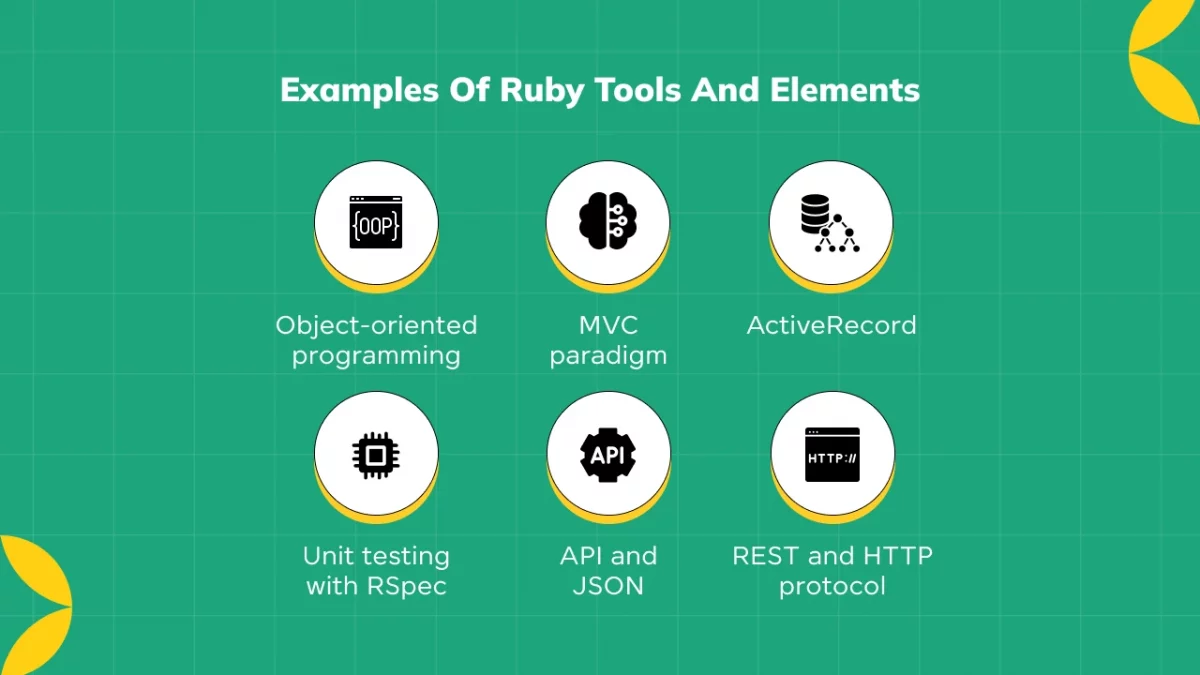
Object-Oriented Programming
Rails applications are written in Ruby, which is fully object-oriented. Each class represents a real-world entity, and its methods define behavior. For example, a User object might carry attributes such as name and email, while methods handle actions like authentication or notifications. This structure makes the system modular and easier to extend.
MVC Pattern
Rails follows the Model–View–Controller pattern. Data lives in the model, logic in the controller, and presentation in the view. A request from the browser passes through the controller, which calls the model, and then hands the results to the view. This separation keeps responsibilities clear and simplifies collaboration between developers working on different layers.
ActiveRecord
Rails integrates database interaction through ActiveRecord. Each table maps to a class, and each row maps to an object. A Product model, for example, can represent items in an online store. Instead of writing SQL directly, developers work with methods that read, update, or remove records. This reduces complexity and helps maintain clean, readable code.
Unit Testing with RSpec
Testing is part of Rails culture, and RSpec is the most common choice. A unit test might confirm that a method calculates the right discount or that a user cannot register without an email address. These tests give teams confidence to update code without breaking existing features. Continuous testing becomes a backbone for long-term stability.
APIs and JSON
Modern applications often communicate with mobile apps or other services. Rails can serve responses in JSON, which makes it simple for external systems to process the data. A shopping app, for example, can request product details in JSON format and display them to a mobile user. This support turns Rails into a reliable backend for multi-platform solutions.
REST and HTTP Protocol
Rails routes requests in a way that matches REST principles. Different HTTP verbs, such as GET, POST, PUT, and DELETE, correspond to actions like reading data, creating records, updating entries, or removing them. This consistency makes Rails applications predictable, easier to maintain, and more compatible with other systems that follow the same standard.
5 Reasons Why Backend Developers Love Ruby on Rails
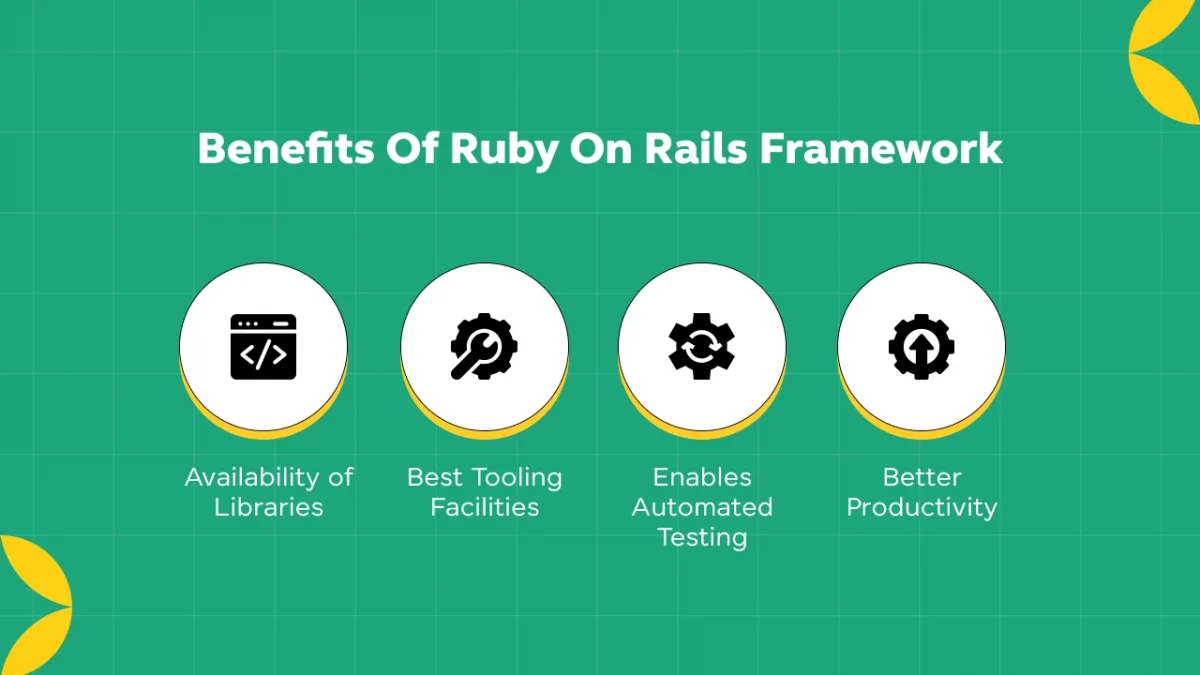
Backend developers often love Ruby on Rails for several reasons:
1. Rapid Application Development (RAD)
Ruby on Rails is renowned for its emphasis on rapid development. Its convention-over-configuration approach, along with built-in generators and scaffolding tools, allows developers to quickly create functional prototypes and full-fledged applications. By minimizing the need for boilerplate code and configuration, Rails enables developers to focus more on solving business problems and iterating on features, leading to faster time-to-market and increased productivity.
2. Open Source Libraries
The Ruby on Rails ecosystem boasts many open-source libraries, known as gems, which provide pre-built solutions for common functionalities and integrations. These gems cover many needs, including authentication, authorization, payment processing, and more. By using these libraries, developers can accelerate development, reduce code duplication, and benefit from community-contributed best practices and optimizations.
3. Model View Controller (MVC)
Ruby on Rails adheres to the Model-View-Controller (MVC) architectural pattern, which promotes a clear separation of concerns and modular code organization. With MVC, backend logic (models), user interface (views), and application flow control (controllers) are decoupled, making it easier to maintain, test, and scale applications.
This architectural clarity enhances code readability, facilitates collaboration among developers, and simplifies troubleshooting and debugging.
4. Great Testing Environment
Testing is an important aspect of backend development, ensuring that applications function correctly, remain stable, and adapt to evolving requirements. Ruby on Rails provides a robust testing environment with built-in support for various testing frameworks, including RSpec, MiniTest, and Cucumber. Developers can write unit tests, integration tests, and acceptance tests to verify the behavior of their applications at different levels of granularity.
Additionally, Rails’ emphasis on convention and dependency injection makes it conducive to test-driven development (TDD) and behavior-driven development (BDD), promoting a culture of quality and reliability in software development.
Also Read: Top 10 Full-Stack Developer Frameworks in 2025
5. Code Modification and Migration
As applications evolve, developers often need to modify existing code and migrate data to accommodate new features, performance improvements, or changes in business requirements. Ruby on Rails excels in facilitating code modification and database migrations through tools like ActiveRecord and Rails migrations.
ActiveRecord’s object-relational mapping (ORM) capabilities abstract away the complexities of database interactions, while Rails migrations provide a structured approach to making incremental changes to the database schema. This enables seamless updates and version management, ensuring that applications remain flexible, maintainable, and scalable throughout their lifecycle.
These features make Ruby on Rails a favorite among backend developers who value productivity, maintainability, and scalability in web development projects.
Also Read: Ruby vs. Python: Comparison
Kickstart your backend development journey with HCL GUVI’s Ruby on Rails course! Master ROR to build scalable, secure, and high-performing web applications with clean, maintainable code. Learn how to design databases, handle APIs, and power full-stack applications effectively. With real-world projects, expert mentorship, and hands-on coding practice, you’ll gain the skills to become a job-ready backend developer. Enroll today and start building powerful backends with Ruby on Rails!
Explore: Top 10 Ruby on Rails Project Ideas [With Source Code]
Applications of Ruby on Rails
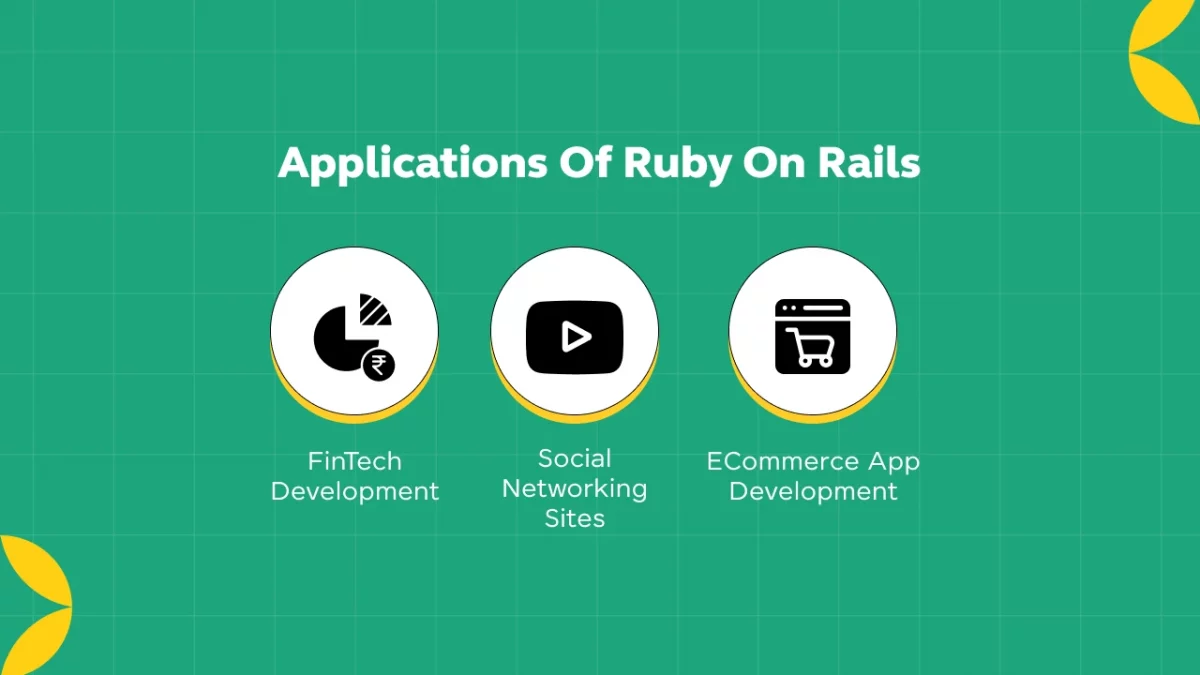
Rails is known for speeding up development while keeping projects secure and maintainable. These qualities make it suitable for industries that demand stability and fast iteration. Three common areas stand out where Rails continues to prove its value.
Fintech Platforms
Financial applications demand strict reliability. Rails supports rapid feature delivery while offering strong safeguards against risks such as data leaks or unauthorized access. Teams use it to handle user authentication, transaction records, and reporting dashboards. The framework’s structure also helps fintech startups meet compliance requirements without losing development speed.
Social Networking Applications
Rails encourages modular design, which fits naturally with social features like profiles, messaging, and friend connections. Its convention-driven approach helps teams launch quickly and then expand with features such as real-time notifications or content feeds. Many social networking platforms started with Rails because it allowed them to reach users fast and refine features as the community grew.
E-commerce Development
Retail and online marketplaces rely on Rails for its ability to manage catalogs, shopping carts, and order processing. The framework integrates well with payment gateways and inventory systems. Its flexibility allows developers to adapt storefronts to unique brand needs while keeping performance high. Caching and background jobs also make large product catalogs manageable without slowing the buying experience.
Step-by-Step Integration Guide for Ruby on Rails
1) Prepare the environment
The process begins with the right foundation. A project runs best on a consistent Ruby version, a reliable database, and a clear version control setup. Teams that align these elements early avoid conflicts later and give themselves a stable base to build on.
2) Create the application structure
Once the environment is ready, the application can be generated with Rails’ standard structure. This layout is valuable because it already reflects best practices: models for data, controllers for flow, and views for presentation. Starting with this clear separation keeps the project organized as it grows.
3) Establish conventions
With the structure in place, it is important to agree on conventions. Rails promotes consistent naming and placement of files, which allows new developers to understand the system quickly. Following these conventions reduces confusion and speeds up collaboration.

4) Manage database changes carefully
As features are added, the database schema evolves. Each change should be introduced with care, reviewed by the team, and tested against existing data. This prevents errors from reaching production and makes future modifications easier to handle.
5) Build a testing culture
Testing is not an afterthought. A strong suite of tests gives developers confidence to add new features without fear of breaking existing functionality. When the team treats tests as part of everyday work, quality remains high and unexpected regressions become rare.
6) Plan for performance early
An application that feels fast with ten users may slow down with a thousand. Monitoring performance from the beginning helps identify bottlenecks before they become problems. This habit protects user experience and avoids the cost of major rewrites later.
7) Integrate background processing
Not every task belongs in the main request cycle. Sending emails, processing images, or importing data are better handled in the background. Offloading this work keeps the application responsive and gives users smoother interactions.
8) Strengthen security practices
Security must remain a continuous focus. Rails includes built-in protections, but they are most effective when paired with habits like regular dependency updates, careful session management, and input validation. These measures protect both users and business’s reputation.
9) Add caching and optimization layers
As traffic grows, caching plays a central role in keeping response times short. Fragment caching for views and strategic caching for data allow the application to serve results quickly without overloading resources. This step extends the life of the infrastructure and keeps users satisfied.
10) Monitor and refine continuously
Integration is not finished once the app runs in production. Logging, error tracking, and performance reviews reveal how the application behaves in real conditions. Acting on these signals helps the team refine features and strengthen reliability over time.
Ruby on Rails vs Other Backend Frameworks
| Feature | Ruby on Rails (ROR) | Django (Python) | Laravel (PHP) | Express.js (Node.js) |
| Language | Ruby | Python | PHP | JavaScript |
| Architecture | MVC | MTV (Model-Template-View) | MVC | Minimal, middleware-based |
| Learning Curve | Moderate | Moderate | Beginner-friendly | Beginner-friendly |
| SEO Support | Strong (RESTful routing, clean URLs, meta flexibility) | Strong (URL routing, multilingual support) | Good (routing and caching) | Average (requires plugins) |
| Performance Optimization | Built-in caching and ActiveRecord tuning | Caching and ORM optimization | Good but less advanced | Relies on external tools |
| Community and Ecosystem | Mature, strong gem ecosystem | Large Python ecosystem | Large PHP ecosystem | Very large JavaScript ecosystem |
| Security Features | Strong defaults against SQL injection, XSS, CSRF | Strong defaults with built-in protections | Strong defaults against SQL injection, XSS, and CSRF | Relies on middleware packages |
| Best Use Cases | Scalable web apps, SaaS platforms, marketplaces | Data-heavy apps, scientific tools, web apps |
Best Practices in Ruby on Rails
Rails gives developers a strong foundation, but the quality of an application depends on the practices used throughout its lifecycle. Consistent habits keep projects stable and easier to grow.
Organize Code With Care
Large controllers or models often become difficult to read. Moving shared logic into smaller service objects makes responsibilities clearer. This separation helps teams update features without creating side effects in unrelated parts of the system.
Plan Database Migrations
Schema changes affect every part of an application. A single migration that seems minor can cause issues for existing data. Creating a migration plan that includes rollbacks reduces risk during deployment. Testing migrations in a staging environment before production keeps the process safe.
Maintain a Reliable Test Suite
Rails offers strong support for automated testing. A project benefits when developers commit to writing tests for both individual methods and interactions between components. Tests protect against regressions and shorten the time needed to make changes. A reliable test suite gives confidence during refactoring and scaling.
Follow Established Conventions
Rails promotes convention over configuration. Consistent naming and structure allow new developers to read and understand code without long explanations. Following conventions also prevents unnecessary debates about design patterns, which keeps progress steady.
Monitor Performance Regularly
Applications that handle small datasets often appear fast. Growth exposes queries and endpoints that strain resources. Adding monitoring tools early helps teams see where bottlenecks form. Fixing issues at this stage is easier than trying to rebuild after traffic increases.
Strengthen Security Practices
Rails protect against common threats, but additional measures are important. Validating input, updating dependencies, and managing sessions carefully reduces exposure to attacks. These actions maintain trust and protect both users and data.
Why Should You Learn Ruby on Rails in 2025?
Learning Ruby on Rails in 2025 can be highly advantageous for several reasons:
A) Demand for Rails Developers is Higher Than Ever
Despite the evolving landscape of web development technologies, the demand for Ruby on Rails developers remains robust. Startups and established companies alike continue to seek Rails talent to build scalable, maintainable web applications. Learning Ruby on Rails in 2025 opens up numerous job opportunities and enhances your employability in the tech industry.
Also Read: Top 10 Backend Web Development Frameworks In 2025
B) Earn Top Salaries as a Ruby on Rails Developer
Ruby on Rails developers command competitive salaries in the tech job market. Due to the specialized skills required and the demand-supply gap, experienced Rails developers often earn top-tier compensation packages. Learning Ruby on Rails can lead to lucrative career prospects and financial stability.
C) Career Advancement Through Diverse Rails Functionality
Ruby on Rails offers a diverse set of functionalities that cater to developers at different stages of their careers:
- An Entry-level Ruby on Rails Developer: Beginners can quickly grasp the fundamentals of web development and gain hands-on experience by building simple applications using Rails’ intuitive framework.
- A Mid-level Ruby on Rails Developer: Mid-level developers can deepen their understanding of Rails’ advanced features, such as caching, background job processing, and API development. They can also take on more complex projects and mentor junior developers.
- A Senior-level Ruby on Rails Developer: Senior developers possess extensive experience in architecting scalable, enterprise-grade applications using Ruby on Rails. They play key roles in decision-making, architecture design, and leading development teams.
D) Ruby on Rails Skills are Versatile for Businesses
Ruby on Rails’ versatility makes it an attractive choice for businesses across various industries. Its rapid development capabilities, robust testing environment, and MVC architecture enable companies to build scalable, maintainable web applications efficiently. Whether it’s e-commerce platforms, social networks, or content management systems, Ruby on Rails can adapt to diverse business needs, making it a valuable asset for organizations seeking technological innovation and agility.
E) Engaged Rails Open-source Community Makes Upskilling a Breeze
The Ruby on Rails community is renowned for its inclusivity, collaboration, and dedication to knowledge-sharing. With numerous online forums, meetups, conferences, and documentation resources available, aspiring and experienced developers can easily access learning materials, seek guidance from seasoned professionals, and stay updated on the latest trends and best practices in Rails development.
The supportive nature of the Rails community fosters continuous learning and professional growth, making upskilling an enjoyable and rewarding experience.
Learning Ruby on Rails in 2025 can be a smart investment in your career, offering lucrative opportunities, career advancement prospects, and the chance to work with a versatile and thriving framework.
Also Read: The 5 Most User-Friendly Programming Languages
Conclusion
If you’re intrigued by the potential of Ruby on Rails and eager to learn more, now is the perfect time to take action. There’s no shortage of resources available to help you master Ruby on Rails. Take the first step towards realizing your goals by learning ROR, engaging with the Rails community, and starting your journey of discovery and growth in backend development. The future is bright, and with Ruby on Rails as your ally, the possibilities are limitless.
FAQs
What makes Ruby on Rails a suitable choice for backend development?
Ruby on Rails is well-suited for backend development due to its convention-over-configuration approach, which reduces the need for boilerplate code and accelerates development. Its MVC architecture promotes code organization and separation of concerns, enhancing maintainability and scalability.
Is Ruby on Rails still relevant in today’s rapidly evolving tech landscape?
Despite the emergence of new technologies and frameworks, Ruby on Rails remains relevant and widely used in the industry. Its simplicity, productivity, and emphasis on developer happiness continue to attract startups, enterprises, and individual developers.
What career opportunities are available for developers proficient in Ruby on Rails?
Proficiency in Ruby on Rails opens up various career opportunities in backend development. Rails developers can pursue roles such as software engineer, web developer, backend developer, and Ruby on Rails developer across various industries, including e-commerce, fintech, healthcare, and more.
Success Stories

About the Author
Vaishali
I'm a seasoned writer with four years of experience across technical, non-technical, and just about every genre or niche you can imagine. Adaptable and curious, I enjoy exploring new topics and making information engaging and easy to understand. Fueled by a steady stream of tea, I approach each project with creativity, reliability, and genuine enthusiasm for storytelling.
View all posts by Vaishali
Connect with me @







































Did you enjoy this article?