


Interview Articles
Wipro Elite NTH Interview Experience 2026: What Candidates Say
Wipro HR Interview Questions for Elite NTH 2026: How to Answer Them - Best Guide
Wipro Technical Interview Questions 2026: Most Asked Questions and Answers


Get In Touch For Details! Request More Information
Conquer Your Next Interview: Top 5 Java Programs for Freshers
Jul 30, 2026 6 Min Read 37381 Views
(Last Updated)
Java interviews for freshers rarely start with frameworks or complex system design. They start with logic. Interviewers want to see how you think, how you break a problem down, and how comfortably you work with loops, conditions, strings, and numbers.
That’s why a small set of core Java programs keeps showing up in technical rounds year after year. These questions may look basic, but they reveal a lot about your fundamentals, problem-solving approach, and coding clarity. So if you’re a fresher looking for a job in the Java programming field, it is important to thoroughly prepare yourself for the interview process.
In this article, we’ll walk through five such Java interview programs in detail, not just showing the code, but explaining the thinking behind each one so you can handle follow-up questions with confidence.
Quick Answer:
Freshers preparing for Java interviews should master core programs like Fibonacci series, prime number checking, string palindrome, bubble sort, and Armstrong number. These questions test fundamental logic, loop control, and problem-solving skills that interviewers consistently evaluate in entry-level technical rounds.
Table of contents
- Top 5 Must-Know Java Interview Programs for Freshers
- Fibonacci Series
- Check if a Number is Prime
- String Palindrome
- Bubble Sort
- Armstrong Number
- Tips for Solving Interview Questions Efficiently
- Conclusion
- FAQs
- What are the basic programs asked in interviews for freshers in Java?
- How to prepare for Java interview for freshers?
- How to practice Java for interview?
Top 5 Must-Know Java Interview Programs for Freshers
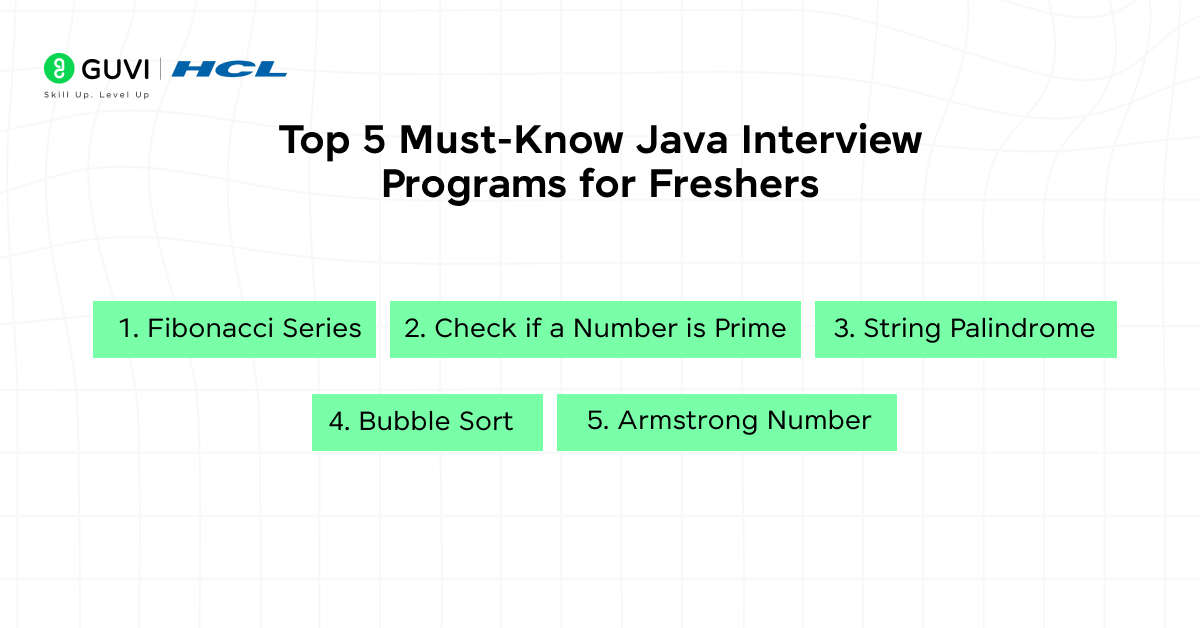
These 5 must-know Java Interview programs are designed to test your problem-solving skills and your ability to apply Java concepts to real-world scenarios.
1. Fibonacci Series
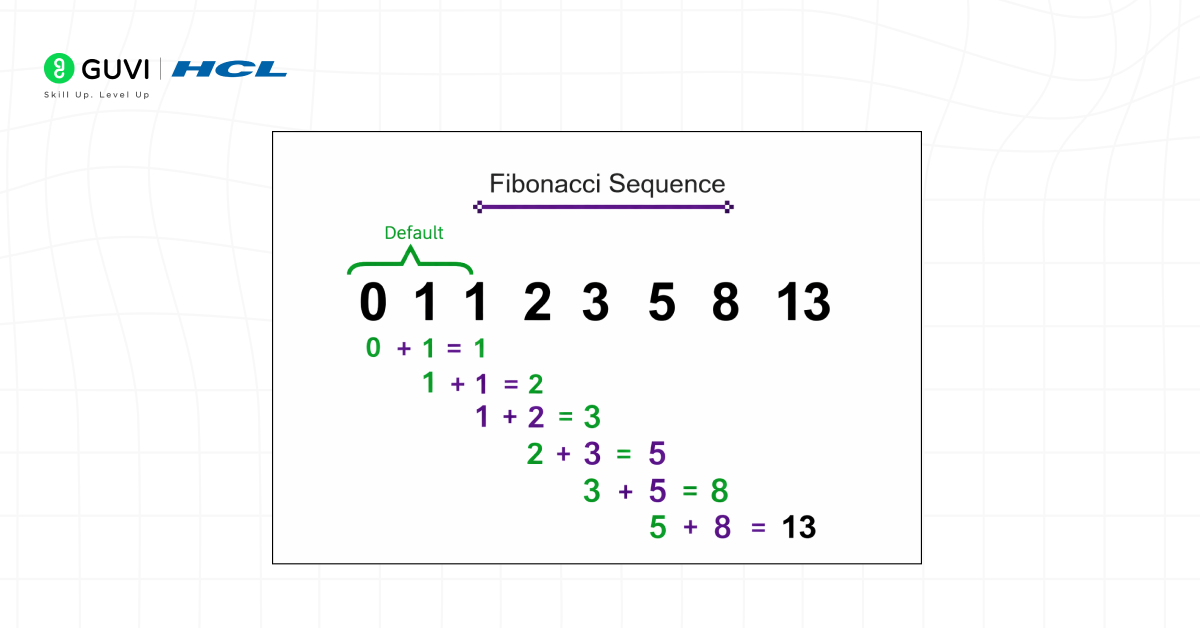
The Fibonacci series is one of the most common starter questions in Java interviews, but what it really checks is how well you understand iteration and value flow. The series begins with two base numbers, usually 0 and 1. Every number that follows is simply the sum of the previous two.
When interviewers ask this, they are less interested in the series itself and more interested in how you manage changing values inside a loop. You need to remember the previous two numbers at every step and update them correctly as the loop progresses.
What the question actually tests
This is not about Fibonacci numbers. It’s about whether you understand state, iteration, and how values evolve over time.
Interviewers want to see:
- Can you track previous values correctly?
- Do you understand loop-based sequence generation?
- Do you know when recursion is overkill?
The core idea
Each number is the sum of the previous two.
So if you start with:
0, 1
The sequence becomes:
0, 1, 1, 2, 3, 5, 8, ...
You are always carrying two values forward.
How to think before coding?
Ask yourself:
- What are my starting values?
- How many times should the loop run?
- Which variables change every iteration?
You usually need:
- one variable for the previous value
- one for the current value
- one temporary variable for the next value
Logic walkthrough
- Initialize first two numbers.
- Print them.
- Loop from the 3rd position to n.
- Calculate
next = previous + current. - Shift values forward.
Common mistakes
- Forgetting to update variables in the right order.
- Using recursion without explaining its cost.
- Off-by-one errors in loop conditions.
Interview twist you might hear
- “Can you do this using recursion?”
- “What’s the time complexity?”
- “How would you generate only even Fibonacci numbers?”
If you say:
Iterative solution is O(n) time and O(1) space, you instantly sound more senior.
Here is the code to Fibonacci Series:
class FibonacciSeries{
public static void main(String args[])
{
 int a1=0,b2=1,c3,i,count=10;
 System.out.println(a1+" "+b2); //simply printing 0 and 1

 for(i=2;i<count;++i) //the loop starts from 2 because 0 and 1 have already been printed
 {
  c3=a1+b2;
  System.out.println(" "+c3);
  a1=b2;
  b2=c3;
 }

}}
2. Check if a Number is Prime
The prime number program looks simple on the surface, but it’s a great test of logical thinking and optimization. A prime number is a number greater than 1 that is divisible only by 1 and itself.
Freshers often make the mistake of checking divisibility all the way up to the number itself. Interviewers want to see whether you know that you can stop much earlier. The key insight is that if a number has any factor greater than its square root, it must also have a factor smaller than the square root. So checking up to √n is enough.
In an interview, your explanation matters as much as your code. Saying why you stop at the square root immediately signals strong fundamentals.
What the question actually tests
This is about logical pruning and efficiency, not division.
Interviewers are checking:
- Do you understand mathematical boundaries?
- Can you optimize brute-force logic?
- Do you handle edge cases?
The core idea
A prime number:
- has exactly two divisors: 1 and itself
- cannot be divided evenly by any other number
How to think before coding?
Ask:
- What’s the smallest number that is not prime? (1)
- Do I need to check all numbers till n? (No)
- When can I stop early?
Key insight:
If a number has a factor greater than √n, it must also have one smaller than √n. So checking till √n is enough.
Logic walkthrough
- If number ≤ 1 → not prime.
- Loop from 2 to √n.
- If any number divides evenly → not prime.
- If none do → prime.
Common mistakes
- Checking till
n-1(wastes time). - Forgetting that 1 is not prime.
- Not breaking the loop early.
Interview twist you might hear
- “How would you check primes for very large numbers?”
- “How would you find all primes in a range?” (Sieve of Eratosthenes)
- “What’s the time complexity?”
Correct answer:
O(√n) time, O(1) space
Here is the code for finding whether a number is prime or not!
public class PrimeCheck{
 public static void main(String args[]){
  int a,b=0,flag=0;
  int num=3;  //this variable represents the number to be checked
  b=num/2;
  if(num==0||num==1){
   System.out.println(num+" is not prime number");
  }else{
   for(a=2;i<=b;i++){
    if(num%a==0){
     System.out.println(a+" is not prime number");
     flag=1;
     break;
    }
   }
   if(flag==0)  { System.out.println(a+" is prime number"); }
  }
}
}
3. String Palindrome
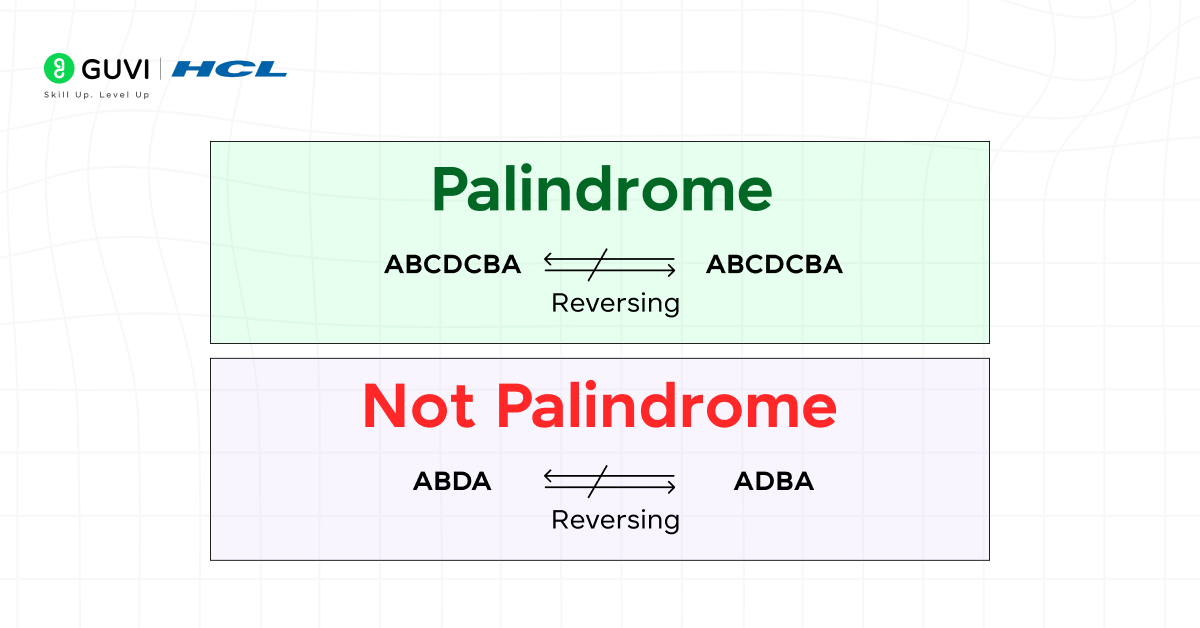
A string palindrome question tests how well you handle strings, indexes, and comparisons in Java. A palindrome is a string that reads the same forwards and backwards, such as “level” or “madam”.
Many beginners reverse the string and compare it with the original. While that works, interviewers often prefer a more efficient approach that compares characters from both ends moving inward. This shows better space awareness and algorithmic thinking.
The idea is simple. You start with one pointer at the beginning of the string and another at the end. If the characters match, you move both pointers toward the center. If at any point they don’t match, the string is not a palindrome.
What the question actually tests
This checks string handling, indexes, and comparison logic.
More importantly, it checks:
- Do you understand immutability?
- Can you reason with characters?
- Do you choose the right approach?
The core idea
A string is a palindrome if:
original == reversed
Examples:
- level
- madam
- radar
How to think before coding?
You have two main approaches:
- Reverse the string and compare.
- Compare characters from both ends moving inward.
Approach 2 is more efficient and interview-friendly.
Logic walkthrough (two-pointer method)
- Set
left = 0,right = length - 1 - Compare characters at both positions.
- If mismatch → not a palindrome.
- Move inward until pointers cross.
Common mistakes
- Using
==instead of.equals(). - Ignoring case sensitivity.
- Not handling spaces or punctuation when asked.
Interview twist you might hear
- “Ignore spaces and special characters.”
- “Make it case-insensitive.”
- “Check palindrome without extra memory.”
If you handle these calmly, you stand out.
Here is the code for Palindrome checking:
class PalindromePractice{
 public static void main(String args[]){
  int p,sum=0,tempo;
  int num=454; //This variable represents the number to be checked for palindrome

  tempo=num;
  while(num>0){
   p=num%10;  //getting the remainder
   sum=(sum*10)+p;
   num=num/10;
  }
  if(tempo==sum)
   System.out.println("palindrome number ");
  else
   System.out.println("not palindrome");
}
} Many so-called “basic” Java interview programs are actually used by interviewers to judge senior-level thinking. For example, a Fibonacci question can quickly turn into a discussion on time and space complexity, while a palindrome check reveals how well you understand memory usage and string handling. These problems aren’t about memorization: they’re designed to see how clearly you think under pressure and how well you explain your logic.

4. Bubble Sort
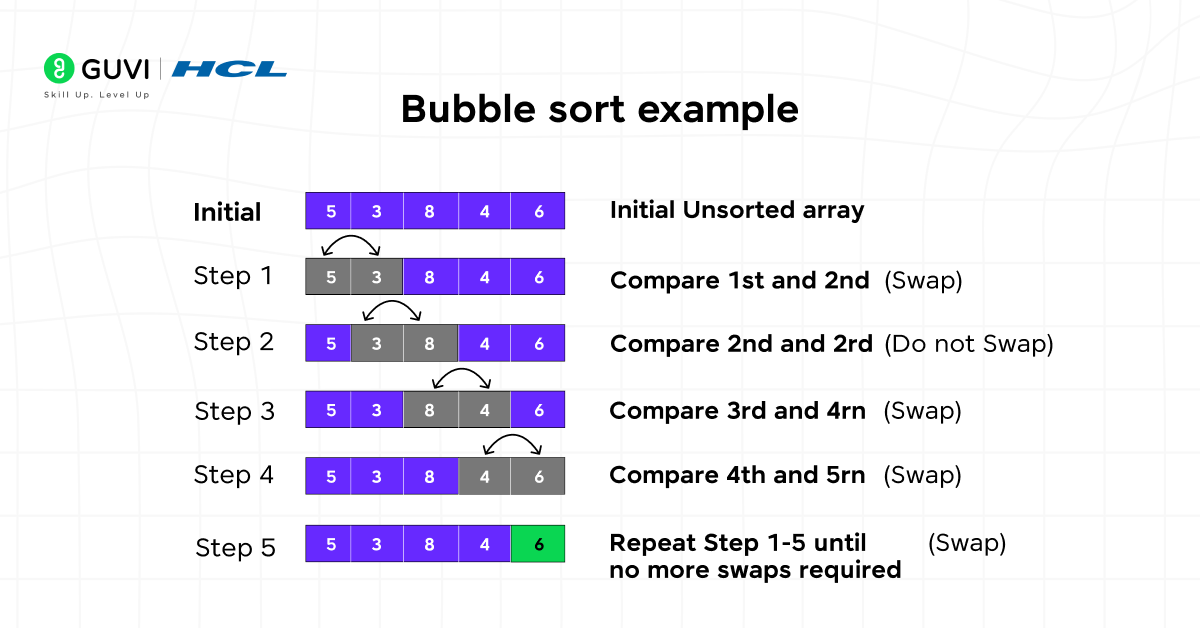
Bubble Sort is often the first sorting algorithm that freshers encounter in interviews. It’s not used much in real-world systems, but it’s excellent for testing your understanding of nested loops and array manipulation.
The core idea is that you repeatedly compare adjacent elements and swap them if they are out of order. After each pass, the largest unsorted element “bubbles” to the end of the array. With every new pass, one more element is already sorted, reducing the number of comparisons.
What does the question actually test?
This is not about sorting efficiency. It’s about nested loops, comparisons, and swapping logic.
Interviewers want to see:
- Can you reason step by step?
- Do you understand how arrays mutate?
- Can you explain each pass clearly?
The core idea
Bubble Sort:
- compares adjacent elements
- swaps them if they’re in the wrong order
- pushes the largest element to the end in each pass
How to think before coding?
Ask:
- How many passes do I need? (n-1)
- After each pass, what is already sorted?
- Can I reduce comparisons in later passes?
Logic walkthrough
- Outer loop controls passes.
- Inner loop compares adjacent elements.
- Swap if left > right.
- Reduce inner loop range each pass.
Common mistakes
- Wrong loop boundaries.
- Forgetting to reduce inner loop range.
- Messing up swap logic.
Interview twist you might hear
- “What’s the time complexity?” → O(n²)
- “Is Bubble Sort stable?” → Yes
- “Why is it rarely used in real systems?”
Correct reasoning:
It’s simple but inefficient for large datasets.
Here is how you solve bubble sort:
public class BubbleSort {
    static void bubbleSort(int[] arr) {
        int num = arr.length;
        int tempo = 0;
         for(int i=0; i < num; i++){
                 for(int j=1; j < (num-i); j++){
                          if(arr[j-1] > arr[j]){
                                 //swapping elements
                                 tempo = arr[j-1];
                                 arr[j-1] = arr[j];
                                 arr[j] = tempo;
                         }

                 }
         }

    }
    public static void main(String[] args) {
                int arr[] ={3,60,35,2,45,320,5};

                System.out.println("The array before Bubble Sort:");
                for(int i=0; i < arr.length; i++){
                        System.out.println(arr[i] + " ");
                }
                System.out.println();

                bubbleSort(arr); //sorting the array elements using bubble sort method we wrote earlier

                System.out.println("The array after Bubble Sort:");
                for(int i=0; i < arr.length; i++){
                        System.out.println(arr[i] + " ");
                }

        }
}
5. Armstrong Number
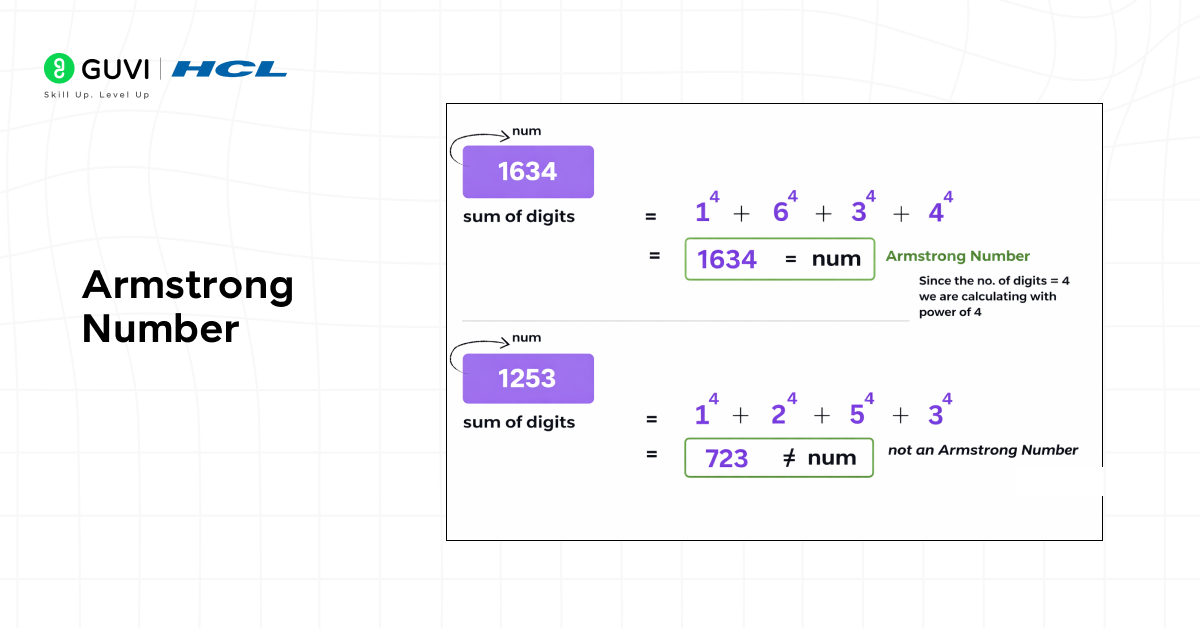
The Armstrong number program tests your ability to break a number into digits and apply mathematical logic. A number is called an Armstrong number if the sum of its digits raised to the power of the number of digits equals the original number.
For example, 153 is an Armstrong number because:
1³ + 5³ + 3³ = 153
To solve this, you first store the original number. Then you repeatedly extract the last digit using the modulus operator, raise it to the required power, and add it to a running sum. At the end, you compare the sum with the original number.
What does the question actually test?
This checks digit extraction, math operations, and loop control.
It also quietly checks:
- Can you break a number into digits?
- Can you reconstruct logic from a definition?
The core idea
A number is Armstrong if:
sum of (each digit ^ number of digits) == original number
Example:
153 1³ + 5³ + 3³ = 153
How to think before coding?
You need to:
- Preserve the original number.
- Extract digits one by one.
- Apply power logic.
- Compare result with original.
Logic walkthrough
- Store original number.
- While number > 0:
- digit = number % 10
- add digit³ to sum
- number = number / 10
- Compare sum with original.
Common mistakes
- Forgetting to reset the number.
- Hardcoding power without explanation.
- Using floating-point comparisons carelessly.
Interview twist you might hear
- “What about numbers with different digit counts?”
- “Can you make this generic?”
- “What’s the time complexity?”
A strong answer:
Time complexity is O(d), where d is the number of digits.
Here is the code for checking Armstrong numbers:
public class ArmstrongCheck {

    public static void main(String[] args) {

        int num = 1634, ogNum, remainder, final = 0, h = 0;

        ogNum = num;

        for (;ogNum != 0; ogNum /= 10, ++h);

        ogNum = num;

        for (;ogNum != 0; ogNum /= 10)
        {
            remainder = ogNum % 10;
            final += Math.pow(remainder, h);
        }

        if(final == num)
            System.out.println(num + " is an Armstrong number.");
        else
            System.out.println(num + " is not an Armstrong number.");
    }
}
Tips for Solving Interview Questions Efficiently
Now that you are familiar with some of the most commonly asked Java interview programs, here are some tips to help you get through the interviews with ease:
- Practice, practice, practice – the more you practice solving Java programs, the more comfortable and confident you will be during the interview.
- Understand the logic behind the programs – it is important to not just memorize the solutions to the programming questions but to also understand the logic behind them.
- Keep it simple – while it is important to write efficient and optimized code, it is also important to keep it simple and easy to read.
- Show your work – be sure to explain your thought process and the steps you took to arrive at your solution.
- Test your code thoroughly – a must for all programmers: shows how serious you are about your code so get into a habit of testing it regularly.
If you are interested in learning Java to the fullest and implement it on Full-stack applications with ease, consider enrolling in HCL GUVI’s Certified Java Full-stack Developer Course, where you will be exposed to hands-on projects with Mentor assistance, Placement Guidance and a Globally Recognised Certification from HCL GUVI!
Conclusion
In conclusion, mastering these five Java programs won’t just help you clear coding rounds, it will strengthen the foundation you’ll rely on throughout your career. Each problem trains a different muscle, from iteration and condition checks to string handling and mathematical reasoning.
More importantly, they teach you how to explain your logic clearly, which is often what separates selected candidates from rejected ones. Practice these programs until you can write them without hesitation and explain every line comfortably. Once your fundamentals are solid, advanced concepts become much easier to learn and interviews stop feeling intimidating.
FAQs
What are the basic programs asked in interviews for freshers in Java?
Some of the most commonly asked programs asked in interviews for freshers in Java are 1) The Fibonacci Series, 2) The Prime Number Check, 3) String Palindrome, 4) Bubble Sort, 5) Merge Sort, 6)Armstrong Number, and 7) Factorial along with a few others.
How to prepare for Java interview for freshers?
You must thoroughly brush up on the following: 1) Java fundamentals, 2) Java OOP Concepts, 3) Multithreading, concurrency, and thread basics, 4) Array, 5) Garbage Collection, and 6) Data Structures and Algorithms.
How to practice Java for interview?
You must go through all the basics of Java programming, practice various programs, implement your customized changes and compare the results with other students. Referring to courses by HCL GUVI and practicing on their award-winning platforms will surely help you ace your Java interviews.
Success Stories













Did you enjoy this article?