


Artificial Intelligence and Machine Learning Articles
Claude for Git: Commit Messages and PR Descriptions
How to Use Claude for Architecture Decision Records (ADRs)


Get In Touch For Details! Request More Information

How to Use Claude for Iterative Drafting
Aug 12, 2026 4 Min Read 44 Views
(Last Updated)
Most people use Claude by writing one prompt, reading the output, and either accepting it or starting over with a different prompt entirely. This one-shot approach misses the real productivity gain that Claude offers, which is the ability to refine, redirect, and improve a draft through structured iteration the way a skilled editor would. Claude iterative drafting turns Claude into a collaborative writing partner that gets progressively closer to what you need with each round, producing final output that feels genuinely crafted rather than generated.
Table of contents
- Quick TL;DR
- Why Iterative Drafting Outperforms One-Shot Generation
- The Iterative Drafting Framework
- Stage 1: Foundation prompt
- Stage 2: First draft and structural review
- Stage 3: Targeted refinement rounds
- Stage 4: Final polish
- The Four-Stage Iterative Drafting Process with Claude
- Stage 1: Writing a Strong Foundation Prompt
- Stage 2: Reviewing the First Draft for Structure
- Stage 3: Targeted Refinement Rounds
- Stage 4: Final Polish Pass
- Conclusion
- FAQs
- What is Claude iterative drafting?
- Why is iterative drafting better than one-shot generation?
- How many iteration rounds does good drafting typically require?
- What is the most important rule in iterative drafting with Claude?
- How do I stop Claude from changing things I was happy with during revision?
- Can iterative drafting work for short content like emails and social posts?
Quick TL;DR
Claude for iterative drafting is the process of using Claude to produce, refine, and improve written content through structured rounds of feedback and revision rather than trying to generate a perfect output in a single prompt. Each iteration builds on the previous version, with the writer directing Claude toward better clarity, tone, structure, or specificity at each round. This approach consistently produces stronger final output than one-shot generation because it mirrors how professional writers actually work, through progressive refinement rather than a single attempt.
Why Iterative Drafting Outperforms One-Shot Generation
The instinct when using Claude is to write the most detailed prompt possible upfront and hope the first output is usable. This works for simple, well-defined tasks but consistently underperforms for complex writing where the best output requires judgment calls that only become clear once you see a first draft.
| Approach | How It Works | Best For |
| One-shot generation | Single detailed prompt, accept or reject output | Short, simple, well-defined tasks |
| Iterative drafting | First draft, then structured rounds of refinement | Complex, nuanced, or high-stakes writing |
| Hybrid approach | Strong first prompt followed by targeted iteration | Most professional writing tasks |
Iterative drafting is not slower than one-shot generation. It is faster because each round of feedback takes thirty seconds to write and produces a meaningfully better output, while starting over from scratch with a new prompt loses all the progress of the previous attempt.
Read More: How to Build AI Apps with Claude and Share Them Easily
The Iterative Drafting Framework
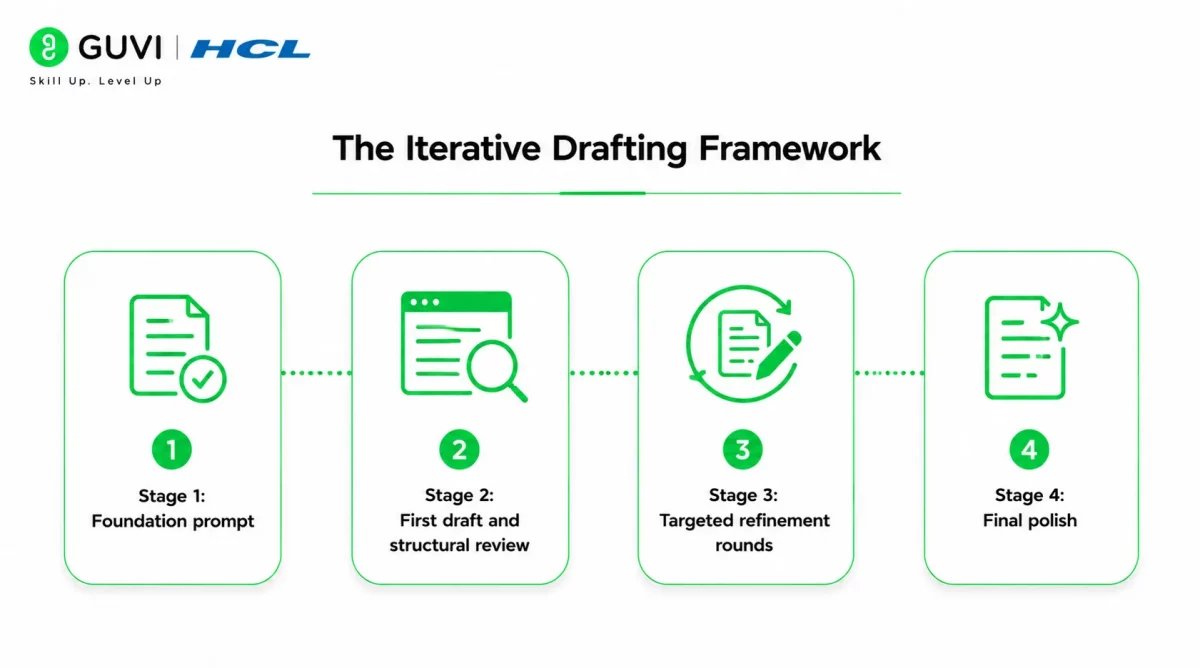
A structured iterative drafting session follows four stages regardless of the content type.
Stage 1: Foundation prompt
Establish context, audience, tone, goal, and format constraints before asking for any content. The richer the foundation, the better the first draft.
Stage 2: First draft and structural review
Generate the first draft and evaluate structure, argument flow, and completeness before worrying about sentence-level quality. Fix the architecture before the decoration.
Stage 3: Targeted refinement rounds
Give Claude one specific type of feedback per round. Mixing multiple types of feedback in a single instruction produces inconsistent results. One round per dimension: tone, then clarity, then length, then voice.
Stage 4: Final polish
A final pass focusing on opening and closing sentences, transitions between sections, and any phrases that still feel generic or off-voice.
Want to build professional writing and communication skills that combine human judgment with AI efficiency? Explore HCL GUVI’s Business Analytics Course, designed to help you develop the clear thinking and structured communication modern professional roles demand.

The Four-Stage Iterative Drafting Process with Claude
Stage 1: Writing a Strong Foundation Prompt
The foundation prompt sets everything Claude needs to produce a useful first draft. Invest two to three minutes writing it rather than starting with a vague instruction.
I need help writing [content type].

Context: [What this is for, where it will appear, why it matters]
Audience: [Who will read this, their knowledge level, what they care about]
Goal: [What you want the reader to think, feel, or do after reading]
Tone: [3 adjectives describing the voice: e.g. direct, warm, authoritative]
Format: [Length, structure, any specific sections required]
Constraints: [What to avoid, character limits, banned phrases]

Do not write the content yet. Confirm you understand the brief
and ask me any clarifying questions before starting.
The final instruction, asking Claude to confirm understanding before writing, surfaces misalignments in the brief before they produce an off-target first draft that wastes an iteration round correcting fundamental misunderstandings.
Stage 2: Reviewing the First Draft for Structure
Once Claude produces the first draft, resist the instinct to immediately ask for sentence-level edits. Evaluate structure first because fixing a poorly structured draft at the sentence level wastes multiple iteration rounds.
Before we refine this draft, I want to check the structure.

Issues I see with the current draft:
- [List structural issues: sections in wrong order, missing section,
  argument not building logically, key point buried, opening too slow]

Please restructure the draft to address these issues without
changing the writing style or sentence quality yet.
Show me the restructured version.
Separating structural revision from prose revision is the single most important habit in iterative drafting. Trying to fix both simultaneously produces muddled feedback that Claude cannot execute cleanly.
Giving feedback on one specific dimension at a time, a technique called targeted revision in writing pedagogy, produces measurably better outcomes than comprehensive feedback across multiple dimensions simultaneously. This principle is the foundation of the round-by-round iterative drafting approach used in this guide.
Stage 3: Targeted Refinement Rounds
With the structure confirmed, run one focused refinement round per dimension. Each round takes thirty seconds to brief and two minutes to review.
Round 1: Tone adjustment
The tone in this draft is [too formal / too casual / inconsistent].
Rewrite it to feel more [target tone adjective].
Specifically, the sections that feel most off are [identify sections].
Do not change the structure or add new content, only adjust the voice.
Round 2: Clarity and concision
Tighten this draft for clarity. Remove any sentences that repeat a
point already made. Cut any filler phrases like "it is important to note"
or "in today's world." Break any sentence over 25 words into two sentences.
Target a 15 percent word count reduction without losing any key points.
Round 3: Specificity
This draft is too generic in several places. Identify the 3 most generic
claims or sections and rewrite them to be more specific. Add a concrete
example, a specific number, or a named scenario wherever the current
draft makes a vague claim that could appear in any article on this topic.
Round 4: Opening and closing
Rewrite the opening paragraph and the closing paragraph only.
The opening needs to [hook faster / establish stakes more clearly /
start with the reader's problem not the solution].
The closing needs to [be more actionable / end with more conviction /
connect back to the opening idea].Professional writers allocate up to 70 percent of total writing time to revision rather than initial drafting according to writing process research. Claude’s iterative drafting capability directly mirrors this pattern, making it a more accurate model of how strong writing is actually produced than single-prompt generation.
Stage 4: Final Polish Pass
The final pass catches residual issues that targeted rounds miss because they were focused on specific dimensions rather than the overall reading experience.
Read this draft as a demanding editor and identify:
1. Any sentence that still sounds like it was written by AI rather
   than a human with a specific point of view
2. Any transition between sections that feels abrupt or mechanical
3. The single weakest sentence in the entire draft
4. Any word used more than three times that should be varied

Do not rewrite the draft yet. List only the issues with their
location so I can decide which ones to address.
Asking Claude to identify issues rather than immediately fix them keeps you in the editorial decision-making seat. You choose which issues to address and how, rather than accepting Claude’s judgment on every dimension simultaneously.
Conclusion
Claude iterative drafting shifts the question from “can Claude write this perfectly in one shot?” to “how quickly can Claude and I get this to the standard I need?” That shift in mindset consistently produces better output because it uses Claude’s generation speed alongside human editorial judgment at each stage rather than trying to front-load all judgment into a single prompt.
Build the four-stage framework into your next significant writing task, invest two minutes in the foundation prompt, separate structural from prose revision, and run one targeted refinement round per dimension.
FAQs
What is Claude iterative drafting?
The process of using Claude to produce and refine written content through structured rounds of targeted feedback rather than accepting or rejecting a single generated output.
Why is iterative drafting better than one-shot generation?
It mirrors how professional writing actually works, through progressive refinement. Each round fixes one specific dimension, producing stronger final output than any single prompt can achieve regardless of how detailed it is.
How many iteration rounds does good drafting typically require?
Most professional writing tasks reach a strong final output in three to five targeted rounds covering structure, tone, clarity, specificity, and final polish.
What is the most important rule in iterative drafting with Claude?
Give one type of feedback per round. Mixing structural, tonal, and clarity feedback in a single instruction produces inconsistent revisions that are harder to evaluate and often introduce new problems while fixing others.
How do I stop Claude from changing things I was happy with during revision?
Specify exactly what to change and explicitly instruct Claude to leave everything else unchanged. “Rewrite only the opening paragraph, do not change anything else” is more reliable than a general revision instruction.
Can iterative drafting work for short content like emails and social posts?
Yes, though fewer rounds are needed. A two-round process covering structure then tone is usually sufficient for short-form content, while long-form content benefits from the full four-stage framework.
Success Stories

About the Author
HCL GUVI
This article was selected and published as part of the HCL GUVI AI Blogathon 2026, an initiative designed to encourage students, AI enthusiasts, and aspiring tech writers to simplify complex AI concepts through impactful technical content. The contest recognized high-quality, original, and insightful AI-focused blogs, with selected authors receiving publication opportunities on the HCL GUVI blog platform along with official author credits and recognition.
View all posts by HCL GUVI
Connect with me @












Did you enjoy this article?