


Java Articles
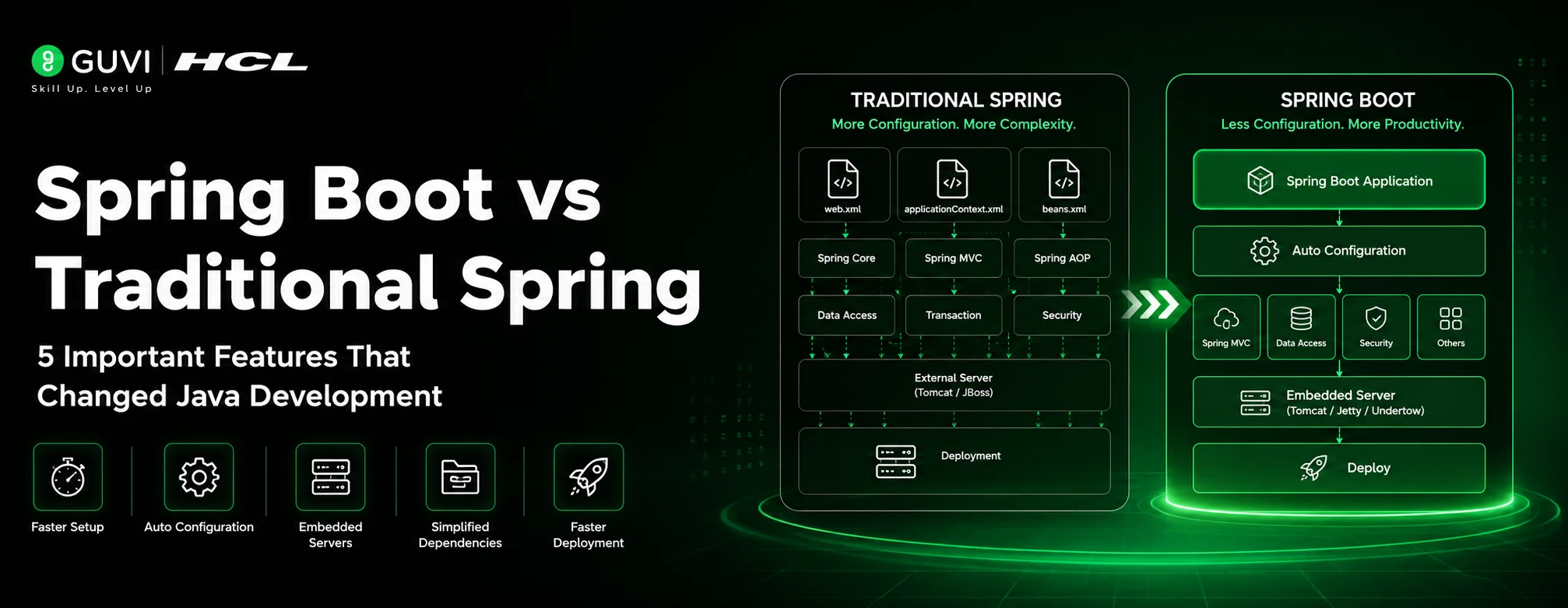
Spring Boot vs Traditional Spring: 5 Important Features That Changed Java Development
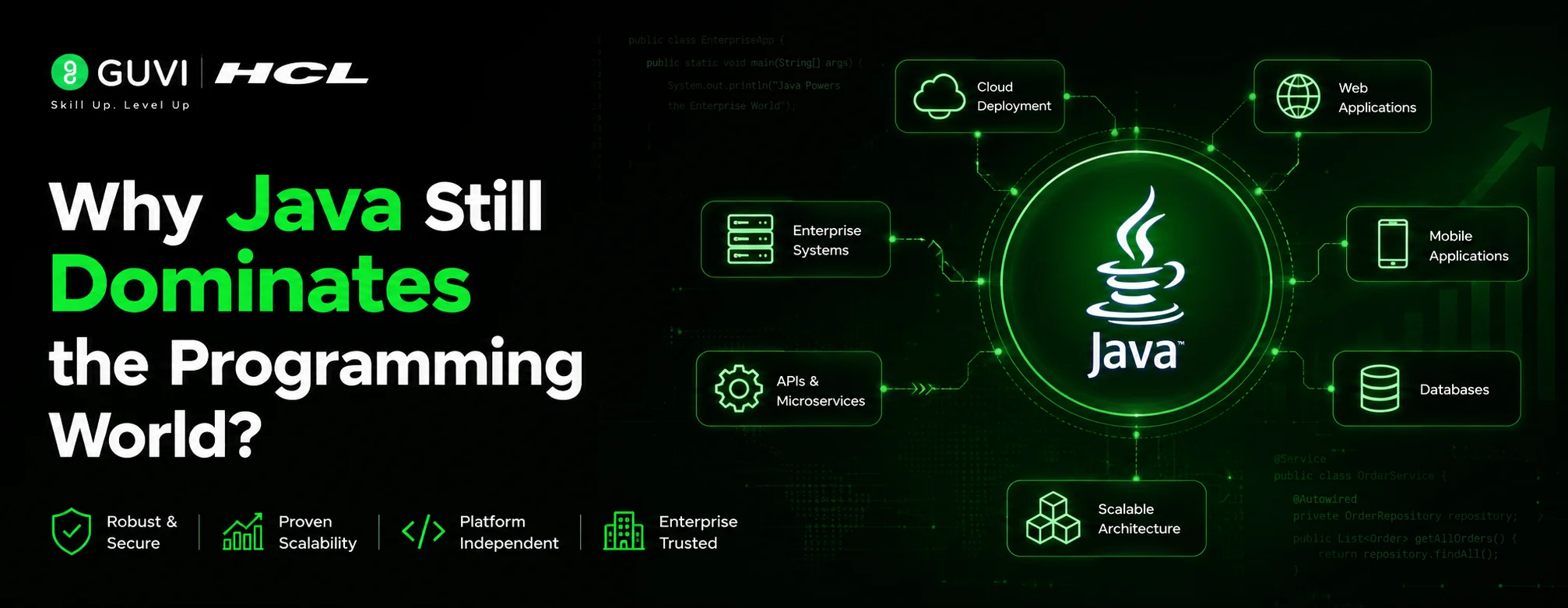
Why Java Still Dominates the Programming World?
Spring Boot vs Node.js Differences That Can Transform Your Tech Career in 2026


Get In Touch For Details! Request More Information
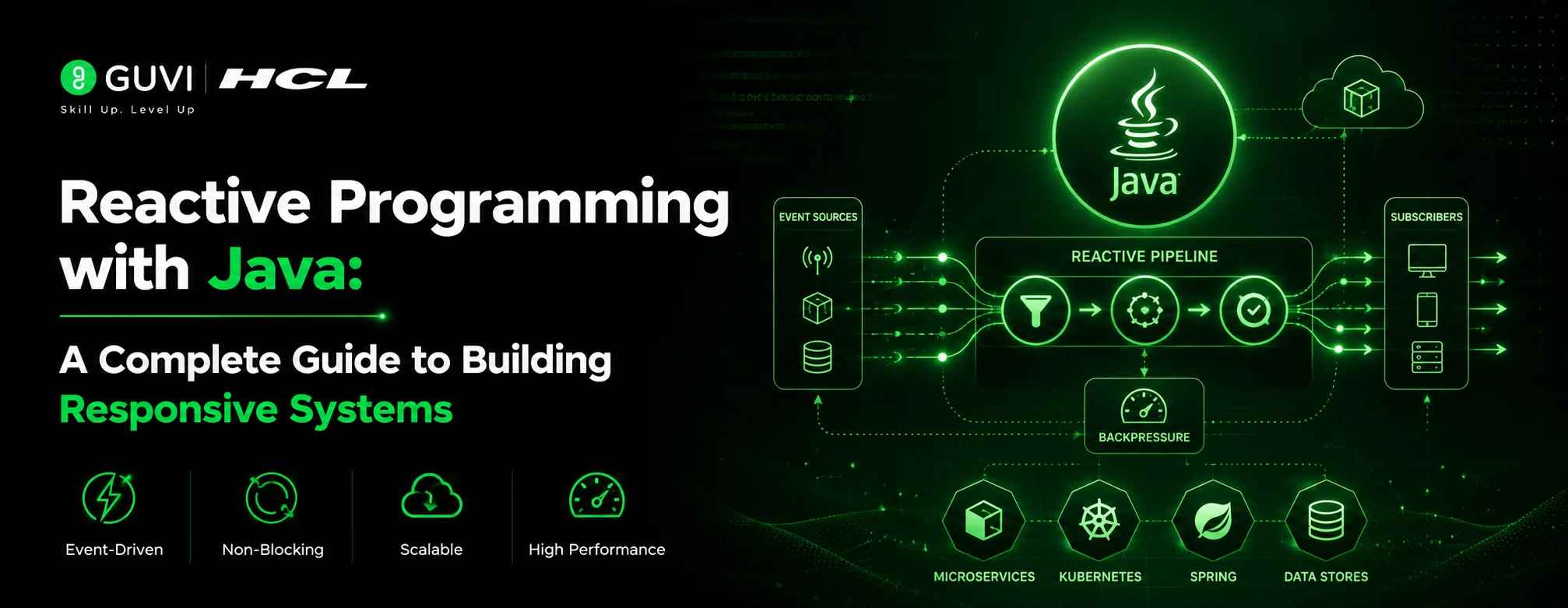
Reactive Programming with Java: A Complete Guide to Building Responsive Systems
Jun 16, 2026 4 Min Read 27 Views
(Last Updated)
In today’s world of high-traffic applications, real-time data streams, and millions of concurrent users, traditional blocking I/O just doesn’t cut it. Enter reactive programming — a paradigm that’s revolutionizing how we build Java applications.
Reactive programming with Java enables you to build systems that are:
- Responsive — Always available and fast
- Resilient — Fault-tolerant and self-healing
- Elastic — Scales horizontally under load
- Message-driven — Asynchronous and non-blocking
With Java 9+ introducing the Reactive Streams API and frameworks like Project Reactor, RxJava, and Spring WebFlux, reactive programming has become more accessible than ever.
In this comprehensive guide, you’ll learn everything about reactive programming in Java, from fundamentals to real-world implementation.
Table of contents
- What Is Reactive Programming?
- The Core Concept
- Traditional vs. Reactive Approach
- The Reactive Manifesto
- Why Reactive Programming in Java?
- Handle High Concurrency Efficiently
- Non-Blocking I/O
- Better Resource Utilization
- Real-Time Data Processing
- Key Concepts in Reactive Programming
- Publisher & Subscriber
- Flux & Mono (Project Reactor)
- Backpressure
- Operators
- Reactive Programming Frameworks for Java
- Project Reactor
- RxJava
- Spring WebFlux
- R2DBC (Reactive Relational Database Connectivity)
- Building Your First Reactive Application
- Example: Reactive REST API with Spring WebFlux
- Step 1:Add Dependencies
- Step 2: Create Model
- Step 3: Create Reactive Repository
- Step 4: Create Reactive Controller
- Step 5: Run the Application
- Reactive vs. Blocking: Performance Comparison
- Throughput Test Results
- Real-World Reactive Use Cases
- Netflix— Streaming to 200M+ Users
- Uber— Real-Time Ride Matching
- LinkedIn— Feed & Messaging
- Financial Trading Platforms
- Future of Reactive Programming in Java
- Emerging Trends (2026)
- Key Takeaways
What Is Reactive Programming?
The Core Concept
Reactive programming is an asynchronous programming paradigm that focuses on data streams and the propagation of change. Instead of waiting for operations to complete (blocking), you subscribe to data streams and react when data arrives.
Traditional vs. Reactive Approach
| Traditional (Blocking) | Reactive (Non-Blocking) |
|---|---|
| Request → Wait → Response | Request → Subscribe → React when ready |
| One thread per request | One thread serves thousands of requests github |
| CPU waits for I/O | CPU handles other tasks while waiting |
| Synchronous execution | Asynchronous execution |
| Harder to scale | Naturally scales horizontally |
With reactive programming, one thread can successfully serve 10+ users simultaneously, dramatically improving resource utilization.
The Reactive Manifesto
Reactive systems follow four principles from the Reactive Manifesto:
- Responsive — Respond quickly and consistently
- Resilient — Recover from failures automatically
- Elastic — Scale up/down based on demand
- Message-Driven — Use asynchronous message passing
Why Reactive Programming in Java?
1. Handle High Concurrency Efficiently
Traditional Java applications use one thread per request, which is expensive:
- Thread creation: ~1MB stack memory
- Context switching overhead
- Limited by available threads
Reactive programming uses a small thread pool (often just 2-10 threads) to handle thousands of concurrent connections
2. Non-Blocking I/O
Instead of blocking threads waiting for:
- Database queries
- API calls
- File operations
- Network requests
Reactive systems continue processing other requests while waiting for I/O operations to complete.
3. Better Resource Utilization
text
Traditional: 1000 concurrent users = 1000 threads Reactive: 1000 concurrent users = 10 threads [web:31]
This means massive cost savings in cloud environments where you pay per CPU/core.
4. Real-Time Data Processing
Perfect for:
- Stock trading platforms — Handle price streams
- Chat applications — Real-time messaging
- IoT systems — Process sensor data streams
- Analytics — Live dashboards and monitoring
Key Concepts in Reactive Programming
1. Publisher & Subscriber
The foundation of reactive programming:
Publisher (emits data) → Subscriber (receives & reacts)
- Publisher: Produces data/events (e.g., database, API, user input)
- Subscriber: Consumes data and reacts to it
- Subscription: Connects publisher to subscriber

2. Flux & Mono (Project Reactor)
Project Reactor is the most popular reactive library for Java:
| Type | Description | Example |
|---|---|---|
| Flux<T> | 0 to N items (stream) | List of users, database rows github |
| Mono<T> | 0 or 1 item | Single user, HTTP response github |
// Flux: Multiple values
Flux names = Flux.just(“John”, “Jane”, “Bob”);
// Mono: Single value
Mono user = userRepository.findById(1);
3. Backpressure
Backpressure prevents overwhelming the subscriber when the publisher is too fast. The subscriber can request a specific number of items:
text
Publisher (fast) ← Request N ← Subscriber (slow)
This is crucial for memory management and preventing OutOfMemory errors.
4. Operators
Operators transform, filter, and manipulate data streams:
java
Flux.just(1, 2, 3, 4, 5) .filter(n -> n % 2 == 0) // Filter even numbers .map(n -> n * 2) // Multiply by 2 .subscribe(System.out::println); // Output: 4, 8
Common operators:
- map() — Transform each item
- filter() — Filter items based on condition
- flatMap() — Transform to async streams
- zip() — Combine multiple streams
- retry() — Retry on error
- timeout() — Add timeout
Reactive Programming Frameworks for Java
1. Project Reactor
Project Reactor is the reactive library behind Spring WebFlux and the de facto standard for reactive Java.
Key Features:
- Flux and Mono types
- Rich operator library (80+ operators)
- Built-in backpressure support
- Seamless Spring Framework integration
- Used by Netflix, Uber, and major enterprises
Maven Dependency:
<dependency> <groupId>io.projectreactor</groupId> <artifactId>reactor-core</artifactId> <version>3.6.0</version> </dependency> |
2. RxJava
ReactiveX for JVM — the original reactive library for Java.
Key Features:
- Observable, Single, Completable, Maybe types
- Cross-language (RxJS, RxSwift, etc.)
- Rich ecosystem
- More complex than Reactor
3. Spring WebFlux
Spring’s reactive web framework built on Project Reactor.
Key Features:
- Non-blocking web server (Netty)
- Reactive MongoDB, PostgreSQL, Redis
- Compatible with Spring Boot 2.0+
- Functional and annotated programming models
4. R2DBC (Reactive Relational Database Connectivity)
Reactive database driver for SQL databases.
// Reactive PostgreSQL with R2DBC
Flux<User> users = database.select("SELECT * FROM users") .as(User.class) .all();
Building Your First Reactive Application
Example: Reactive REST API with Spring WebFlux
Let’s build a simple user service using reactive programming:
Step 1:Add Dependencies
<!-- Reactive MongoDB -->
<dependency>
    <groupId>org.springframework.boot</groupId>
    <artifactId>spring-boot-starter-data-mongodb-reactive</artifactId>
</dependency>

<!-- Project Reactor -->
<dependency>
    <groupId>io.projectreactor</groupId>
    <artifactId>reactor-core</artifactId>
</dependency>
Step 2: Create Model
public class User {
private String id;
private String name;
private String email;
// Constructors, getters, setters}
Step 3: Create Reactive Repository
import org.springframework.data.mongodb.repository.ReactiveMongoRepository;
public interface UserRepository extends ReactiveMongoRepository {
Mono findByEmail(String email);
Flux findByNameContaining(String name);
}
Step 4: Create Reactive Controller
import org.springframework.web.bind.annotation.;
import reactor.core.publisher.;
@RestController
@RequestMapping(“/api/users”)
public class UserController {
private final UserRepository userRepository;

public UserController(UserRepository userRepository) {
    this.userRepository = userRepository;
}

// GET all users (returns Flux)
@GetMapping
public Flux<User> getAllUsers() {
    return userRepository.findAll();
}

// GET single user (returns Mono)
@GetMapping("/{id}")
public Mono<User> getUserById(@PathVariable String id) {
    return userRepository.findById(id);
}

// POST create user
@PostMapping
public Mono<User> createUser(@RequestBody User user) {
    return userRepository.save(user);
}

// PUT update user
@PutMapping("/{id}")
public Mono<User> updateUser(
    @PathVariable String id,
    @RequestBody User user
) {
    user.setId(id);
    return userRepository.save(user);
}

// DELETE user
@DeleteMapping("/{id}")
public Mono<Void> deleteUser(@PathVariable String id) {
    return userRepository.deleteById(id);
}

// GET users by name (search)
@GetMapping("/search/{name}")
public Flux<User> searchByName(@PathVariable String name) {
    return userRepository.findByNameContaining(name);
}
}
Step 5: Run the Application
./mvnw spring-boot:run
Your reactive API is now running! It can handle thousands of concurrent requests with minimal threads.
Reactive vs. Blocking: Performance Comparison
Throughput Test Results
Example from MariaDB reactive programming test:
| Metric | Blocking (JDBC) | Reactive (R2DBC) |
|---|---|---|
| Threads Used | 100 | 2-10 github |
| Requests/Sec | ~5,000 | ~15,000 github |
| Response Time | 200ms avg | 50ms avg github |
| Memory Usage | 100MB | 20MB github |
| Scalability | Linear (more threads = more memory) | Exponential (more throughput per thread) github |
Key Finding: One thread in reactive mode successfully serves 10+ users compared to 1 user per thread in blocking mode.
When to Use Reactive Programming
✅ Use Reactive When:
| Use Case | Why Reactive? |
|---|---|
| High-concurrency web apps | Handle 10K+ concurrent users sam-solutions |
| Real-time data streaming | Process live data feeds sam-solutions |
| Microservices architecture | Non-blocking inter-service calls |
| IoT applications | Process millions of sensor events sam-solutions |
| Chat/messaging apps | WebSocket connections scale better |
| Financial trading | Low-latency price updates sam-solutions |
| API gateways | Route thousands of requests/sec |
❌ Avoid Reactive When:
| Use Case | Why Not Reactive? |
|---|---|
| Simple CRUD apps | Traditional is simpler |
| Legacy systems | Migration complexity |
| Team lacks experience | Steep learning curve medium |
| CPU-bound tasks | No benefit for computation |
| Small traffic apps | Over-engineering |
| Third-party libraries are blocking | Mixed paradigms cause issues sam-solutions |
Real-World Reactive Use Cases
1. Netflix — Streaming to 200M+ Users
Netflix uses RxJava and reactive programming to handle:
- Recommendation engines
- Video streaming
- User interface data loading
- Microservices communication
2. Uber — Real-Time Ride Matching
Uber uses reactive streams for:
- Live location tracking (millions of GPS updates/sec)
- Dynamic pricing (real-time demand calculation)
- Driver-rider matching
3. LinkedIn — Feed & Messaging
LinkedIn’s reactive architecture powers:
4. Financial Trading Platforms
High-frequency trading systems use reactive programming for:
Future of Reactive Programming in Java
Emerging Trends (2026)
- Java Virtual Threads (Java 21+)
- Reactive Spring Boot 3
- Better integration and performance
- Improved observability
- Cloud-Native Reactive
- Kubernetes-native scaling
- Serverless reactive functions
- Reactive GraphQL
- Real-time subscriptions
- Apollo Federation with reactive backends
Java reactive programming continues evolving as modern software demands non-blocking, event-driven systems.
Key Takeaways
Success Stories

About the Author
Lavish Jain
A Professional Developer Mentor and Corporate Trainer with over 10 years of experience, I have contributed to technological advancements through comprehensive training and mentorship. My journey includes pivotal roles at Cluebix, Focus-4D,ThoughtWorks, and currently with Guvi -HCL Group, where I shape the careers of aspiring developers. I specialize in simplifying complex concepts, making them accessible to learners at all levels, and have successfully trained lakhs of budding developer through corporate and boot camp courses focused on full-stack development.
View all posts by Lavish Jain
Connect with me @











Did you enjoy this article?