


Data Structure Articles
Sliding Window Technique: Explained with Examples
Two Pointer Technique: Problems and Applications


Get In Touch For Details! Request More Information
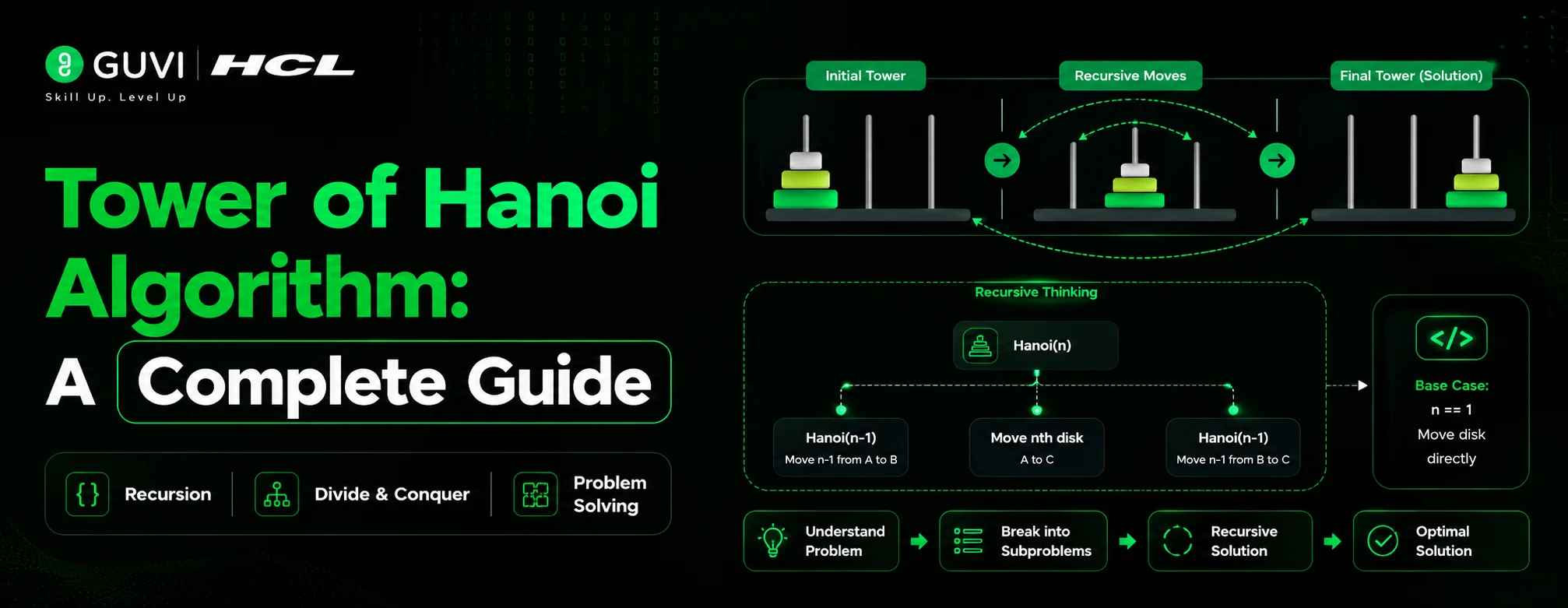
Tower of Hanoi Algorithm: A Complete Guide
Sep 10, 2026 5 Min Read 1153 Views
(Last Updated)
The Tower of Hanoi Algorithm is one of the most popular recursive problems in computer science. At first glance, it looks like a simple puzzle involving disks and rods. However, beneath that simplicity lies a powerful lesson in recursion, mathematical thinking, optimization, and algorithm design.
For students, the Tower of Hanoi problem is often the first real introduction to recursion. For professionals,it represents an elegant demonstration of dividing up large problems into smaller subproblems. It is a piece of code that is widely discussed in programming interviews, programming data structures and algorithmic problem solving environments because it helps to impart a mindset that helps solve far more complex systems.
Unlike many theoretical algorithms that feel disconnected from practical programming, the Tower of Hanoi Algorithm trains developers to think systematically. It helps to understand recursion trees, stack memory, divide and conquer logic and computational complexity.
We are going to dive deep into the Tower of Hanoi Algorithm, from its rules, to recursive logic.
Quick Answer:
The Tower of Hanoi Algorithm is a recursive problem-solving method used to move disks between three rods while following specific rules. It is widely used to teach recursion and algorithmic thinking in computer science.
Table of contents
- What is the Tower of Hanoi Algorithm?
- Understanding the Rules of the Tower of Hanoi
- Rule 1: Only One Disk Can Move at a Time
- Rule 2: A Larger Disk Cannot Be Placed on a Smaller Disk
- Rule 3: Only the Top Disk Can Be Moved
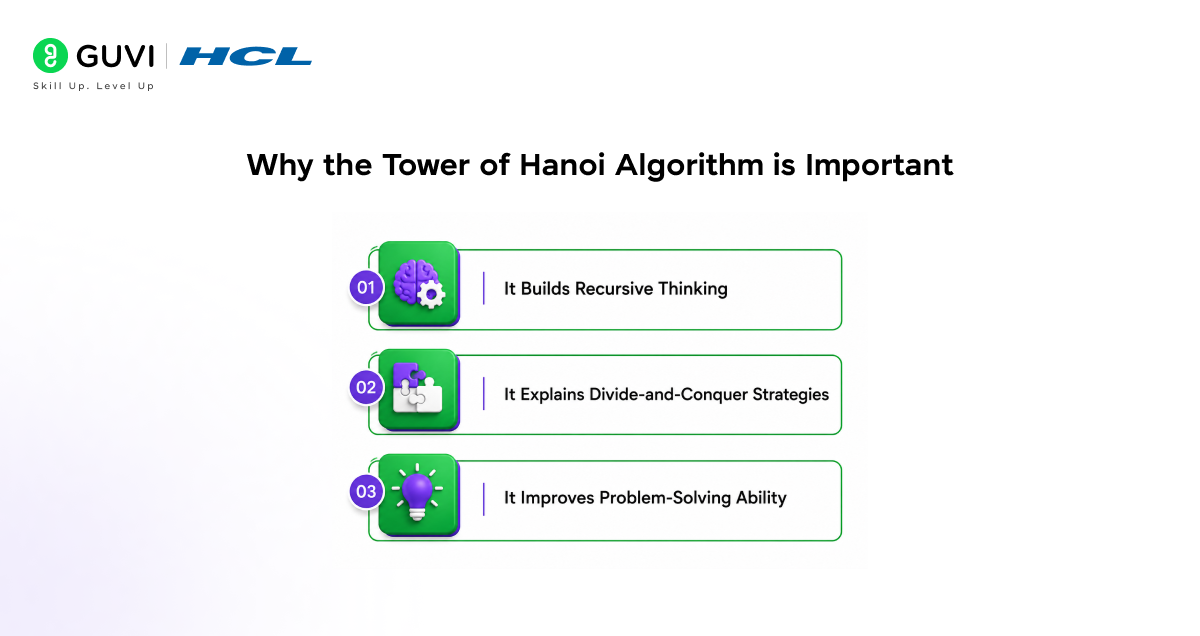
- Why the Tower of Hanoi Algorithm is Important
- It Builds Recursive Thinking
- It Explains Divide-and-Conquer Strategies
- It Improves Problem-Solving Ability
- The Core Logic Behind the Tower of Hanoi Algorithm
- Recursive Structure of the Tower of Hanoi Algorithm
- Visualizing the Tower of Hanoi Algorithm
- Recursive Formula of the Tower of Hanoi Algorithm
- Pseudocode for Tower of Hanoi Algorithm
- Tower of Hanoi Algorithm in Python
- Tower of Hanoi Algorithm in C++
- Tower of Hanoi Algorithm in Java
- Common Mistakes Students Make
- Incorrect Base Case
- Wrong Parameter Order
- Confusion Between Recursive Calls
- Wrapping it up:
- FAQs
- What is the Tower of Hanoi Algorithm?
- Why is the Tower of Hanoi Algorithm important?
- Is the Tower of Hanoi Algorithm used in real-world applications?
What is the Tower of Hanoi Algorithm?
The Tower of Hanoi Algorithm is a recursive algorithm used to solve a puzzle consisting of three rods and multiple disks of different sizes.
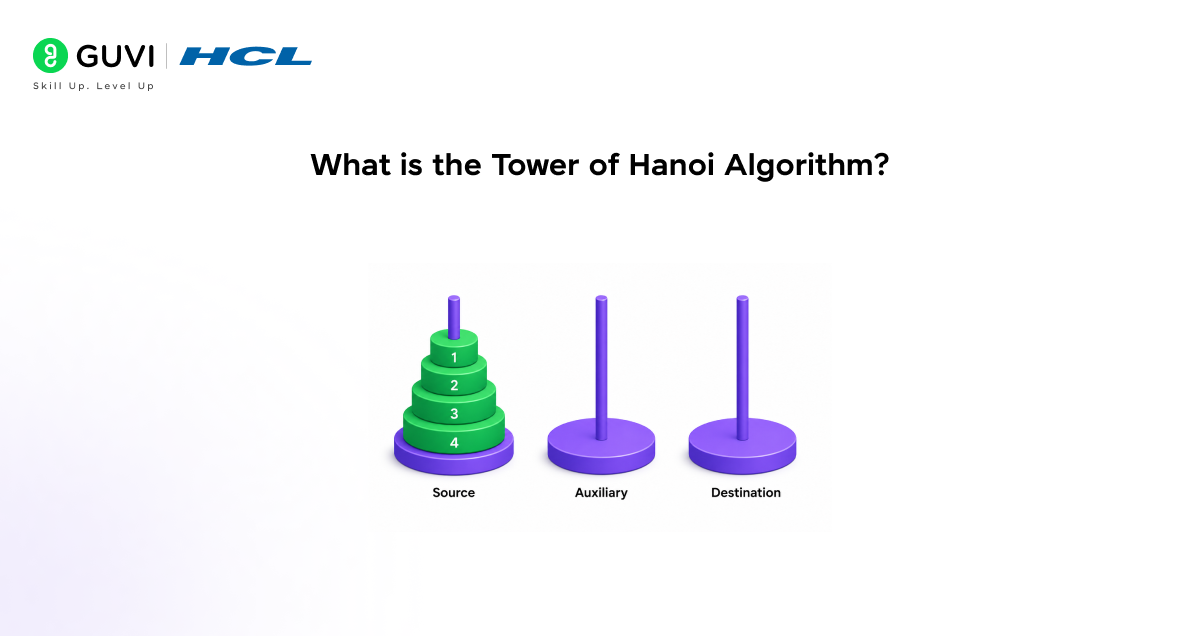
The puzzle is initially presented with all of the disks on one rod in decreasing order of size. The goal is to transfer all the disks to a different rod, subject to certain movement constraints.
This problem may seem easy, but as the number of disks gets larger, the number of moves required increases exponentially.
In computer science, it is used to explain:
- Recursion
- Divide and conquer
- Backtracking concepts
- Mathematical induction
- Stack operations
- Algorithm complexity
The problem illustrates the recursive solution to a large problem by solving a series of smaller versions of the same problem.
Understanding the Rules of the Tower of Hanoi
The puzzle contains:
- One source rod
- One auxiliary rod
- One destination rod
- Multiple disks of different sizes
The disks start stacked on top of each other on the source rod.
The following rules must always be followed:
Rule 1: Only One Disk Can Move at a Time
It is not possible to move two or more disks together.
One disk is moved at a time in each operation.
Rule 2: A Larger Disk Cannot Be Placed on a Smaller Disk
This is the most important constraint.
The disks are always to be placed from largest to smallest.
Rule 3: Only the Top Disk Can Be Moved
Moving a disk that is under other disks directly is not possible.
These rules form the recursive challenge.
Why the Tower of Hanoi Algorithm is Important
The Tower of Hanoi puzzle is often thought of as an academic exercise by many students. In reality, it builds a number of basic computational abilities.
It Builds Recursive Thinking
The problem cannot be solved efficiently through brute-force trial and error.
Programmers learn to think recursively, however:
- Solve a smaller version
- Use that solution
- Increase its size to tackle the larger problem
This mental model is fundamental in computer science.
It Explains Divide-and-Conquer Strategies
The algorithm teaches a decomposition.
The algorithm iteratively breaks down the puzzle into subproblems rather than solving the entire puzzle at once.
This same principle is utilized in many sophisticated algorithms such as:
- Merge Sort
- Quick Sort
- Binary Search
- Tree Traversals
It Improves Problem-Solving Ability
The Tower of Hanoi Algorithm encourages structured reasoning.
Developers develop their identification skills:
- Base cases
- Recursive transitions
- State changes
- Dependency chains
These skills are crucial in software engineering.
The Core Logic Behind the Tower of Hanoi Algorithm
The power of the algorithm is its simplicity.
To move n disks from source to destination:
- Move the top n−1 disks from source to auxiliary
- Move the biggest disk to destination
- Move the n−1 disks from auxiliary to destination
This recursive subdivision continues until there is only a single disk.
The smallest problem is chosen as the base case.
Recursive Structure of the Tower of Hanoi Algorithm
Here is an example that explains how to think about the recursion of a given concept.
In this case, we are using three disks:
Disk 1, Small
Disk 2, Medium
Disk 3, Large
Our Goal:
To move from A to C.
Step 1 – Move from A to B (medium disks).
Step 2 – Move from A to C (large disk).
Step 3 – Move from B to C (medium disks).
Since you have two disks to move, you must call the method (the last step) twice.
Every time you call the method, it will continue until there are no more disks to move.
This self-repeating structure is exactly why the algorithm is recursive.
(Note: There are also several technical reasons to use recursion in programming; for example, managing system resources.)
Visualizing the Tower of Hanoi Algorithm
When students first learn recursion, it often feels abstract.
The Tower of Hanoi puzzle helps visualize recursive execution clearly.
For example:
Initial State
| Rod A | Rod B | Rod C |
| 3 | ||
| 2 | ||
| 1 |
Final State
| Rod A | Rod B | Rod C |
| 3 | ||
| 2 | ||
| 1 |
The recursive process gradually transforms the initial state into the final state.
The Tower of Hanoi puzzle has a well-known theoretical solution that requires a minimum of 2ⁿ − 1 moves to complete for n disks. For 64 disks, this number becomes 18,446,744,073,709,551,615 moves, an astronomically large value that grows exponentially with each additional disk. This extreme growth is often illustrated through a famous legend describing monks moving disks once per second, suggesting it would take longer than the age of the universe to finish the puzzle. The problem is widely used in computer science to demonstrate recursion and exponential time complexity.
Recursive Formula of the Tower of Hanoi Algorithm
The recursive relation is:
T(n)=2T(n−1)+1
Where:
- T(n) = minimum moves for n disks
- T(n−1) = moves required for smaller subproblem
The formula exists because:
- First recursive call: move n−1 disks
- One move for largest disk
- Second recursive call: move n−1 disks again
Pseudocode for Tower of Hanoi Algorithm
The pseudocode is simple yet elegant.
TOH(n, source, auxiliary, destination)
IF n == 1
Move disk from source to destination
RETURN
TOH(n-1, source, destination, auxiliary)
Move nth disk from source to destination
TOH(n-1, auxiliary, source, destination)
This structure is considered one of the cleanest recursive algorithms in computer science.
Tower of Hanoi Algorithm in Python
Python is one of the best languages for learning recursion because of its readable syntax.

def tower_of_hanoi(n, source, auxiliary, destination):
if n == 1:
print(f”Move disk 1 from {source} to {destination}”)
return
tower_of_hanoi(n-1, source, destination, auxiliary)
print(f”Move disk {n} from {source} to {destination}”)
tower_of_hanoi(n-1, auxiliary, source, destination)
tower_of_hanoi(3, ‘A’, ‘B’, ‘C’)
Tower of Hanoi Algorithm in C++
#include <iostream>
using namespace std;
void towerOfHanoi(int n, char source, char auxiliary, char destination)
{
if(n == 1)
{
cout << “Move disk 1 from “
<< source << ” to “
<< destination << endl;
return;
}
towerOfHanoi(n-1, source, destination, auxiliary);
cout << “Move disk “
<< n << ” from “
<< source << ” to “
<< destination << endl;
towerOfHanoi(n-1, auxiliary, source, destination);
}
int main()
{
towerOfHanoi(3, ‘A’, ‘B’, ‘C’);
}
Tower of Hanoi Algorithm in Java
class TowerOfHanoi {
static void solve(int n, char source,
char auxiliary,
char destination)
{
if(n == 1)
{
System.out.println(
“Move disk 1 from “
+ source + ” to ” + destination);
return;
}
solve(n-1, source, destination, auxiliary);
System.out.println(
“Move disk ” + n +
” from ” + source +
” to ” + destination);
solve(n-1, auxiliary, source, destination);
}
public static void main(String[] args)
{
solve(3, ‘A’, ‘B’, ‘C’);
}
}
Common Mistakes Students Make
The Tower of Hanoi Algorithm can be simple to work out if you understand Recursion, however, there are still many mistakes made by beginners.
Incorrect Base Case
Some students forget the stopping condition.
This leads to infinite recursion and stack overflow errors.
Wrong Parameter Order
When you are calling an auxiliary parameter or rod, the order of your source, auxiliary & destination matter.
If you were to switch them around, you will completely change the logic behind the program.
Confusion Between Recursive Calls
Many learners struggle to understand why two recursive calls are needed.
1st Recursive Call is to move the largest disk off the Source & make room on the Source.
2nd Recursive Call is to move all of the smaller disks from the Auxiliary to the Destination building the Stack at the Destination
Wrapping it up:
The Tower of Hanoi Algorithm is a masterclass in recursive thinking, logical decomposition, and computational reasoning.
For beginners, it provides one of the clearest introductions to recursion. For experienced developers, it reinforces critical concepts like divide-and-conquer strategies, stack behavior, and complexity analysis.
The reason the Tower of Hanoi problem is timeless is because of how elegant it is; i.e., it involves a relatively few number of rules but the amount of complexity that can be generated with a few simple rules is enormous and has taught many generations of programmers how to think through their problem-solving process in a systematic way.
Whether you are preparing for coding interviews, learning data structures, or improving problem-solving skills, mastering the Tower of Hanoi Algorithm builds a strong foundation that extends far beyond this single puzzle.
FAQs
1. What is the Tower of Hanoi Algorithm?
The Tower of Hanoi Algorithm is a recursive algorithm used to solve a puzzle involving three rods and multiple disks. The goal is to move all disks from one rod to another while following specific movement rules.
2. Why is the Tower of Hanoi Algorithm important?
The algorithm is important because it teaches recursion, divide-and-conquer strategies, stack memory concepts, and algorithmic thinking.
3. Is the Tower of Hanoi Algorithm used in real-world applications?
While the exact puzzle is mostly educational, its recursive principles are used in file traversal, automation systems, AI search problems, and hierarchical task decomposition.
Success Stories

About the Author
Vishalini Devarajan
An Aerospace Engineer turned content writer, I focus on making complex concepts easy to understand through well-structured, reader-friendly blogs. Whether it’s a technical topic or a non-technical one, I love creating content that is clear, engaging, and impactful.
View all posts by Vishalini Devarajan
Connect with me @















Did you enjoy this article?