


Artificial Intelligence and Machine Learning Articles
Finance Manager to Data Analytics: Career Growth, Salary and Seniority
How to Evaluate LLM Outputs in Production Deployments
AI/ML Skills Gap 2026: Why Companies Can't Find Job-Ready Talent
20 AI/ML Interview Questions Recruiters Can Use Without a Tech Background - Best Guide


Get In Touch For Details! Request More Information
Replit Agent Self-Testing for Agent 3 with REPL Verification
Jul 13, 2026 4 Min Read 1122 Views
(Last Updated)
AI-generated code today often looks correct. UIs render, buttons work, and data appear on the dashboard. The problem comes when users interact with the app: they find broken interactions or APIs and fail quietly. These aren’t superficial issues.
This is a real problem with the current AI paradigm: it optimizes for the appearance of correct code rather than actual correctness. Applications look finished, but don’t work. Agent 3 from Replit tackles this with self-testing using REPL-based verification. It executes code, tests it, and fixes it in a tight feedback loop.
In this article, let’s understand Replit Agent Self-Testing, how to eradicate Potemkin functionality with Agent 3, how REPL provides real validation, and how to build your own self-testing systems.
TL;DR
- Replit Agent 3 is a self-testing system where AI generates code, executes it, tests it, and fixes it automatically.
- It uses REPL-based verification, where tests run by executing the actual code, as opposed to a static analysis tool.
- The result is that agents will not deliver “Potemkin” UIs where the interface looks like it works while actually containing broken logic.
- The testing is done by a test sub-agent, which mimics user actions and validates both the frontend and backend workflow.
- Using the test sub-agent enables Agent 3 to be fully autonomous for 200+ minutes for reliability testing.
Table of contents
- What Is Replit Agent Self-Testing?
- How AI Agents Build Applications Today
- The Real Issue: Potemkin Interfaces
- The Shift: Validation Through Execution Instead of Static Validation
- How the REPL Is So Powerful
- Example: Stateful verification using REPL
- How Agent 3 Performs Self-Testing
- Hidden Architecture: Dual-Agent System
- An Example: A Full Self-Testing Workflow
- Why Code-Based Testing Is More Effective
- Persistent State as a Crucial Enabler
- Why This Enables Long Autonomous Runs
- The Real Innovation: A Hybrid System
- Limitations You Should Not Ignore
- Conclusion
- FAQs
- What is Replit Agent self-testing?
- What are Potemkin interfaces in AI systems?
- Why is REPL important in this approach?
- How does Agent 3 improve reliability?
- Is this better than traditional testing?
- Can this fully replace human testing?
What Is Replit Agent Self-Testing?
Replit Agent self-testing is a practical way to verify AI-generated code by actually running and testing it inside a live REPL environment. Instead of assuming the code works, the agent checks how it behaves, catches failures, and keeps improving it through repeated testing until the application works as expected.
How AI Agents Build Applications Today
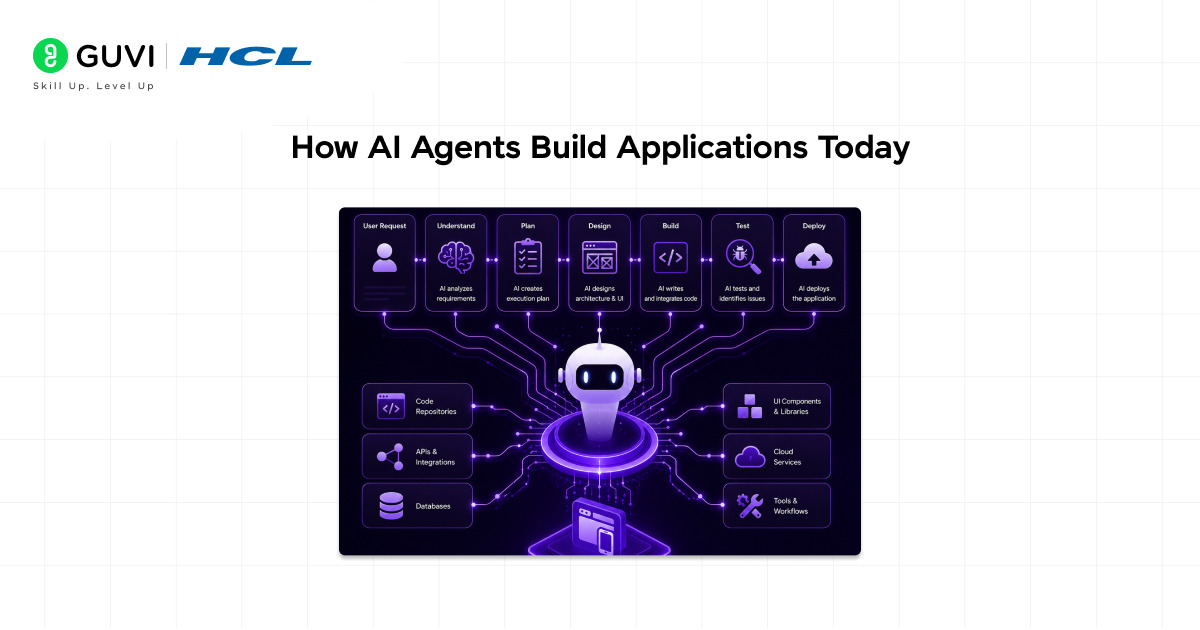
Currently, AI agents are used to produce entire applications: all parts from the UI components down to the back end, usually in a single workflow. For example, an agent can scaffold an interface, link to an API, and then simulate a complete user workflow in a system with very little human intervention.
The main problem is that most of these systems proceed linearly: the agent creates code, assumes it works, then continues to the next step without properly checking whether the system actually works when tested under real conditions.
Most of the output provided by current agents doesn’t guarantee that the various parts connect properly or behave as expected. As the systems become larger, these mistakes become progressively worse and can start to affect the whole system.
The Real Issue: Potemkin Interfaces
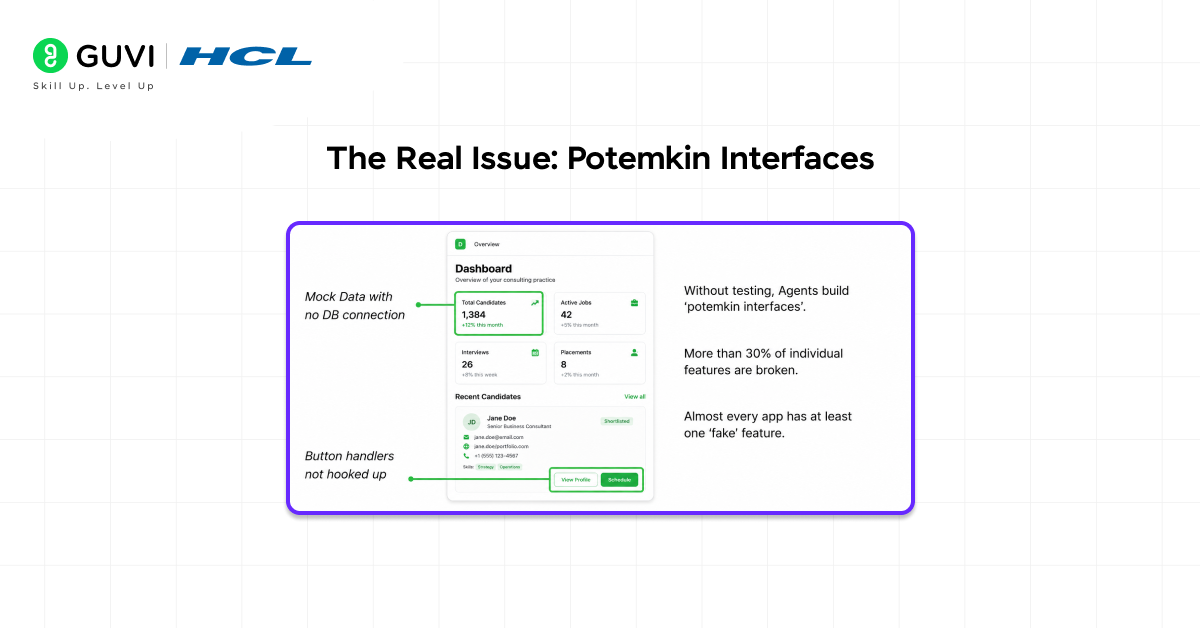
AI agents can produce finished-looking application output that actually does not work. These are called Potemkin interfaces because they look complete but are not functional beneath the surface. The UI displays correctly, buttons will respond, and dashboards display data, but there is no actual system logic to support these operations or deal with data correctly.
The result is the appearance of a working system without any actual mechanism that validates correctness. Without verification, the agent will continue building upon an unstable foundation and producing a system that will not work.
Self-testing is required. Otherwise, agents optimize for what looks correct rather than what actually works.
Also Read: Agent 3: Replit’s Most Autonomous AI Agent Explained
The Shift: Validation Through Execution Instead of Static Validation
Traditional validation methods like syntax checks or unit tests often miss how applications behave in real user scenarios.
Agent 3 represents a shift towards execution-based testing. Instead of asking if the code looks like valid code, it determines if the code actually executes successfully under realistic circumstances. This is done by incorporating environments, web browsers, and feedback loops to match the user’s experience.
How the REPL Is So Powerful
The REPL allows for continuous execution with state and tests workflows by reusing previous execution, not from scratch, with the context refreshed after every step. The agent can use variables and sessions as the user can.
Example: Stateful verification using REPL
let orderId = await createOrder(cartItems);
console.log(“Order created:”, orderId);
// later in the same session
let status = await getOrderStatus(orderId);
if (status !== “confirmed”) {
throw new Error(“Order verification failed”);
}
Here, the agent retains the orderId across steps and verifies it later, enabling multi-step validation.
How Agent 3 Performs Self-Testing
The system in Agent 3 performs iterative development and testing in a tight loop.
Agent 3 first writes code, executes it using the REPL, checks the execution with signals during runtime, and corrects it if necessary. The process then loops back again until a correct execution has been reached.
This is not a one-time test case; this is a full cycle of a multiple-stage process that makes iterative corrections until success.
To better understand how self-testing AI agents and REPL-based verification work in real-world scenarios, you can explore this GenAI ebook as a practical reference.
Hidden Architecture: Dual-Agent System
Agent 3 decouples the generation part from the testing part into separate agents. The main agent handles features, the planning part, and the testing sub-agent tests the implemented features.
The testing sub-agent executes workflows, simulates user behaviors, and gives the test results to the main agent, preventing the system from being overloaded.
AI systems that separate code generation from testing tend to be more reliable.
This is because a dedicated testing agent evaluates the application’s actual behavior independently, rather than trusting the generated code blindly.

An Example: A Full Self-Testing Workflow
An order agent has implemented the features of an order system. The agent then checks the behavior of these new features through a full verification.
The agent runs the system, adds an item to the cart, finishes an order, and then checks the UI display and database state.
await page.goto(‘/checkout’);
await page.fill(‘#name’, ‘User’);
await page.fill(‘#address’, ‘Chennai’);
await page.click(‘#place-order’);
let confirmation = await page.innerText(‘#status’);
let order = await db.getLatestOrder();
if (confirmation !== “Order placed” || !order) {
throw new Error(“Order flow validation failed”);
}
If the UI shows success but no data is stored, the agent detects the issue, fixes the logic, and reruns the test.
Why Code-Based Testing Is More Effective
Instead of relying on predefined actions, Agent 3 uses code-driven automation. This allows flexible and efficient testing of complex workflows.
Code supports loops, conditions, and reusable logic, reducing repetitive actions.
for (let i = 0; i < 12; i++) {
await page.click(‘.next-month’);
}
await page.click(‘.day-15’);
This replaces multiple manual steps with a single structured operation.
Persistent State as a Crucial Enabler
Persistence is one of the core benefits offered by REPL-based systems. An agent never loses its context over time between interactions.
This allows it to save values, retrieve them later on, and maintain sessions across multiple interactions. This is critical for multi-step workflows where outputs of prior steps are necessary for later validation.
This persistence is indispensable for testing real-world systems.
Why This Enables Long Autonomous Runs
Without verification, errors pile up rapidly, and systems become unreliable. The agents fail because they continue working based on incorrect assumptions.
Self-testing with the REPL-based approach can help catch and correct mistakes in early stages. This ensures stability of the system and the ability to have longer runs.
This principle allows the agent to run on its own over long periods of time.
The Real Innovation: A Hybrid System

The system has a balance of execution-based validation, browser interaction, and REPL-based persistent environments integrated into the system.
The contribution is code generation and validation that the system will behave as expected under real-world conditions. The hybrid system is Agent 3’s true strength.
Limitations You Should Not Ignore
The tests themselves do not guarantee the reliability of the agent. Agents will misinterpret results or fail to discover certain issues or limitations in the logic.
When designing complex applications, agents might need manual correction.
It is important to understand limitations to develop dependable systems.
To effectively build self-testing AI agents using Replit Agent, understanding how execution-based validation, REPL workflows, and iterative feedback loops interact is essential for creating reliable and scalable systems. Programs like HCL GUVI’s Artificial Intelligence and Machine Learning course can help build these skills through hands-on experience.
Conclusion
The Replit Agent 3 helps system development go beyond simple code generation; it allows for effective verification of the generated code. This ensures that systems are not only good to look at, but also truly dependable.
Through its usage of REPL-based systems, browser-level tests, and feedback loops, agents can develop and verify systems on their own. If an AI agent cannot verify its own output, it will always risk building systems that only appear to work. Real reliability starts when agents can test, fail, and correct themselves.
FAQs
1. What is Replit Agent self-testing?
It is a system where an agent generates, executes, verifies, and fixes code automatically in a loop.
2. What are Potemkin interfaces in AI systems?
They are interfaces that appear functional but lack real backend logic or actual execution.
3. Why is REPL important in this approach?
REPL enables persistent execution and stateful testing, allowing multi-step validation.
4. How does Agent 3 improve reliability?
By continuously testing its output through execution and correcting errors in real time.
5. Is this better than traditional testing?
It complements traditional testing by adding real execution-based validation.
6. Can this fully replace human testing?
No. It reduces manual effort but still requires human oversight for complex scenarios.
Success Stories

About the Author
Vishalini Devarajan
An Aerospace Engineer turned content writer, I focus on making complex concepts easy to understand through well-structured, reader-friendly blogs. Whether it’s a technical topic or a non-technical one, I love creating content that is clear, engaging, and impactful.
View all posts by Vishalini Devarajan
Connect with me @














Did you enjoy this article?