


Uncategorised Articles
The Weekly Client Check-In: A Template for Forward Deployed Engineers
Q-Learning Explained: A Beginner's Guide


Get In Touch For Details! Request More Information

Why ECE Graduates Are Switching to VLSI Careers
May 25, 2026 7 Min Read 1256 Views
(Last Updated)
Electronics and Communication Engineering produces graduates with a broad skill set. The curriculum covers signal processing, communication systems, embedded systems, analog and digital circuits, and semiconductor devices.
Graduates leave with options across multiple domains and often spend the early part of their careers deciding which direction to pursue seriously.
A growing number of ECE graduates are making a deliberate move toward VLSI. Very Large Scale Integration is the discipline behind chip design, translating functional specifications into physical silicon that powers every modern electronic device.
The demand for VLSI engineers has grown significantly as semiconductor investment has increased globally. ECE graduates are positioned to enter this field with a meaningful head start over candidates from other engineering backgrounds.
In this article, let us understand what is driving ECE graduates toward VLSI careers, what the transition actually involves, what roles are available, and what it takes to build a credible path into the semiconductor industry from an ECE foundation.
Table of contents
- TL;DR
- How ECE Graduates Approach Career Decisions Today
- The Real Problem: A Widening Gap Between ECE Curriculum and Industry Readiness
- The Shift: Why VLSI Has Become a Primary Career Target for ECE
- What the VLSI Career Tracks Look Like for ECE Graduates
- Track 1: RTL Design
- Track 2: Verification
- Track 3: Physical Design
- Track 4: Analog and Mixed-Signal Design
- Track 5: Design for Test
- An Example: What an ECE Graduate's VLSI Preparation Path Looks Like
- Why VLSI Offers Better Long-Term Career
- ECE Foundation as a Crucial Enabler
- Why VLSI Enables a Durable and Progressively Rewarding Career Path
- The Real Innovation: Hardware Expertise in a Software-Saturated Market
- Conclusion
- Why are ECE graduates well-suited for VLSI careers?
- What are the main VLSI career tracks available to ECE graduates?
- How long does it take to prepare for a VLSI role after an ECE degree?
- Is VLSI a better career choice than software for ECE graduates?
- What skills does an ECE graduate need to develop for VLSI that the degree does not cover?
TL;DR
1. ECE VLSI careers are attracting graduates because semiconductor demand has expanded significantly across AI hardware, automotive chips, communications, and consumer electronics.
2. ECE graduates enter VLSI with directly applicable knowledge in digital circuits, analog electronics, semiconductor devices, and signal integrity that other engineering backgrounds lack.
3. The primary VLSI career tracks are RTL design, verification, physical design, analog design, and DFT, each requiring a focused set of skills beyond the core ECE curriculum.
4. VLSI roles offer strong compensation, global mobility, and long-term career stability because the semiconductor industry underpins every technology sector.
5. The transition from ECE to VLSI requires deliberate skill development in hardware description languages, EDA tools, and design methodology that is not fully covered in most undergraduate programs.
What Is a VLSI Career?
A VLSI career involves working on the design, verification, physical implementation, or testing of integrated circuits. VLSI engineers work at semiconductor companies, fabless chip design firms, and electronic design automation tool providers to create the chips that power processors, memory, communication hardware, consumer electronics, and embedded systems.
How ECE Graduates Approach Career Decisions Today
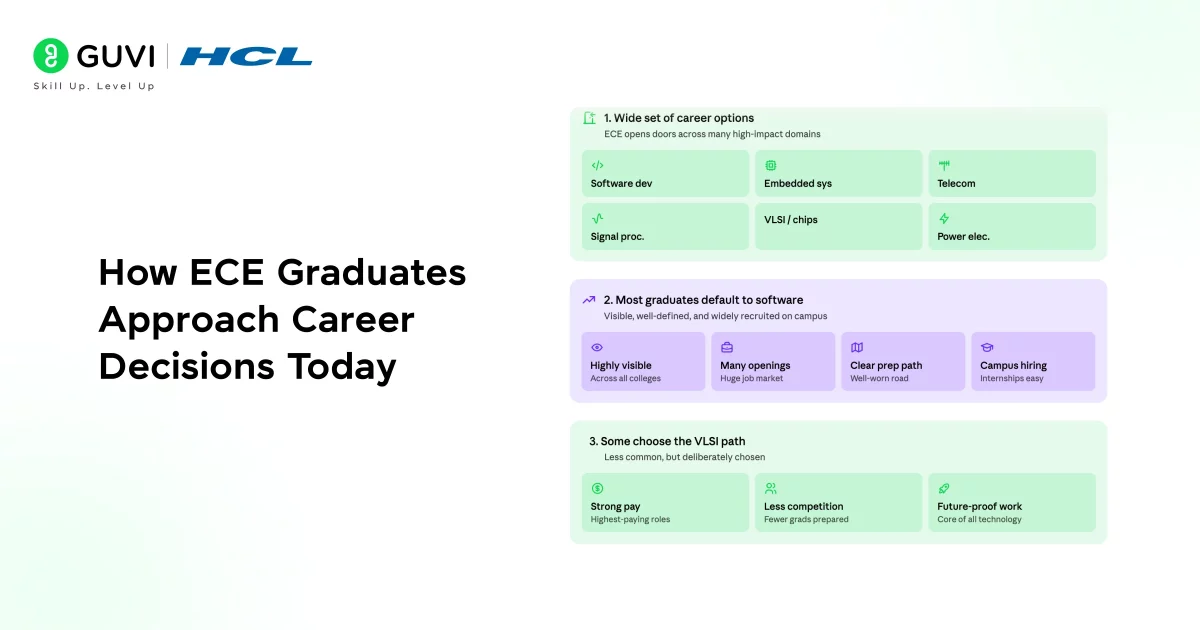
ECE graduates face a wider set of career options than most engineering disciplines. The breadth of the curriculum means they are eligible for roles in software development, embedded systems, telecommunications, power electronics, signal processing, and hardware design simultaneously.
This breadth is an advantage in terms of options, but creates real difficulty in terms of direction.
Many ECE graduates default to software roles immediately after graduation because those positions are more visible and more frequently recruited on campus. The path to a software job is well-worn. The path to a chip design role is less documented and requires more targeted preparation.
The graduates who move toward ECE VLSI careers typically do so because they develop a specific interest in hardware during their degree or encounter the field through a project or internship. Others arrive after researching the job market and recognising that VLSI roles offer strong compensation and lower competition than software positions at the same level.
The Real Problem: A Widening Gap Between ECE Curriculum and Industry Readiness

Most ECE programs teach the theory that underlies VLSI work, but do not provide the practical depth that semiconductor employers require at the time of hiring. A graduate may understand CMOS logic and have seen a Verilog module in a lab session without being able to write synthesisable RTL or use an EDA tool competently.
The gap between the ECE curriculum and VLSI industry readiness is acknowledged by both graduates and employers. Companies that hire fresh graduates into chip design roles invest heavily in onboarding because candidates arrive with the right theoretical foundation but without the workflow familiarity that productive contribution requires from day one.
This gap is not a reason to avoid ECE VLSI careers. It is a reason to close it deliberately through targeted preparation before or immediately after graduation.
Graduates who address this gap specifically are competitive candidates for entry-level VLSI roles. Those who do not address it are not, regardless of how strong their academic record is.
The Shift: Why VLSI Has Become a Primary Career Target for ECE
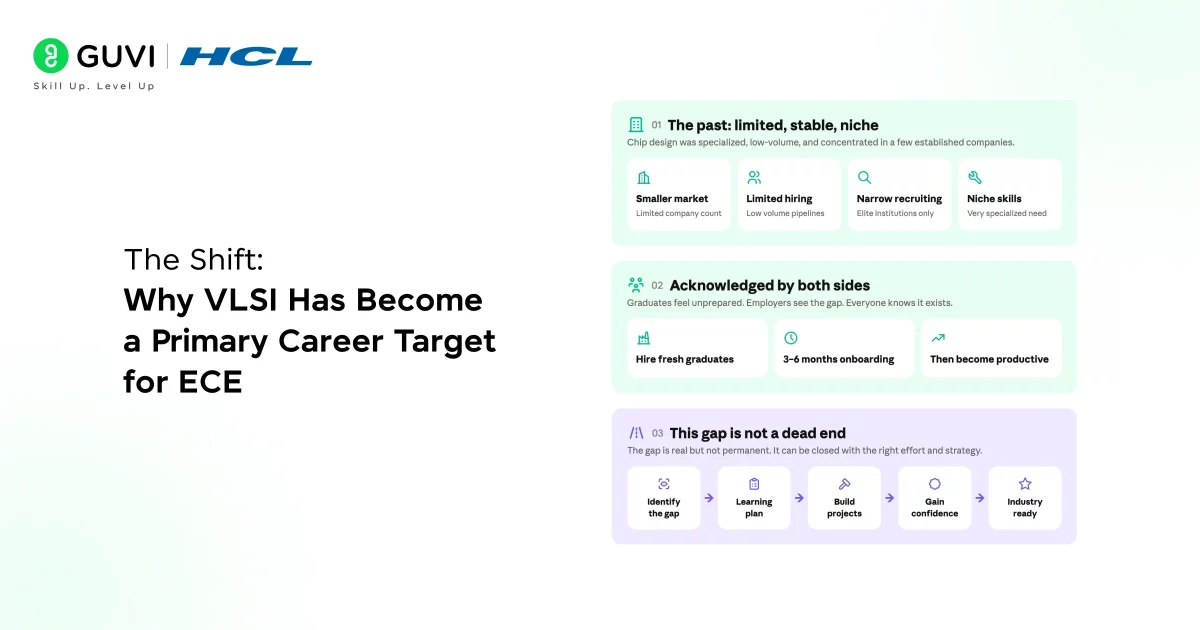
The semiconductor industry has changed significantly in the past several years. Chip design was once a relatively stable field with limited hiring volume outside a small number of established companies.
The expansion of AI hardware, domestic chip manufacturing initiatives, the proliferation of custom silicon in automotive and edge computing, and the demand for advanced communication chips have together created a hiring environment where qualified VLSI engineers are scarce relative to demand.
This shift has made ECE VLSI careers more visible and more actively promoted. Companies that previously hired only through narrow recruiting pipelines are broadening their search. Compensation for experienced VLSI engineers has risen significantly.
The structural demand for chip design talent is not a short-term fluctuation. Every major technology trend,d from artificial intelligence to electric vehicles, depends on advances in semiconductor design. ECE graduates entering VLSI now are entering a field with durable demand and a long runway for career development.
What the VLSI Career Tracks Look Like for ECE Graduates
VLSI is not a single job. It is a collection of specialised disciplines that together cover the full chip design flow from specification to manufactured silicon. ECE graduates typically enter one of five tracks depending on their interests and the specific skills they develop during preparation.
Track 1: RTL Design
RTL design engineers write the hardware description language code that specifies the functional behaviour of a chip. They translate architecture specifications into synthesizable Verilog or SystemVerilog modules and collaborate with verification engineers to confirm that the implementation matches the specification.
RTL design requires strong digital logic skills, familiarity with synthesis constraints, and the ability to think about hardware timing and resource utilisation simultaneously.
Track 2: Verification
Verification engineers build the environments and tests that confirm a design behaves correctly before it is sent to fabrication. Modern chip verification uses SystemVerilog and the UVM methodology to create constrained-random stimulus, functional coverage models, and assertion-based checks.
Verification is the largest single hiring category in chip design because the complexity of modern chips requires more verification effort than design effort. ECE graduates with strong programming skills and attention to logical correctness are well-suited to this track.
Track 3: Physical Design
Physical design engineers take a synthesised netlist and implement it as a physical layout that can be manufactured. The work involves floorplanning, placement, routing, timing closure, and design rule checking.
It requires understanding the relationship between logical design decisions and their physical consequences in silicon, including the effects of wire length on timing and the constraints imposed by the manufacturing process.
Track 4: Analog and Mixed-Signal Design
Analog design engineers work on circuits that operate in the continuous domain,n including PLLs, ADCs, DACs, amplifiers, and power management circuits. This track requires the deepest understanding of transistor-level behaviour and is the most directly connected to the analog electronics content in the ECE curriculum.
Analog roles are fewer in number than digital roles,s but command high compensation and are difficult to fill because the skill set is rare.
Track 5: Design for Test
DFT engineers integrate testability structures into chip designs so that manufactured parts can be efficiently tested for defects. The work involves scan insertion, ATPG, boundary scan, and built-in self-test design.
DFT is an area where ECE graduates can develop a highly specific and valued expertise that is essential to the manufacturing pipeline but less visible than design or verification roles.
An Example: What an ECE Graduate’s VLSI Preparation Path Looks Like
A final-year ECE student who decides to target RTL design roles has a specific set of gaps to close between their curriculum and the expectations of a hiring manager. The path from ECE coursework to interview readiness typically covers the following areas in sequence.
| Phase 1: Foundations (Months 1 to 2) Digital design review: combinational and sequential logic Verilog and SystemVerilog syntax and coding style Simulation basics using ModelSim or Xcelium Phase 2: Design Practice (Months 3 to 4) RTL coding of standard building blocks: FIFOs, arbiters, state machines, ALUs, shift registers Synthesis using Synopsys Design Compiler or Yosys Understanding timing reports and setup/hold violations Phase 3: Project Work (Months 5 to 6) Complete end-to-end design project: Specification to RTL to synthesis to timing closure Document design decisions and trade-offs Prepare to discuss the project in technical interviews Phase 4: Interview Preparation Digital design questions: CDC, FSM design, pipeline hazards Verilog coding exercises Company-specific tool and methodology research |
This preparation path takes roughly six months of focused work alongside or after the degree. Graduates who complete it are prepared to contribute in an entry-level RTL design role and to discuss their preparation credibly in technical interviews.
India is one of the largest contributors to global chip design talent. Major semiconductor companies like Qualcomm, Intel, Texas Instruments, Cadence, Synopsys, and ARM operate significant design and verification centers across cities such as Bengaluru, Hyderabad, Pune, and Chennai.
ECE graduates with VLSI skills are entering an active and growing hiring market, often without needing to relocate abroad at the entry level.

Why VLSI Offers Better Long-Term Career
Software development roles for ECE graduates are plentiful at the entry level, but face increasing competition from computer science graduates and automation of routine development tasks. The supply of software candidates has grown faster than demand in several categories.
VLSI faces the opposite dynamic. The supply of qualified chip design engineers has not kept pace with the expansion of semiconductor demand. Senior VLSI engineers with ten or more years of experience command compensation significantly above the software engineering average at equivalent experience levels.
The specialisation required to do VLSI work well creates a career moat that generalist software skills do not provide.
ECE graduates who invest in VLSI skill development early are building expertise in a field where experience compounds. Each design project, each silicon tape-out, and each successful verification closure adds to a body of work that is difficult for a late entrant to replicate quickly.
ECE Foundation as a Crucial Enabler
The reason ECE graduates are well-positioned for VLSI careers is that the theoretical foundation the degree provides is directly relevant to chip design work in a way that other engineering backgrounds are not.
A computer science graduate entering VLSI must learn digital logic, semiconductor device behaviour, and hardware timing from scratch. An ECE graduate has covered all of these in their degree program.
This foundation reduces the preparation time required to reach interview readiness and improves the depth of understanding that the graduate brings to early career work. An ECE graduate who understands why a flip-flop has a setup time constraint approaches timing closure problems differently from someone who learned only the rule.
The ECE foundation is not sufficient on its own for ECE VLSI careers, but it is a genuine advantage. Using that advantage deliberately rather than ignoring it in favour of a generic software path is the core argument for ECE graduates who are deciding where to direct their careers.
Why VLSI Enables a Durable and Progressively Rewarding Career Path
VLSI careers follow a clear progression from entry-level design or verification work through senior engineering roles, technical lead positions, and architecture work. Each stage of progression requires genuine technical depth that cannot be acquired quickly.
This means the career ladder is stable and not easily disrupted by market fluctuations or technology changes that commoditise other roles.
The diversity of application domains in which chip design work is required also provides optionality across a career. An ECE VLSI engineer who starts in mobile processor design can move to automotive safety chips, AI accelerators, or memory subsystem design based on how their interests evolve.
The core skill set transfers across these domains even though the specific applications differ significantly.
The Real Innovation: Hardware Expertise in a Software-Saturated Market
The career case for ECE graduates moving into VLSI is ultimately about differentiation. The engineering job market has a large and growing surplus of software generalists and a persistent and growing shortage of hardware specialists.
An ECE graduate who develops genuine VLSI competence occupies a position in the job market that is difficult to fill from any other direction and is protected by the genuine scarcity of people who can do the work well.
This is not a theoretical advantage. It shows up in hiring timelines, compensation negotiation, geographic mobility, and the stability of employment through economic cycles.
Semiconductor design work has not been offshored or automated in the ways that other engineering functions have been, because the intellectual complexity of chip design at the frontier does not yield to cost-reduction strategies. ECE VLSI careers sit at a rare intersection of strong demand, genuine scarcity, and work that compounds in value with experience.
If you want to build a strong career in chip design, semiconductor technology, and hardware innovation, don’t miss the opportunity to enroll in HCL GUVI’s Intel & IITM Pravartak Certified ECE VLSI course. Backed by Intel certification, this program equips you with industry-relevant skills in VLSI design, FPGA development, ASIC flow, and semiconductor fundamentals—while adding a globally recognized credential to your resume, giving you a powerful edge in the competitive VLSI and semiconductor job market.
Conclusion
ECE graduates are moving toward VLSI careers because the semiconductor industry offers what most other engineering domains currently do not: strong and growing demand, genuine scarcity of qualified candidates, compensation that reflects that scarcity, and work that builds compounding expertise over a long career.
The ECE degree provides the theoretical foundation that makes this path accessible. The gap between that foundation and industry readiness is closable with focused preparation.
Through deliberate development of hardware description language skills, EDA tool familiarity, and design methodology understanding, ECE graduates can position themselves for entry-level VLSI roles that lead to careers in one of the most technically demanding and economically important industries in the world.
If an ECE graduate defaults to a software path without evaluating what VLSI offers, they are leaving the most direct application of their degree on the table. Real career leverage for ECE graduates starts when the hardware foundation the degree provides is used to enter the industry that depends on it most.
FAQs
1. Why are ECE graduates well-suited for VLSI careers?
ECE graduates have direct curriculum coverage of digital logic, semiconductor devices, analog circuits, and signal processing that are foundational to chip design work. This theoretical base reduces the preparation required to reach VLSI interview readiness compared to candidates from other engineering backgrounds.
2. What are the main VLSI career tracks available to ECE graduates?
The primary tracks are RTL design, verification, physical design, analog and mixed-signal design, and design for test. Each requires a focused set of skills beyond the core ECE curriculum and offers a distinct career progression within the semiconductor industry.
3. How long does it take to prepare for a VLSI role after an ECE degree?
Most graduates require approximately four to six months of focused preparation covering hardware description languages, EDA tool basics, design methodology, and project work before they are competitive candidates for entry-level positions in their chosen VLSI track.
4. Is VLSI a better career choice than software for ECE graduates?
VLSI offers stronger long-term differentiation, less competition from adjacent disciplines, and higher compensation at senior levels compared to generalist software roles. It is a more direct application of the ECE degree and addresses a genuine market shortage.
5. What skills does an ECE graduate need to develop for VLSI that the degree does not cover?
Most ECE programs provide limited practical depth in synthesizable RTL coding, EDA tool workflows, design verification methodology, and timing analysis. These are the gaps that targeted preparation must address before a graduate is ready for industry hiring.
Success Stories

About the Author
Vishalini Devarajan
An Aerospace Engineer turned content writer, I focus on making complex concepts easy to understand through well-structured, reader-friendly blogs. Whether it’s a technical topic or a non-technical one, I love creating content that is clear, engaging, and impactful.
View all posts by Vishalini Devarajan
Connect with me @














Did you enjoy this article?