


Artificial Intelligence and Machine Learning Articles
Finance Manager to Data Analytics: Career Growth, Salary and Seniority
How to Evaluate LLM Outputs in Production Deployments
AI/ML Skills Gap 2026: Why Companies Can't Find Job-Ready Talent
20 AI/ML Interview Questions Recruiters Can Use Without a Tech Background - Best Guide

Get In Touch For Details! Request More Information
Building AI agents for healthcare and life sciences
Jun 20, 2026 7 Min Read 765 Views
(Last Updated)
A doctor reviewing 200 patient records before rounds. A researcher manually scanning thousands of clinical trial results. A hospital administrator chasing down insurance approvals one form at a time. These are not edge cases. They are daily realities in healthcare, and they consume enormous amounts of skilled human time.
AI agents are beginning to change that picture. Not by replacing the doctors, researchers, and administrators doing this work, but by handling the parts that are repetitive, time-consuming, and do not require human judgment. That frees the people who matter most to focus on the decisions that actually do.
This article explains what AI agents for healthcare are built and in the life sciences context, when they genuinely help, how to build them responsibly, and what to watch out for. No jargon. No fluff. Just clear, practical guidance you can act on.
Quick TL;DR Summary
- This guide explains what AI agents are and why healthcare is one of the most important places to deploy them carefully.
- It covers the core building blocks of a healthcare AI agent, including tools, memory, and safety checkpoints.
- You will learn when AI agents genuinely help in clinical, research, and administrative settings and when a simpler approach is better.
- A step-by-step breakdown walks you through building your first healthcare AI agent the right way.
- Real-world examples show how hospitals, research teams, and life sciences companies are using agents today.
- Practical strategies help you avoid the most common and most costly mistakes in this high-stakes field.
Table of contents
- What Are AI Agents in Healthcare
- The Problem with Current Healthcare Workflows
- When to Use AI Agents in Healthcare
- Tasks involving large volumes of unstructured information
- Repetitive processes that follow a consistent pattern
- Research tasks requiring synthesis across many sources
- Monitoring and alerting tasks
- The Core Building Blocks
- The Agent
- Tools
- Memory
- Safety and Escalation Rules
- Audit and Logging
- Step-by-Step: Building Your First Healthcare AI Agent
- Step 1: Define the task with clinical precision
- Step 2: Identify who reviews the output and when
- Step 3: Map out the data sources the agent needs
- Step 4: Build and test each component separately
- Step 5: Run it on synthetic or de-identified data first
- Step 6: Introduce human review at every consequential step
- Step 7: Monitor continuously after deployment
- Real-World Examples of AI Agents in Healthcare and Life Sciences
- The Hospital System Reducing Documentation Burden
- The Pharmaceutical Company Accelerating Drug Discovery
- Who Should Use Which Approach
- Individual clinicians and small practices
- Hospital and health system IT teams
- Clinical research teams
- Pharmaceutical and biotech companies
- Healthcare regulators and policy teams
- Enterprise health systems
- Pros and Cons of AI Agents in Healthcare
- Pros:
- Cons:
- Top Strategies to Get the Most Out of AI Agents in Healthcare
- Start with administrative tasks before clinical ones
- Never remove the human from consequential decisions
- Be explicit about what the agent cannot do
- Invest in data quality before agent quality
- Log everything and review it regularly
- Build trust with clinical staff through transparency
- Plan for failure from the start
- Conclusion
- FAQs
- Are AI agents in healthcare subject to regulatory approval?
- How do AI agents handle patient privacy?
- Can AI agents make clinical decisions?
- What happens when a healthcare AI agent makes a mistake?
- Where should a healthcare organisation start with AI agents?
What Are AI Agents in Healthcare
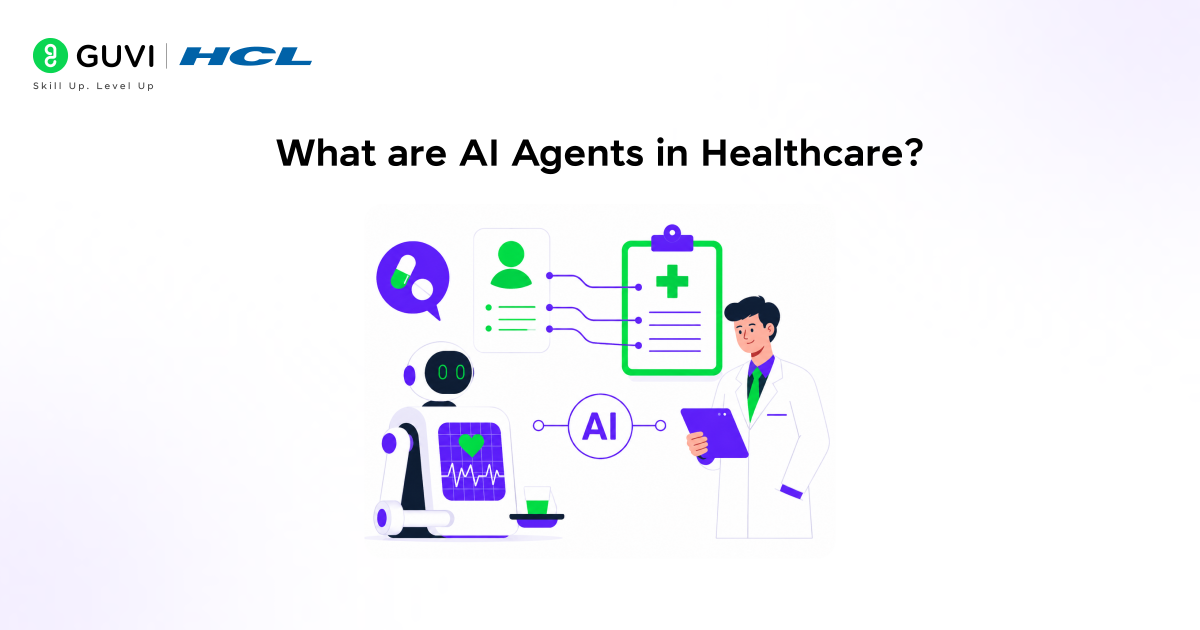
An AI agent in healthcare is a system that takes a goal, figures out the steps needed to reach it, and carries them out using the tools available to it. It does not just answer a question. It acts on information, retrieves what it needs, processes it, and produces a result.
In a hospital setting, an agent might review incoming patient data, flag abnormal values, cross-reference them with the patient’s history, and generate a summary for the attending physician before they walk into the room. In a research lab, an agent might scan thousands of published studies, extract relevant findings, and produce a structured literature review in minutes rather than weeks.
The key difference between a regular AI tool and an agent is that agents can take sequences of actions over time. They are not limited to one-shot responses. They plan, act, check the result, and continue until the task is done.
The Problem with Current Healthcare Workflows
Healthcare professionals spend a significant portion of their working hours on tasks that have nothing to do with patient care. Physicians spend time on documentation, prior authorisations, and administrative correspondence. Researchers spend months on literature reviews that could inform faster decisions. Lab teams manually compile data that sits in disconnected systems.
The consequences are real. Clinician burnout is rising. Research timelines stretch longer than they need to. Errors creep into manual processes. Patients wait longer than necessary for decisions that depend on information that already exists somewhere in the system.
Standard software has helped at the margins, but it is rigid. It can follow rules but cannot reason. AI agents are different because they can handle tasks that require judgment, pattern recognition, and working across multiple sources of unstructured information, which is exactly the kind of work that fills healthcare workflows.
In healthcare, this matters enormously because so many important tasks are not single questions. They are multi-step processes that require pulling information from multiple sources, applying logic across all of it, and producing something a human can act on.
When to Use AI Agents in Healthcare
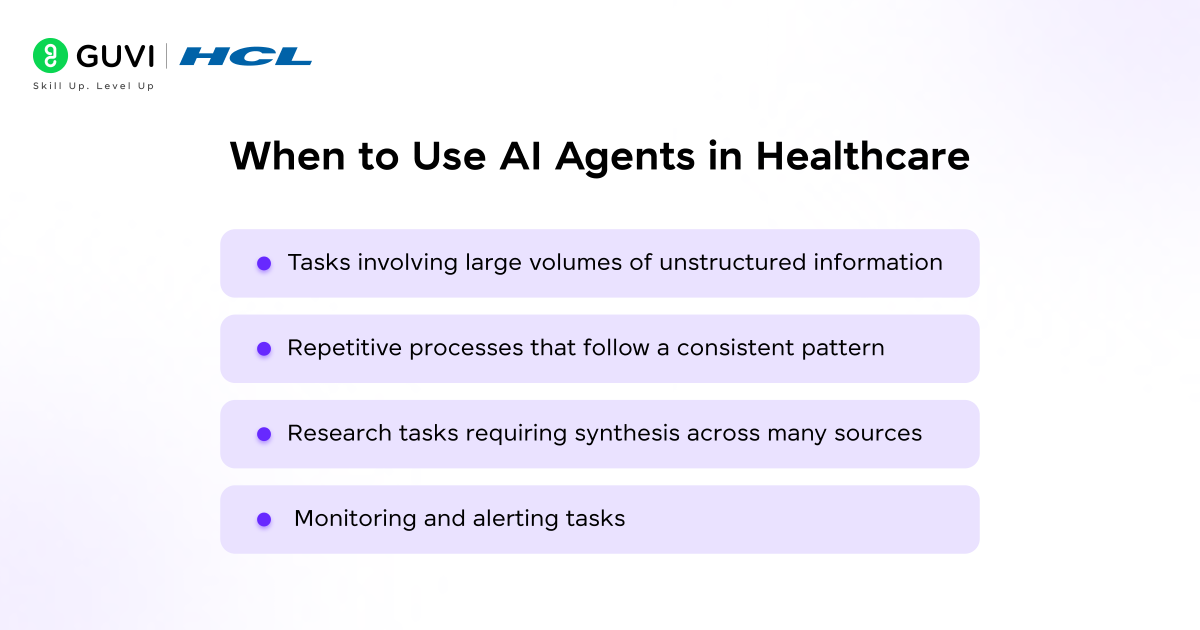
AI agents are not the right solution for every healthcare problem. In a field where errors have serious consequences, it is worth being precise about where they add genuine value.
1. Tasks involving large volumes of unstructured information
Patient records, clinical notes, research papers, and lab reports contain enormous amounts of useful information locked in text. AI agents can read, extract, and organise this information far faster than humans can.
2. Repetitive processes that follow a consistent pattern
Prior authorization requests, appointment scheduling, insurance coding, and routine documentation follow predictable structures. Agents handle these reliably and free up skilled staff for work that requires human judgment.
3. Research tasks requiring synthesis across many sources
Literature reviews, drug interaction checks, and clinical trial matching all require pulling information from dozens or hundreds of sources and finding patterns across them. Agents do this faster and more consistently than manual processes.
4. Monitoring and alerting tasks
Watching patient vitals, flagging abnormal lab results, or tracking trial participant data for safety signals are tasks that benefit from continuous attention that no human team can sustain at scale.
Research published in medical informatics journals shows that AI-assisted clinical documentation can reduce the time physicians spend on administrative tasks by up to 40%, without compromising the quality or completeness of medical records.
The Core Building Blocks
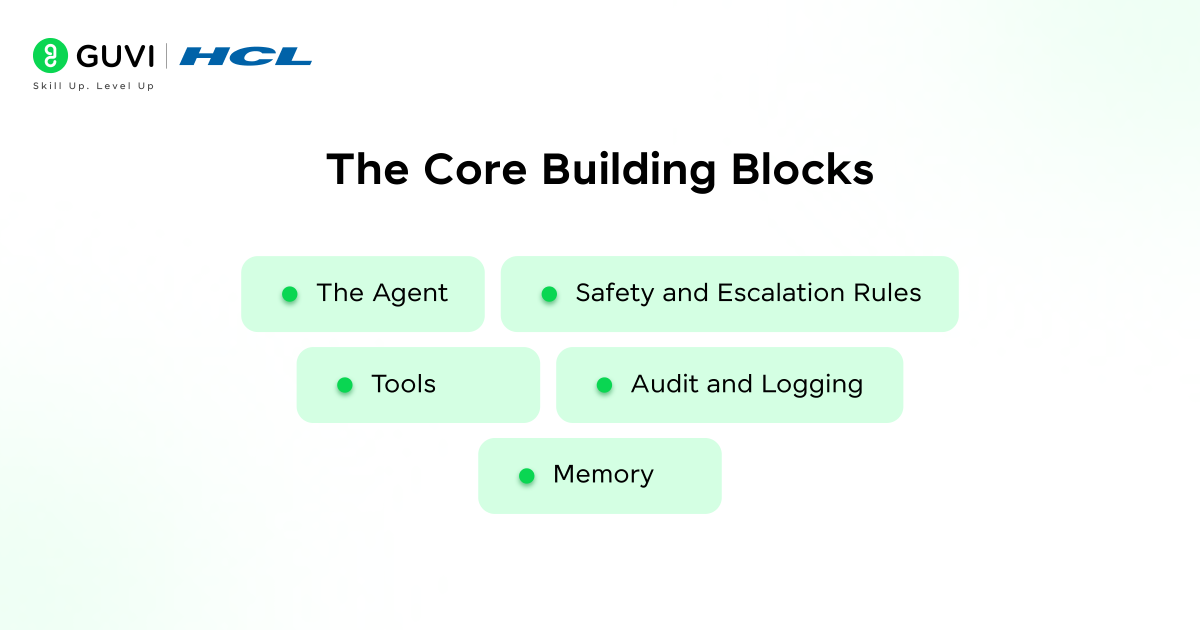
Every AI agent built for healthcare runs on the same core components. Understanding these is essential before building anything in a regulated, high-stakes environment.
1. The Agent
The AI model at the centre of the system. It receives a task, reasons through what needs to happen, decides which tools to use, and acts on its decisions. In healthcare, the instructions given to this agent, what it is allowed to do, what it must escalate, and how it should handle uncertainty, matter enormously.
2. Tools
Tools are what allow an agent to interact with the real world. In healthcare, relevant tools include electronic health record systems, medical literature databases, lab systems, scheduling platforms, and communication tools. The agent uses these to retrieve, process, and send information. Only give an agent the tools it genuinely needs for its task.
3. Memory
Healthcare agents need to keep track of context across a task. In-context memory covers everything in the current session. External memory, stored in databases the agent can query, allows it to retain and retrieve patient history, previous interactions, or reference information across sessions. How memory is managed directly affects both performance and privacy compliance.
4. Safety and Escalation Rules
This building block does not exist in most non-healthcare agent guides, but it is the most important one here. Every healthcare agent needs explicit rules for what it cannot decide on its own, what it must flag for a human, and how it should communicate uncertainty. An agent that silently makes a wrong clinical assumption is far more dangerous than one that says it is not sure and asks for review.
5. Audit and Logging
Every action an agent takes in a healthcare context should be logged. Who triggered the task, what the agent did, what tools it called, and what it produced must all be traceable. This is not optional. It is a regulatory requirement in most jurisdictions and a basic safety standard in all of them.
Read More: Applications of AI in Healthcare
Step-by-Step: Building Your First Healthcare AI Agent
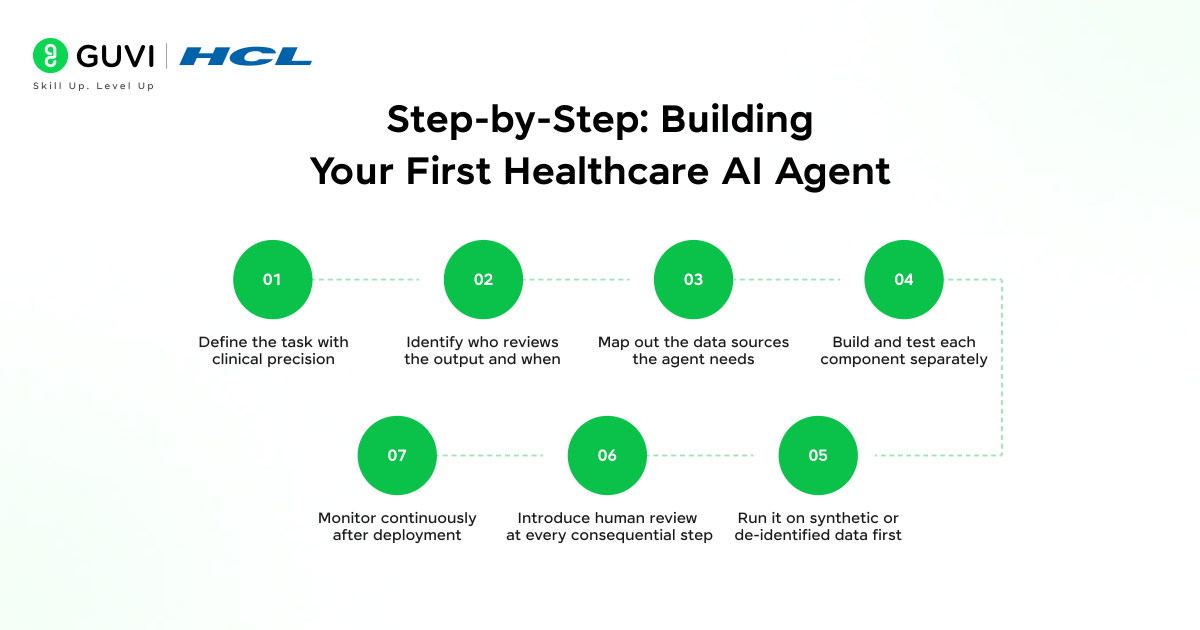
Step 1: Define the task with clinical precision
Write down exactly what the agent needs to do, what information it starts with, and what it should produce. In healthcare, the output specification matters as much as the task itself. A vague output in a clinical context is a safety risk, not just an inconvenience.
Step 2: Identify who reviews the output and when
Before you build anything, decide where the human sits in the process. Which decisions must a clinician or qualified professional make? What does the agent produce for them to act on? Never let an agent take a consequential clinical action without a defined human review step.
Step 3: Map out the data sources the agent needs
List every system the agent will need to access. Check that accessing those systems is covered by your data governance policies and that patient consent and privacy requirements are met. In most healthcare environments, this step involves your compliance, legal, and IT security teams before any code is written.
Step 4: Build and test each component separately
Build the agent’s individual capabilities in isolation before connecting them. Test the document retrieval tool on its own. Test the summarisation logic on its own. Test the escalation rules on their own. In healthcare, finding a problem at this stage is far cheaper than finding it after the system has touched real patient data.
Step 5: Run it on synthetic or de-identified data first
Before connecting a live system to real patient records, run the agent on synthetic datasets or properly de-identified data. This lets you catch errors, edge cases, and unexpected behaviour without any risk to patient privacy or safety.
Step 6: Introduce human review at every consequential step
Build the review checkpoint into the system architecture, not as an afterthought. The agent produces a result. A qualified human reviews it before it is used to make a decision or take an action. Log both the agent output and the human decision. Over time, this log becomes valuable for evaluating and improving the system.
Step 7: Monitor continuously after deployment
Deploying a healthcare AI agent is not a one-time event. Put monitoring in place from day one. Track what the agent produces, how often humans override or correct it, and whether its performance changes as the data it encounters changes, set thresholds for when the system should be paused and reviewed.
Real-World Examples of AI Agents in Healthcare and Life Sciences

1. The Hospital System Reducing Documentation Burden
A large hospital network deployed an AI agent that listens to physician-patient consultations and drafts clinical notes in real time. Physicians review and approve the notes before they enter the record. Documentation time dropped from an average of 90 minutes per day to under 20, giving physicians nearly two hours back to spend with patients. The agent does not make clinical judgments. It captures and structures what the physician said.
2. The Pharmaceutical Company Accelerating Drug Discovery
A life sciences company uses a multi-agent system to support early-stage drug discovery. One agent scans published research for compounds with relevant properties. A second agent cross-references those compounds against known safety profiles. A third synthesises the findings into a prioritised shortlist for the research team to evaluate. What previously took a team of researchers several months now takes days, with the human scientists focusing on evaluation and decision-making rather than information gathering.
Who Should Use Which Approach
Healthcare is not one environment. The right starting point depends on the setting, the stakes, and the technical maturity of the team.
1. Individual clinicians and small practices
Start with documentation assistance and scheduling. These carry the lowest risk and deliver immediate time savings.
2. Hospital and health system IT teams
Begin with administrative use cases like coding assistance and appointment management before moving into clinical workflows.
3. Clinical research teams
Literature review automation and patient matching are high-value starting points where errors are catchable before they reach patients.
4. Pharmaceutical and biotech companies
Use multi-agent systems for research synthesis and regulatory document preparation, with humans in the decision loop throughout.
5. Healthcare regulators and policy teams
Horizon scanning, document review, and public comment analysis are low-risk entry points that build familiarity with the technology.
6. Enterprise health systems
Full orchestration with compliance review, audit logging, and human-in-the-loop checkpoints from day one. Do not scale clinically without all of these in place.
Pros and Cons of AI Agents in Healthcare
Pros:
- Handle large volumes of unstructured clinical and research data that no human team could process at the same speed
- Reduce administrative burden on clinicians and free up time for patient care
- Improve consistency in repetitive processes like coding, documentation, and eligibility checking
- Enable faster research synthesis and drug discovery workflows
- Can monitor continuously for safety signals that humans would miss at scale
- Scale to match demand without proportional increases in staffing costs
Cons:
- Errors in a healthcare context can have serious consequences for patients
- Requires significant investment in compliance, governance, and validation before deployment
- Integration with legacy healthcare IT systems is often complex and slow
- Patient privacy regulations add significant constraints to data handling
- Clinician trust takes time to build and can be damaged quickly by a visible failure
- Ongoing monitoring and maintenance is not optional and adds to long-term costs
Regulatory bodies like the FDA (United States) and MHRA (United Kingdom) have issued guidance on AI and machine learning in healthcare. Any AI system used for clinical decision support may be subject to regulatory oversight depending on how its outputs are applied. Involving legal and compliance teams before deployment is critical.
Top Strategies to Get the Most Out of AI Agents in Healthcare
1. Start with administrative tasks before clinical ones
The highest-risk place to start is also the most tempting: clinical decision support. Build confidence and internal capability with lower-risk administrative applications first. Move into clinical workflows once you have governance frameworks, validation processes, and clinical champions in place.
2. Never remove the human from consequential decisions
In healthcare, the human review step is not a formality. It is the safety net. Build it into the architecture from the beginning, not as an afterthought, and never remove it to save time or cost.
3. Be explicit about what the agent cannot do
Write clear rules for what the agent must escalate, what it should flag as uncertain, and what it is not authorised to decide. Agents that clearly communicate their limits are far safer and build more trust than those that project false confidence.
4. Invest in data quality before agent quality
An agent is only as good as the data it works with. In many healthcare environments, data is fragmented, inconsistently formatted, and incomplete. Cleaning and standardising inputs produces bigger improvements in output quality than upgrading the model.
5. Log everything and review it regularly
In healthcare, audit logs are both a regulatory requirement and an operational tool. Review them regularly to catch drift, identify patterns in errors, and find opportunities to improve the agent’s instructions or escalation rules.
6. Build trust with clinical staff through transparency
Clinicians are more likely to engage with and benefit from AI tools when they understand what the tool does and does not do. Involve clinical staff in design and testing. Show them the outputs, the limitations, and the review process. Trust built through transparency is far more durable than trust assumed through mandate.
7. Plan for failure from the start
Decide what happens when the agent produces a wrong result, a delayed result, or no result. Have a fallback process. Healthcare workflows cannot simply stop because a system is down or wrong. Build resilience from day one.
If you want to learn more about building multi-agent systems, do not miss the chance to enroll in HCL GUVI’s Intel & IITM Pravartak Certified Artificial Intelligence & Machine Learning course. Endorsed with Intel certification, this course adds a globally recognized credential to your resume, a powerful edge that sets you apart in the competitive AI job market.
Conclusion
AI agents in healthcare and life sciences represent one of the most significant opportunities in modern medicine, and one of the most serious responsibilities in AI development. The potential to reduce clinician burnout, accelerate research, improve consistency, and ultimately deliver better patient outcomes is real and growing.
But this is not a domain where moving fast and fixing problems later is acceptable. The stakes are too high. The right approach is to start carefully, build governance from the beginning, keep humans in the loop on every consequential decision, and expand only when what you have built has proven itself reliable.
The teams that will do this well are not the ones who deploy the most agents the fastest. They are the ones who deploy the right agents in the right places with the right oversight in place. Start there, build trust, and grow from a foundation that holds up when it matters most.
FAQs
1. Are AI agents in healthcare subject to regulatory approval?
It depends on how the output is used. AI systems that inform or support clinical decisions may be classified as Software as a Medical Device in many jurisdictions, which carries regulatory requirements. Always involve your legal and compliance team before deploying anything in a clinical context.
2. How do AI agents handle patient privacy?
Responsible healthcare AI agents are designed to operate within the constraints of relevant privacy regulations such as HIPAA in the United States or GDPR in Europe. This includes using de-identified or anonymised data for testing, restricting access to the minimum data needed for the task, and maintaining full audit logs of all data access.
3. Can AI agents make clinical decisions?
Current best practice is that AI agents in healthcare support clinical decisions rather than make them. The agent provides information, summaries, or recommendations. A qualified human professional makes the decision and takes responsibility for it.
4. What happens when a healthcare AI agent makes a mistake?
This is why human review checkpoints and audit logging are non-negotiable. When a mistake is caught, the log tells you exactly what the agent did and why. The error is corrected by the human reviewer before it affects a patient. The log is then used to improve the agent’s instructions or escalation rules.
5. Where should a healthcare organisation start with AI agents?
Administrative workflows with low clinical risk are the right starting point for most organisations. Documentation assistance, scheduling, prior authorisation drafting, and internal knowledge retrieval all deliver real value with manageable risk profiles. Build experience, governance, and clinical trust there before moving into higher-stakes clinical applications.
Success Stories

About the Author
Vishalini Devarajan
An Aerospace Engineer turned content writer, I focus on making complex concepts easy to understand through well-structured, reader-friendly blogs. Whether it’s a technical topic or a non-technical one, I love creating content that is clear, engaging, and impactful.
View all posts by Vishalini Devarajan
Connect with me @














Did you enjoy this article?